


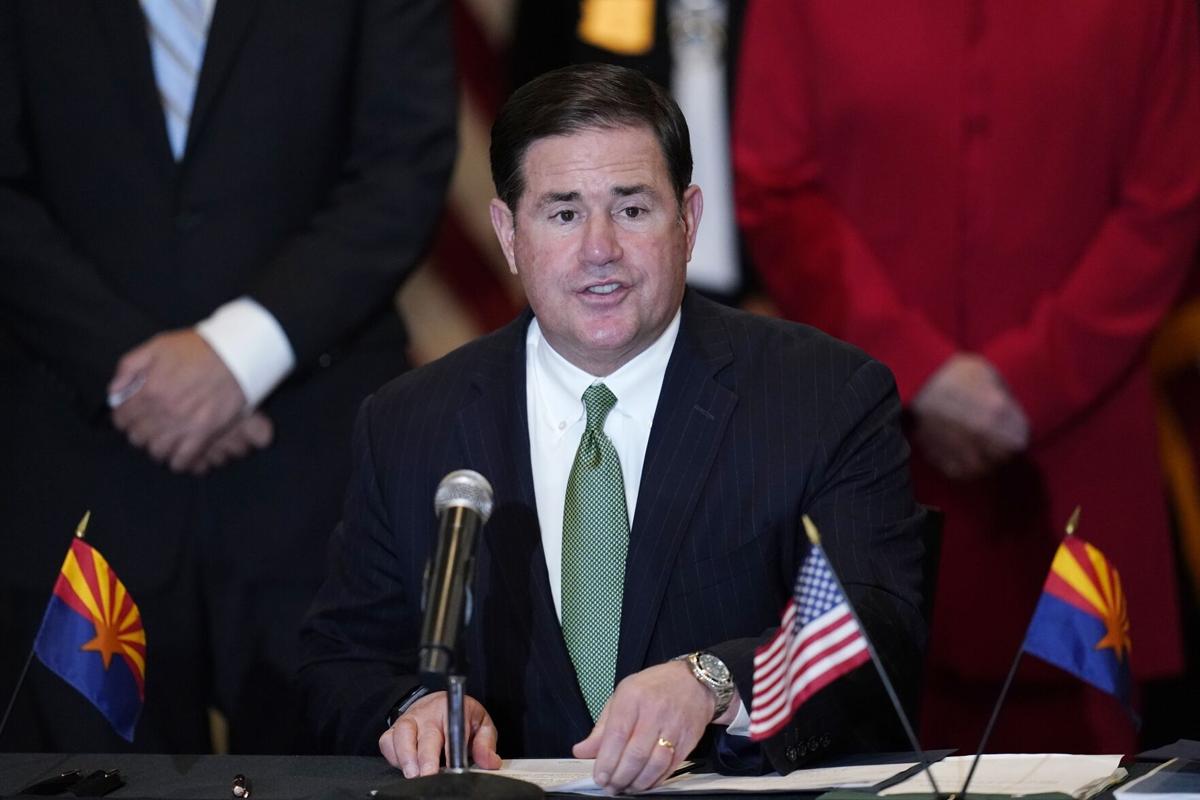
PHOENIX — Gov. Doug Ducey on Wednesday signed legislation putting in place an immediate $1.3 billion tax cut — set to rise to $1.9 billion — that is designed largely to benefit Arizona’s most wealthy.
The move comes as Ducey inked his approval to the $12.8 billion spending plan just ahead of the new fiscal year that began Thursday morning. It also came as state lawmakers approved the last elements of the budget package for the new fiscal year after jettisoning provisions to vastly expand the number of children who could get publicly funded vouchers to attend private and parochial schools.
But it still will make it easier for some students to leave public schools and get these vouchers.
Ducey cited what he said are various investments, ranging from $100 million for wildfire prevention and mitigation efforts and $55 million for border security to $13 million for body cameras for state troopers, in a prepared statement about his decision to sign the budge. The governor made no mention of legislation which allows the Department of Public Safety to deny public access to the footage from those cameras.
And he specifically cited the 2.5% flat tax to be phased in over three years, scrapping the tiered system that now has tax rates up to 4.5% for earnings by married couples in excess of $318,000. And the plan also helps the most wealthy — those with earnings of more than $500,000 — avoid paying all or part of the 3.5% surcharge voters approved in November to help supplement education funding.
“Each and every Arizona taxpayer, no matter their income, will experience a tax cut under our historic tax reform,” the governor said in a prepared statement.
His office had previously boasted about an average tax cut of $350.
But what the governor did not say is that an analysis of the plan shows that about 53% of the tax relief will go to the 9,645 Arizonans with a taxable income of more than $1 million.
By contrast, only about 1% is available for those who have taxable earnings of $50,000 or less.
For those in the $20,000 to $25,000 range, for example, legislative budget staffers figure the average tax cut would be $3, rising to $5 for those in the $25,000 to $30,000 income bracket and $8 for those between $30,000 and $40,000 range.
Those in the $75,000 to $100,000 income bracket would see a cut of $115. It’s not until reaching the $200,000 to $500,000 range where the average cut hits four digits.
Press aide C.J. Karamargin said he rejects the premise behind any questions about Ducey approving a tax-cut plan that mainly benefits those at the top of the income scale.
“The premise assumes that the only way Arizonans can benefit from the budget and the tax package is through this tax reform proposal,” he said. “I think it is myopic to think that this budget only benefits a certain group of people.”
But Karamargin did defend the structure of the cuts, saying that the flat tax and the cap on what the wealthy pay due to Proposition 208 will “keep Arizona competitive.”
The last piece of the budget to fall in place Wednesday deals with K-12 education.
Key to that are vouchers, generally worth between $6,000 and $7,000, to allow students to attend private or parochial schools. Right now these are available to those with special needs, foster children, children living on reservations and those attending public schools rated D or F.
Sen. Paul Boyer, R-Peoria, sought to expand that to any student who is eligible for the federal free or reduced-price lunch program, a figure he pegged at about $40,470 a year for a family of four. He also wanted to make vouchers available to any child of a veteran.
That would have opened the door for vouchers for about 700,000 schoolchildren of the approximately 1.1 million students now in public schools.
But that proved unacceptable to several House Republicans. And with all Democrats opposed, he had to compromise.
The final version does not change who is eligible. But it does reduce the time that students have to attend a failing school before being able to switch and get a voucher from 100 day, as it is now, to just 45 days.
And for students in these schools who come from needy families — meaning they qualify for free or reduced-lunch programs — there would be no requirement to even go to the local school first. Those provisions could ease the exit from public schools for eligible students.
The move still drew opposition from Democrat lawmakers who said the state should be investing more in the public schools. Sen. Kirsten Engel, D-Tucson, said any money going to these private schools though what are formally known as “empowerment scholarship accounts” is money that should be used to improve those failing schools.
But Boyer disputed that public schools don’t have enough money.
He said Arizona got $5 billion in federal COVID aid for schools this year. And that, Boyer said, is on top of $6.7 billion in state aid.
What’s also in the budget, he said, are other earmarked dollars, ranging from $5 million for career and technical education for ninth graders and $17 million for “targeted K-12 investments” to $193 million for school repairs and construction and another $69 million specifically for seven new schools.
“So, my question to you is, when will it ever be enough to allow poor and minority students to leave the schools that are failing them?” he asked. “From my perspective, I don’t know if we’re ever going to see the other side say, ‘OK, today’s the day we’ve done enough for district schools and now we’re going to allow to leave the school that’s failing them.’”
And Boyer said the voucher funds can be used not just for private and parochial schools.
He said parents can put the money into microschools, generally small schools that may mix students of various grades, often led by a learning guide. And voucher dollars can go for parents to purchase materials to home-school their children, for online schools and for tutors to provide one-on-one online instruction.
What makes that important this year, he said, is that about 50,000 students who had been enrolled in public schools before the pandemic have not returned. And he said low-income children are hit particularly hard, what with working parents, single-parent homes and the “digital divide” of not having access to computers for online learning or broadband internet.
All that brought an angry response from Sen. Martin Quezada, D-Glendale.
“I am sick of the majority coming in and telling us what people of color need and ignoring what people of color are actually telling you,’’ he said. Quezada said the record shows that these kinds of programs only further segregation.
The dollar value of vouchers often do not cover the full cost of a private school education. That means that some schools may not be a realistic option for parents who cannot afford the difference.
“This perpetuates a lie that schools that have large numbers of students of color in those public schools, that those schools are bad schools,” he said. Quezada said those schools need the government to invest in them.
But Rep. Walt Blackman, R-Snowflake, who is Black, had a different take on the legislation.
“As a parent, what gives you the right to decide where I send my kid if the school is failing?” he asked.
There’s more in HB 2898 than vouchers.
It specifically prohibits any local law or school board regulation requiring the use of face coverings by students or staffers during school hours and on school property. Also forbidden is any mandate that students or teachers be vaccinated against COVID-19 or wear a face covering to participate in in-person instruction.
There also is a ban on what some have dubbed “critical race theory” in schools. It specifically prohibits teaching students that one race, ethnic group or sex is inherently morally or intellectually superior to another; that any individual by virtue or race, ethnicity or sex is inherently racist, sexist or oppressive; that any individual bears responsibility for actions committed by others of the same race, ethnicity or sex; and that any individual should feel discomfort, guilt, anguish or psychological distress because of their race, ethnicity or sex.
Boyer, in abandoning his bid to expand who is eligible for vouchers, wasn’t the only one to give up something to get a version of HB 2989 that was acceptable to both the House and Senate — or, at least, to the bare Republican majorities that make up both chambers.
Gone is a proposal added in the House by Rep. Judy Burges, R-Skull Valley, that would have required schools to have a comparative discussion of communism and totalitarianism that conflict with the founding principles of the United States. It also would have mandated new civics instruction “to prepare students to be civically responsible and knowledgeable adults.”

