

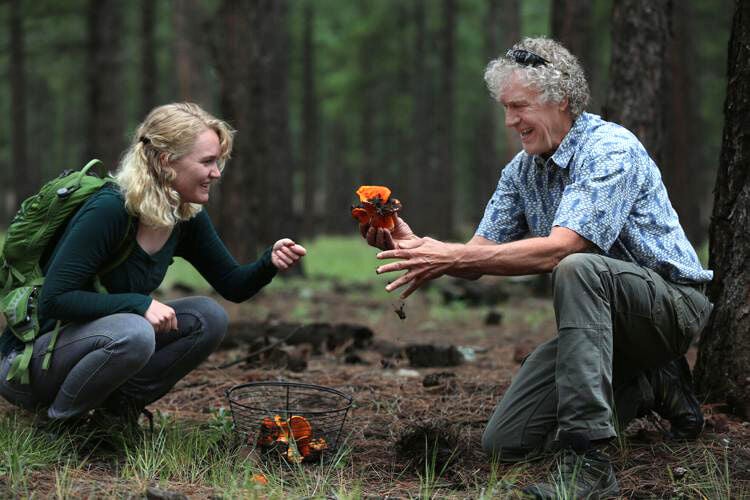
FLAGSTAFF — Some types of love are born of necessity. That’s how Claire Johnson came to love hunting mushrooms with her father through the forests around Flagstaff. Two years ago, in the summer of 2020, when COVID-19 lockdowns kept the world inside, Claire and Rick Johnson needed to get out.
“We were both losing our minds during lockdown,” Claire said. She’s a nurse, and at the time she was specifically assigned to the hospital COVID wing. Her line of duty made Claire anxious about spreading the novel virus to her loved ones. She needed a way to keep her family life consistent without the stress.
“We made an agreement that we would go hiking at least once a week,” Claire said. “It was a way for us to see each other and feel safe about it.”
Then one day, while hiking through the ponderosa pines, Claire spotted a pop of white from underneath the duff. It was a mushroom. A Barrow’s bolete — Boletus barrowsii — brought forth by a good rain. Intrigued, Claire consulted a knowledgeable family friend.
“She told me it was edible,” Claire said. She ate the bolete, and the next time she went hiking with Rick, she was tuned to the forest floor. The way Rick describes it, from that point on Claire’s love of mushroom hunting “just took off.” She acquired the accoutrements of a leather sheathed knife, a wire egg basket and a field guide. She and Rick have been hunting mushrooms together every summer since.
This summer, the steady rain in northern Arizona has made it “a good year” for mushroom hunting.
“The lobsters right now are in full swing,” she said.
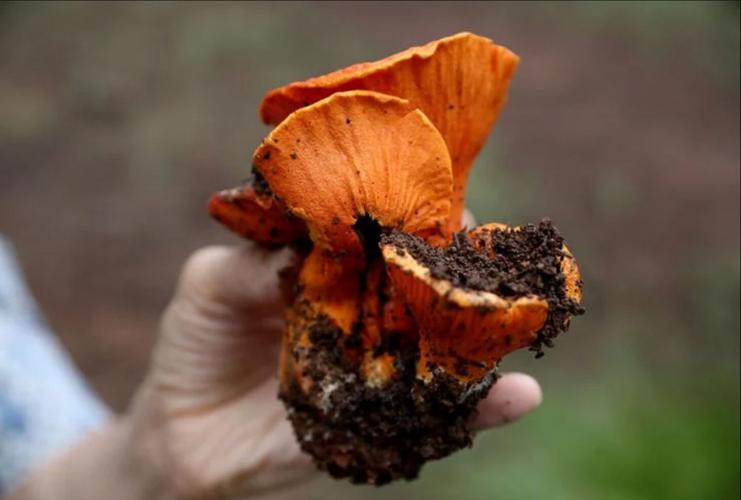
Lobster mushrooms — Hypomyces lactifluorum — are unmistakable. Their meaty folds cup upward out of the pine needles, deep orange like the fascia of cooked crabs. Nothing else in the forest shares their color, their rippling skin, or their culinary potential. They are delightfully edible. Served deep-fried or in rolls, quiches, pastas — just about anything you can do with an ocean lobster you can do with a forest lobster.
“I usually will put lobsters in omelets,” Claire said. “I also just got a recipe from a friend to make lobster bisque. I’m looking forward to that.”
An ‘all-encompassing’ mushroom
For Claire, the act of eating something she has picked from the forest floor scratches “a primordial itch.”
“It’s just very fulfilling in a very human way,” she said, “to be able to feed myself and feel self-sufficient.”
Hunting lobster mushrooms is also easy. A child can do it. Rick said children might even be better hunters. “They’re really great at it,” he said.
Amber Meyer might agree. She enjoys hunting lobsters with her children, aged 8 and 12.
“It’s really fun,” Meyer said. “And it’s a way to get the kids excited to eat healthy food. When they help me pick mushrooms, they’re excited to eat what they had picked earlier that day.”
Of all mushrooms, Meyer feels comfortable having her children pick lobsters because of the mushroom’s bold characteristics. She said they are hard to misidentify.
“If they weren’t so easy to recognize, I don’t think I’d let my kids pick them,” Meyer said.
Meyer, like many others, understands that proper identification of mushrooms is a matter of life and death.

Bright orange lobster mushrooms are spouting out from the pine needle duff in the Ponderosa pine forests surrounding Flagstaff.
According to Mike Dechter of the Arizona Mushroom Society, “while most mushrooms are not poisonous, there are a few that are and they can be regularly seen in the Flagstaff area.” On Aug. 17, Flagstaff animal control responded to a call about a dog that consumed an unknown mushroom. Unfortunately, the dog died.
The diversity of mushroom species, and the range of their impacts when ingested, make them “one of the last mysteries we have in this world,” Dechter said.
“There’s just so much information, so many interesting things going on there that we really don’t know much about,” he said. “When they pop up, we get to learn — oh! — This one smells like almonds. This one’s edible. This one could make you have a psychedelic experience. This one could kill you.”
The high stakes of mushroom identification combined with the surplus of available information make it a challenge. Dechter said success is built on a body of knowledge that depends on person-to-person transfer. Identifying a mushroom you intend to eat is too risky, too complex to leave it up to a remote source. In the internet age (especially in a pandemic era of Zoom meetings and remote everything), the knowledge of mushroom identification is a defiant, in-person outlier.
“We can Google anything,” Dechter said. “But you can’t google what mushroom that is. It’s very difficult.”
Organizations such as the Arizona Mushroom Society offer opportunities for people to connect with identification experts. Decther said learning how to identify a mushroom beyond the shadow of deadly doubt requires full engagement of the senses. People “have to show up,” Dechter said: “They have to be there in person, they have to participate to get good valuable knowledge.”
The way mushroom knowledge spreads person to person is one way that it’s “a relational activity,” said Vicki Blackgoat, an avid gardener who recently began learning how to hunt mushrooms. She gave thanks to her teachers and spoke to the ethos of mushroom identification.
“You make sure that your fellow man, or your friend or your mother or your sister identifies something correctly and completely,” Blackgoat said. “Because you’re trying to protect them. You’re giving them a tool, you’re giving them another food source.”
This careful passage of knowledge about the goods and evils of mushrooms, this desire to keep another safe while assisting them with a need a primary as food, makes the community of mushroom hunting one that “epitomizes that whole idea of relationships and community,” Blackgoat said.
“I think it is all encompassed there,” she said. “That’s how we as human community need to take care of one another.”
And as Blackgoat has been learning more about mushroom hunting, she has identified a preference.
“My favorite so far has been the lobster mushrooms,” she said.
A delicious disease
To humans, lobsters are unmistakable, edible and delicious. But to the mushrooms itself, lobsters are the result of a vicious infection.
Lobster mushrooms are not actually a mushroom at all. They’re a parasite. Specifically, lobsters are an ascomycete fungus that invades other mushrooms. In Flagstaff, lobsters usually attack a type of big white mushroom known as Russula brevipes.
Once infected, the parasitic lobster fungus “takes over the Russula brevipes and kind of eats its DNA as much as it can,” Dechter said. “From an off white gilled mushroom, (the russula) goes to this bright orange solid mushroom with no gills at all anymore. It completely converts the mushroom.”
The lobster “mushroom” that results from a thoroughly infected russula is a completely different texture and taste than a healthy russula, “a much superior mushroom for eating,” Decther said.
“Year after year, if it rains here, we see the lobsters,” he said. “I have to say, Flagstaff is the lobster capital of the world, because we get so many here.”

