


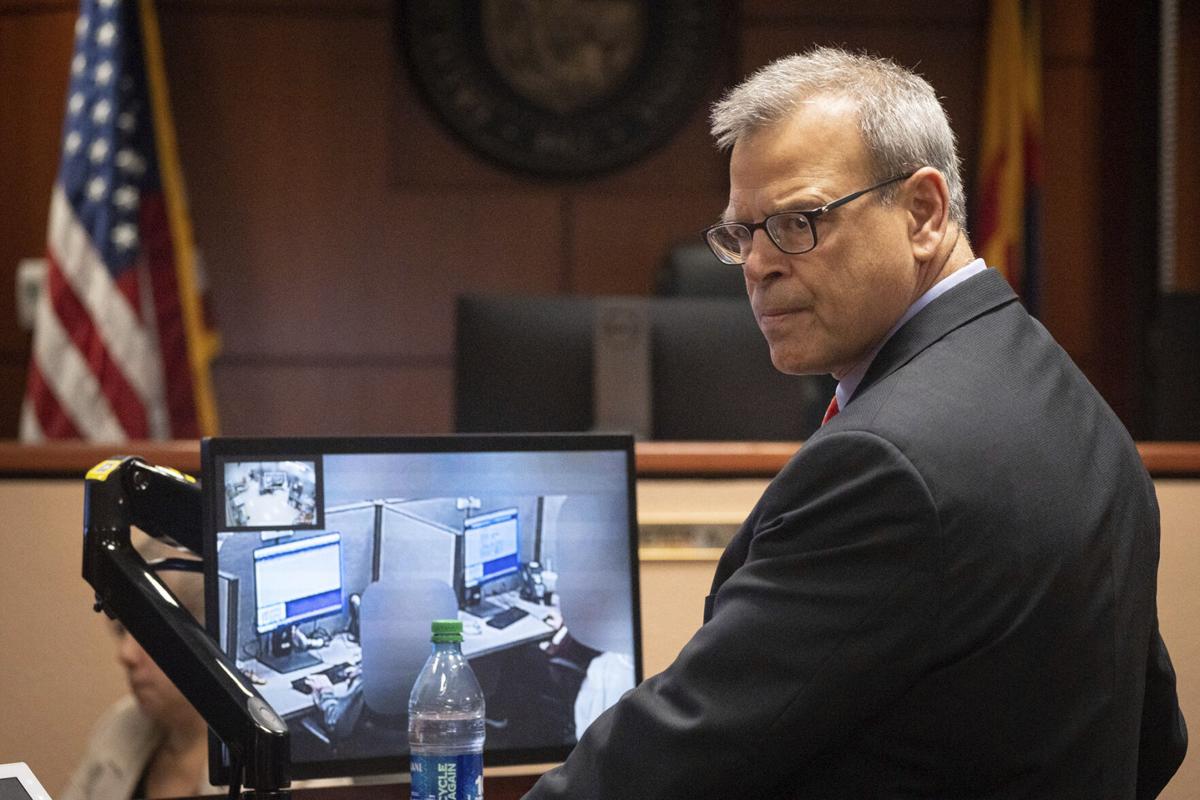
PHOENIX — The key witness for Kari Lake testified Thursday he doesn’t believe it was possible for Maricopa County election workers to have met their legal requirement to compare the signatures on early ballots cast with other records.
Eric Speckin, testifying for the unsuccessful GOP candidate for governor as she tries to get the 2022 election results overturned, said his examination of data he got from Maricopa County shows people employed by the elections department compared the signatures on 321,495 envelopes in less than three seconds. That led Kurt Olsen, one of Lake’s attorneys, to ask Speckin his “expert opinion’’ about whether it’s possible to make such a comparison in such a short time.
“I don’t believe it can be done,’’ Speckin answered. “This is what I do and I’ve done for 30 years, handwriting and signatures,’’ he said, saying he believes he is “at the top of the pyramid’’ of who could to this kind of comparison.
“If I can’t do it, I don’t see how anyone could do it on a mass scale, day after day, hour after hour at these rates,’’ he said. “It can’t be so.’’
But Rey Valenzuela, the county’s elections director, testified that’s not true.
He said it could take just seconds for a verifier, with an image from the envelope and an image of the registration record on a screen in front of them, to determine they are consistent.
Arizona law requires election officials, on receiving early ballots, to “compare the signatures thereon with the signature on the elector’s registration record.’’ Lake’s case is built on her contention the county never met that requirement, though her lawyers have offered no explanation of why they say that didn’t happen.
Under cross examination, Craig Morgan, an attorney representing the county, asked Speckin — who never actually examined any of the ballots or the comparison signatures — whether he could say that any ballots with mismatched signatures were counted.
He conceded he could not.
Elena Rodriguez Armenta, an attorney representing Gov. Katie Hobbs, who defeated Lake in the November election, told the judge that means Lake has not met her burden on proving by clear and convincing evidence that the legally required examination of ballots was not conducted.
Even if Lake could show that — a point Rodriguez Armenta is not conceding — Lake can win her case only if she also can show there is a “competent mathematical basis’’ that the outcome of the election would have been different. Hobbs’ attorney said Lake offered no such evidence.
There’s something else that could affect Maricopa County Superior Court Judge Peter Thompson’s eventual ruling.
Lake offered up Speckin, who charges $600 an hour, as an expert witness to help the court analyze and understand the evidence. But Morgan said Speckin calls himself a “forensic document analyst,” though there is no such official title.
“In your line of work you can call yourself whatever you want,’’ Morgan told Speckin.
“Sure,’’ he responded. But Speckin said that has to be backed up in court.
Morgan pointed up one case, out of Hong Kong, where he said an appellate judge said an opinion Speckin gave in court was not reliable.
There is also the question of whether the Maricopa County data on which Speckin was opining — the number of seconds per review — is accurate. Speckin said it was what he received after he submitted a public records request.
Olsen said the question of whether Speckin examined ballots is irrelevant, saying the data itself proves Lake’s case despite the county’s claim it was complying with the law to verify signatures.
“Signature verification is not simply what we say it is,’’ Olsen told the judge. He said the law requires reviewers to not just compare signatures — meaning take look at both — but to make actual comparisons.
And that takes time, he said. “You cannot just throw two signatures up on a screen and do a comparison,’’ Olsen said. “Defendants would have the court believe that ‘compare’ has no meaning.’’
He said the numbers back that up — and not just the ones showing 321,495 signatures verified in three seconds or less.
He cited Speckin’s testimony that about 70,000 signatures were verified in fewer than two seconds. Speckin said the top seven reviewers in that category verified 100% of the signatures as matches.
Whatever Thompson rules is virtually certain to be appealed to the Arizona Supreme Court.
That court already rejected all of Lake’s other claims, including that there were violations of requirements to maintain a chain of custody on ballots and that problems with equipment on Election Day affected the outcome.
Get your morning recap of today's local news and read the full stories here: http://tucne.ws/morning

