


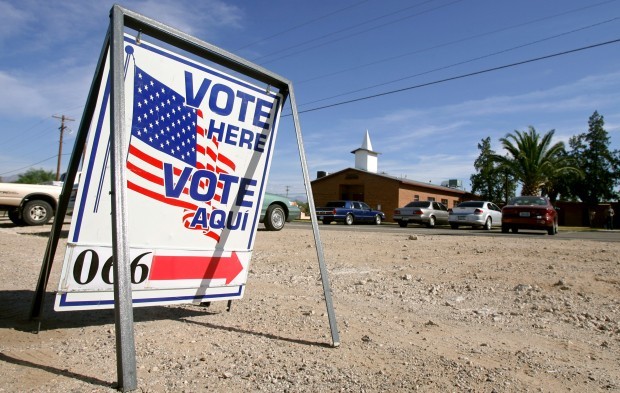
Arizona voters won’t get a chance to make a series of changes in state election laws.
In a brief order late Friday, the state Supreme Court affirmed a trial judge’s conclusion there were not enough valid signatures on petitions submitted by Arizonans for Free and Fair Elections to qualify an initiative for the November ballot.
Backers had submitted more than 475,000 signatures last month.
Some were struck by the Secretary of State’s Office, and counties disqualified some others in a random sample. The business-oriented Free Enterprise Club, which opposes the initiative, then filed challenges in court.
Judge Joseph Mikitish said once invalid and duplicate signatures were removed, the proposal fell 1,458 short of the 237,645 signatures needed.
The justices rejected arguments by Jim Barton, attorney for the campaign, that Mikitish was using an incorrect formula to determine the disqualification rate of the random sample of signatures reviewed by county election officials.
Scot Mussi, president of the Free Enterprise Club, said the high court got it right.
There was no immediate comment from initiative backers.
The initiative contained a list of proposals that would have eased the process of voter registration and voting.
Some were new ideas for Arizona, such as allowing people to register and vote at the same time, including on Election Day. And people would have been registered to vote automatically when getting an Arizona driver’s license unless they opted out.
The proposal also would have reinstated the state’s permanent early voting list which automatically provides mail-in ballots for anyone who opts in.
State lawmakers voted to repeal that last year, replacing it with a system that stops the early ballots from coming for those who do not use them for at least two election cycles, though those voters still would be able to vote in person.
Backers of the initiative said the legislative changes aren’t fair for those who may not be regular voters but turn out only when there are issues or candidates on the ballot of interest to them.
Also gone would have been the law that makes it a crime to take someone else’s voted early ballot to a polling place unless that person is a relative, member of the same household or a caretaker.
For those who do like to vote in person, the initiative would have required that election officials do what they could to keep waiting times in lines at polling places to no more than 30 minutes. It would have granted permission for people who are not election officials to provide food, nonalcoholic beverages, and the use of umbrellas or chairs to make people waiting to vote comfortable, as long as those offers were not tied to how someone voted.
And the initiative would have rolled back decisions by lawmakers to increase the amount of money that individuals and political action committees can give to candidates, a figure currently set at $6,250. That would have been capped at $1,000 for local and legislative candidates and $2,500 for statewide races.
There was also a provision designed to keep lawmakers from tinkering with presidential electors. It said any changes in selecting electors must be made by Jan. 1 of the election year, precluding last-minute changes pushed through in November or December by legislators unhappy with the popular vote.

