

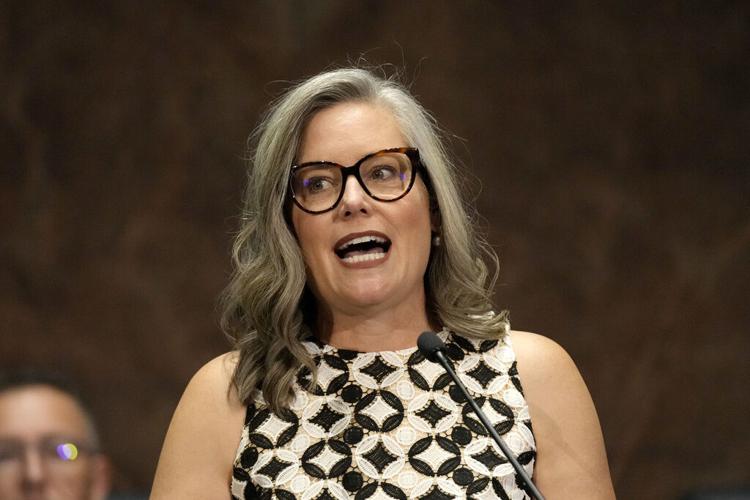
PHOENIX — Gov. Katie Hobbs wants to tap into proceeds of the state land trust to raise salaries for teachers and school support staff. By how much remains unclear.
In a proposal released Tuesday, the Democratic governor wants lawmakers to put a measure on the ballot to extend Proposition 123. That plan, first approved by voters in 2016, allows the state to use money in the trust to provide more education dollars.
Authorization is expiring in 2025. Republican legislative leaders already unveiled a plan to extend it for another decade, but this time using the proceeds to pay for a $4,000 pay raise for teachers.
Hobbs wants to go farther.
She wants to increase the amount of money the state siphons out of the trust from the current 6.9% a year — the figure Republican lawmakers want to continue — to 8.9%.
Hobbs said that would generate an average of $761 million a year over the proposition’s 10-year life if it is extended by voters.
Of that, about $347 million a year would go to “educator compensation.’’
Not across-the-board raise
But unlike the GOP plan, she would not require schools to use all of it for salaries.
“It is not an across-the-board salary increase,’’ said Hobbs’ press aide Christian Slater. He said schools could use it any way they want within the category of compensation, which he said also could include paying for health insurance or retirement.
Nor would it require that schools give all teachers the same amount. That would allow a district, for example, to decide to put all of the funds into raising salaries for beginning teachers.
“It’s designed to allow neighborhood schools to decide what’s best for their needs,’’ Slater said.
Hobbs’ plan also has something not being pushed by Republicans: additional dollars to boost salaries for support staff, such as librarians and guidance counselors.
Rep. Matt Gress, R-Phoenix, said they were excluded from the GOP plan because the biggest shortage is in teachers, not bus drivers.
Hobbs wants some for school safety
Hobbs also wants $39 million for school safety and security.
And she wants to set aside about $257 million a year to continue general education funding — something also not in the Republican plan.
That’s crucial because Proposition 123 currently adds more than $420 million a year to K-12 funding. If the GOP plan to extend the diversion uses all that for higher teacher salaries, that will reduce available general education dollars.
Gress insisted that won’t happen, and that the state is able to cover those costs out of its regular tax revenues.
Hobbs isn’t buying that plan, as the state faces a deficit this fiscal year and next — and possibly for years into the future. She wants to ensure that $257 million of the anticipated $761 million annual distribution would continue to be earmarked for K-12 funding, regardless of the state’s revenue collections.
Legislature can bypass Hobbs
Gress, one of the architects of the Republican legislative plan, said he wants to review the proposal in depth.
“My No. 1 priority is to raise pay for classroom teachers,’’ he told Capitol Media Services.
“We have a teacher shortage,’’ Gress continued. “Surely that’s something we would be able to find bipartisan agreement on.’’
As to increasing the withdrawal from the land trust to 8.9%, he said that needs to be “carefully studied’’ to ensure the funds are “sustainable and responsible.’’
“That’s the best way to actually make good on these commitments,’’ Gress said.
For his part, Senate President Warren Petersen said he welcomes Hobbs into the discussion. But the Gilbert Republican also said Hobbs really has no say in the matter.
That’s because any plan to extend or expand Proposition 123 would have to go to voters. And only the Legislature can put issues on the ballot, a decision that bypasses the governor.
Hobbs says it won’t harm land trust
Inherent in both the GOP plan and the one being advanced by Hobbs is the the concept that there is essentially free money to be had for education.
The federal government gave 10 million acres to Arizona when it became a state in 1912 with the restriction that it be held for the benefit of certain beneficiaries, mostly public schools.
Some of that land has been sold off for development. About 9.2 million acres remain, available for lease for farming, commercial and grazing uses.
Earnings from the trust go to the beneficiaries, in this case mostly K-12 education. Schools also get 2.5% annually from what is in the trust.
Proposition 123 increased the amount of money that can be taken from the the body of the trust each year to 6.9%, with the proceeds earmarked to supplement available K-12 funds.
Voter approval for that diversion expires in 2025.
The Republican plan would keep the 6.9% distribution, but with the dollars transferred to the $4,000 pay raise for teachers.
Hobbs insists that taking 8.9% out of the body of the trust won’t hurt it.
Her office produced no actuarial studies on Tuesday. But she said there is currently nearly $8 billion in the trust and it has grown an average of 7.24% annually, even with the funds withdrawn by Prop. 123.
“We can increase compensation for educators and make schools safer for our kids, all without raising taxes on Arizonans,’’ the governor said in a prepared statement. “Or we can let billions of dollars accrue in a bank account and do nothing to address our immediate needs.’’
That argument is the same one aides to Republican former Gov. Doug Ducey advanced in pushing the original Prop. 123.
“The money would be better used in our schools than on Wall Street,’’ said Ducey’s press aide at the time, Dan Scarpinato. “But right now this money isn’t benefiting anyone by sitting in a bank account.’’
“Would break bank,” treasurer says
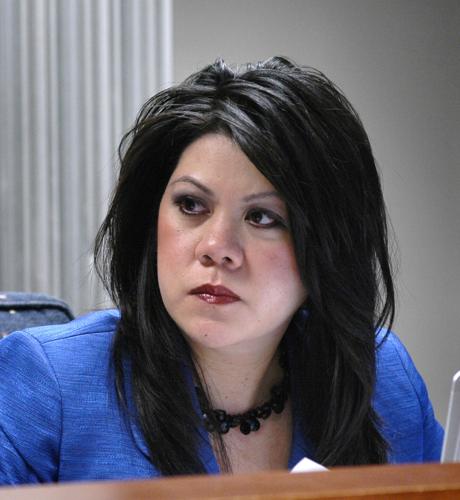
Republican State Treasurer Kimberly Yee, whose office administers the trust account, agreed with the Democratic governor on one point. She said there is $8.2 billion in the trust.
Yee told Capitol Media Services, though, that what Hobbs wants to do makes no fiscal sense.

Arizona Treasurer Kimberly Yee
“It’s unsustainable,’’ she said. “It would break the bank.’’
Yee said the state would be taking out more money each year than the trust earns, meaning an ever-decreasing balance in what is supposed to be a permanent endowment to benefit education.
“They have not coordinated or consulted with our office with respect to our projection, our long-time research into what the current economy is, inflationary factors,’’ she said.
It’s not just the governor’s plan that the treasurer finds problematic. She said even the GOP plan to continue with a 6.9% would harm the trust, though to a lesser extent.
“Wall Street forecasters in general predict a 5.45% return for the next decade’’ on the kind of portfolio of investments the state currently has, Yee said.
“If we were to continue at a 6.9% distribution or higher, it would dip into the corpus (body) of the trust,’’ she said.
Yee said her research shows that a safe annual withdrawal would be in the 4% to 5% range.
“I believe that’s prudent,’’ she said. “I believe it’s consistent with what most endowments distribute across the globe. And it also falls in line with IRS guidelines of a 5% payout for private-type endowments.’’
Get your morning recap of today's local news and read the full stories here: tucne.ws/morning

