

PHOENIX — The state’s high court agreed Wednesday to narrow the ability of those not directly involved in legal matters to pursue ethics complaints against lawyers, despite concerns it will lead to less transparency.
The new rule in essence creates two classes of people who can ask the State Bar of Arizona to determine whether an attorney’s actions violate a host of rules covering issues ranging from financial misconduct, to conflicts of interest, to filing frivolous lawsuits.
Nothing would change for clients of an attorney in question, who would be involved at all stages of the disciplinary process. Complaints also still could be filed by people with first-hand knowledge of the alleged misconduct, as well as by judges who become aware of improper activities.
Everyone else still could ask the State Bar, which is tasked by the Arizona Supreme Court with investigating misconduct, to take a look. But it would be solely up to the Bar to decide whether to pursue an inquiry or dismiss it out of hand.
Anyone filing a complaint who is not a direct witness would not be notified of what is going on with the investigation. He or she also could have no impact on that decision and could not object to any agreement the Bar reached with the attorney.
The new rule was written by David Byers, who runs the Administrative Office of the Court. He said it was designed to keep the disciplinary process from “being weaponized by partisans or the appearance of that occurring.”
In proposing the rule earlier this year, Byers said there were 40 election-related complaints since the 2020 election. He said many came from Democrats and their allies — some from out of state — filing complaints against lawyers representing Republicans who were trying to have elections overturned. Many of these complaints appear to have been filed largely for political reasons, he said.
The justices adopted the rule in August on an emergency basis ahead of this year’s election. But they held off until Wednesday on making it permanent, to give people more time to comment.
Most comments they received panned the idea.
George Riemer, an attorney in Sun City West, said the fact there were 40 election-related complaints, by itself, is no reason to alter the rules.
“(Byers) provided no definition of who he considered to be partisan or information as to when a complaint was being used as a weapon to do something nefarious or otherwise improper,” Riemer told the court. “Filing a complaint based on other than direct and specific first-hand knowledge does not make you a partisan; being partisan makes you partisan.”
Ralph Adams, a former senior Bar counsel in Arizona, now retired, said it is “completely irrelevant” whether someone has first-hand knowledge of the events.
“The First Amendment protects complainants’ free speech rights,” he said, including their right to comment about a complaint they have filed.
He agreed that Byers’ concern about 40 election-related complaints is no reason to change the rules. In the same four years, he said, the Bar processed more than 9,200 complaints.
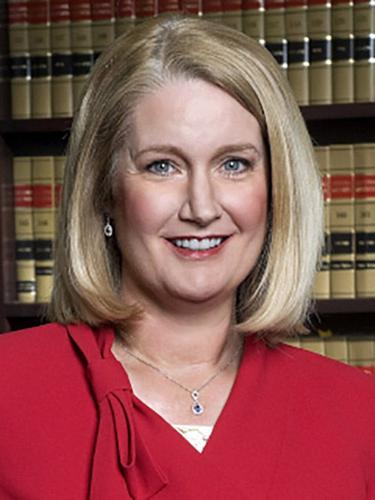
Chief Justice Ann Timmer, who signed Wednesday’s order, said she has no personal knowledge of whether Democrats tried to use the complaint system to go after attorneys representing Republicans who filed election challenges.
“But what caught our attention, certainly, is there was an increase after the last election with Republican attorneys being the subject of Bar complaints,” she told Capitol Media Services. These complaints didn’t come from just one or two people but multiple individuals, Timmer said.

Justice Ann Scott Timmer
Under the old rules, she said, all “complainants” were entitled to get notified and have a role in the discipline process.
While 40 complaints may not seem like much, Timmer said the bigger worry is what this portends, especially with social media.
“People are engaged with what goes on in courts,” she said. “They should be. And we want them to be.”
But the flip side, the chief justice said, is that the current system essentially encourages anyone who read anything in a newspaper or online about a pending legal dispute — even if that person has no personal knowledge — to file a complaint. That is not necessarily limited to election cases, Timmer said, but could extend to family law matters such as child custody.
“Our ethics rules and complaint procedure rules are really not written for that,” she said, but are designed to handle situations where people have personally observed unethical behavior.
That usually is a client, she said. But Timmer said it also could be a judge or opposing counsel with first-hand knowledge of the actions or legal filings of the attorney in question, “people that are observing the activity or are affected by it.”
“The court’s fear, I think, is when you start having groups of people, or potentially, in the future, a campaign of ‘everybody file something,’ and they have these corresponding rights, then that’s problematic,” Timmer said.
It would distract from the Bar doing the core work of attorney discipline, forcing attorneys and staff to instead spend time notifying every complainant about every step, she said.
Timmer acknowledged one way of handling any potential increase in complaints without changing the rules would have been to simply increase the amount of money the Bar has to handle disciplinary actions. But she said the dues in Arizona already are among “the highest in the nation.”
There was one comment in favor: from Senate President Warren Petersen, R-Gilbert, who was admitted to practice law just last year.
“Not only can the current process be weaponized by partisans, but it also can be weaponized for any reason,” Petersen said.
But Dianne Post, an international human rights attorney, urged the court to disregard his comments.
She said he is one of the lawmakers who has been behind legislative efforts to weaken the State Bar and its ability to discipline attorneys.
“Appeasing bullies is cowardly and is never the appropriate solution,” Post said. “Surely, the (Supreme) Court and the Bar can fight that issue without compromising our ethical responsibilities or our duty to the Constitution and the rule of law.”
There was no immediate response from Petersen, who voted in favor of legislation last year to have the Supreme Court itself license attorneys and eliminate the requirement that lawyers belong to the State Bar. That measure, sponsored by Sen. Justine Wadsack, R-Tucson, was vetoed by Democratic Gov. Katie Hobbs.
Amelia Cramer, a former chief deputy Pima County attorney now in private practice, had her own objections, including denying the right of some who file complaints from being informed of the outcome.
“More transparency, not less, regarding Bar discipline is warranted in these times of distrust of government institutions and misuse of the justice system for political purposes,” she wrote. “Those who submit Bar charges deserve to know ultimately what happened with respect to those charges.”
And Maureen Kane, a retired attorney from Chandler, had a broader concern with the rules. She said they could “exacerbate distrust of our profession.”
“I would hope not,” said Timmer. She said that’s why the court went out of its way to publicize the new rule. And she stressed that nothing in the rule eliminates an attorney’s duty to report ethical violations.


