

PHOENIX — The newly adopted $16.1 billion state budget has left some Democrats wondering whether there was a better deal to be had by the Democratic governor working in divided government with the GOP-controlled Legislature.
It was the first real budget test for Gov. Katie Hobbs, the first Democrat to be Arizona governor in more than a dozen years. The budget adopted last year after she was first elected came as the state was flush with cash, and there was plenty of money to go around.
But now, with the surplus gone and hard choices to be made, many are questioning whether Hobbs could have done better. The Legislature narrowly approved the budget late Saturday and adjourned for the year.
There were some victories for the Democrats.
Lawmakers added $15 million to the state’s Housing Trust Fund designed to help provide affordable homes for low-income individuals. That is just 10% of what was allocated a year ago, however.
Democrats succeeded in getting a $135 million cap on the amount of money that corporations could take as income tax credits for contributions to "school tuition organizations,'' which provide scholarships for low-income students to attend private and parochial schools.
But some noted that cap, at least for the moment, will save the state just $7 million.
More to the point, STOs are less likely to be sought now that the state has universal vouchers of tax dollars, starting at around $7,300 per student, for parents to send their children to those same private and parochial schools.
Hobbs already had given up in January on any plans to curb the number of vouchers, by going back to the days when they were available only to students who met certain conditions, such as having learning disabilities, being in foster homes or attending public schools rated D or F.

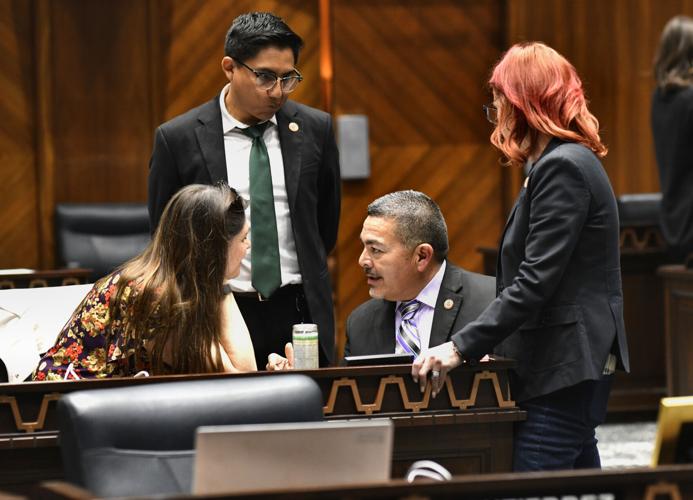
House Minority Leader Lupe Contreras, center, talks budget issues Saturday night with fellow Democrats Stephanie Stahl Hamilton, Oscar De Los Santos and Nancy Gutierrez.
Still, she promised some limits, like a requirement that a student have first attended public schools for at least 100 days before switching to a voucher; prohibiting price gouging; setting minimum education standards and requiring accountability for how voucher funds were spent.
The final budget, however, simply closes a $2.5 million loophole that allowed double dipping: attending public schools during the regular academic year and getting a voucher for summer school. And, after reports of voucher funds going for ski trips and Lego sets, it directs the Department of Education to establish standings on how those dollars can be spent.
Voucher spending, however, remains uncapped.
Education funding cuts
At the same time, there are cuts to education funding, including a $2.1 million cut to a workforce training program and $3 million taken from a program that encourages dual enrollment in high school and college.
Additional funding won last year will be evaporating, including $37 million for schools based on the number of students in poverty, and $29 million in other additional assistance for some capital needs ranging from books and computers to buses.
What Democrats got instead was a promise to restore those dollars after this budget year — but not until the 2027-2028 school year. And that is unenforceable, as it does not bind future legislators.
“That’s a massive and irresponsible transfer of wealth from the poor to the rich,’’ said Assistant House Minority Leader Oscar De Los Santos, a Laveen Democrat, about the spending on education. De Los Santos didn’t vote for the package who didn’t vote for the package negotiated by Hobbs with GOP leaders.
There was another victory that could be considered hollow.
Lawmakers authorized community colleges to establish a “Promise Program.’’ Mirrored after one at the state university level, it ensures that eligible Arizona residents can get their tuition and fees paid if other financial aid does not cover the costs.

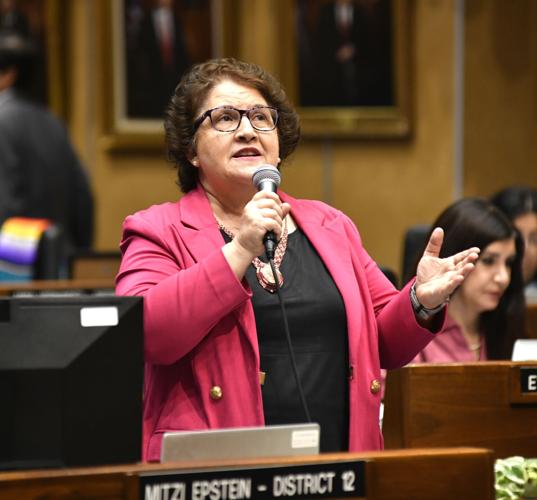
Senate Minority Leader Mitzi Epstein, a Tempe Democrat, explains Saturday night why she voted for the budget package.
But it is just an authorization, with no actual money attached. Rep. David Livingston, R-Peoria, who chairs the House Appropriations Committee, said colleges are free to find money in their own budgets or go out and seek private dollars.
All that left House Minority Leader Lupe Contreras disappointed, to the point where he would not support the package. The Avondale Democrat said he, and his caucus, didn’t have any input.
“It was built by the governor and the (House) speaker and the (Senate) president,’’ he said.
“Would we have rather been in the negotiations? Yes,’’ Contreras said. He said the only reason the package got some Democratic support is that GOP leaders found they didn’t have the votes within their own caucus and found themselves having to “buy off’’ some of them by adding back a few items.
And there were add-ons to the basic budget, including $2 million for a mental health telehealth pilot program to serve individuals outside Maricopa and Pima counties; an identical amount for entities that provide after-school programs to low income individuals; a $1 million allocation for counseling in Southern Arizona and $500,000 for heat mitigation programs in the same area.
One charges “failure in leadership”
So where does Hobbs fit in for what Contreras considers a bad budget?
“I’m not going totally put the blame on her,’’ he said. “She has to sign the budget at the end,’’ he said, noting that House Speaker Ben Toma and Senate President Warren Petersen also played roles.
“They have to run these two chambers here,’’ Contreras said. “Myself and (Senate Minority) Leader (Mitzi) Epstein, we’re still not the ones dictating how the budget was built.’’

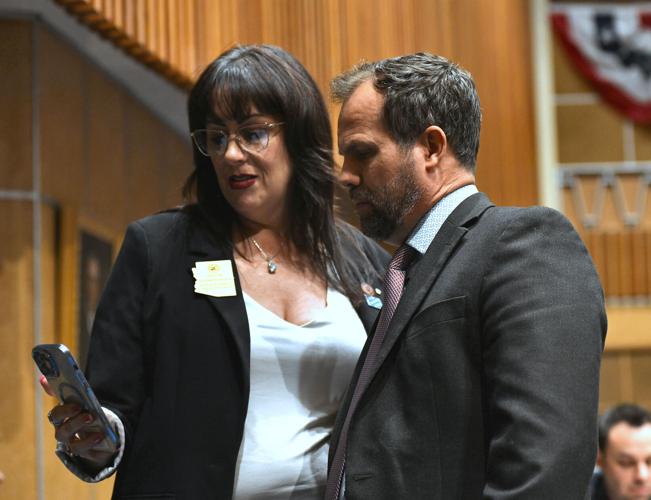
Republican Senate President Warren Petersen confers Saturday night with Tucson GOP Sen. Justine Wadsack.
But Epstein, a Tempe Democrat, said as far as she is concerned, Hobbs is not to blame for what she said has been decades of Republican policies of cutting spending
“Gov. Hobbs has done everything she could to deal with this intractable (Republican) caucus,’’ Epstein said. “And it’s a lot better than it would have been without Gov. Hobbs.”
Phoenix Democratic Sen. Anna Herandez, however, is not willing to let Epstein — or the governor — off the hook.
“There’s been a failure in leadership that could have gotten us a better budget,’’ Hernandez said.
“You should also have a spine,’’ she said. “You should have the back of your rank-and-file Democrats that are fighting for the people of Arizona. My leadership, from the very top of the (executive) tower, failed me and all of the people of Arizona by the process that this budget was delivered.’’
Add to the list of Democrats angry with the governor: Attorney General Kris Mayes. She blasted the plan, approved by Hobbs, to take $195 million from a settlement the state made with opioid manufacturers and pharmacies to deal with the costs of treating those who became addicted. The money will be swept up in the state budget to fund what Mayes said is “backfilling’’ a budget deficit at the Department of Corrections, Rehabilitation and Reentry.
Mayes contends that transfer violates the terms of the settlement, signed by a federal judge, that restricts how those dollars can be used. And, the swept funds aside, Mayes argues that puts the entire $1.14 billion settlement in legal jeopardy.

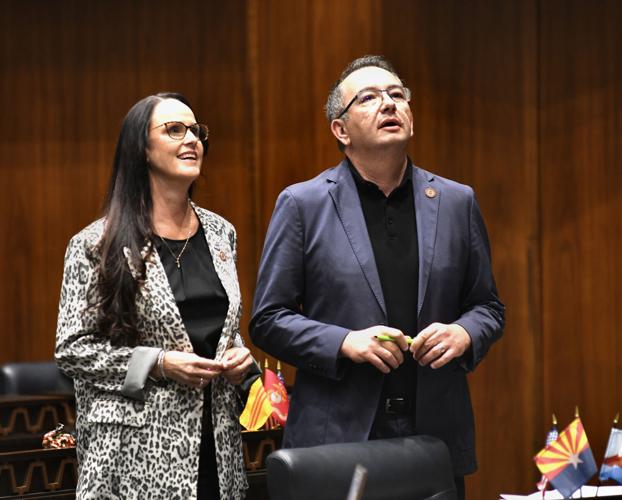
Sen. Janae Shamp and House Speaker Ben Toma watch the tally board Saturday night as lawmakers vote on a fix to the current budget and a $16.1 billion spending plan for the coming fiscal year.
Lawmakers did add wording saying the funds can be used only for Corrections department’s “costs of care, treatment, programs and other expenses for individuals with opioid use disorder and co-occurring substance use disorder or mental health conditions or for any other approved purposes as prescribed in a court order (or) a settlement agreement.’’
Mayes called it an “egregious grab,’’ saying it still doesn’t comply with the process that requires the funds be awarded by competitive bidding. She said is exploring legal options.
Hobbs declined an interview request to talk about preparing the budget and, specifically, about what some Democratic lawmakers were saying about what was presented to them as a finished product.
But her press aide Christian Slater, in a written statement, said there were 38 budget meetings from May 2 until the plan was adopted “to inform Democratic legislators of negotiations, hear their priorities, and receive feedback.’’ Some of those, he said, were just “staff to staff,’’ with others including Democratic legislative leaders and members “and at times the governor herself.’’
Some Republicans also voted ‘no’
None of this is to say that Republicans who refused to support the budget package are any more happy with their own leadership.
“Many of my colleagues on this side of the aisle think that Katie Hobbs is not particularly bright,’’ said Rep. Alexander Kolodin, R-Scottsdale, as he voted against the package. “But today she has certainly outplayed us, because she’s playing the long game.’’
Rep. Barbara Parker, R-Mesa, said she thought that, as a member of the House Appropriations Committee, she should have been involved in the negotiation process to get a fiscally responsible budget.
“It’s been implied that I’m asking for something unreasonable or that I’m not working with the body on this,’’ Parker said. “And I want my voters to know that I continued to plead for a little bit of policy that I consider Republican platform principles, conservative and constitutional. And I didn’t get those requests.’’
But Rep. Travis Grantham, the House speaker pro-tem, said his party members should recognize reality.
“We have a one-seat majority in the Arizona House, we have a one-seat majority in the Senate,’’ said the Gilbert Republican. That means if not every Republican goes along, leadership has to get votes from Democrats.
And on top of that, he said, the governor can sign or veto the budget and even has the constitutional power to line-out expenditures with which she disagrees.
Personally, Grantham said if he got to prepare a spending plan “most of what’s being asked for wouldn’t be in it.’’
“But I can’t get that because I’m not in a majority with 50 other people who think like me,’’ he said. “This is how it works.’’
And Petersen, finding himself attacked on social media, penned a similar response.
“This is an incredibly conservative budget, especially in light of divided government,’’ the Senate president posted.
Get your morning recap of today's local news and read the full stories here: tucne.ws/morning

