


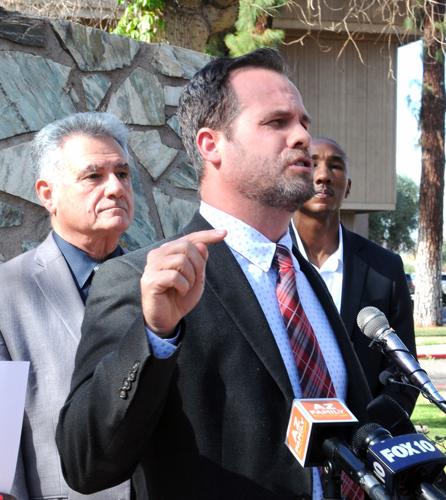
The state’s top two Republican lawmakers are asking a federal appeals court to protect them from having to explain their motives in promoting and voting to ban transgender girls’ participation in girls’ sports.
The attorney for House Speaker Ben Toma and Senate President Warren Petersen contends that U.S. District Court Judge Jennifer Zipps got it wrong when she ordered them to answer questions from the lawyers representing transgender girls who have sued to overturn the law.

Arizona House Speaker Ben Toma
Justin Smith, the private attorney the two legislative leaders hired, acknowledged that they asked to become parties to the lawsuit rather than simply let state schools chief Tom Horne defend the 2022 ban. But he said that decision does not waive or override the privilege lawmakers have against being required to explain their motives in court.
What the 9th Circuit rules could prove crucial.
Generally speaking, the motives behind legislation are irrelevant to its legality. Courts judge each challenged law on whether it is illegal or unconstitutional.

Arizona Senate President Warren Petersen
And Smith cited cases, going back more than a century, that protected lawmakers from having their motives questioned.
But in this case the challengers said the ban violates the Equal Protection Clause of the U.S. Constitution. Zipps said these kinds of cases can be judged not only on the letter of the law but also whether lawmakers “acted with discriminatory intent’’ in approving legislation.
“This discovery may shed light on whether the Arizona legislature acted with a constitutionally permissible purpose in enacting the law,’’ Zipps said in issuing her order last month.
The judge said the fact that Toma and Petersen decided to intervene in the case only strengthens her decision that they, just like any other party to a civil lawsuit, have to submit to depositions and turn over certain documents.
The case most immediately affects two transgender girls who challenged the 2022 law.
It requires public schools and any private schools that compete against them to designate their interscholastic or intramural sports strictly as male, female or coed. It specifically says teams designated for women or girls “may not be open to students of the male sex.’’
Proponents said the law is justified based on arguments that males have an inherent biological advantage.
Zipps already blocked the state from enforcing the law against the two transgender girls, one set to attend Kyrene Aprende Middle School and the other attending the private Gregory School in Tucson. She said the statute violates Title IX, the federal law that bars discrimination based on sex in educational opportunities.
But still pending is whether Zipps will make that order permanent. Potentially more significant, a ruling in this case about these two plaintiffs could set the stage for similar challenges to the law by others affected statewide.
Democratic Attorney General Kris Mayes declined to defend the law, telling Capitol Media Services it was clear her views did not align with those of Republican state schools chief Tom Horne, who is named as a defendant in the case. She allowed Horne to hire his own attorney.
Horne has actively defended the law, saying it protects biological girls from unfair competition and ensures they are not injured by those who are stronger and more powerful. He also rejected arguments that these two girls have no advantage because they are either prepubescent or are taking puberty blockers.
But Toma and Petersen decided they wanted their own voice in the case, hiring an attorney at taxpayer expense to argue they have “unique legislative interests’’ in defending the validity of the law, interests that may differ from those of Horne. That, in turn, opened the door to the plaintiffs’ lawyers requesting documents related to the passage of the law and to seeking to interview both lawmakers.
In filings with the 9th Circuit, Smith, the attorney for the GOP lawmakers, said there is a need for them to block Zipps’ order.
“The legislative leaders will suffer damage and prejudice that cannot be corrected on appeal,’’ he told the appellate court. “Information disclosure cannot be undone, and the intrusion of a deposition is not correctable even if testimony is excluded at trial.’’
Smith said Zipps was wrong in concluding the decision by Toma and Petersen to intervene and become parties to the lawsuit meant they opened themselves up to being questioned.
He said the U.S. Supreme Court has concluded legislative privilege can be waived only by an “explicit and unequivocal renunciation,’’ something he said has not occurred here. Smith said the mere fact of participating in litigation doesn’t reach that level.
“A plaintiff does not waive attorney-client privilege by filing a lawsuit, and a legislator does not waive legislative privilege by intervening in a lawsuit,’’ he said.
“Allowing high-ranking legislators to be deposed about their motives because they intervened to defend state law implicates constitutional concerns involving the separation of powers,’’ Smith told the appellate court.
Zipps, in her ruling, said it was Toma and Petersen’s claim of their “unique legislative interests’’ in defending the law that opened the door to them being questioned.
“(They) put their legislative intent at issue in their assertions that (1) the law does not discriminate on the basis of transgender status, and (2) the purpose of the law is to ‘redress past discrimination against women in athletics’ and ‘promote equity of athletic opportunity between the sexes’ in school sports,’’ the judge wrote.
She said that relates directly to the fact that the lawsuit alleges a violation of the Equal Protection Clause.
“The government must establish that its sex-based classification is substantially related to an important government objective,’’ the judge concluded, putting the burden on the state to justify the law and making the motives behind it legally relevant.
Zipps already has ruled that Title IX also applies to transgender girls, those who were born male.
The documents issue is somewhat different.
Smith said the GOP leaders have produced more than 400 documents and 1,100 pages of records. But they have withheld five as “privileged,’’ saying they were created by other legislators who are not parties to the lawsuit.
Zipps said those withheld documents consist of emails to state lawmakers about the enactment of the law, including “one with talking points’’ about the statute.
No date has been set for a hearing.
Get your morning recap of today's local news and read the full stories here: tucne.ws/morning

