

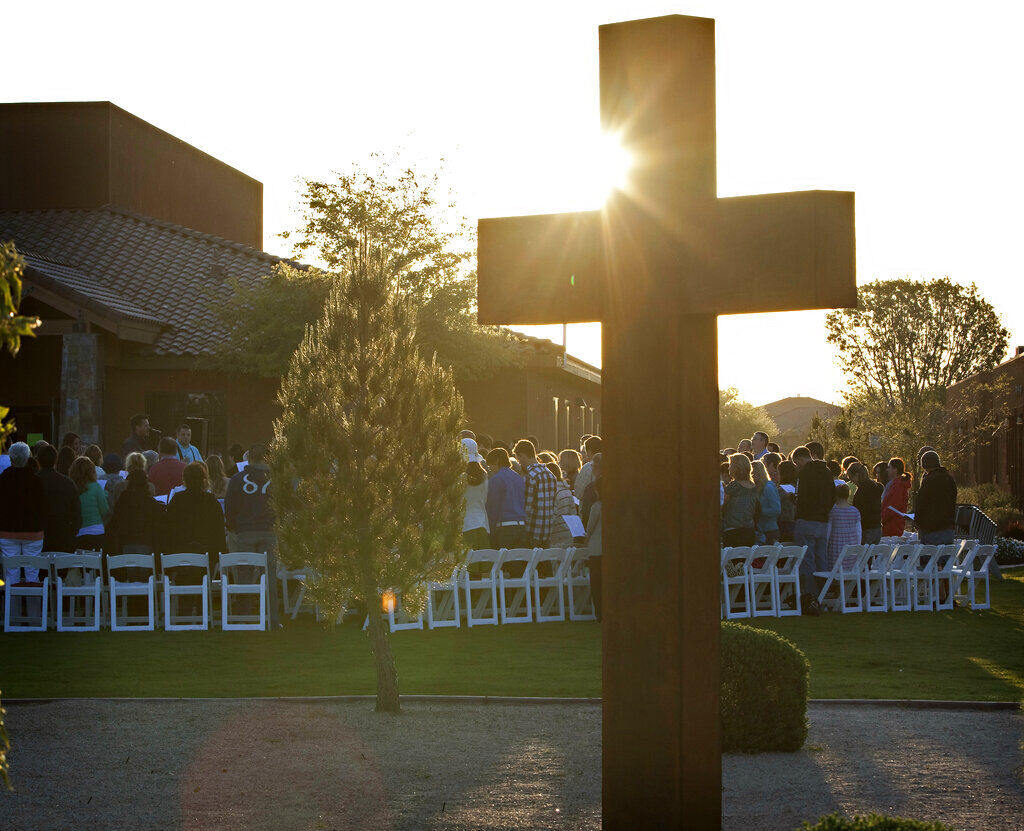
PHOENIX — State lawmakers want to give churches, synagogues, mosques and other nonprofit religious institutions authority to use their land to build “affordable” homes — regardless of whether the projects conflict with area zoning.
On an 11-5 vote Monday, the House Appropriations Committee approved a measure that would give leeway for churches — and the developers that would work with them — to construct three-story or more multi-family homes and apartments on the properties they own. That could mean converting parking lots and other vacant land.
Critics called it overly broad, and some legislators worried such developments could sharply change the character of residential neighborhoods.
Among them was Rep. Matt Gress, a Phoenix and Paradise Valley Republican, who would like the bill to have more restrictions, such as a 150-foot setback from existing homes.
“I can still see this three-story apartment complex with significant density in a single-family home,’’ he said. “I can certainly see into the windows. And they can certainly see into my back yard.’’
The bigger issue, according to Mesa Democratic Rep. Lorena Austin, is that what’s now being promoted as affordable is not.
“We have townhouses in my district going for $350,000,’’ she said. “Housing is something we need very desperately.’’
It became clear during Monday’s debate that the bill, in its current form, is unlikely to get the votes it needs in the full House.
Several lawmakers agreed to vote to let it go forward on the promise that before it would be sent to Gov. Katie Hobbs, there would be changes, such as tightening up what some see as loopholes allowing developers to “game’’ the system.
Even that may not be enough to overcome opposition from neighborhood groups, which was strong enough last year to kill a similar plan in the Senate.
This measure, HB 2199, is one of several efforts to increase the supply of housing.
Lawmakers approved several last year, including requiring some cities to allow multi-family development in some areas now zoned for single-family homes. There is a new proposal this year to override some municipal regulations to allow construction of “starter homes’’ that are smaller than allowed by zoning and on smaller lots.
HB 2199 takes a different approach, at least partly on the premise that churches and other religious institutions have a vested interest in creating more affordable options.
Under its provisions, churches could use the laxer rules to erect housing and apartments that would otherwise never be permitted in certain areas.
There are some guardrails already in the bill, beyond height limitations.
One, for example, is that a church would need to have owned the property for at least three years before being allowed to do development that conflicts with local zoning laws.
Some consider that to be too broad. So one of the changes being weighed would limit the exemption to the property on which the church already is located, versus some piece of church-owned land elsewhere.
Then there are questions about what happens when the church no longer owns the land, whether the property has been sold or the congregation no longer exists.
HB 2199 would require that there be a restrictive covenant in the deed — binding on future owners — that for 55 years at least 40% of the units are set aside for low-income households.
And, for the moment, the height restriction is a big vague.
The bill does mention a three-story limit. But in its current form, it also permits construction up to the height of “a previously existing structure on the eligible site,’’ something that could include the steeple.
Rep. Kevin Volk, a Tucson Democrat involved in real estate, mostly commercial, said it is difficult to find places to put affordable housing.
On one hand, he said, neighbors don’t want those who are transients or homeless in their communities.
“And we don’t want to blade virgin desert to create housing,’’ Volk said. “And we want the housing to be accessible to services and transportation. And we want them to be welcomed by their immediate property neighbors.’’
There’s also the problem of affordability, which he said can be overcome if the property owner is willing to provide it.
“This bill does something” about the fact “we are cornered into a crisis where we have 180,000 or 270,000 needed housing units in Arizona,’’ Volk said in supporting the measure.
But his fellow Tucson Democrat Rep. Nancy Gutierrez said she can’t support the measure as it now stands. She said if lawmakers are serious about making housing affordable they would consider more sweeping changes, ranging from imposing rent caps to limiting the ability of out-of-state corporations to buy up housing stock.
Tucson Democratic Rep. Stephanie Stahl Hamilton said she is supportive of the concept but unsure she can vote for it.
“I think the church can mostly be counted on to do the right thing,’’ she said, adding that “mixed housing is good for our community.’’
The problem is political, Stahl Hamilton said. She said her district includes parts of three counties, encompassing big city and lots of towns. “I’ve heard from a couple of the mayors this bill gives them some heartburn,’’ she said.
“This has me over a barrel,’’ Stahl Hamilton continued. “Because if I take to heart that title ‘representative,’ I am at odds on how to represent my constituents.’’
In the end, she abstained from voting.
So did Rep. Stacey Travers.
The Phoenix Democrat acknowledged that Rep. David Livingston, R-Peoria, sponsor of the legislation, has promised there will be changes when the bill reaches the House floor. But Travers said she’s unwilling to support something based on a promise of fixes.
And she noted these promised fixes don’t always occur. Consider, Travers noted, the decision a decade ago to prohibit cities from banning short-term rentals in residential neighborhoods.
It was billed as a way for a homeowner to make a few bucks by renting out a spare bedroom, possibly to visitors in town for a sports event. What happened is developers bought up homes in neighborhoods specifically to use them as short-term rentals, leading to complaints of everything from party houses to drying up the available housing supply.
Travers said she fears this bill is a bit of the same. “Just because we build more doesn’t mean it’s going to become affordable,” she said.
Rep. Lupe Diaz, R-Benson, said his problem with the idea is more philosophical. “When you move the church into a housing project as it is outlined, I’m not really sure it’s well thought out,’’ he said. “You have the possibility of losing the sacred land and sacred footprint that may be there.’’
Gress said he also believes things should remain sacred, though his focus is different. “What about the sacredness of single-family neighborhoods?’’ he asked.
He said developers aren’t getting their way at city councils, so they instead turn to state lawmakers who are “more insulated’’ from the day-to-day operations of a city.
Get your morning recap of today's local news and read the full stories here: tucne.ws/morning

