

PHOENIX — The elderly, disabled or homeless should be unable to use their food stamps at McDonald's, no matter what federal law allows, an Arizona lawmaker says.
Ditto Jack in the Box, Carl's Jr. or Subway.
Rep. Teresa Martinez, a Casa Grande Republican, acknowledged that federal law allows an exception to the general prohibition against such purchases under the Supplemental Nutrition Assistance Program for those who fit one of those categories. Instead, it permits states to allow those who are eligible to use their Electronic Benefit Transfer cards at fast-food restaurants — and only those that have been approved by the state — to get meals there.
What's behind that, according to the U.S. Department of Agriculture, is providing an option for those who may not be able to prepare meals for themselves or may not have permanent housing for storing or preparing food.
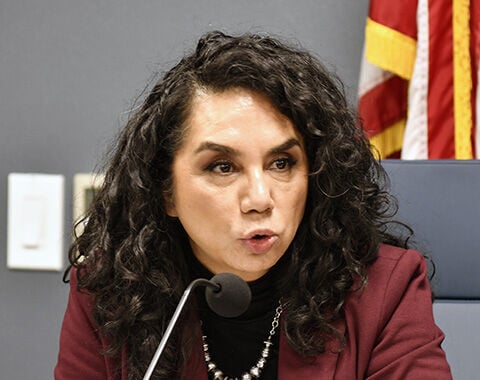
Rep. Teresa Martinez
Arizona opted into the program in 2007. And the Department of Economic Security, which administers the federally funded food stamp program, says that the most recent data shows about 25,200 households qualify for using their benefits at participating restaurants. That is about 7.2% of all households that are getting SNAP benefits.
Martinez, however, wants Arizona out of the program. And that's what her HB 2107 would make happen.
On one hand, Martinez said she understands what's behind it.

A sign in the window of a Jack in the Box in Laveen lets customers know it allows purchases by SNAP recipients who have an Electronic Benefit Transfer Card.
"What's a homeless man going to do with five pounds or two pounds of raw beef or raw chicken?'' she asked. But Martinez said there are other choices.
Consider, she said, it can cost $8 or more to buy a Big Mac, especially if you add on fries and a soda.
"For $8 at a grocery store, a homeless person, anybody, can buy a loaf of bread, a pack of baloney, and some cheese,'' Martinez said. "And that will last them a week.''
And if that's not an option, she said, someone with an EBT card can just as easily walk into a convenience store and buy a pre-made sandwich.
"I'm not trying to punish the homeless people,'' Martinez said.
Instead, Martinez said, she wants them and others to make smarter decisions, both from a financial and health standpoint, especially as they are buying their food with tax dollars.
Martinez said she's not preaching what she has not done herself.
"I was on stamps many, many years ago,'' she said.
"I wasn't on them for very long,'' Martinez continued. "And I went to the grocery store and made every dollar count.''
And her objections are not just about money.
"It's not nutritious,'' she said.
But some who advocate for affected groups say it's not that simple.
"We do say the policy makers should ensure that recipients of food benefits have access to healthy diets,'' said Dana Kennedy. She is the state director for AARP.
"That includes recipients who have limited or no capacity to buy, prepare or store food,'' Kennedy said. She also said if the concern is nutrition there are ways to "encourage healthy eating without unreasonably restricting food choice.''
Kennedy said that what is considered "fast food'' is defined by the restaurants that are allowed to accept food stamps. But she pointed out there are healthier options available.
"Most now offer a salad and yogurt,'' Kennedy said.
There's another consideration that could have a particular impact on the homeless: If they bought packages of baloney and cheese, the summer heat could make it impractical to keep it for any period of time.
Even if there is a legitimate reason to let the elderly, disabled and homeless use food stamps at fast food restaurants — a point she is not conceding — Martinez said she's not sure they are the only ones buying burgers and fries. She said she's convinced that some of the restaurants are not checking to ensure that those using food stamps fit within the eligibility criteria.
Her proof: the signs on participating restaurants saying "EBT accepted here.''
"It doesn't give the impression that it's only for certain types of EBT cards,'' she said. "I believe in my heart of hearts that the majority of SNAP payments that McDonald's and Jack in the Box are getting are from regular folks who use SNAP who have homes.''
That, however, appears to be precluded by requirements set out by USDA. They say that SNAP recipients who are eligible will have an electronic benefit transfer card that is coded to allow them to be accepted at participating restaurants — and that EBT cards without that coding automatically will be declined.
Still, Martinez said there's at least a public perception problem.
"I just think the taxpayer who funds the SNAP program gets frustrated when they see people using a SNAP card and they've got the latest iPhone, and they've got their hair done, they've got their nails done, and they're getting into a nicer car than the taxpayer,'' she said.
"And we've all seen that happen,'' Martinez said. "I'm sure it's very frustrating for people to say, 'Well, here's a family of five and they're using SNAP benefits and so I'm paying not only for my Big Mac, but I'm paying for their Big Mac, too?' ''
That requirement for fast-food restaurants to be set up with an electronic EBT terminal — one that can differentiate between those who are entitled to shop there and those who are not — also means that residents of some communities don't have as broad an option as others.
This is an opt-in system. And not every fast food restaurant chooses to participate.
For example, DES lists 80 sites in Mesa, with a variety ranging from Burger King and Del Taco to Firehouse Subs, Rally's Hamburgers and Subway.
Tucson has 58, including some of the regular fast-food places as well as Wienerschnitzel and Yin Yang Express.
But there are just three places that accept EBT cards in Green Valley, two in Chino Valley — and only a single Burger King on Naco Highway in Bisbee.
Martinez is not alone in her bid to restrict food stamp purchases.
Rep. Leo Biasiucci crafted a plan last year to ban the purchase of sodas and junk food.
The Lake Havasu City Republican had to strip out the second part of that after conceding that his definition was so broad that it put health and granola bars in the same category as candy bars.
He did get the Legislature to approve the ban on sodas, only to have it vetoed by Gov. Katie Hobb who said it deprives SNAP recipients of purchasing power "and relegates them to a new underclass of grocery shoppers.''
Instead, the governor, who said she, too, once was a food stamp recipient, said lawmakers should focus their attention not on legally limiting what people can buy but instead on "more productive efforts to expand opportunities for participants to purchase fresh foods.''
Biasiucci said he is trying to craft a new approach this year, one that would limit food stamp purchases to what now can be bought by pregnant women, new mothers and their offspring in the Women, Infants, and Children program. He called them "the essentials,'' including fruit, vegetables, milk, baby formula and food, and cereals.
All this comes as, effective Jan. 1, Indiana, Iowa, Nebraska, Utah and West Virginia imposed their own restrictions after on what can be bought with SNAP benefits after being granted permission by USDA, mostly banning soda purchases. And 13 other states will impose their own limits later this year.

