

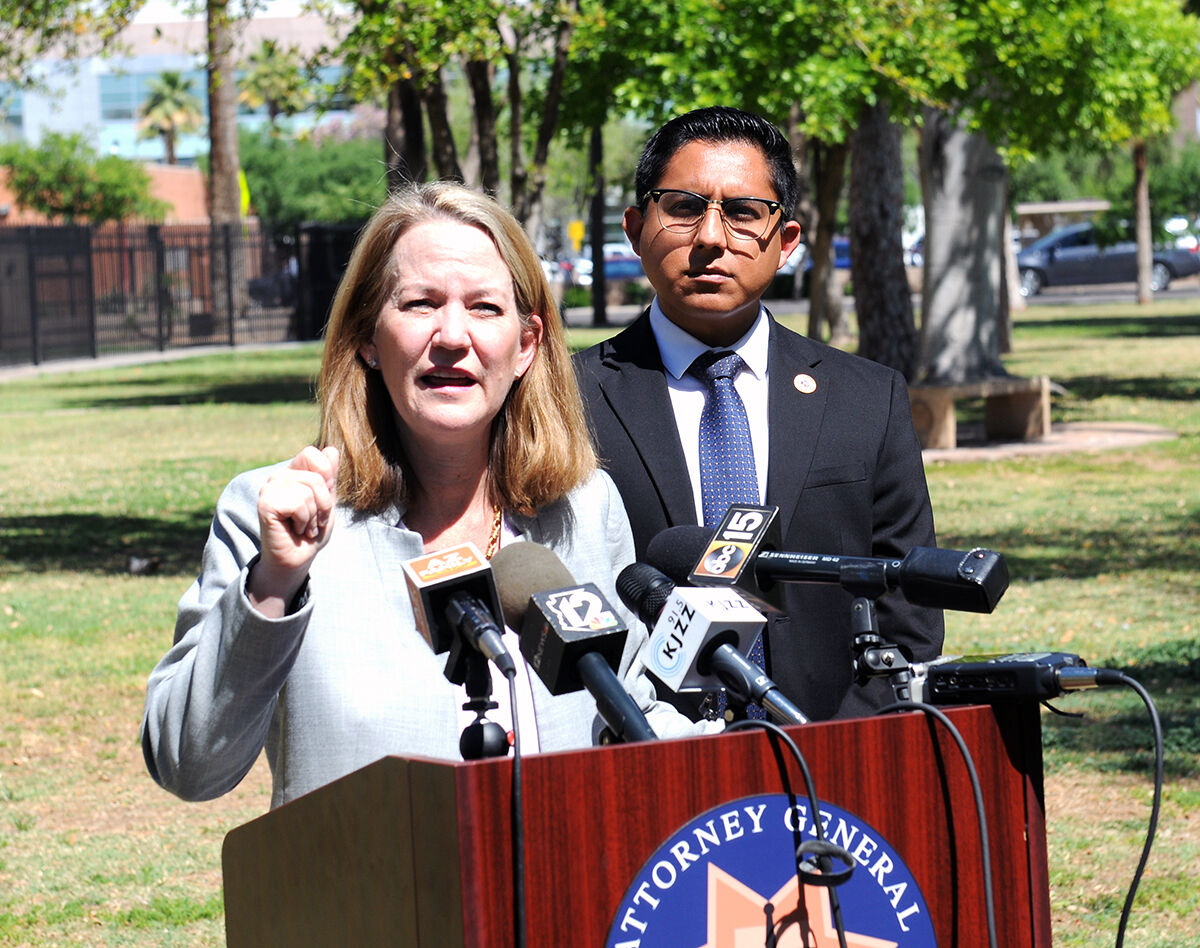
PHOENIX — Attorney General Kris Mayes plans to use “nuisance’’ laws to go after farmers using other state laws to legally pump unlimited quantities of groundwater.
At a news conference Thursday at the Capitol, the Democratic attorney general lashed out at House Republicans for launching a probe into how she is running her office. One specific item GOP lawmakers want to investigate is her public announcement that she is investigating water usage in rural Arizona with an eye on taking some farmers to court.
Mayes defends her action.
“I have been traveling to rural counties that lack any groundwater protection to directly hear from residents whose wells have gone dry or will in the near future thanks to mega-farms and Wall Street hedge funds who knew they could take advantage of our state,’’ she said.
Rep. Jackie Parker, R-Mesa, who chairs a panel formed to investigate Mayes’ actions, said there’s a legal problem with the attorney general’s plan. It starts, she said, with a state law that says agricultural operations are presumed not to constitute a nuisance “unless the agricultural operation has a substantial adverse effect on the public health and safety.’’
Also, she pointed out that the Legislature, not the attorney general, sets policies on who can withdraw groundwater and how much. Pumping is regulated in certain urban areas but not elsewhere.
That leaves the question of what authority Mayes claims to have to use nuisance laws to go after farmers, whether corporate or individual, over their pumping. Mayes said that is still under review.
“My office is very seriously investigating the very real possibility that these huge mega-farms, including the Saudi farm owned by Fondomonte in La Paz County and the Riverview Dairy in Cochise County, do violate our nuisance laws,’’ Mayes said. Illegal “nuisances” are any activities that improperly injure, inconvenience, annoy or cause damages to others, those laws say.
Mayes is sending “dozens of investigators’’ to La Paz and Cochise counties to look at issues including wells drying up, the cracking of foundations in homes, and fissures that are threatening houses, she said.
“And I have hired a hydro geologist to provide expert testimony in a potential lawsuit,’’ she said.
She also said it doesn’t matter if other laws have permitted those who own or lease land in rural areas to pump as much water as they want. That does not preclude her from going to court to claim that pumping violates nuisance laws, she said.
She cited her office’s decision to use nuisance laws to go after a company’s plans to start mining rock and gravel on a 25-acre site it owned in a neighborhood in a rural area near Chino Valley. The site was within 100 feet of homes.
State Mine Inspector Paul Marsh said he had no choice under existing laws but to approve the mining plan. Mayes then got an injunction.
But there never was a ruling on whether the mine was a nuisance — or even whether the nuisance law applies: The company’s plan was dropped after someone else bought the property.
As for using the law to go after farmers, “We’ll see in a court of law whether or not I’m right,’’ Mayes said.
She said she is driven to pursue the theory she does have that authority because residents of the affected areas “are desperate for help.’’ They’ve been “ignored by these Republicans,’’ Mayes said, gesturing to the state House.
There have been some efforts to deal with groundwater in rural areas.
The state canceled leases of its land with Fondomonte, which had been pumping water — no one knows how much because there is no monitoring — to grow alfalfa to feed dairy cattle in the Middle East.
But Fondomonte continues to farm on other private lands. And Minnesota-based Riverview Dairy bought more than 50,000 acres near Willcox.
Various legislative proposals to limit pumping — or to require the measuring of water withdrawn — have so far failed to advance amid opposition from farming interests.
On the other side are supervisors from several rural counties who openly worry that, absent some intervention, they will lack the water to serve residents, much less continue to grow.
“Wells are going dry,’’ said La Paz County Supervisor Holly Irwin, who has pushed for legislative action.
“It’s not about taking water from anybody,’’ she said. “It’s trying to protect what we have in the aquifers.’’
There are some proposals to allow the formation of special districts to monitor and regulate pumping. But that idea has been hung up over who gets to decide whether to form a district and who makes decisions.
That, said Mayes, leaves nuisance lawsuits as one option — at least for the time being. Rep. Austin Smith, R-Wittman, vice chair of the special House panel, is trying to eliminate that.
He is the sponsor of HB 2124 to amend state agriculture laws to require a court to award legal fees in any nuisance lawsuit designed to “take or reduce the water used by the other party.’’ And if that’s not enough, the measure would strip the attorney general of the ability to file nuisance actions of any type at all.
The bill needs final House approval before going to Democratic Gov. Katie Hobbs, where it faces an uncertain future.
Hobbs doesn’t comment on proposed legislation, said gubernatorial press aide Christian Slater. But he noted that she vetoed several other measures earlier this week, saying she wants water policy “addressed in a holistic manner that provides real solutions for the challenges we face throughout the state.’’
The Republicans on the special panel — Democrats refused to participate in what Minority Leader Oscar De Los Santos called a “sham committee’’ — also are unhappy that Mayes has an ultimate fallback plan to deal with unregulated groundwater pumping: taking the issue directly to voters.
“I’m hoping we don’t get to the point where we have to do a ballot initiative,’’ Mayes said.
Going to voters would not be necessary, she said, if she is successful in using the nuisance law to curb pumping, “or these people (state lawmakers) get their act together and protect our groundwater supplies against unreasonable pumping by the Saudis and a Minnesota dairy and a whole bunch of other folks.’’
Her comments about a ballot measure also drew the ire of Parker and Smith, who co chairs what’s been dubbed the ad doc committee on executive oversight.
“Publicly advocating for a ballot measures raises questions about your ability to impartially perform any duties required for any future ballot measure relating to groundwater issues,’’ they wrote to Mayes.
In their role in heading the committee, they’ve gone a step farther.
In their letter to Mayes, they demanded transcripts or recordings of all her town hall meetings where groundwater or public nuisance issues were discussed. They also want emails — and not just to the AG’s Office internet domain — mentioning any of a number of terms including groundwater, farm, pumping, nuisance, agriculture, dairy, wells or listening sessions.
They want expense records of employees involved in nuisance or town hall issues, as well.
Richie Taylor, Mayes’ press aide, said the office will comply with public records laws. He said any advocacy by Mayes on any ballot measure would be done on her own time and with her own money.
In investigating the AG’s actions, Parker and Smith said the issue goes beyond what authority she claims to have. They say there’s a financial component.
“Farming is a vital part of our state’s economy,’’ they said, citing 2019 figures from the University of Arizona that about 95% of these are “family farms.’’
The same report said more than 40% of the farms are smaller than 50 acres, with 15% being 500 or more acres.
The House panel investigating Mayes is looking into more than just her actions related to groundwater.
House Speaker Ben Toma said he wants lawmakers to investigate other actions she has taken including indicting two Cochise County supervisors over their initial refusal to certify the results of the 2022 election. Republicans are also unhappy Mayes has refused to defend a state law prohibiting “biological boys” from participating in girls’ sports, and another that contends the overturning of Roe v. Wade means Arizona can enforce a territorial-era law outlawing abortion except to save the life of the mother.
Mayes also is investigating whether to bring charges against 11 Republicans who signed a document after the 2020 election declaring that Donald Trump had won the presidential vote in Arizona — he did not — and that they were the official Arizona electors.
Parker took a swat at the absence of Democrats from the committee’s first hearing.
“Clearly they think their elected officials are above the law,’’ she said.
Get your morning recap of today's local news and read the full stories here: tucne.ws/morning

