

PHOENIX — The state Court of Appeals has refused to reinstate the indictment against 11 fake electors and others who Attorney General Kris Mayes contends were part of a scheme to overturn the 2020 presidential race.
In a brief order Monday, Presiding Judge Kent Cattani said he and two of his colleagues considered the request by Mayes to overturn a trial court ruling that grand jurors were not given all the information they needed before they handed up the indictments. But he said the trio decided not to step in.
The decision leaves Mayes with a handful of options.
She could start all over again with a new grand and present her case that there is sufficient evidence to charge all of them with fraud, conspiracy and forgery in connection with signing and submitting documents to federal officials and Congress that Donald Trump had won the popular vote in Arizona and was entitled to the state’s 11 electoral votes. The official tally, however, shows that Joe Biden won the state by 10,457 votes.
There’s also the option of bypassing a grand jury with a “direct information,’’ asking a judge to determine if there’s sufficient evidence to move forward.
But Dennis Wilenchik, who represents James Lamon, who signed the certificate, said he doubts Mayes would pursue that.
“We would get to cross-examine witnesses and destroy her case from the onset,’’ he said.
Mayes could appeal to the Supreme Court.
Or she could drop the case. That’s the argument being made to her by Gina Swoboda who chairs the state GOP who said the Democratic attorney general should “stop wasting time and taxpayer resources on partisan lawfare, noting the charges go back to what the defendants are accused of doing in 2020.
“Five years later, Kris Mayes is still fixated on 2020 while violent crime, fentanyl trafficking and border chaos threaten our communities every single day,’’ Swoboda said in a prepared statement. “This obsession is not justice — it’s politics.’’
That, however, does not appear to be an option for Mayes.
“This case has never been about anything other than preserving democracy and upholding the rule of law,’’ said Richie Taylor, the AG’s press aide. “Pretending it’s politically motivated is just a convenient way for the GOP chair to distract from the facts of the case.’’
But Swoboda pointed out that similar cases filed in other states have faltered.
Earlier this month a judge in Michigan said prosecutors there had failed to show that the 16 people who signed paperwork in 2020 declaring that Trump had won the electoral votes intended to commit fraud. And without that intent, the judge said, the case brought by Michigan Attorney General Dana Nessel falls apart.
That question of intent is critical here in Arizona — and what was behind the decision in May by Maricopa County Superior Court Judge Sam Myers to send the case back to the grand jury. He said grand jurors were not given access to the Electoral Count Act of 1887 and did not have that federal law explained to them before they found probable cause to indict those here.
What makes that significant is that federal law specifically addresses the possibility of competing presidential electors from a state and how Congress must handle them.
And that goes to the heart of the defense, both here and in Michigan: the claim by defendants that they were not trying to commit fraud but that they were preparing an “alternate slate’’ of electors to send to Washington if it turned out that Trump actually outpolled Joe Biden. And there was, at the time, pending litigation over the election results.
It is impossible to know at this point whether providing that information to the grand jurors would have made any difference in their decision to indict the electors and others involved in the plan.
But Myers said the jurors were entitled to that information. And since they did not get it, the indictment is flawed.
In seeking to overturn Myers’ decision — and resurrect the indictment — prosecutors argued the state has no duty to instruct grand jurors on laws that are not part of the elements of the offense or might provide them legal justification for their acts.
They also said the failure to read the 1887 law to grand jurors in any way legally prejudiced the defendants. And anyway, they said the state provides the grand jury “the substance of text of the relevant portions’’ of that law.
Myers, however, wasn’t buying it.
The judge acknowledged that law was discussed during the presentation of the case to the grand jury, and the jury did ask a witness for the state about the requirements of the law.
But where the prosecutors erred, he said, was failing to give the grand jurors the actual texts of the law before they returned indictment charges all with conspiracy, forgery, and conducting fraudulent schemes and practices in connection with the 2020 election.
“A prosecutor has a duty to instruct the grand jury on all the law applicable to the facts of the case,’’ Myers wrote. And he said that includes instructing the jurors on “justification defenses’’ that, based on the evidence provided, are relevant to the jurors determining whether there is probable cause to believe they have committed a crime.
“Due process compels the prosecutor to make a fair and impartial presentation to the grand jury,’’ Myers said. And he said that is true even if the jurors do not make any specific request for additional legal instruction.
It is that order that the Court of Appeals refused on Monday to set aside.
The indictment charges 18 people with being part of a scheme to “prevent the lawful transfer of the presidency of the United States, keeping President Donald J. Trump in office against the will of Arizona voters, and depriving Arizona voters of their right to vote and have their votes counted.’’
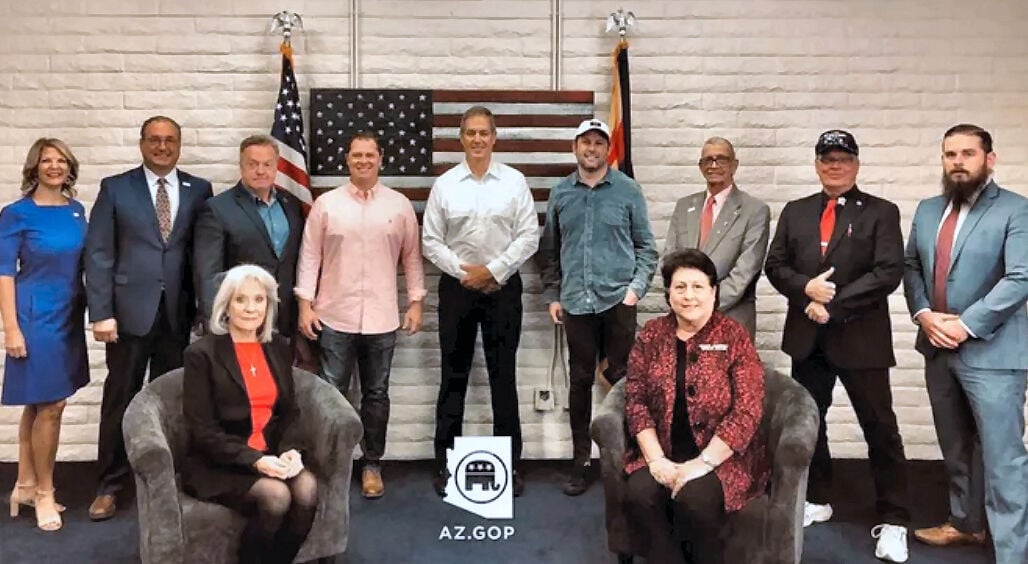
The most visible part of that plot, at least in Arizona, was 11 Republicans signing a document claiming that Trump had won the popular vote here and that they represented the state’s 11 electoral votes to be cast for him. That list includes two then-current state senators — Jake Hoffman of Queen Creek, who is still in the Legislature and Anthony Kern of Glendale who is not but is now seeking reelection — as well as Kelli Ward who at the time was the chair of the Arizona Republican Party, and her husband Michael.
The defendants have said they did nothing wrong and simply prepared the documents in case litigation would show that Trump actually won. But the indictment says the actions here — and similar ones in other states — were part of a larger plan to deny Biden the necessary 270 electoral votes he needed, throwing the decision on the race to Congress.
Charges also were brought in Arizona against others in the Trump orbit, including former White House chief of staff Mark Meadows and several of Trump’s attorneys, including John Eastman, Christian Bobb and Rudy Giuliani. Another Trump attorney, Jenna Ellis, is having the charges against her dismissed after she agreed to cooperate with prosecutors.
Trump himself was listed as an unindicted co-conspirator.
Tyler Bowyer an executive at Turning Point USA who was one of the 11 who signed the document, praised Monday’s ruling.
“Another huge loss for the radical AG who has wasted millions of AZ taxpayer dollars,’’ he posted on social media.
And Kern, in his own post on X, said that Mayes was keeping the case alive only “to appears your insane Democrat base for votes.’’
Even if Mayes manages to reinstate the charges, there are other legal hurdles to obtaining convictions.
For example, attorney Michael Bailey, in his own legal proceedings, said that the signing of the certificate by those declaring themselves the “duly elected electors’’ of the state, was immaterial.
“It could have no legal effect without a second document, the certificate of ascertainment from a competent state authority,’’ wrote Bailey. He represents Boris Epshteyn who was an outside counsel to Trump’s 2020 campaign. And Bailey said the electors had no influence on getting that certificate.
“Thus, respondents could not have been found guilty of fraud under any circumstances,’’ he wrote.

