


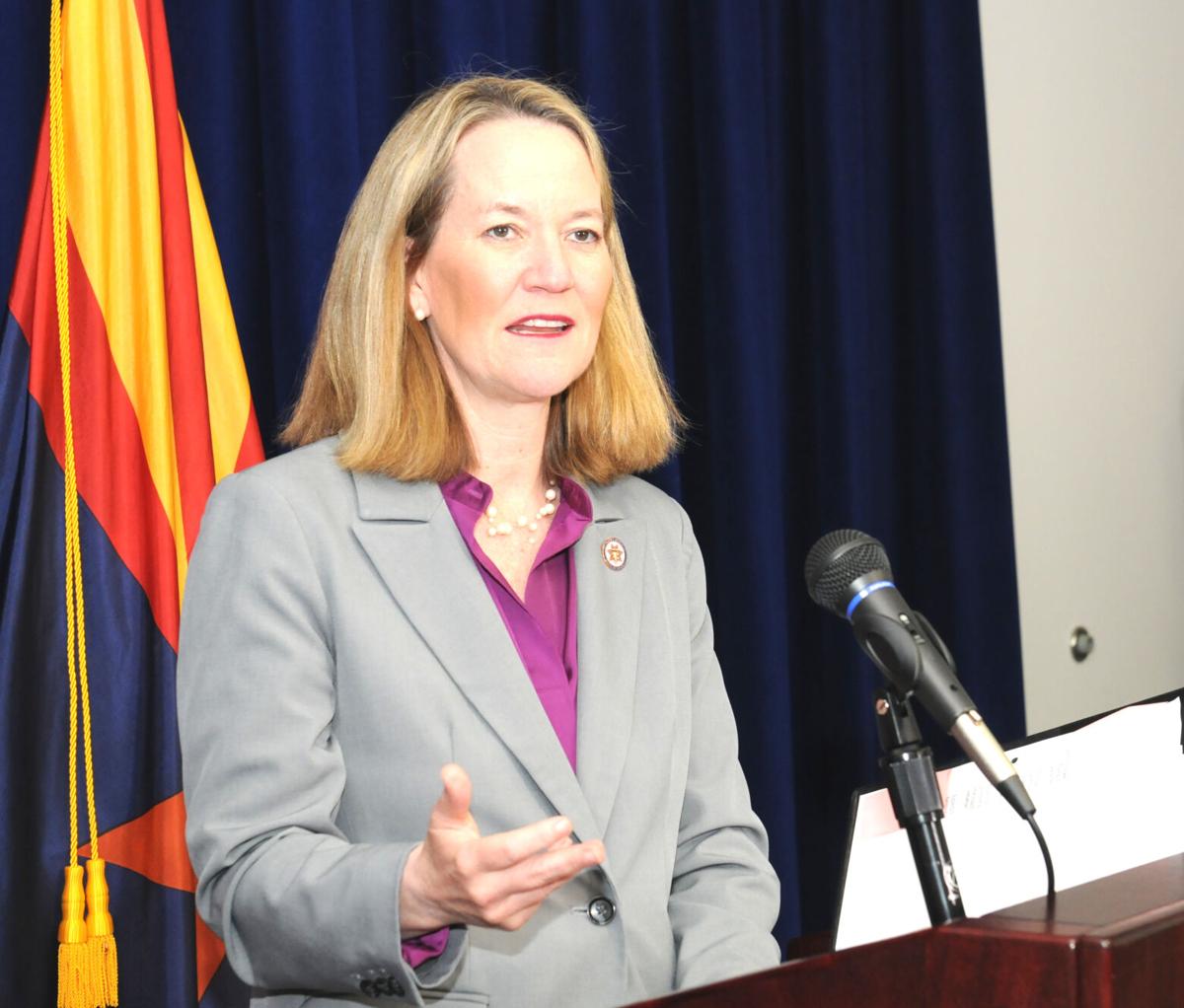
PHOENIX — Arizona's attorney general is asking the U.S. Court of International Trade to strike down as illegal the host of international tariffs imposed by President Donald Trump.
In new filings Wednesday, Democratic Attorney General Kris Mayes, along with counterparts in 11 other states, acknowledges there are situations in which a president can impose tariffs on an emergency basis. But she said these are for limited reasons and must, by law, be of limited duration.
By contrast, Mayes said, the president has simply declared that the trade imbalance with other countries — the fact that we buy more from them than we sell to them — justifies imposing tariffs that start at 10% and go up from there.
"These edicts reflect a national trade policy that now hinges on the president's whims rather than the sound exercise of his lawful authority,'' the lawsuit says. "By claiming the authority to impose immense and ever-changing tariffs on whatever goods entering the United States he chooses, for whatever reason he finds convenient to declare an emergency, the president has upended the constitutional order and brought chaos to the American economy.''
The lawsuit also challenges the reason Trump gave for specific tariffs on products from Mexico, Canada and China: that those countries were involved in smuggling of drugs and migrants into the United States. The court filing says there is no rationale between those claims and simply tacking what amounts to a surcharge to U.S. customers on the price of items from those countries.
"This is a necessary response to an administration that continues to operate far outside the bounds of the law and the Constitution,'' Mayes said at a news conference announcing her 13th lawsuit against Trump. "We are facing an unprecedented and lawless presidency, one that has made a habit over the last three months of disregarding the separation of powers and ignoring the two other co-equal branches of government.''
Mayes, who is co-leading the lawsuit with Dan Rayfield, attorney general of Oregon, said this is more than an argument over presidential powers.
"The tariffs will depress Americans' wages by slowing economic growth, increasing unemployment, and raising inflation,'' the lawsuit says, and "will make the goods that Americans (and the plaintiff states) depend on more expensive and scarce.''
Mayes said the Arizona Department of Transportation, for instance, has contracts to buy many pieces of equipment, parts and supplies, many of which are imported from other countries.
"The tariffs are already increasing costs for ADOT,'' the lawsuit states. That includes one contractor seeking a price increase citing the higher tariffs.
"So, our roads and highways are getting more expensive to build and maintain,'' Mayes said.
She also said state universities doing research are likely to be affected because of "specialized equipment not available from domestic sources.''
She specifically cited SHIELD USA, short for Substrate-based Heterogeneous Integration Leadership Demonstration. That is described as technology allowing for seamless assembly of multiple semiconductor chips. There is no commercial capacity for this technology existing now in the United States, her office says.
Mayes said the tariffs on this project alone potentially will increase costs by $1.4 million.
The effects will be much broader, according to the attorney generals, saying even studies done by the administration conclude 95% of the cost of the tariffs — essentially a tax on imports — will be paid by individuals and companies in the United States.
To put a finer point on that, Mayes invited Bill Sandweg, owner of Copper Star Coffee, to detail effects he's seen.
He said the main ingredient in what he sells simply can't be grown in most of the country. That means tariffs can't work to accomplish what the president says is his goal — to bring production back from other countries. Sandweg said he may be luckier than some, having locked in the price of his beans through November. But he said he remains financially exposed to tariffs.
"Our specialty equipment is not built in the United States,'' Sandweg said. The spices for his chai coffee come from India and other places now subject to 47% tariffs. And as for cups and other paper products, "All of Kirkland paper towels and toilet paper, they manufacture all that in Canada,'' he said.
Cost issues aside, the lawsuit asks the court to declare there's no legal basis for Trump's actions on tariffs.
"The Constitution assigns to Congress, not the president, the power to lay and collect taxes, duties imports and excises,'' it says.
Mayes and her colleagues say Congress did give the president the power to negotiate with other countries — but specifically to reduce our own tariffs in exchange for similar actions by other countries. There also is authority to act when another country acts in a manner that injures domestic industry.
Or, the president can act when other countries "dump'' their products on the U.S. at artificially low prices. But even then, that is limited to 150 days.
None of these bars have been met, the challenging states are telling the court.
That leaves the president's claim he can take action under the International Emergency Economic Powers Act. That's also not what the law allows, the challenging states say.
According to Mayes and her counterparts, that 1977 law allows the president to regulate imports and exports in certain non-wartime emergencies — but only under "an unusual and extraordinary threat," which they say doesn't exist now.
The tariffs are based largely on the trade deficit between the United States and other countries. Even Trump's Worldwide Tariff Order issued on April 2 — what he dubbed "Liberation Day'' — acknowledges that the deficits are "persistent.''
"Thus, by definition, they are not 'unusual or extraordinary,' '' the lawsuit states. "The United States has run a persistent trade deficit in goods since the 1970s.''
The litigation also says there is no evidence, as claimed by Trump, that the economic policies of other countries "suppress domestic wages and consumption.''
The challengers also cite the arbitrary nature of the tariffs, which start at 10%.
"The Worldwide Tariff Orders even impose tariffs on places that are not involved in international trade,'' the lawsuit says. Those range from the military base on the Indian Ocean island of Diego Garcia, to the Heard and McDonald Islands — about 2,500 miles southwest of Australia — which are home to only penguins and no humans.
"The administration's chosen formula," the lawsuit adds, "is not an accepted methodology for calculating trade barriers and has no basis in economic theory.''
Along with Arizona and Oregon, the other states suing are Colorado, Connecticut, Delaware, Illinois, Maine, Minnesota, Nevada, New Mexico, New York and Vermont.

