

PHOENIX — Two education groups are asking voters to do what the Republican-controlled Legislature has been so far unwilling to do: put some restraints on vouchers.
The initiative being proposed by the Arizona Education Association and Save Our Schools Arizona would put into law that families making more than $150,000 a year — adjusted annually for inflation — are ineligible for what are formally known as Empowerment Scholarship Accounts. These are taxpayer-funded vouchers parents can use to send their children to private or parochial schools, or to homeschool them and hire tutors.
That part of the plan is similar to what Gov. Katie Hobbs proposed last year in an effort to curb the cost of the program, which is approaching $1 billion a year. Her proposal didn't even get a hearing.
But there is more in what proponents have dubbed the Protect Education, Accountability Now Act.
Much of what is in the measure would require private schools that get money for tuition from vouchers to meet some of the same standards that apply to traditional public schools. That includes background checks for educators, a requirement to investigate allegations of misconduct by staff and a mandate that students at these schools take assessment tests similar to what are required at public schools.
And then there is a specific provision barring parents — mostly those who homeschool and can use vouchers for educational materials — from spending their cash on "non-educational items or luxury goods.''
There already are some constraints in existing law that are designed to prohibit using voucher dollars for products and services that are not primarily education. And there even is a specific bar to the purchase of entertainment and other primarily noneducational items like televisions, video game consoles, and home theater and audio equipment.

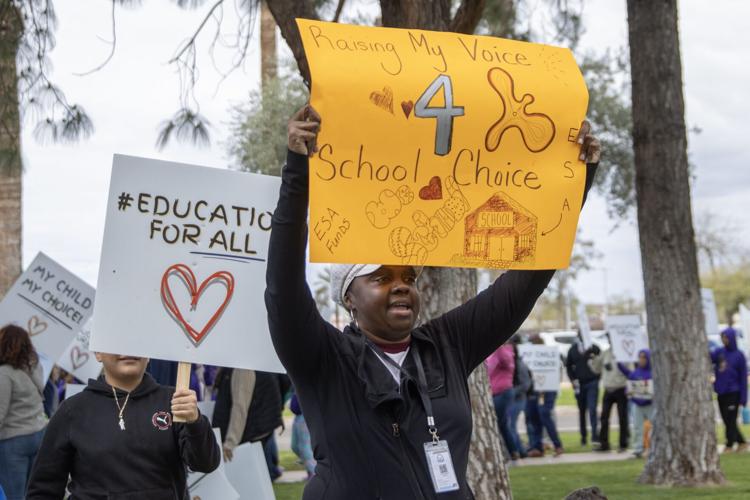
A rally in 2023 by supporters of Arizona's Empowerment Scholarship Account program was held at the State Capitol. A new initiative effort would put restraints on the program.
But investigative reporting by Craig Harris at KPNX, the Phoenix NBC affiliate, showed that it has not stopped parents from using their voucher funds to purchase diamond rings and necklaces, appliances, lingerie, trips to theme parks and recreational equipment.
Part of the issue is that state schools chief Tom Horne, citing limited staff, has set up a risk-based auditing system, automatically approving expenses up to $2,000 and then seeking to claw back the money if there has been misuse.
The initiative, however, makes clear, up front, what isn't allowed with a very specific list including appliances, home improvements, admission to water or amusement parks, water slides, hot tubs, international travel, restaurant dining, and any type of motor-operated vehicle or watercraft.
It would also divide $2 million among the Department of Education, the state Board of Education, the Department of Public Safety, and the Attorney General's Office to enforce the provisions of the measure.
Backers need 255,949 valid signatures by July 2 to put the initiative on the November ballot.
The proposal drew a sharp response from House Speaker Steve Montenegro.
"The effort is not about accountability or improvement,'' said the Goodyear Republican.
"It is a direct attack on parents — working families, military families, rural families, and families of children with special needs — who finally have options and refuse to give them up,'' he said in a prepared statement. "ESA opponents are willing to sacrifice students' futures to protect an education bureaucracy that puts its own power ahead of kids.''
But Beth Lewis, executive director of Save Our Schools, said that misses the point. She said nothing in the initiative eliminates vouchers.

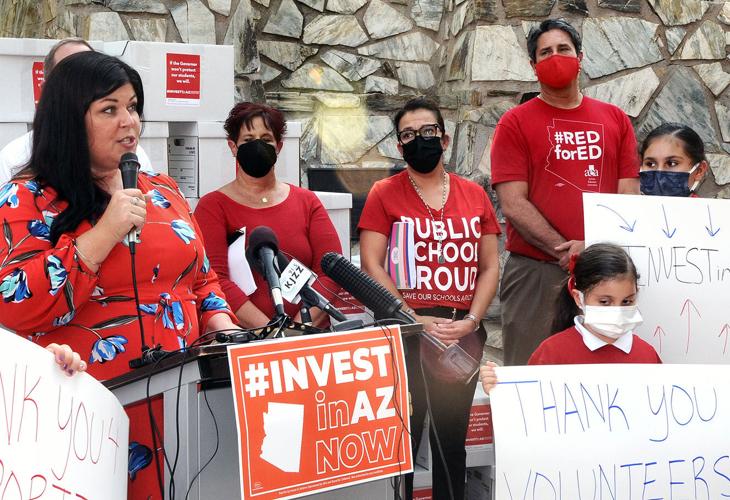
Beth Lewis, executive director of Save Our Schools Arizona, shown here at a 2021 rally, is helping lead a new effort to put restraints on the state's school voucher program.
These were first approved in 2011, providing state funds to parents whose children have special needs that could not be met in public schools.
Over the years, it has been expanded, taking in foster children, children living on reservations, children of active-duty military, and students attending public schools rated D or F.
But the big change came in 2022 when then-Gov. Doug Ducey signed legislation creating "universal vouchers,'' allowing any student — including those whose parents already were paying to send them to private schools — to get a voucher.
Enrollment ballooned from about 12,000 to around 100,000 now, with the typical voucher worth $7,400.
Lewis said the initiative would not eliminate vouchers — even the universal ones — though there would be those income caps for parents. And she said there are special exemptions from some of the provisions for children with disabilities, the students for whom the original program was designed.
Montenegro, however, said if the initiative were to become law, it would "force tens of thousands of students out of schools that work for them and back into district systems that have already failed too many families.''

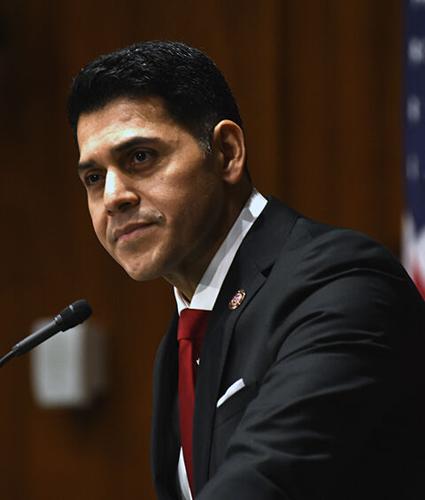
Montenegro
"House Republicans built the strongest school choice program in the nation because parents, not government or union bosses, know what their children need,'' he said.
Lewis, however, said there would be no need to take the case directly to voters if lawmakers had made some changes on their own.
"We've got a $1 billion voucher program that has next to zero guardrails for transparency, accountability or safety,'' she said. These issues should have been addressed when the universal voucher program was approved in 2022, Lewis said.
"Arizona lawmakers have refused now for three sessions in a row — we're in the fourth — with this program with universal, and they have just stubbornly refused to make any headway,'' she said, leading to cases of fraud and abuse as well as children who are not safe. "This is the time to make sure that these things are getting corrected.''
One key issue is the question of exactly how much there should be state oversight and standards, particularly when it comes to academics and whether students in private schools, funded by state vouchers, are getting the education they need.
Proponents have argued that parents are in the best position to choose the best educational options for their children and don't need things like test results. But Lewis said there needs to be ways to determine achievement.
"With the universal expansion, we've seen tons of schools pop up in strip malls,'' she said. "They're there overnight, they've got a vinyl banner, they hand the kid a Chromebook.''
Lewis said that might work for some kids.
"But parents need to make sure that these choices are actually worth their salt and that somebody isn't selling them a song, because a kid only gets one chance at fourth grade,'' she said.
Anyway, Lewis said, the initiative is structured so the requirement for accountability can be done either by testing students or the school being accredited by a regional or national organization.
Geneva Fuentes, communications director of the Arizona Education, said she had no figures to share on how much it would take to not just get the signatures but to wage what could be an expensive campaign to convince voters to support it.
"But we also know what it takes to win, and we're going to be doing that,'' she said.
Fuentes declined to say how much of the funding might come from the National Education Association.
But that group put $7.75 million into a 2020 campaign to raise taxes on the state's wealthiest residents to help fund K-12 education. The measure that would have raised $880 million did pass, only to be declared illegal by a judge.

