

GAZIANTEP, Turkey — With hope of finding survivors fading, stretched rescue teams in Turkey and Syria searched Wednesday for signs of life in the rubble of thousands of buildings toppled by the world's deadliest earthquake in more than a decade.
The confirmed death toll approached 12,000.
Turkish President Recep Tayyip Erdogan visited the especially hard-hit Hatay province, where more than 3,300 people died and entire neighborhoods were destroyed. Residents there have criticized the government's response, saying rescuers were slow to arrive.
Erdogan, who faces a tough battle for reelection in May, acknowledged "shortcomings" in the response to Monday's 7.8 magnitude quake but said the winter weather was a factor. The earthquake destroyed the runway in Hatay's airport, further disrupting the response.
"It is not possible to be prepared for such a disaster," Erdogan said. "We will not leave any of our citizens uncared for." He also hit back at critics, saying "dishonorable people" were spreading "lies and slander" about the government's response.

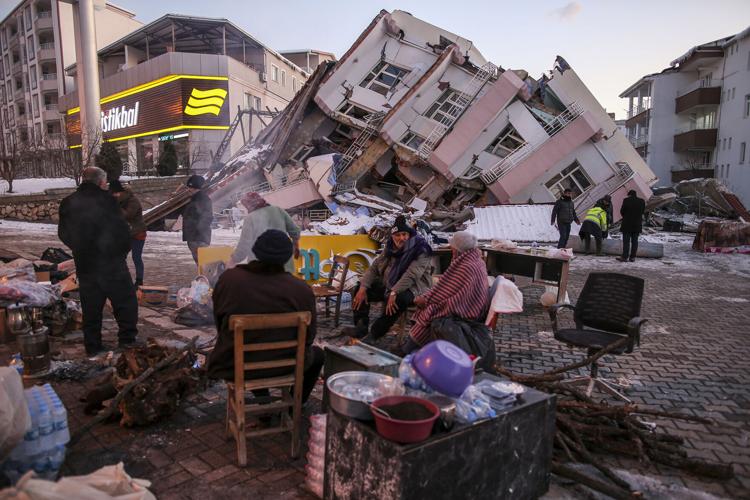
People stand by collapsed buildings Wednesday in Golbasi, in southern Turkey.
Turkish authorities said they are targeting disinformation, and an internet monitoring group said access to Twitter was restricted despite it being used by survivors to alert rescuers.
Search teams from more than two dozen countries have joined tens of thousands of local emergency personnel in Syria and Turkey. But the scale of destruction from the quake and its powerful aftershocks was so immense and spread over such a wide area — including a region isolated by Syria's ongoing civil war — that many people were still awaiting help.
Experts said the survival window for those trapped under the rubble or otherwise unable to obtain basic necessities was closing rapidly. At the same time, they said it was too soon to abandon hope.
"The first 72 hours are considered to be critical," said Steven Godby, a natural hazards expert at Nottingham Trent University in England. "The survival ratio on average within 24 hours is 74%, after 72 hours it is 22% and by the fifth day it is 6%."

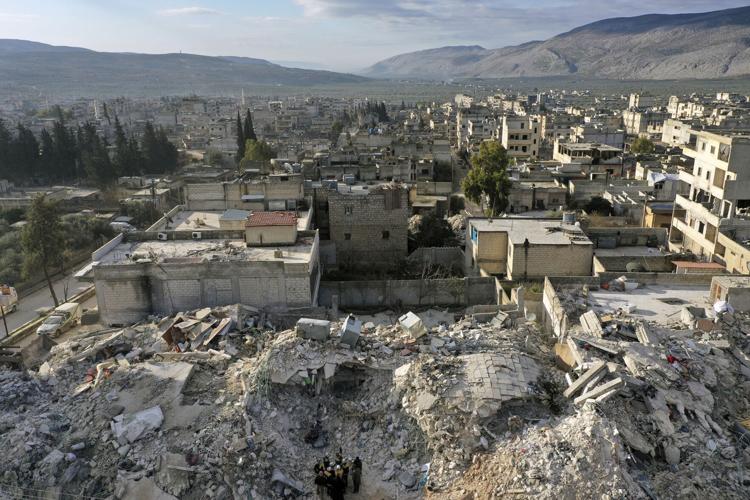
Rescuers search through the rubble of collapsed buildings Wednesday in the town of Armanaz, Idlib province, Syria.
Rescuers at times used excavators or picked gingerly through debris. With thousands of buildings toppled, it was not clear how many people might still be caught in the rubble.
In the Turkish city of Malatya, bodies were placed side by side on the ground and covered in blankets while rescuers waited for vehicles to pick them up, said former journalist Ozel Pikal.
Pikal, who took part in the rescue efforts, said he thinks at least some of the victims froze to death as temperatures dipped to 21 degrees Fahrenheit.
"As of today, there is no hope left in Malatya," Pikal said by telephone. "No one is coming out alive from the rubble."
Road closures and damage in the region made it hard to access all the areas that need help, he said, and there was a shortage of rescuers where he was.
"Our hands cannot pick up anything because of the cold," said Pikal. "Work machines are needed."

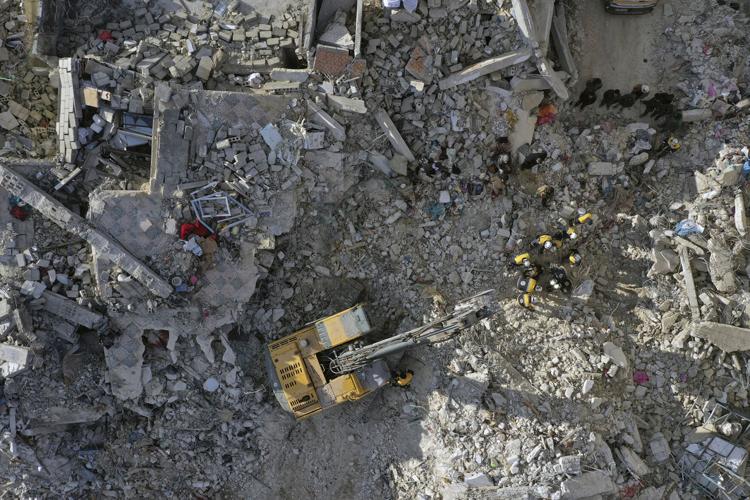
Rescuers search through the rubble of collapsed buildings Wednesday in the town of Armanaz, Idlib province, Syria.
The region was already beset by more than a decade of civil war in Syria. Millions have been displaced within Syria itself and millions more have sought refuge in Turkey.
Turkey's president said the country's death toll passed 9,000. The Syrian Health Ministry said the death toll in government-held areas climbed past 1,200. At least 1,600 people have died in the rebel-held northwest, according to the volunteer first responders known as the White Helmets.
That brought the overall total to almost 12,000. Tens of thousands more are injured.
David Alexander, a professor of emergency planning and management at University College London, said data from past earthquakes suggested the likelihood of survival was now slim, particularly for individuals who suffered serious injuries.
"Statistically, today is the day when we're going to stop finding people," he said. "That doesn't mean we should stop searching."

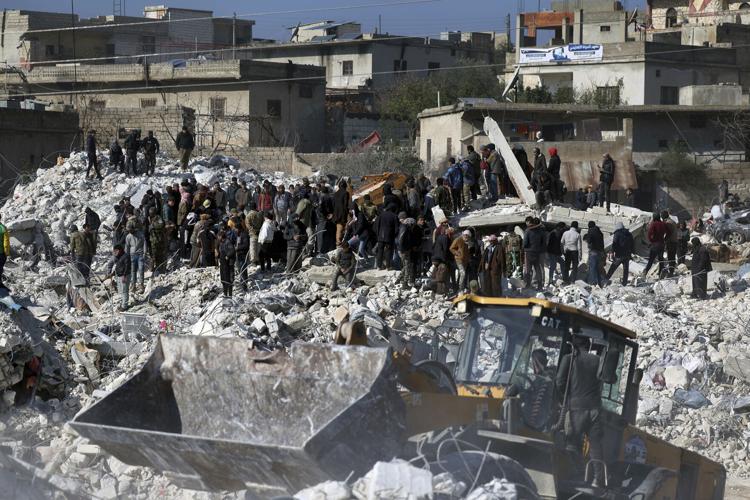
Rescuers and residents search through the rubble of collapsed buildings Wednesday in the town of Harem near the Turkish border, Idlib province, Syria.
Alexander cautioned that the final death toll may not be known for weeks because of the sheer amount of rubble.
The last time an earthquake killed so many people was 2015, when 8,800 died in a magnitude 7.8 quake in Nepal. A 2011 earthquake in Japan triggered a tsunami, killing almost 20,000 people.
In Syria, a baby born during Monday's earthquake miraculously survived after being pulled from the rubble. It was a moment of hope in the battered country where the ongoing civil war is making relief efforts difficult.
Many of those who survived the earthquake lost their homes and were forced to sleep in cars, government shelters or outdoors amid rain and snowfall in some areas.
"We don't have a tent, we don't have a heating stove, we don't have anything. Our children are in bad shape," Aysan Kurt, 27, said. "We did not die from hunger or the earthquake, but we will die freezing from the cold."
In Syria, aid efforts have been hampered by the ongoing war and the isolation of the rebel-held region along the border, which is surrounded by Russia-backed government forces. Syria itself is an international pariah under Western sanctions linked to the war.
Turkey sits on top of major fault lines and is frequently shaken by earthquakes. Some 18,000 were killed in similarly powerful earthquakes that hit northwest Turkey in 1999.
A look at the world's deadliest earthquakes in the past 25 years
Feb. 6, 2023 in Turkey and Syria: More than 20,000 killed
Updated
Feb. 6, 2023: A magnitude 7.8 earthquake shook Turkey and war-torn Syria, killing more than 20,000 people. The death toll is expected to rise.
June 22, 2022 in Afghanistan: 1,100 killed
Updated
June 22, 2022: In Afghanistan, more than 1,100 people die in magnitude 6.1 earthquake.
Aug. 14, 2021 in Haiti: 2,200 killed
Updated
Aug. 14, 2021: In Haiti, a magnitude 7.2 earthquake kills more than 2,200 people.
Sept. 28, 2018 in Indonesia: 4,300 killed
Updated
Sept. 28, 2018: A magnitude 7.5 earthquake hits Indonesia, triggering a tsunami and killing more than 4,300 people.
April 25, 2015 in Nepal: 8,800 killed
Updated
April 25, 2015: In Nepal, more than 8,800 people are killed by a magnitude 7.8 earthquake.
March 11, 2011 in Japan: 20,000 killed
Updated
March 11, 2011: A magnitude 9.0 quake off the northeast coast of Japan triggers a tsunami, killing nearly 20,000 people.
Jan. 12, 2010 in Haiti: 316,000 killed
Updated
Jan. 12, 2010: In Haiti, over 100,000 people are killed by a magnitude 7.0 quake. Government estimates put the number at a staggering 316,000 dead.
May 12, 2008 in China: 87,500 killed
Updated
May 12, 2008: A magnitude 7.9 quake strikes eastern Sichuan in China, resulting in over 87,500 deaths.
May 27, 2006 in Indonesia: 5,700 killed
Updated
May 27, 2006: More than 5,700 people die when a magnitude 6.3 quake hits the island of Java, Indonesia.
Oct. 8, 2005 in Pakistan: 80,000 killed
Updated
Oct. 8, 2005: A magnitude 7.6 earthquake kills over 80,000 people in Pakistan's Kashmir region.
March 28, 2005 in Indonesia: 1,300 killed
Updated
March 28, 2005: A magnitude 8.6 quake in northern Sumatra in Indonesia kills about 1,300 people.
Dec. 26, 2004 in Indonesia: 230,000 killed
Updated
Dec. 26, 2004: A magnitude 9.1 quake in Indonesia triggers an Indian Ocean tsunami, killing about 230,000 people in a dozen countries.
Dec. 26, 2003 in Iran: 20,000 killed
Updated
Dec. 26, 2003: A magnitude 6.6 earthquake hits southeastern Iran, resulting in more than 20,000 deaths.
May 21, 2003 in Algeria: 2,200 killed
Updated
May 21, 2003: More than 2,200 people are killed in a magnitude 6.8 earthquake in Algeria.
Jan. 26, 2001 in India: 20,000 killed
Updated
Jan. 26, 2001: A magnitude 7.6 quake strikes Gujarat in India, killing as many as 20,000 people.
Aug. 17, 1999 in Turkey: 18,000 killed
Updated
Aug. 17, 1999: A magnitude 7.6 earthquake hits Izmit, Turkey, killing about 18,000 people.
May 30, 1998 in Afghanistan: 4,000 killed
Updated
May 30, 1998: Over 4,000 people are killed after a 6.6 magnitude temblor hits Afghanistan's Badakhshan province.

