

KRAMATORSK, Ukraine — Huddled in the back of a café near the train station where a missile killed dozens of people a year ago, Nastya took slow, deliberate breaths to calm herself. Overnight, her neighborhood was bombed again, and she just couldn’t take any more.
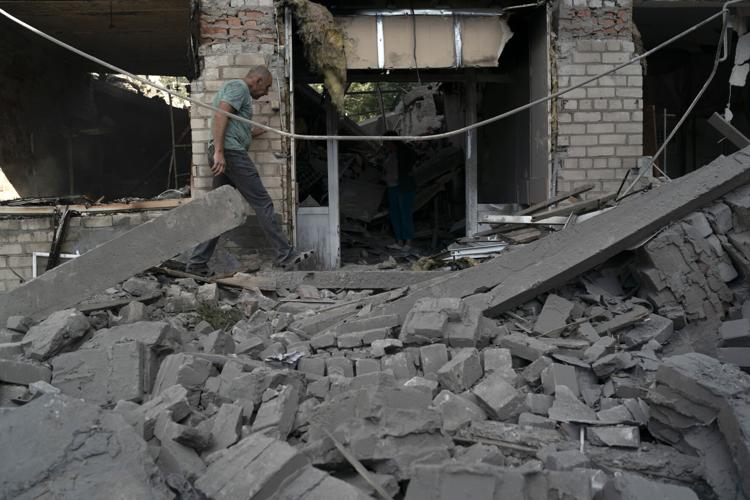
Heeding her parents’ advice, the 20-year-old woman had visited the nearby psychiatric hospital that morning — a place that also bore the scars of war after being repeatedly bombed, including by a missile that destroyed part of the building last September. But the staff swept up the shattered glass, shoveled away the debris and carried on working, determined to stay in Kramatorsk, in Ukraine’s eastern Donbas region, to help those in need.

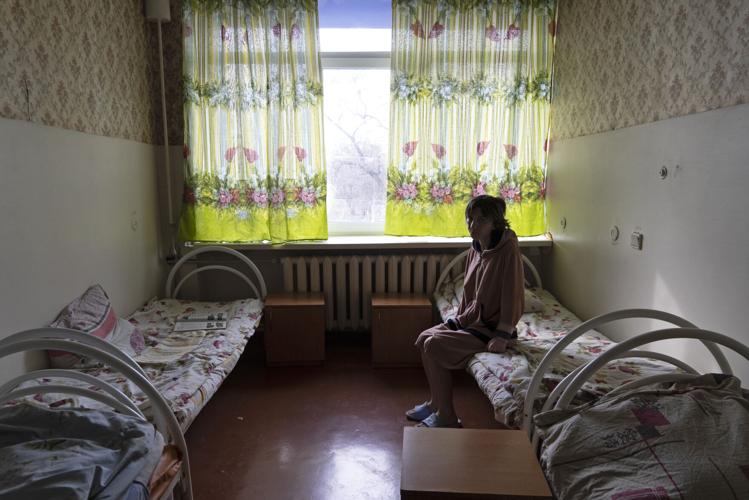
Natalia, 37, a patient, sits in her room at a psychiatric hospital March 21 in Kramatorsk, Ukraine.
For Nastya, it was a lifeline.
“After today’s shelling, I could no longer cope with anxiety, the feeling of constant danger,” the speech therapy student said, giving only her first name to talk last month about the difficult decision to seek mental health care. The stigma of Soviet-era psychiatry, when dissidents were incarcerated in psychiatric institutions as a form of punishment, still lingers.
“I just realized that my psychological health is much more important,” she said.

A man walks over debris in a psychiatric hospital that was heavily damaged after a Russian attack Sept. 7 in Kramatorsk, Ukraine.
There are hundreds of thousands like Nastya in Ukraine, experts say, and the number of people needing psychological help is only expected to rise as the war continues. In December, the World Health Organization said one in five people in countries that have experienced conflict in the past decade will suffer from a mental health condition, and estimated that about 9.6 million people in Ukraine could be affected.
Russia’s invasion in February 2022 resulted in millions of people being displaced, bereaved, forced into basements for months due to incessant shelling or enduring harrowing journeys from Russian-occupied regions.
For Nastya, as for so many, the war changed everything overnight. There is a before — a life of simple pleasures, of going for coffee and laughing with friends. And an after.
“You wake up with the feeling that you are just surrounded by horrors, anxieties, surrounded by constant air raid sirens, flying planes, helicopters,” she said. “You’re simply in a closed circle which is not filled with the happy times of before, but with great fear. Fear of the unknown, fear of dying here and now.”
Hundreds of miles to the west, 38-year-old Tatyana, a worker at the Zaporizhzhia nuclear power plant who spent four months living under Russian occupation in the town of Enerhodar, trembled as she recounted seeing bombs explode near the plant, and how her family endured a 24-hour ordeal to escape to Ukrainian-held territory.
When she visited a support center in Boyarka, south of Kyiv, several months ago to register for aid, she collapsed into uncontrollable tears. The staff called a psychologist.
Therapy has helped, said Tatyana, who also asked that her surname not be used to talk openly about seeking out mental health care. Her gaze was blank and unfocused during pauses as she spoke following a group therapy session last week. She’s trying to cope with the feelings of living in a war.

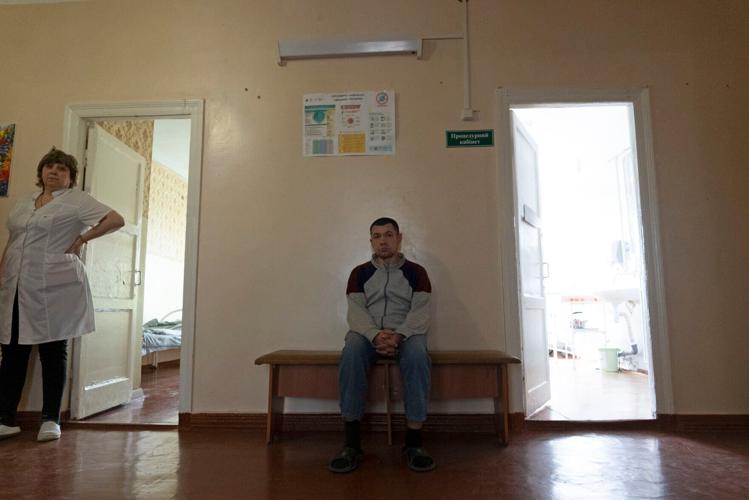
Oleksandr, a patient, sits in a corridor at a psychiatric hospital March 21 in Kramatorsk, Ukraine.
“This fear that comes when you realize that you may lose everything in a moment,” she said. Life is “like a light switch. It can be turned off and never turn on again.”
The need for mental health treatment has shot up across Ukraine, professionals say, even as they deal with the effects of war in their own lives.
“The demand is huge, and unfortunately it will only grow,” said psychotherapist Pavlo Horbenko, who has worked at a center in Kyiv treating people affected by war since 2014, when Russia annexed Crimea and set up two proxy breakaway states in Ukraine’s east.
He noted a significant increase in patients seeking treatment for sexual violence, bereavement and suicidal thoughts. “Previously, it was one or two requests a week, and now there can be 10 a day.”
Judging by other countries that have suffered conflict, psychological treatment needs increase rapidly after the fighting ends, Horbenko said.
For now, people are focused on surviving. “But when the war is over, .... then we can afford to relax. And when we can relax, the symptoms that have been accumulating for all this time will appear,” he said.
Like a soldier wounded in battle who doesn’t feel pain until he is out of immediate danger, “that’s when the wounds start to hurt. This is how it is with psychological traumas.”
Horbenko said there has been an increase in the number of mental health specialists in Ukraine since 2014, but far more are needed. “The demand still far exceeds the capacity,” he said.
Authorities have been seeking to increase mental health services across Ukraine.
Lebanese psychiatrist Dr. Maya Bizri recently visited Ukraine as part of a program run by the medical aid organization MedGlobal, at the request of the Ministry of Health, to assess needs and train doctors and nurses in recognizing mental health issues in both colleagues and patients.
“What is really being affected ... are the health care workers,” Bizri said. “There are a lot of trainings about how to deal with traumatized patients or with physical injuries, but no one addresses the health care of the health care professionals.”
Under the MedGlobal program, doctors and nurses are trained to help themselves and colleagues cope with psychological pressures, so they can in turn train others.
“There is an acute distress and an acute unmet need that is not being addressed, and if you want a health care system that is resilient, you have to take care of your own people,” Bizri said. “And I think the Ministry of Health is very aware of that because they are very engaged in doing this.”
Ukrainian dolphins and sea lions find refuge in Romania, and more of today's top videos
A port city in Romania has taken in a number of dolphins, sea lions and their trainers from Ukraine, LIV golfers are bringing criticism to the Masters tournament, and more of today's top videos.

This is the heartwarming story of the Constanta dolphinarium, in the Romanian port city of Constanta, that has taken in a number of dolphins, …

Golf’s prestigious Masters tournament kicked off today with 18 players from the controversial LIV golf series. But with the LIV players comes …

Tennessee's Republican-led state legislature on Thursday expelled two Democratic lawmakers who led gun control protests at the state capitol i…

A crowd cheered in support for two Democrats as they were expelled from the Tennessee House of Representatives. They took part in a gun contro…

Coronation day is just around the corner. And while the goal is to have a hiccup-free event, history has taught us that’s not always the case.…

Israel conducted rare airstrikes in Lebanon on Friday, a sharp escalation that has sparked fears of a broader conflict with the international …

If you’re looking to immortalize a pet you’ve owned and lost, but shy away from taxidermy, this toy making company in the Philippines has foun…

At the ZSL London zoo, animals and visitors alike partake in Egg-citing activities to celebrate Easter. Footage released by the zoo shows the …

Ukraine is equipping itself with European tanks and fighter jets as it prepares for a new offensive against Russian troops. But on the ground,…

