

Nude statue brouhaha; emu on I-10; toaster meth
- Updated
Odd and interesting stories from the Midwest.
- By LEWIS KENDALL Bozeman Daily Chronicle
- Updated
BOZEMAN, Mont. (AP) — A year after looters dug up a chunk of land previously occupied by a historic military fort, local educators are using the opportunity to learn more about Bozeman's past.
Last October, three men were caught digging on land a few miles east of downtown Bozeman, which, nearly 150 years earlier, was home to the area's military camp Fort Ellis. The square-mile parcel of land is currently owned by Montana State University's Agricultural Experiment Station, which occasionally uses it for grazing. The men, who claimed they had only dug up two vintage beer bottles, were not charged, reported the Bozeman Daily Chronicle (http://bit.ly/2embo6H).
But the sizeable hole — filled with historically significant artifacts from buttons and tools to animal bones — presented the university with a problem. Left exposed, the artifacts would quickly degrade, so a group of MSU instructors decided to use the chance to study the site.
On Oct. 15, Nancy Mahoney, an instructor in MSU's Department of Sociology and Anthropology, and Jack Fisher, a professor in the same department, as well as a group of students, spent the day surveying the site and excavating noteworthy relics.
"We looked at is as an opportunity to do something great, and that's what it's turned into," Mahoney said.
The hole was dug on one of the fort's trash sites, Mahoney said, and its contents are extremely useful in understanding more about the way the camp operated.
"We want to see what are they drinking? Was there a lot of medicine out here? Were there women out here?" she said. "A lot of things we can learn from the trash and supplement the historical record."
Fort Ellis, located east of the city off what is now Frontage Road, opened in 1867 after Gallatin Valley residents demanded protection from local Indian populations.
The fort community grew to include 250 buildings — containing a hospital, cemetery and 30,000-acre grazing and timberland reservation — helping provide economic support to the area after the closure of the Bozeman Trail. Fort Ellis closed in 1886.
After securing a permit from the state to excavate the 35-by-25 foot hole, Mahoney, Fisher and Crystal Alegria, who works for educational organization Project Archaeology and co-founded the Extreme History Project, spent several weeks clearing, weeding and imaging the area.
With the help of students, the group plans to analyze the various artifacts — which will find a new home at the Museum of the Rockies — and present their findings to the Montana Archaeological Society next year.
"When a site is important to the town, it's important for the community to know about it so it has more care and protection," Mahoney said. "This site is integral to understanding how Bozeman became a thriving town."
"It presents a good opportunity to bring to the public's attention to this historic site and its value to the region," added Fisher. "And it's a good opportunity for students to get some hands-on experience."
Once their work is done, the group plans to cover the hole and fill it back in with dirt to preserve the site for future study. The university is working with local law enforcement and promoting its Montana Site Stewardship Program to prevent similar looting incidents, Mahoney said.
"This is the kind of thing that can happen very quickly if we're not aware," she said. "This is an educational opportunity not only because of what it can tell us about the past, but also that this stuff can disappear if we don't protect it."
___
Information from: Bozeman Daily Chronicle, http://www.bozemandailychronicle.com
- Updated
MCMINNVILLE, Ore. (AP) — State health officials have issued a health alert about marijuana products that may have been tainted with high levels of a pesticide and sold to about 130 people southwest of Portland.
The Oregon Health Authority said Friday the alert concerns dried flower marijuana sold by a medical marijuana dispensary called New Leaf in McMinnville.
The strain names are Dr. Jack, batch number G6J0051-02, and Marion Berry, batch number G6J0051-01.
The products were sold to customers between Oct. 17 and Oct. 19 and came from batches that failed a pesticide test, containing high levels of a chemical known as spinosad.
Anyone finding the tainted product can return it to the dispensary or dispose of it.
Effects of smoking marijuana containing spinosad are not known. According to the National Pesticide Information Center at Oregon State University, spinosad is a natural substance made by a soil bacterium that can be toxic to insects.
Those concerned about exposure should contact the Oregon Poison Center at 800-222-1222.
- By JENNIFER SINCO KELLEHER Associated Press
- Updated
HONOLULU (AP) — A man convicted in a federal drug case involving six pounds of crystal methamphetamine mailed to Hawaii in a toaster was sentenced Friday to 18 years in prison.
A jury in April convicted Allen Gorion, 32, of meth dealing and conspiracy charges. He and his co-defendant were arrested last year after picking up the package, which was mailed to Kapolei from North Hollywood, California.
Authorities intercepted the package, replaced most of the drugs with pseudo-meth and delivered it, using a U.S. postal inspector posing as a mail carrier. The drugs were hidden in a Black & Decker four-slice toaster oven, according to court documents.
In a bid for a lighter sentence, Gorion testified at Friday's sentencing hearing that he thought he was helping someone move and didn't realize there were drugs in his car. He denied touching the bag, even though special powder authorities put on the fake drugs was on his hands.
"I don't find Mr. Gorion to be credible," U.S. District Judge J. Michael Seabright said.
Co-defendant Leland Akau previously pleaded guilty and was sentenced to 15 ½ years in prison.
Gorion said he takes responsibility for his actions. Assistant U.S. Attorney Tony Roberts disagreed, saying "he took us to trial, he was fighting the case."
Gorion testified that a man he knew to be involved with meth dealing bought him a plane ticket to California. When asked if the trip was for trafficking drugs, Gorion responded, "Might have been. ... I didn't know what was going on."
Defense attorney Cliff Hunt asked psychologist Marvin Acklin to describe Gorion's attention deficit hyperactivity disorder. Gorion has a well-documented history of "severe" ADHD, Acklin said.
Hunt said Gorion has strong community support, gesturing to the courtroom gallery full of about two dozen relatives and friends. Hunt asked the judge to sentence Gorion to the mandatory minimum of 10 years. Gorion, who has four daughters, was going through a divorce, was depressed and suicidal when he linked up with a drug dealer and started smoking meth with him, Hunt said.
Roberts, the prosecutor, noted Gorion's criminal history, which includes stealing a car and punching his spouse.
"I feel sorry for his daughters and family, also," Roberts said, but added that doesn't excuse Gorion's actions involving a drug that has had a "horrendous" community impact.
- By AMY BETH HANSON Associated Press
- Updated
HELENA, Mont. (AP) — A judge's decision not to order prison time for a Montana man who raped his 12-year-old daughter has sparked outrage from afar and calls closer to home to toughen the state's law, which allows such lenience in certain circumstances.
Enacted in a wave of similar legislation around the country after the killing of a 9-year-old Florida girl in 2005, the Montana statute requires a minimum sentence of 25 years in prison for anyone convicted of rape, incest or sexual abuse of a child 12 or younger.
But unlike many of those other laws, Montana's also allows judges to dole out far less severe punishment in a case where a court-appointed evaluator determines that ordering treatment outside prison "affords a better opportunity for rehabilitation of the offender and for the ultimate protection of the victim and society."
District Judge John McKeon, who oversees a three-county area of eastern Montana, cited that exception this month when he gave the father a 30-year suspended sentence after his guilty plea to incest and ordered him to spend 60 days in jail over the next six months, giving him credit for the 17 days already served. His sentence requires him to undergo sex offender treatment and includes many other restrictions.
Court records said the mother walked in on the father raping the child. The Associated Press is not identifying the man to avoid identifying the victim of a sexual assault.
McKeon took the rare step of issuing a statement a day after news of the Oct. 4 sentencing was widely published. In that statement and in his sentencing order, issued Monday, the longtime judge listed the factors that weighed into sparing the man prison time, including that:
— An evaluator found the defendant could be treated and supervised in the community;
— The man did not have a felony record, had a job and community support;
— The victim's mother and grandmother wrote letters to the court supporting community-based treatment, saying it would keep the man in the lives of his two sons s and offered the family the opportunity to heal.
— Prosecutors did not challenge the results of the man's psychosexual evaluation;
— There was a "lack of input directly from the victim" or from an advocate for the victim.
"The sentence may not be a popular decision by certain members of the general public, but it is a just and proper decision given the record before the Court and the law the Court is sworn to uphold," McKeon wrote in the sentencing order.
An online petition arguing McKeon should be impeached has gathered more than 82,000 signatures in just over a week, from Montana, outside the state, Canada and elsewhere. McKeon had previously announced his intention to retire next month after 22 years as a state judge.
District Judge Blair Jones, the chairman of the Montana Judicial Standards Commission, said Friday that he could not disclose whether any complaints had been made against McKeon. Such complaints aren't made public until the commission decides whether they have merit.
Nearly every state has enacted mandatory prison terms for child sex offenders, commonly referred to as "Jessica's laws" after Jessica Lunsford, the Florida girl kidnapped and killed by a neighbor with a history of crimes against children who had failed to register as a sex offender. Many of the measures also severely restrict where such offenders can live and work, impose GPS monitoring and other conditions once they are released.
It's not clear whether any of those laws contains an exception along the lines of Montana's, which itself may not be on the books much longer. This week, a commission studying Montana's sentencing laws recommended that lawmakers eliminate the exception to the 25-year minimum term, in the interest of more consistent sentencing.
Assistant Attorney General Dan Guzynski contrasted the case McKeon handled with that of a man he prosecuted last year, who received the mandatory minimum after being convicted of raping his 10-year-old daughter.
"Both (sex offender) evaluators said (the fathers) were treatable in their community, both were sentenced under the very same law, both raped their children," Guzynski told members of the Commission on Sentencing on Wednesday. "One is going to spend the next 25 years in prison and one is out on probation."
___
AP writer Matt Volz contributed to this report.
- Updated
DENVER (AP) — Malala Yousafzai (mah-LAH'-lah YOO'-suhf-zeye) has made a surprise visit to a Denver high school that offers special programs for refugee students.
The Denver Post reports (http://tinyurl.com/zk38ack) the Pakistani children's rights activist spoke at a South High School assembly Friday after students from Eritrea (ehr-ih-TREE'-uh), Cambodia and Sierra Leone told their stories.
Her visit hadn't been announced, and when she walked onto the stage, the audience erupted into cheers and screams.
Malala was shot and wounded by the Taliban in 2012 because she advocated for education for girls and women. She shared the 2014 Nobel Peace Prize.
She visited South High during an international tour to advocate for education access. She had heard about the school during a visit to the city in 2015.
___
Information from: The Denver Post, http://www.denverpost.com
- Updated
LOS ANGELES (AP) — Los Angeles police are holding a man they say stabbed to death his 13-month-old daughter, then walked out of his burning apartment with a knife stuck in his chest.
Capt. Steve Carmona tells City News Service that an officer answering an assault with a deadly weapon report found the man Friday afternoon outside a North Hollywood apartment building — with a steak knife in his chest.
He says the man may have been using methamphetamine.
Officer Drake Madison says he's hospitalized in critical condition.
Madison says the man allegedly stabbed his daughter and set an apartment fire that was quickly doused.
He says initial reports that the child was thrown out of a window were wrong.
The girl's mother took her to a hospital, where she was pronounced dead.
- Updated
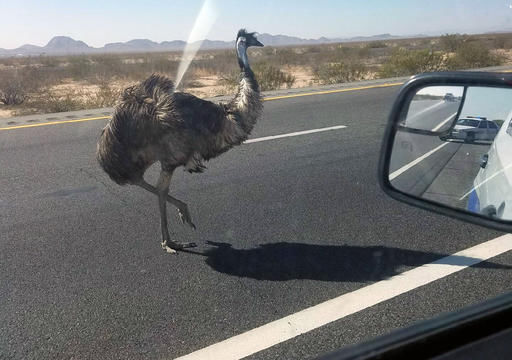
PHOENIX (AP) — State troopers say an emu crossed a Phoenix road, got to the other side and narrowly avoided getting hurt.
Arizona Department of Public Safety spokesman Quentin Mehr says the agency received reports Friday around 10 a.m. that an emu was on the loose on Interstate 10.
According to Mehr, a responding trooper found the bird in the median.
The emu then crossed the interstate and ended up on the dirt shoulder.
Mehr says a second trooper showed up and both officers drove alongside the animal to keep it from entering traffic lanes.
An officer from the Arizona Department of Agriculture arrived and used a lasso to wrangle the emu into a trailer.
Authorities say it is still unclear how the emu came into the area.
- Updated
STERLING, Colo. (AP) — Authorities say they recovered more than 26,000 pieces of undelivered mail in northeastern Colorado and arrested a former Postal Service worker.
The U.S. Attorney's Office said Friday the recovered mail was addressed to people in Sterling and Fort Morgan. Authorities haven't said where or how they found it.
Twenty-two-year-old Tayson Adam Hidalgo of Sterling is charged with delaying or destroying mail between October 2014 and April 2016.
He didn't immediately return a telephone message left by The Associated Press.
If convicted, Hidalgo faces up to five years in prison and a fine of up to $250,000. He's free on an unsecured $5,000 bond and is due in court on Oct. 25.
A meeting is scheduled in Sterling on Nov. 7 to brief residents on when the mail will be delivered.
- Updated
GALLUP, N.M. (AP) — Authorities say two Gallup residents have been accused of illegally using the credit card of a California woman who died in a New Mexico car crash.
New Mexico State Police say 40-year-old Bryan Burrola and 36-year-old Amy Lucero were arrested Wednesday in Gallup.
They both are being held on suspicion of credit card fraud and possession of a stolen credit card.
Raina Lopez died in an Aug. 29 crash on Interstate 40 and her vehicle was removed from the scene by a Gallup tow company.
Lopez's family told police last month that someone had recently used her credit card to buy more than $3,000 worth of items.
Police say Burrola was an employee of the tow company and lives with Lucero, who allegedly possessed one of Lopez's stolen credit cards.
- Updated
BEND, Ore. (AP) — Hundreds of students in Central Oregon have benefited from a new state grant that waives community college tuition for low-income students.
About 500 of the 1,075 new students enrolled at Central Oregon Community College have received Oregon Promise aid, but school officials say it's not yet clear if more students are attending as a result of the program, The Bulletin reported (https://is.gd/qxdLgT ).
"That's the mystery, is how many of these students would have already come," said Kevin Multop, director of financial aid at COCC.
The Oregon Promise program subsidizes community college tuition for students who graduated from an Oregon high school in the spring or summer with at least a 2.5 cumulative GPA, or have completed their GED this year.
Central Oregon Community College Dean of Student Enrollment Services Alicia Moore said it seems most of the new Oregon Promise students are direct from high school, not GED recipients.
"Anecdotally, we know the majority are direct from high school," she said.
At COCC, 43.7 percent of Oregon Promise students received a federal Pell Grant, meaning that cash was put toward their tuition before Oregon Promise money was. This is part of the Oregon grant's requirements that the state funding be the "last dollar in," according to Multop. He says all other funding goes toward community college funding before the state money.
The Legislature has not decided whether the Oregon Promise program will be available again in the 2017-18 school year, but COCC officials are preparing for next year assuming it will be renewed. This means the school is working to hone its success program, which is required to receive state funding.
Per the Legislature, Oregon community colleges had to create some requirements for students who receive Oregon Promise grants. At COCC, students are required to complete three requirements if they intend to receive money again in 2017-18: participate in academic advising, attend orientation and enroll in and complete a college success class.
Moore says of the 500 Oregon Promise students at COCC, 398 participated in orientation and are eligible for funds again next year.
___
Information from: The Bulletin, http://www.bendbulletin.com
- By JOE SUTTER The Messenger
- Updated
RENWICK, Iowa (AP) — Like most small towns, Renwick has had its share of businesses closing down.
For as long as anyone can remember, one of the oldest buildings in town was home to the local bar. When it shut its doors, a group of friends banded together to make sure it wouldn't stay empty.
"When doors start closing in town, the town folds up fast," said Hal Skiye, who is now the owner of the Blue Moose Saloon.
"We've known each other forever," Skiye said of the group that purchased the building. "And everybody here had the same concern - what do we do now? Everybody still wants a social life, and driving isn't the answer anymore."
The Messenger (http://bit.ly/2elr11z ) reports that the bar was once called the "One More?" The previous owners closed up shop June 21.
Just one month later a group of seven came together and formed an LLC to purchase the building. Remodeling work began Aug. 10.
Skiye was joined by Jeff and LaDonna Thompson, Brian and Stephanie Thompson, Ron Oberhelman, Rod Nelson, Vaughn Reekers and Todd George.
They had a big job ahead of them.
"It was unbelievable," Skiye said. "The ceiling was - that was probably ceiling tile that had been in here for 30 years. They were all sagging. The biggest thing was the floor. That was basically rotted out."
"The cooler behind the bar was just about ready to fall through," Brian Thompson said.
Everyone pitched in and had something to do, Skiye said.
"Fortunately everybody had their own calling," he said. "Three of the partners are good construction, carpenter workers, so they did that; another partner helped with the ceiling, and then three of us sawed boards and did whatever needed to be done. It was a joint effort."
"Once they got going, there was somebody in here every night and weekend," said Jeff Thompson.
Working without missing a day, the remodel was complete in 3 ½ weeks, Skiye said, in time to be open for the Iowa-Iowa State game in September.
"It didn't turn out quite like we planned, but it was open," he said, adding that an official grand opening has been scheduled for Nov. 12.
According to plan or not, the bar's opening has gone over well with the town.
"We've been busy every night since it opened," said bartender Cari Sisson.
"I can't thank the people enough for supporting it like they have so far," Skiye said.
"A lot of them are really surprised in the change. The atmosphere," Jeff Thompson added.
The bar has a light, family-friendly atmosphere now, Skiye said.
"This building has basically been open forever," he said. "It's closed two or three times when owners changed hands, maybe for remodeling."
None of the group could say what the building was originally, though they said it was one of the first businesses erected after the town was founded in 1881.
The deed shows names going back more than 100 years, to Jacob Funk and Cyrus Smith, some of the original founders of the town, Skiye said.
"When we were growing up, it was always a bar," said Amy Schneider, one of the bartenders.
"I remember coming in here 50 years ago with my dad, and her dad, and just different people throughout five decades," Skiye said. "Fifty years ago it was just a beer joint or pool hall. The farmers would bring in their little pints in their pockets, they'd buy the pop from the bar and mix their own drinks."
Skiye remembered a lot of good times at the bar under numerous different owners.
But the bar's name is based on another memory, that Skiye thought had been forgotten.
"Back in the '70s with CB radios, that was my CB handle," he explained. "I had a blue Torino and I'm kind of big, so I ended up being the Blue Moose back in high school days.
"I thought everybody had forgotten about that."
After going back and forth for weeks seeking a name, the Blue Moose moniker finally stuck.
It wasn't Skiye's idea.
"The only thing I like about it is they came up with a good logo, but as far as the name it's one of the dumber ones," he said.
Keeping the shop alive, providing a local place for Renwick residents to gather and supporting the town are all important to the investors.
They work here, they farm here, and none want to move somewhere else.
"No way," Skiye said.
"We grew up here," Schneider said.
"My family's here," Brian Thompson said.
"It's a pretty good little town," Skiye said.
"It's funny; this town can pull together," he added. "People from other towns say I don't know how Renwick does that. When something happens they're all just there for everybody."
The Blue Moose Saloon sells fried foods — french fries, fish, chicken strips — and is open seven days a week. Stephanie Thompson takes care of sales of sweatshirts with the Blue Moose logo, and LaDonna Thompson, who is also the manager, keeps the saloon's Facebook page up to date.
The bar once had only two TVs, but now has four, and can bring a TV outside to the beer garden for special occasions, LaDonna Thompson said.
The investors also hope to draw visitors from convertible clubs, motorcycle groups and poker runs.
They plan on having a big Halloween party and pheasant season opener Oct. 29 with prizes.
"We're hoping for a lot of good times in here. That's the main thing," Skiye said.
An AP Member Exchange shared by the Messenger
- Updated
PHOENIX (AP) — Arizona's largest electricity provider says the average time for peak power demand in the summer is significantly later than from four years ago, largely because of the increasing popularity of rooftop solar.
Phoenix-based Arizona Public Service Co. says the average summer peak during 2016 was 5:15 p.m. That's 45 minutes later than the 4:30 p.m. average peak during summer months in 2012.
APS says the shift isn't surprising because total energy installed on customers' rooftops across Arizona has doubled and even tripled year over year.
The utility says that shifts demand for its electricity to later in the day when the sun is descending and solar power on the grid is declining.
- Updated
PROVO, Utah (AP) — A Utah woman who gave birth while in a Walmart checkout line got an impromptu baby shower at the store.
The Provo Daily Herald reports (http://bit.ly/2eyNMLI ) employees gave mother Cecelia Rivas baby clothes, a stroller, a car seat and plenty of diapers for her son Matias on Wednesday.
Store manager Dustin Haight says the mother and baby are like family now.
Rivas says she'd felt labor pains early the morning of Oct. 9 and went to the store for a few things before going to the hospital, but when her water broke in line she knew she was going to give birth in the store.
She says she was surprised and scared, but things went well and her third child is now at home.
- By PAMELA JOHNSON Loveland Reporter-Herald
- Updated
LOVELAND, Colo. (AP) — Majestic bighorn sheep deftly dart up and down the steep, jagged walls of canyons throughout Colorado, delighting wildlife watchers when they spot the iconic Colorado animal that, just over a century ago, neared extinction.
With a statewide population of 7,000 bighorns, thanks to decades of work to rebuild the population, big horns cut a prominent profile throughout Colorado's canyons, including the Big Thompson Canyon west of Loveland.
There, a herd of about 70 sheep thrive throughout the seasons, reported the Loveland Reporter-Herald (http://bit.ly/2evx833).
"It's definitely one of the most viewed sheep herds in Larimer County," said Ben Kraft, a wildlife biologist with Colorado Parks and Wildlife.
"It's amazing how agile they are going up and down those rocks."
Once prominent throughout Colorado canyons, bighorn sheep populations were decimated by the early 1900s due to diseases from domestic livestock and over hunting, leading the efforts to repopulate. For decades, Colorado Parks and Wildlife and the Rocky Mountain Big Horn Society worked together to rebuild the populations by transplanting sheep from one location to another.
The first such transplant, from the still popular Georgetown herd, occurred in 1940, according to information on the Colorado Parks and Wildlife website. Since then, more than 100 transplants have taken place, mostly in the 1970s and 1980s, throughout the state.
Twice, sheep have been transplanted to supplement the Big Thompson herd — 26 sheep from the Mummy Range in 1987 and 22 from Georgetown in 2000.
The most recent infusion was to boost the herd after a large die off of all ages of sheep due to pneumonia, likely from domestic sheep, in the late 1990s.
Before then, the Big Thompson herd boasted 150 to 200 sheep. The disease knocked it down to about 100, and now there are even less.
However, despite some lingering effects of the disease and some indication of bacteria from domestic sheep, spread through interactions, documented in the herd as recent as two years ago, Kraft said the Big Thompson herd is considered to be on the rebound.
The biggest sign, he said, is that the ewes giving birth to healthy lambs.
"If we weren't seeing any, we would be really alarmed," Kraft added.
Perhaps, he said, another reason the herd is smaller now is due to road construction and development in the Big Thompson Canyon since the 1990s.
"That area may not be able to support as many big horns as it used to because of loss of habitat," Kraft said.
But the population of 70 seems to be a healthy number, as indicated by births, which is why Colorado Parks and Wildlife issues hunting licenses in the herd, according to Kraft. This year, there were two licenses for ewes and two for rams.
The animals forage on grass, forbes and shrubs year round and can be spotted throughout the canyon in all seasons. They do travel more to the east end of the canyon in the spring and the west in the winter, noted Kraft.
Throughout most of the year, the rams roam in "bachelor bands," while the ewes and their young group together.
But during mating season, November and December, the dominant rams will join the female herd. Sometimes, the rams even fight each other for dominance, crashing their horns together with force until one ram clearly champions.
"Three years ago, I saw two rams, and they did that for like 25 minutes until one collapsed," Kraft described. "The other jumped on his back."
Babies are born from May through July, during which time the mothers move to really steep terrain, like the Narrows, for protection from predators.
The animals are able to dart up steep canyons because of the way they are built. They have small feet, blocky legs and a stout body, Kraft described.
"They're a lot more compact animal than a deer or an elk," he said. "They've evolved to living in that kind of habitat."
Several different herds live in Larimer County, including one in the Poudre Canyon, one in the Rawah Wilderness and three in Rocky Mountain National Park. Two combined herds on the west side of the national park are estimated at 300 total animals, while the east-side herd has about 100 animals that live in the Mummy Range area, said Mary Kay Watry, conservation biologist.
The herd on the east side of the park mostly stays within the boundaries, however, some rams do roam and likely interact with ewes in the Big Thompson herd, said Watry, who works for Rocky Mountain National Park.
Wildlife viewing is one of the most popular activities in Rocky Mountain National Park, and big horn sheep are definitely a draw along with many other species, as they are in the Big Thompson Canyon.
"Their majestic appearance, that's a big drive and symbol of wilderness," Watry said. "Their agility on rough terrain makes them very impressive to watch and to see."
___
Information from: Loveland Daily Reporter-Herald, http://www.reporterherald.com/
- By LEWIS KENDALL Bozeman Daily Chronicle
BOZEMAN, Mont. (AP) — A year after looters dug up a chunk of land previously occupied by a historic military fort, local educators are using the opportunity to learn more about Bozeman's past.
Last October, three men were caught digging on land a few miles east of downtown Bozeman, which, nearly 150 years earlier, was home to the area's military camp Fort Ellis. The square-mile parcel of land is currently owned by Montana State University's Agricultural Experiment Station, which occasionally uses it for grazing. The men, who claimed they had only dug up two vintage beer bottles, were not charged, reported the Bozeman Daily Chronicle (http://bit.ly/2embo6H).
But the sizeable hole — filled with historically significant artifacts from buttons and tools to animal bones — presented the university with a problem. Left exposed, the artifacts would quickly degrade, so a group of MSU instructors decided to use the chance to study the site.
On Oct. 15, Nancy Mahoney, an instructor in MSU's Department of Sociology and Anthropology, and Jack Fisher, a professor in the same department, as well as a group of students, spent the day surveying the site and excavating noteworthy relics.
"We looked at is as an opportunity to do something great, and that's what it's turned into," Mahoney said.
The hole was dug on one of the fort's trash sites, Mahoney said, and its contents are extremely useful in understanding more about the way the camp operated.
"We want to see what are they drinking? Was there a lot of medicine out here? Were there women out here?" she said. "A lot of things we can learn from the trash and supplement the historical record."
Fort Ellis, located east of the city off what is now Frontage Road, opened in 1867 after Gallatin Valley residents demanded protection from local Indian populations.
The fort community grew to include 250 buildings — containing a hospital, cemetery and 30,000-acre grazing and timberland reservation — helping provide economic support to the area after the closure of the Bozeman Trail. Fort Ellis closed in 1886.
After securing a permit from the state to excavate the 35-by-25 foot hole, Mahoney, Fisher and Crystal Alegria, who works for educational organization Project Archaeology and co-founded the Extreme History Project, spent several weeks clearing, weeding and imaging the area.
With the help of students, the group plans to analyze the various artifacts — which will find a new home at the Museum of the Rockies — and present their findings to the Montana Archaeological Society next year.
"When a site is important to the town, it's important for the community to know about it so it has more care and protection," Mahoney said. "This site is integral to understanding how Bozeman became a thriving town."
"It presents a good opportunity to bring to the public's attention to this historic site and its value to the region," added Fisher. "And it's a good opportunity for students to get some hands-on experience."
Once their work is done, the group plans to cover the hole and fill it back in with dirt to preserve the site for future study. The university is working with local law enforcement and promoting its Montana Site Stewardship Program to prevent similar looting incidents, Mahoney said.
"This is the kind of thing that can happen very quickly if we're not aware," she said. "This is an educational opportunity not only because of what it can tell us about the past, but also that this stuff can disappear if we don't protect it."
___
Information from: Bozeman Daily Chronicle, http://www.bozemandailychronicle.com
MCMINNVILLE, Ore. (AP) — State health officials have issued a health alert about marijuana products that may have been tainted with high levels of a pesticide and sold to about 130 people southwest of Portland.
The Oregon Health Authority said Friday the alert concerns dried flower marijuana sold by a medical marijuana dispensary called New Leaf in McMinnville.
The strain names are Dr. Jack, batch number G6J0051-02, and Marion Berry, batch number G6J0051-01.
The products were sold to customers between Oct. 17 and Oct. 19 and came from batches that failed a pesticide test, containing high levels of a chemical known as spinosad.
Anyone finding the tainted product can return it to the dispensary or dispose of it.
Effects of smoking marijuana containing spinosad are not known. According to the National Pesticide Information Center at Oregon State University, spinosad is a natural substance made by a soil bacterium that can be toxic to insects.
Those concerned about exposure should contact the Oregon Poison Center at 800-222-1222.
- By JENNIFER SINCO KELLEHER Associated Press
HONOLULU (AP) — A man convicted in a federal drug case involving six pounds of crystal methamphetamine mailed to Hawaii in a toaster was sentenced Friday to 18 years in prison.
A jury in April convicted Allen Gorion, 32, of meth dealing and conspiracy charges. He and his co-defendant were arrested last year after picking up the package, which was mailed to Kapolei from North Hollywood, California.
Authorities intercepted the package, replaced most of the drugs with pseudo-meth and delivered it, using a U.S. postal inspector posing as a mail carrier. The drugs were hidden in a Black & Decker four-slice toaster oven, according to court documents.
In a bid for a lighter sentence, Gorion testified at Friday's sentencing hearing that he thought he was helping someone move and didn't realize there were drugs in his car. He denied touching the bag, even though special powder authorities put on the fake drugs was on his hands.
"I don't find Mr. Gorion to be credible," U.S. District Judge J. Michael Seabright said.
Co-defendant Leland Akau previously pleaded guilty and was sentenced to 15 ½ years in prison.
Gorion said he takes responsibility for his actions. Assistant U.S. Attorney Tony Roberts disagreed, saying "he took us to trial, he was fighting the case."
Gorion testified that a man he knew to be involved with meth dealing bought him a plane ticket to California. When asked if the trip was for trafficking drugs, Gorion responded, "Might have been. ... I didn't know what was going on."
Defense attorney Cliff Hunt asked psychologist Marvin Acklin to describe Gorion's attention deficit hyperactivity disorder. Gorion has a well-documented history of "severe" ADHD, Acklin said.
Hunt said Gorion has strong community support, gesturing to the courtroom gallery full of about two dozen relatives and friends. Hunt asked the judge to sentence Gorion to the mandatory minimum of 10 years. Gorion, who has four daughters, was going through a divorce, was depressed and suicidal when he linked up with a drug dealer and started smoking meth with him, Hunt said.
Roberts, the prosecutor, noted Gorion's criminal history, which includes stealing a car and punching his spouse.
"I feel sorry for his daughters and family, also," Roberts said, but added that doesn't excuse Gorion's actions involving a drug that has had a "horrendous" community impact.
- By AMY BETH HANSON Associated Press
HELENA, Mont. (AP) — A judge's decision not to order prison time for a Montana man who raped his 12-year-old daughter has sparked outrage from afar and calls closer to home to toughen the state's law, which allows such lenience in certain circumstances.
Enacted in a wave of similar legislation around the country after the killing of a 9-year-old Florida girl in 2005, the Montana statute requires a minimum sentence of 25 years in prison for anyone convicted of rape, incest or sexual abuse of a child 12 or younger.
But unlike many of those other laws, Montana's also allows judges to dole out far less severe punishment in a case where a court-appointed evaluator determines that ordering treatment outside prison "affords a better opportunity for rehabilitation of the offender and for the ultimate protection of the victim and society."
District Judge John McKeon, who oversees a three-county area of eastern Montana, cited that exception this month when he gave the father a 30-year suspended sentence after his guilty plea to incest and ordered him to spend 60 days in jail over the next six months, giving him credit for the 17 days already served. His sentence requires him to undergo sex offender treatment and includes many other restrictions.
Court records said the mother walked in on the father raping the child. The Associated Press is not identifying the man to avoid identifying the victim of a sexual assault.
McKeon took the rare step of issuing a statement a day after news of the Oct. 4 sentencing was widely published. In that statement and in his sentencing order, issued Monday, the longtime judge listed the factors that weighed into sparing the man prison time, including that:
— An evaluator found the defendant could be treated and supervised in the community;
— The man did not have a felony record, had a job and community support;
— The victim's mother and grandmother wrote letters to the court supporting community-based treatment, saying it would keep the man in the lives of his two sons s and offered the family the opportunity to heal.
— Prosecutors did not challenge the results of the man's psychosexual evaluation;
— There was a "lack of input directly from the victim" or from an advocate for the victim.
"The sentence may not be a popular decision by certain members of the general public, but it is a just and proper decision given the record before the Court and the law the Court is sworn to uphold," McKeon wrote in the sentencing order.
An online petition arguing McKeon should be impeached has gathered more than 82,000 signatures in just over a week, from Montana, outside the state, Canada and elsewhere. McKeon had previously announced his intention to retire next month after 22 years as a state judge.
District Judge Blair Jones, the chairman of the Montana Judicial Standards Commission, said Friday that he could not disclose whether any complaints had been made against McKeon. Such complaints aren't made public until the commission decides whether they have merit.
Nearly every state has enacted mandatory prison terms for child sex offenders, commonly referred to as "Jessica's laws" after Jessica Lunsford, the Florida girl kidnapped and killed by a neighbor with a history of crimes against children who had failed to register as a sex offender. Many of the measures also severely restrict where such offenders can live and work, impose GPS monitoring and other conditions once they are released.
It's not clear whether any of those laws contains an exception along the lines of Montana's, which itself may not be on the books much longer. This week, a commission studying Montana's sentencing laws recommended that lawmakers eliminate the exception to the 25-year minimum term, in the interest of more consistent sentencing.
Assistant Attorney General Dan Guzynski contrasted the case McKeon handled with that of a man he prosecuted last year, who received the mandatory minimum after being convicted of raping his 10-year-old daughter.
"Both (sex offender) evaluators said (the fathers) were treatable in their community, both were sentenced under the very same law, both raped their children," Guzynski told members of the Commission on Sentencing on Wednesday. "One is going to spend the next 25 years in prison and one is out on probation."
___
AP writer Matt Volz contributed to this report.
DENVER (AP) — Malala Yousafzai (mah-LAH'-lah YOO'-suhf-zeye) has made a surprise visit to a Denver high school that offers special programs for refugee students.
The Denver Post reports (http://tinyurl.com/zk38ack) the Pakistani children's rights activist spoke at a South High School assembly Friday after students from Eritrea (ehr-ih-TREE'-uh), Cambodia and Sierra Leone told their stories.
Her visit hadn't been announced, and when she walked onto the stage, the audience erupted into cheers and screams.
Malala was shot and wounded by the Taliban in 2012 because she advocated for education for girls and women. She shared the 2014 Nobel Peace Prize.
She visited South High during an international tour to advocate for education access. She had heard about the school during a visit to the city in 2015.
___
Information from: The Denver Post, http://www.denverpost.com
LOS ANGELES (AP) — Los Angeles police are holding a man they say stabbed to death his 13-month-old daughter, then walked out of his burning apartment with a knife stuck in his chest.
Capt. Steve Carmona tells City News Service that an officer answering an assault with a deadly weapon report found the man Friday afternoon outside a North Hollywood apartment building — with a steak knife in his chest.
He says the man may have been using methamphetamine.
Officer Drake Madison says he's hospitalized in critical condition.
Madison says the man allegedly stabbed his daughter and set an apartment fire that was quickly doused.
He says initial reports that the child was thrown out of a window were wrong.
The girl's mother took her to a hospital, where she was pronounced dead.
PHOENIX (AP) — State troopers say an emu crossed a Phoenix road, got to the other side and narrowly avoided getting hurt.
Arizona Department of Public Safety spokesman Quentin Mehr says the agency received reports Friday around 10 a.m. that an emu was on the loose on Interstate 10.
According to Mehr, a responding trooper found the bird in the median.
The emu then crossed the interstate and ended up on the dirt shoulder.
Mehr says a second trooper showed up and both officers drove alongside the animal to keep it from entering traffic lanes.
An officer from the Arizona Department of Agriculture arrived and used a lasso to wrangle the emu into a trailer.
Authorities say it is still unclear how the emu came into the area.
STERLING, Colo. (AP) — Authorities say they recovered more than 26,000 pieces of undelivered mail in northeastern Colorado and arrested a former Postal Service worker.
The U.S. Attorney's Office said Friday the recovered mail was addressed to people in Sterling and Fort Morgan. Authorities haven't said where or how they found it.
Twenty-two-year-old Tayson Adam Hidalgo of Sterling is charged with delaying or destroying mail between October 2014 and April 2016.
He didn't immediately return a telephone message left by The Associated Press.
If convicted, Hidalgo faces up to five years in prison and a fine of up to $250,000. He's free on an unsecured $5,000 bond and is due in court on Oct. 25.
A meeting is scheduled in Sterling on Nov. 7 to brief residents on when the mail will be delivered.
GALLUP, N.M. (AP) — Authorities say two Gallup residents have been accused of illegally using the credit card of a California woman who died in a New Mexico car crash.
New Mexico State Police say 40-year-old Bryan Burrola and 36-year-old Amy Lucero were arrested Wednesday in Gallup.
They both are being held on suspicion of credit card fraud and possession of a stolen credit card.
Raina Lopez died in an Aug. 29 crash on Interstate 40 and her vehicle was removed from the scene by a Gallup tow company.
Lopez's family told police last month that someone had recently used her credit card to buy more than $3,000 worth of items.
Police say Burrola was an employee of the tow company and lives with Lucero, who allegedly possessed one of Lopez's stolen credit cards.
BEND, Ore. (AP) — Hundreds of students in Central Oregon have benefited from a new state grant that waives community college tuition for low-income students.
About 500 of the 1,075 new students enrolled at Central Oregon Community College have received Oregon Promise aid, but school officials say it's not yet clear if more students are attending as a result of the program, The Bulletin reported (https://is.gd/qxdLgT ).
"That's the mystery, is how many of these students would have already come," said Kevin Multop, director of financial aid at COCC.
The Oregon Promise program subsidizes community college tuition for students who graduated from an Oregon high school in the spring or summer with at least a 2.5 cumulative GPA, or have completed their GED this year.
Central Oregon Community College Dean of Student Enrollment Services Alicia Moore said it seems most of the new Oregon Promise students are direct from high school, not GED recipients.
"Anecdotally, we know the majority are direct from high school," she said.
At COCC, 43.7 percent of Oregon Promise students received a federal Pell Grant, meaning that cash was put toward their tuition before Oregon Promise money was. This is part of the Oregon grant's requirements that the state funding be the "last dollar in," according to Multop. He says all other funding goes toward community college funding before the state money.
The Legislature has not decided whether the Oregon Promise program will be available again in the 2017-18 school year, but COCC officials are preparing for next year assuming it will be renewed. This means the school is working to hone its success program, which is required to receive state funding.
Per the Legislature, Oregon community colleges had to create some requirements for students who receive Oregon Promise grants. At COCC, students are required to complete three requirements if they intend to receive money again in 2017-18: participate in academic advising, attend orientation and enroll in and complete a college success class.
Moore says of the 500 Oregon Promise students at COCC, 398 participated in orientation and are eligible for funds again next year.
___
Information from: The Bulletin, http://www.bendbulletin.com
- By JOE SUTTER The Messenger
RENWICK, Iowa (AP) — Like most small towns, Renwick has had its share of businesses closing down.
For as long as anyone can remember, one of the oldest buildings in town was home to the local bar. When it shut its doors, a group of friends banded together to make sure it wouldn't stay empty.
"When doors start closing in town, the town folds up fast," said Hal Skiye, who is now the owner of the Blue Moose Saloon.
"We've known each other forever," Skiye said of the group that purchased the building. "And everybody here had the same concern - what do we do now? Everybody still wants a social life, and driving isn't the answer anymore."
The Messenger (http://bit.ly/2elr11z ) reports that the bar was once called the "One More?" The previous owners closed up shop June 21.
Just one month later a group of seven came together and formed an LLC to purchase the building. Remodeling work began Aug. 10.
Skiye was joined by Jeff and LaDonna Thompson, Brian and Stephanie Thompson, Ron Oberhelman, Rod Nelson, Vaughn Reekers and Todd George.
They had a big job ahead of them.
"It was unbelievable," Skiye said. "The ceiling was - that was probably ceiling tile that had been in here for 30 years. They were all sagging. The biggest thing was the floor. That was basically rotted out."
"The cooler behind the bar was just about ready to fall through," Brian Thompson said.
Everyone pitched in and had something to do, Skiye said.
"Fortunately everybody had their own calling," he said. "Three of the partners are good construction, carpenter workers, so they did that; another partner helped with the ceiling, and then three of us sawed boards and did whatever needed to be done. It was a joint effort."
"Once they got going, there was somebody in here every night and weekend," said Jeff Thompson.
Working without missing a day, the remodel was complete in 3 ½ weeks, Skiye said, in time to be open for the Iowa-Iowa State game in September.
"It didn't turn out quite like we planned, but it was open," he said, adding that an official grand opening has been scheduled for Nov. 12.
According to plan or not, the bar's opening has gone over well with the town.
"We've been busy every night since it opened," said bartender Cari Sisson.
"I can't thank the people enough for supporting it like they have so far," Skiye said.
"A lot of them are really surprised in the change. The atmosphere," Jeff Thompson added.
The bar has a light, family-friendly atmosphere now, Skiye said.
"This building has basically been open forever," he said. "It's closed two or three times when owners changed hands, maybe for remodeling."
None of the group could say what the building was originally, though they said it was one of the first businesses erected after the town was founded in 1881.
The deed shows names going back more than 100 years, to Jacob Funk and Cyrus Smith, some of the original founders of the town, Skiye said.
"When we were growing up, it was always a bar," said Amy Schneider, one of the bartenders.
"I remember coming in here 50 years ago with my dad, and her dad, and just different people throughout five decades," Skiye said. "Fifty years ago it was just a beer joint or pool hall. The farmers would bring in their little pints in their pockets, they'd buy the pop from the bar and mix their own drinks."
Skiye remembered a lot of good times at the bar under numerous different owners.
But the bar's name is based on another memory, that Skiye thought had been forgotten.
"Back in the '70s with CB radios, that was my CB handle," he explained. "I had a blue Torino and I'm kind of big, so I ended up being the Blue Moose back in high school days.
"I thought everybody had forgotten about that."
After going back and forth for weeks seeking a name, the Blue Moose moniker finally stuck.
It wasn't Skiye's idea.
"The only thing I like about it is they came up with a good logo, but as far as the name it's one of the dumber ones," he said.
Keeping the shop alive, providing a local place for Renwick residents to gather and supporting the town are all important to the investors.
They work here, they farm here, and none want to move somewhere else.
"No way," Skiye said.
"We grew up here," Schneider said.
"My family's here," Brian Thompson said.
"It's a pretty good little town," Skiye said.
"It's funny; this town can pull together," he added. "People from other towns say I don't know how Renwick does that. When something happens they're all just there for everybody."
The Blue Moose Saloon sells fried foods — french fries, fish, chicken strips — and is open seven days a week. Stephanie Thompson takes care of sales of sweatshirts with the Blue Moose logo, and LaDonna Thompson, who is also the manager, keeps the saloon's Facebook page up to date.
The bar once had only two TVs, but now has four, and can bring a TV outside to the beer garden for special occasions, LaDonna Thompson said.
The investors also hope to draw visitors from convertible clubs, motorcycle groups and poker runs.
They plan on having a big Halloween party and pheasant season opener Oct. 29 with prizes.
"We're hoping for a lot of good times in here. That's the main thing," Skiye said.
An AP Member Exchange shared by the Messenger
PHOENIX (AP) — Arizona's largest electricity provider says the average time for peak power demand in the summer is significantly later than from four years ago, largely because of the increasing popularity of rooftop solar.
Phoenix-based Arizona Public Service Co. says the average summer peak during 2016 was 5:15 p.m. That's 45 minutes later than the 4:30 p.m. average peak during summer months in 2012.
APS says the shift isn't surprising because total energy installed on customers' rooftops across Arizona has doubled and even tripled year over year.
The utility says that shifts demand for its electricity to later in the day when the sun is descending and solar power on the grid is declining.
PROVO, Utah (AP) — A Utah woman who gave birth while in a Walmart checkout line got an impromptu baby shower at the store.
The Provo Daily Herald reports (http://bit.ly/2eyNMLI ) employees gave mother Cecelia Rivas baby clothes, a stroller, a car seat and plenty of diapers for her son Matias on Wednesday.
Store manager Dustin Haight says the mother and baby are like family now.
Rivas says she'd felt labor pains early the morning of Oct. 9 and went to the store for a few things before going to the hospital, but when her water broke in line she knew she was going to give birth in the store.
She says she was surprised and scared, but things went well and her third child is now at home.
- By PAMELA JOHNSON Loveland Reporter-Herald
LOVELAND, Colo. (AP) — Majestic bighorn sheep deftly dart up and down the steep, jagged walls of canyons throughout Colorado, delighting wildlife watchers when they spot the iconic Colorado animal that, just over a century ago, neared extinction.
With a statewide population of 7,000 bighorns, thanks to decades of work to rebuild the population, big horns cut a prominent profile throughout Colorado's canyons, including the Big Thompson Canyon west of Loveland.
There, a herd of about 70 sheep thrive throughout the seasons, reported the Loveland Reporter-Herald (http://bit.ly/2evx833).
"It's definitely one of the most viewed sheep herds in Larimer County," said Ben Kraft, a wildlife biologist with Colorado Parks and Wildlife.
"It's amazing how agile they are going up and down those rocks."
Once prominent throughout Colorado canyons, bighorn sheep populations were decimated by the early 1900s due to diseases from domestic livestock and over hunting, leading the efforts to repopulate. For decades, Colorado Parks and Wildlife and the Rocky Mountain Big Horn Society worked together to rebuild the populations by transplanting sheep from one location to another.
The first such transplant, from the still popular Georgetown herd, occurred in 1940, according to information on the Colorado Parks and Wildlife website. Since then, more than 100 transplants have taken place, mostly in the 1970s and 1980s, throughout the state.
Twice, sheep have been transplanted to supplement the Big Thompson herd — 26 sheep from the Mummy Range in 1987 and 22 from Georgetown in 2000.
The most recent infusion was to boost the herd after a large die off of all ages of sheep due to pneumonia, likely from domestic sheep, in the late 1990s.
Before then, the Big Thompson herd boasted 150 to 200 sheep. The disease knocked it down to about 100, and now there are even less.
However, despite some lingering effects of the disease and some indication of bacteria from domestic sheep, spread through interactions, documented in the herd as recent as two years ago, Kraft said the Big Thompson herd is considered to be on the rebound.
The biggest sign, he said, is that the ewes giving birth to healthy lambs.
"If we weren't seeing any, we would be really alarmed," Kraft added.
Perhaps, he said, another reason the herd is smaller now is due to road construction and development in the Big Thompson Canyon since the 1990s.
"That area may not be able to support as many big horns as it used to because of loss of habitat," Kraft said.
But the population of 70 seems to be a healthy number, as indicated by births, which is why Colorado Parks and Wildlife issues hunting licenses in the herd, according to Kraft. This year, there were two licenses for ewes and two for rams.
The animals forage on grass, forbes and shrubs year round and can be spotted throughout the canyon in all seasons. They do travel more to the east end of the canyon in the spring and the west in the winter, noted Kraft.
Throughout most of the year, the rams roam in "bachelor bands," while the ewes and their young group together.
But during mating season, November and December, the dominant rams will join the female herd. Sometimes, the rams even fight each other for dominance, crashing their horns together with force until one ram clearly champions.
"Three years ago, I saw two rams, and they did that for like 25 minutes until one collapsed," Kraft described. "The other jumped on his back."
Babies are born from May through July, during which time the mothers move to really steep terrain, like the Narrows, for protection from predators.
The animals are able to dart up steep canyons because of the way they are built. They have small feet, blocky legs and a stout body, Kraft described.
"They're a lot more compact animal than a deer or an elk," he said. "They've evolved to living in that kind of habitat."
Several different herds live in Larimer County, including one in the Poudre Canyon, one in the Rawah Wilderness and three in Rocky Mountain National Park. Two combined herds on the west side of the national park are estimated at 300 total animals, while the east-side herd has about 100 animals that live in the Mummy Range area, said Mary Kay Watry, conservation biologist.
The herd on the east side of the park mostly stays within the boundaries, however, some rams do roam and likely interact with ewes in the Big Thompson herd, said Watry, who works for Rocky Mountain National Park.
Wildlife viewing is one of the most popular activities in Rocky Mountain National Park, and big horn sheep are definitely a draw along with many other species, as they are in the Big Thompson Canyon.
"Their majestic appearance, that's a big drive and symbol of wilderness," Watry said. "Their agility on rough terrain makes them very impressive to watch and to see."
___
Information from: Loveland Daily Reporter-Herald, http://www.reporterherald.com/


View this profile on Instagram#ThisIsTucson 🌵 (@this_is_tucson) • Instagram photos and videos
Most viewed stories
-
New eats! 10 new restaurants that opened in Tucson this fall
-
A list of places that will be open on Christmas Day 2025
-
Ring in 2026 at these fun local New Year's Eve events 🥳
-
Over 40 free events happening in Tucson this December! ⛄
-
40 exciting things to do in Tucson December 19-21! ⭐
-
3 teaspoons of anise, 6 cups of flour and lots of love: My grandma's biscochitos recipe is more than a delicious cookie
-
Save the date! Here's the ultimate list of Tucson holiday events 🎄
-
A local gift guide for the foodie in your life 🍽️