

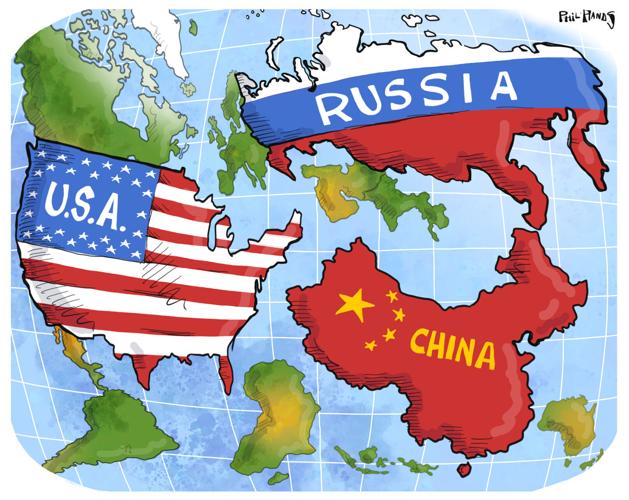
Sure, President Donald Trump’s erratic foreign policy has alienated allies, shredded the U.S.-led rules-based global order, nudged Canada closer to China and turned NATO into something resembling your uncle’s Facebook page after someone brings up politics.
Matt K. Lewis
Other than that? Everything’s terrific.
Just kidding. It might be even worse than we think.
The problem isn’t just that we’re losing friends, it’s that we’re creating potential enemies. And not just the kind who boo the national anthem at sporting events, but the kind who someday might decide that America is the villain in their personal origin story, right before the montage where ominous music starts playing.
If this sounds abstract or alarmist, it’s worth noting that it has already happened.
Osama bin Laden — who was once, awkwardly, an informal ally against the Soviets — was radicalized largely by the Gulf War and the stationing of American troops in Saudi Arabia.
This is notable because the Gulf War — unlike the subsequent Iraq War — had international approval, a clear mission and an exit strategy. By war standards, it was practically a model U.N. bake sale. And yet it still produced consequences that reshaped America’s future, resulting in 9/11 and a couple of not-so-tidy wars.

America’s role in the world is changing. If this wasn’t obvious before, it should be now, following President Donald Trump’s efforts to take over Greenland and his visibly strained relations with traditional allies in Europe and elsewhere.
People also tend to forget the uncomfortable timing. The Gulf War ended in 1991. Sept. 11, 2001, happened 10 years later. The shoe did not drop immediately. It sat there. Quietly. Waiting.
The lesson is not just that military interventions can cause backlash, but that even the ones we conduct “by the book” can still leave people angry years later. Which brings us to today.
Trump has claimed he has the “framework of a deal” with NATO for Greenland, which — if it holds — is good news because you should never underestimate people who can ski and shoot at the same time.
During a recent visit to Greenland, U.S. lawmakers reportedly encountered “a level of anti-Americanism that stunned and depressed them.” Sen. Thom Tillis, R-N.C., warned this could lead to “retaliatory measures” against the U.S., which probably means boycotts. Or harsh looks. Or maybe more.
If the idea of U.S. troops getting bogged down in the snow outside of Nuuk sounds ridiculous, keep in mind that Greenland is merely one of the fights we’ve picked.
We could just as easily be creating enemies much closer to home — or even at home.

Some may be natural-born U.S. citizens swept up in a fiery politics of permanent resistance. Others may be Somali Americans in Minnesota whose families are mistreated by Immigration and Customs Enforcement, or the relatives of a Cuban immigrant whose death at an El Paso detention facility was ruled a homicide, or a hypothetical Venezuelan kid whose father was killed in the operation to exfiltrate Nicolas Maduro.
These are not people who will submit formal complaints. These are people who will hold grudges.
This doesn’t mean America should curl up into a ball and never do anything. But it probably means we should pause before assuming that today’s rhetorical flex or tough-guy sound bite magically disappears once the news cycle moves on.
Because if even the best-laid plans (like the Gulf War) evoke backlash, imagine dealing with the fallout from policies that are impulsive, performative and seemingly designed to irritate as many people as possible.
Just put yourself in the other guy’s shoes.
How would Americans react if another country kidnapped a political leader from our capital, or even threatened to invade the U.S.?
There would be outrage, the emergency return of Lee Greenwood and “freedom fries.” And that would be before things get all “kinetic.”
Now imagine opening social media and seeing a map where someone else’s flag is pasted onto your territory.
This is not how you win hearts and minds. This is how you manufacture righteous indignation and anger.
So it doesn’t matter if Trump walks back his provocative rhetoric. Much of the damage is done.
Rhetoric that treats other nations like hotel properties is not free of charge. It sends a message that trust is optional and sovereignty is revocable. Sooner or later, someone is going to decide that the U.S. is less a partner than a recurring antagonist.
In the real world, you don’t have to go looking for trouble — and you don’t have to go in search of monsters to destroy.
Some of the most dangerous threats have a way of finding you.

