

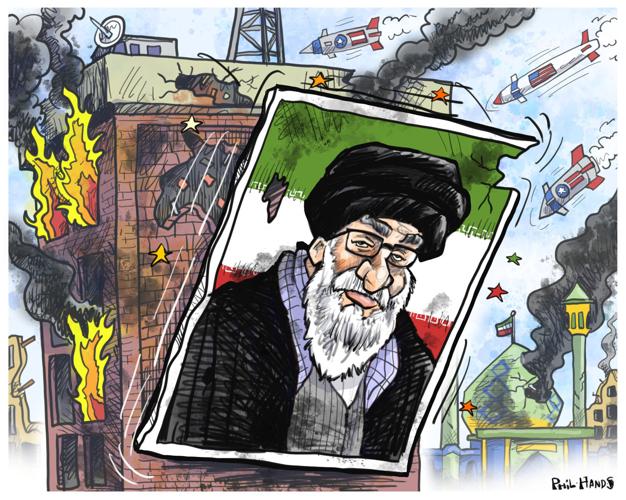


Few will mourn the demise of Iran’s supreme leader or other senior Iranian security officials who terrorized the Iranian people and destabilized countries across the region.

Damian Murphy

Andrew Miller
But other than Israel, none of the countries in the region publicly supported military action against Iran. They understood that while Ayatollah Ali Khamenei deserved his fate, the cost of war could quickly exceed any potential returns.
In just the first few days, those concerns were vindicated. Ten countries were subject to strikes targeting military and civilian infrastructure, putting militaries and civilian populations on edge. In the United Arab Emirates, three civilians were killed and 58 injured amid a barrage of drones and missiles fired at Dubai and Abu Dhabi. Several major airports and hotels have been damaged from Iranian strikes.
If this tempo continues, it remains to be seen whether the UAE can maintain its defenses.
Elsewhere, Americans and other regional partners felt the brunt of Iranian retaliation. Four U.S. soldiers were killed and several others injured in a missile strike. The following day, three U.S. F-15 fighter jets were lost to friendly fire that will cost American taxpayers $117 million per plane. At least one Kuwaiti was killed and 32 injured in missile strikes.
The 'peace president' was right to go to war | Peter Doran
Iran also attacked a major gas plant in Qatar, the biggest oil refinery in Saudi Arabia, residential towers in Bahrain and a synagogue and apartment buildings in Israel.
The war has shaken the global market, with oil prices climbing.
With the ability of regional countries to export gas, oil or any other goods effectively frozen, their economies will hemorrhage revenues as long as the strategically vital Strait of Hormuz is impassable. In the short term, the region from Cyprus to Oman is not better off.

Unfortunately, it looks increasingly likely that this damage will persist, making the region worse off in the long term. Saudi Arabia, the UAE and Qatar expended enormous resources and political capital in making the case that their major cities are safe for tourism and capital investment. These countries, whose economic models are predicated on predictability and peace, must now contend with a renewed reputation of a Middle East plagued by instability and uncertainty.
The longer the war continues, the harder it will be to shed long-term reputation costs.
Qatar and Oman probably feel the most burned by the United States, whose diplomatic efforts were ill-informed and uneven. Both countries tried to support the Trump administration’s diplomatic track and put their reputations on the line to secure a peaceful resolution to the nuclear dispute.
For their efforts, each was subject to a barrage of Iranian missiles and drones in the initial counterattack. Trust has been damaged significantly.
The region cannot be evaluated without considering the Iranian people, who bravely and courageously stood up to the regime. Whatever the Trump administration’s intent, a durable democratic transition in Iran cannot be based on actions by Israel or the United States. Any Iranian leader seen as having been installed by either country will soon suffer from a lack of legitimacy with the Iranian people.
Tragically, it is far from clear that President Donald Trump is committed to supporting a democratic transition. The precedent set in Venezuela — where Trump jettisoned the opposition almost as soon as the helicopter carrying Nicolas Maduro left Venezuelan airspace — is a cautionary tale for Iranians.
This war may teach countries around the world a dangerous lesson. The Joint Comprehensive Plan of Action, while imperfect, effectively kept Iran’s nuclear program in a box.
Iran accepted stringent and closely monitored restrictions on its nuclear program in exchange for economic relief, trusting that a diplomatic agreement would provide greater security than a nuclear weapon -- all without a shot fired. Then Trump shredded the agreement and set in motion a policy culminating in two military interventions.
What conclusion may countries draw from this episode? Perhaps they'll conclude that developing nuclear weapons is essential for maintaining power. Saddam Hussein, Muammar Gaddafi and now Ali Khamenei cast a long shadow that other authoritarian leaders are unlikely to ignore. If, after all this, the incentives for nuclear proliferation increase, no one in the region — whether Israelis, Saudis, Iranians or Americans — will claim to be better off.

