


This is not the story of a young man torn between two worlds.
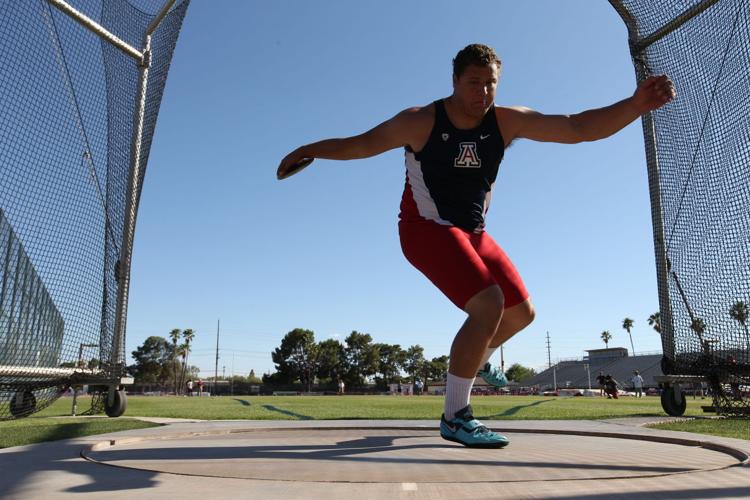
Yes, Gerhard de Beer is from South Africa and resides in Tucson. And yes, he plays two sports for the University of Arizona.
But the way de Beer sees it, the choice is so clear there is no choice. When his track season concludes — hopefully at the NCAA Outdoor Track & Field Championships next month — he will put his discus into storage.
“Even if I qualify for the Olympics, I wouldn’t go,” de Beer said from a bus en route from Kansas City International Airport to Lawrence, Kansas, where he’s competing in the NCAA West Regionals on Friday.
“I want to concentrate on football right now.”
Before fall camp in 2013, de Beer never had played the sport. Less than three years later, he’s the favorite to start at right tackle for the Wildcats.
“Amazing is about the only way I can say it,” UA offensive line coach Jim Michalczik said. “What he’s done is a testament to his work ethic, his attention to detail, his drive, his competitiveness. If he keeps going, he’s got a future doing this.”
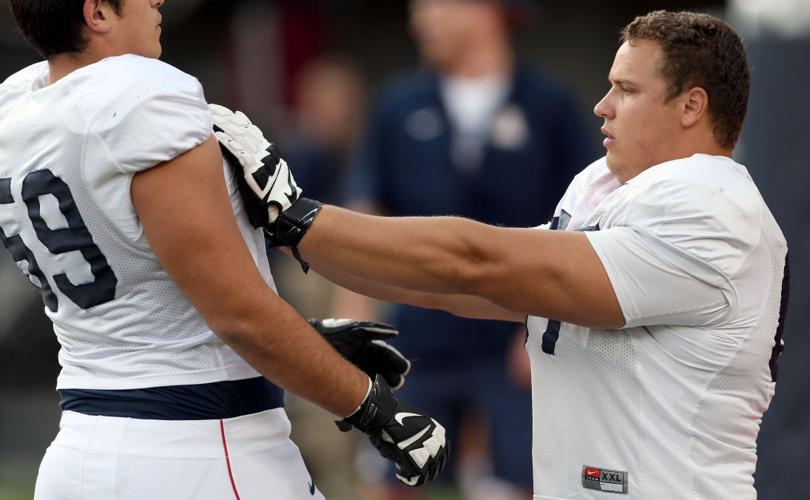
De Beer, 21, possesses the requisite tools to become a professional offensive lineman. He has ideal size — he’s 6 feet 7 inches tall and 315 pounds — enough athleticism and coordination to excel at throwing the discus; and plenty of toughness from years of playing rugby.
“He’s a guy that I think is very close to being very good,” said former Arizona offensive lineman Glenn Parker, who’s now an analyst for Pac-12 Networks.
Although he has come to appreciate the strategic aspects of football — all of which he had to learn from scratch — it’s the physical part of the game that appeals to de Beer the most.
“I love hitting the (expletive) out of people,” he said. “There’s just something about taking a guy from one place to another place that makes me so happy.”
De Beer’s move from Pretoria, South Africa, to Tucson has been a mostly joyous one. He first got the idea of pursuing American football after hearing about Margus Hunt, a thrower from Estonia who became a defensive end at SMU and a 2013 second-round draft pick of the Cincinnati Bengals. The source: Simone du Toit, de Beer’s cousin, who was a thrower for the Mustangs.
Unlike SMU, which had disbanded its men’s track program, Arizona offered exactly what de Beer was looking for: An opportunity to throw the discus and walk on to the football team.
At first, de Beer had no idea what he was doing. As the story goes, locker room neighbor Luca Bruno had to show de Beer how to put on his pads and adjust his helmet.
“That was no joke,” de Beer said. “That really happened.”
But de Beer was determined to learn everything about the game. How thorough is he? De Beer once corrected himself in mid-thought during a video interview with the UA. He had said “a.k.a.” when he meant “i.e.”
Now de Beer had to figure out the difference between DE, TE and OL. After initially trying Hunt’s position, de Beer, who weighed about 245 pounds as a freshman, spent some time at tight end. The former rugby player even punted a bit. Finally, he settled in on the offensive line, where learning blocking techniques represented only half the battle, if that.
“I didn’t know what the hell was going on,” de Beer said. “Just getting to know the plays was a struggle for me.”
Initially, de Beer didn’t know the difference between an inside zone play and an outside zone play. Heck, he didn’t even know what a zone play was.
De Beer also had to learn how to read defenses. He credits Michalczik for being patient with him and teaching him the concepts needed to form a base of knowledge.
“He’s come a long way,” said right guard Jacob Alsadek, who regularly watches film with de Beer after practice. “I consider him one of the smartest guys on the team football-wise.”
Parker believes de Beer’s background in track — and even his lack of football experience — helped him develop as a lineman.
First, the track part: As a discus thrower, de Beer understood what a big difference slight adjustments could make.
“He’s very used to correcting the minutiae to have success,” Parker said.
And the lack of football training?
“He came in very raw, but the great thing about players like that is … there are no bad habits to unlearn,” said Parker, who didn’t play high school football. “They don’t have a way of doing something. They’re taught the right way from the start.”
Still, it took time. De Beer redshirted as a freshman and spent another season on the scout team. He played primarily on special teams last year before getting his first career start, at right guard, against USC on Nov. 7. De Beer started the final three games at left guard and worked with the first team in spring at right tackle, where Arizona is seeking a replacement for Lene Maiava.
“He’s slowly getting better every year,” UA coach Rich Rodriguez said of de Beer. “This should be his best year.”
De Beer has two years of football eligibility remaining, and he believes he’ll need both to maximize his potential. He’s peaking as a thrower as his college track career comes to an end.
De Beer notched a personal record of 61.97 meters (203 feet 3 inches) at the Tucson Elite Classic on Saturday, the fifth-best collegiate mark this season. De Beer, who won the Pac-12 championship last year and finished second at the conference meet earlier this month, would need a throw of 65 meters to hit the Olympic qualifying standard.
Even if he did, de Beer plans to be in Tucson come August, not Rio. He figures he can go back to track later if football doesn’t pan out. It wouldn’t work the other way around.
“If all goes well, I’ll be starting next season,” de Beer said. “I’m going to work harder than ever. The grind never stops.”
Spoken like a true American football player.

