

Arizona Wildcats football: On drawing flags, third-down efficiency, QB history
- Updated
- Arizona Daily Star
- Updated
It doesn’t show up in the box score, unless you comb through the play-by-play. But football coaches understand its underrated value.
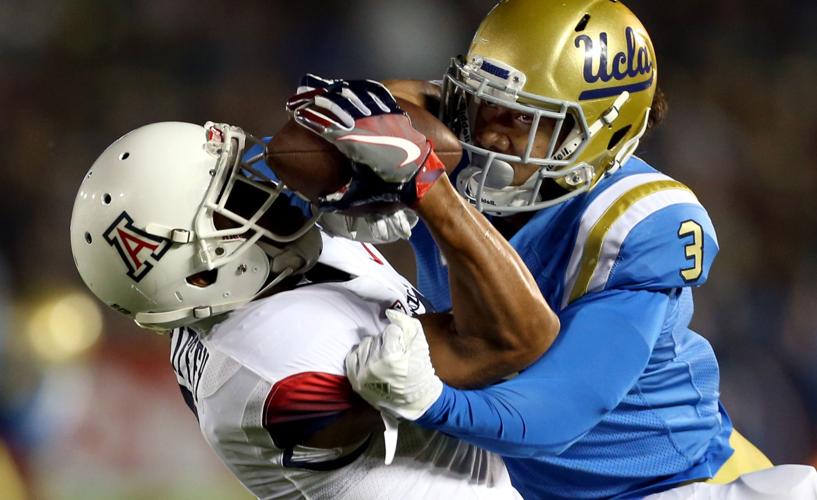
In the past two weeks, Arizona receivers have drawn five pass-interference penalties. Each gave the Wildcats 15 yards and an automatic first down.
Seniors Trey Griffey and Samajie Grant have proved particularly effective at it; each has drawn multiple PI flags this season.
Griffey said the key to getting those calls is to fight through the contact. Position coach Tony Dews instructs his receivers to “just run and let it happen,” Griffey said.
“Fifteen yards is 15 yards,” Dews said. “I think sometimes people don’t realize Trey is as fast as he is. It surprises people. All of a sudden he takes off, and they reach out and grab.”
Pass interference has accounted for half of Arizona’s 12 first downs via penalty this season. If it seems like PI penalties are increasing, UA coach Rich Rodriguez has a theory about that.
Rodriguez said defenses are “trying to take away the easy stuff” from offenses by playing more press coverage. As a result, offenses that rely on short, quick passes are taking more shots down the field.
“They’re … making the quarterback and the receiver execute,” Rodriguez said. “Sometimes they get away with it; sometimes they don’t. A 15-yarder is a lot better than a 50-yarder, so defensive coaches probably say, if you’re losing it, grab him.”
- Updated
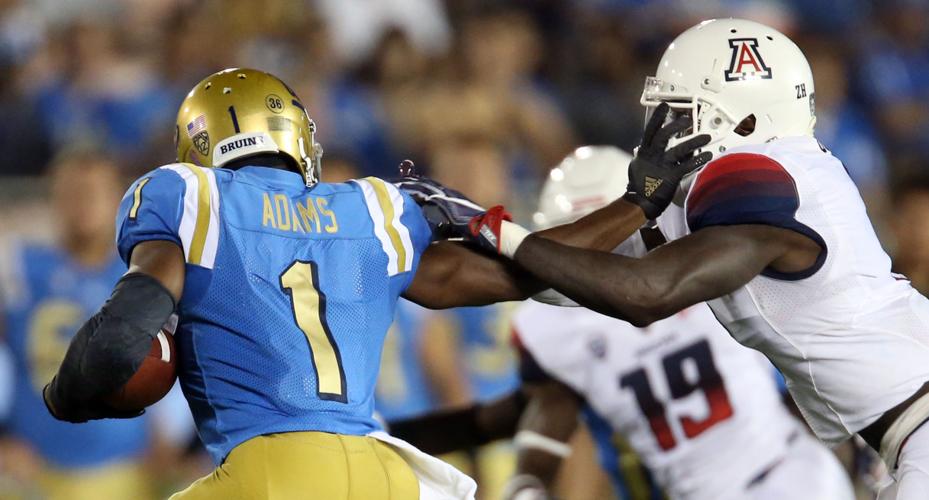
Entering last week’s game against UCLA, Arizona ranked last in the Pac-12 in third-down defense. The Wildcats limited the Bruins to 4 of 12 conversions, a positive step for a unit that it still figuring itself out.
Arizona’s offense also was last in third-down percentage … and got worse.
With quarterbacks, running backs and offensive linemen shuffling in and out of the lineup, the UA was 3 of 16 on third down against UCLA. At 33.3 percent for the season, Arizona was tied for 108th in the nation entering this weekend. Only five teams from Power Five conferences were worse.
Arizona punted on seven consecutive possessions against UCLA, including six three-and-out drives. As a result, the Wildcats couldn’t accomplish two of UA coach Rich Rodriguez’s main offensive goals: establishing a rhythm and wearing down the opposing defense.
As with Arizona’s defensive issues on third down, the offense’s are more of a first- and second-down problem. When the Wildcats need 3 or fewer yards on third down, they convert at a 68.8 percent rate. When they need 4-6 yards, they’re at 36.4 percent. When they need 7 or more, they’re at 13.8. (Those numbers do not include two end-of-game kneel-downs).
“It’s not like we don’t work on it or aren’t conscious of it,” Rodriguez said. “You’ve just got to execute better.”
Utah ranks ninth in the Pac-12 in third-down percentage (39.7) and fourth in third-down defense (37.7). The Utes have converted a league-high nine fourth downs in 10 attempts. The Wildcats are 3 of 9.
- Updated
Arizona defensive lineman Finton Connolly has come a long way since Week 1.
The redshirt freshman from Gilbert Campo Verde High School didn’t dress for the season opener, despite being healthy enough to play. Through four weeks, his lone playing time came late in a blowout victory over Hawaii.
But Connolly kept working, the injuries kept mounting and now Connolly finds himself in a prominent role.
He’s the No. 2 nose tackle behind Aiulua Fanene heading into Saturday’s game at No. 24 Utah. Connolly got his first meaningful action last week against UCLA and he’s in the game plan again against the Utes.
Even though he had played briefly against Hawaii, Connolly said he felt “first-game jitters” last week. There’s a big difference between being part of the rotation and a late-game sub.
“It was a great feeling just to be out there, being back on the field playing again,” Connolly said. “I was nervous. Once I started moving and going, all my nerves were gone.”
Connolly was credited with only one tackle against the Bruins, but it was the sort of play that jumps off the screen. With UCLA starting from its 4-yard line in the fourth quarter, Connolly shot into the backfield and nearly tackled Soso Jamabo for a safety. It ended up as a 3-yard loss back to the 1-yard line.
“I feel a little more confident going into this week,” Connolly said. “I’ve got a lot to work on still, but I think I’m ready. I feel ready. My body feels ready. I’m excited to go in Saturday.”
The nose tackles could be key factors against Utah. The Utes are scrambling at center after senior J.J. Dielman, a 2015 second-team All-Pac-12 selection, suffered a season-ending leg injury.
Utah is expected to run the ball frequently regardless. Fanane (6-5, 308) and Connolly (6-4, 280) provide more bulk than injured starter Parker Zellers (6-1, 247).
But first-year UA defensive line coach Vince Amey doesn’t base his depth chart on size, pedigree or experience.
“I told them from Day 1, I don’t care if you’re a walk-on, a redshirt freshman, a senior, guys that are gonna play are the guys that are gonna work,” Amey said. “The guys that are playing have done that.”
After a slow start, Connolly has become one of those guys.
“I feel like I’ve progressed a long way,” he said. “I’m with the twos. I got some playing time. I’ve just got to keep working on my stuff.”
- Updated
Offensive linemen are, by nature, shrouded in obscurity by virtue of their position. Blocks get less attention than passing touchdowns or broken tackles.
Even by that standard, the Wildcats’ offensive line has its share of unknowns.
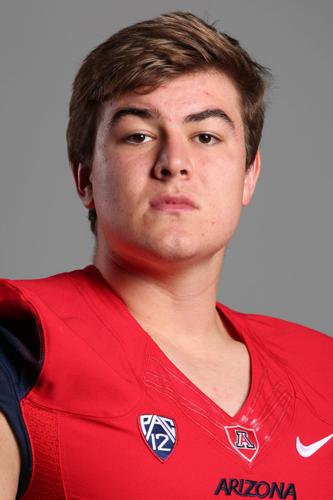
Guards Freddie Tagaloa and Jacob Alsadek and right tackle Gerhard de Beer were all listed on this year’s injury report. All three missed time last week against UCLA. Christian Boettcher, Alex Kosinski and Cody Creason, respectively, played in their place.
Boettcher is notable because of his background — he’s a former walk-on whose lone offers out of Scottsdale’s Desert Mountain High School came from Division II and NAIA programs. He wanted to play in the Ivy League, but an ACL tear his senior season scuttled that.
“I wasn’t the talent that I needed to be to still be a highly recruited guy,” Boettcher said.
So Boettcher walked on at Arizona, largely because of the school’s biochemistry program.
Now he’s on scholarship and a possible starter on Saturday against Utah. Boettcher made his first career start against Hawaii on Sept. 17 and the second last week at UCLA.
Asked this week to name a career highlight, Boettcher recalled being put on scholarship. Coach Rich Rodriguez delivered the news back in May. Here’s how it went Boettcher’s own words:
“They do a good job of keeping it quiet. I called my mom, they don’t give it to you right away, but they let you know, hey, you have a spot. So it was cool, so I called my mom and let her know. She actually wasn’t as emotional as I thought she was going to be. I was crying, personally, and she was … I could tell she was sniffling but not crying. My dad was super excited about it, even more than my mom, but that’s because he runs all the finances (laughs).
“We have end-of-the-spring meetings, so everyone, all 120 guys, they all come in. Coach Rod gives a special talk. Obviously if it’s, like, Anu (Solomon) he says, ‘You’re doing this, this, this and this, we expect you to do this in the fall.’ For some of the other guys they’ll just give, like, ‘Here’s what you need to do, you need to get stronger in the weight room.’ He keeps it personal. When he talked to me, I was the one left guard at that point in the spring so he thought I was going to be a big part of the team. He said, ‘We’d like to put you on scholarship.’”
“I don’t remember the rest of the meeting (laughing). I probably shaked his hand, really shaky.”
“I mean, that’s not where you stop. Once you get that (scholarship), you gotta prove it.”
- Updated
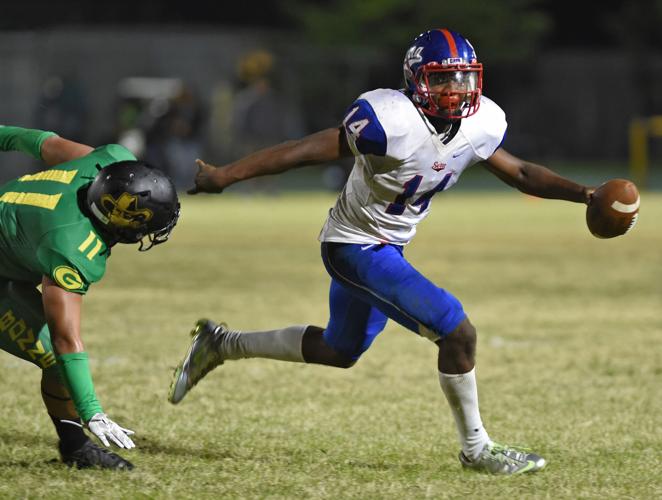
Khalil Tate is on track to make the first college start of his career Saturday, and he’ll battle with an old rival in Utah quarterback Troy Williams.
There’s an alternate universe where that alignment looks quite different.
Back in 2012, Williams, a four-star talent out of Los Angeles’ Narbonne High School, narrowed down his college choices to Washington and Arizona. Spoiler: He didn’t pick the Wildcats.
Williams started with Washington before leaving. He spent time at Santa Monica College before transferring to Utah. He’s now the Utes’ starting quarterback.
If things had been different, maybe Williams would be with the Wildcats on Saturday.
“He’s a good player,” UA coach Rich Rodriguez said. “He’s throwing the ball well, he’s an athletic guy, he’s got a great command of their offense.”
Tate played high school ball at Junipero Serra in Gardena, California. So, it’s Narbonne vs. Serra again, one of the top high school football rivalries in Southern California.
“It’s pretty cool because we played each other in high school,” Tate said. “I was an underclassman. It’s pretty unique to play each other now in college.”
They only played once, back in 2012 when Williams was a senior and Tate a freshman.
Williams’ Gauchos won 22-9, with the quarterback passing for 166 yards and a touchdown.
Tate — and Serra — would have their revenge. Tate was 3-0 against Narbonne as a starter, the last one a 41-40 overtime victory.
In that game, Tate rushed for 295 yards and six touchdowns. UA receiver DeVaughn Cooper played too, finishing with 233 receiving yards and four touchdowns.
Tate’s goal for his latest “matchup” with Williams? Win.
“I like to win,” Tate said. “I come from a winning high school at Serra, so I always win. To lose (last week), it hurts a lot, but I know with a full game I can do better.”
- Arizona Daily Star
It doesn’t show up in the box score, unless you comb through the play-by-play. But football coaches understand its underrated value.
In the past two weeks, Arizona receivers have drawn five pass-interference penalties. Each gave the Wildcats 15 yards and an automatic first down.
Seniors Trey Griffey and Samajie Grant have proved particularly effective at it; each has drawn multiple PI flags this season.
Griffey said the key to getting those calls is to fight through the contact. Position coach Tony Dews instructs his receivers to “just run and let it happen,” Griffey said.
“Fifteen yards is 15 yards,” Dews said. “I think sometimes people don’t realize Trey is as fast as he is. It surprises people. All of a sudden he takes off, and they reach out and grab.”
Pass interference has accounted for half of Arizona’s 12 first downs via penalty this season. If it seems like PI penalties are increasing, UA coach Rich Rodriguez has a theory about that.
Rodriguez said defenses are “trying to take away the easy stuff” from offenses by playing more press coverage. As a result, offenses that rely on short, quick passes are taking more shots down the field.
“They’re … making the quarterback and the receiver execute,” Rodriguez said. “Sometimes they get away with it; sometimes they don’t. A 15-yarder is a lot better than a 50-yarder, so defensive coaches probably say, if you’re losing it, grab him.”
Entering last week’s game against UCLA, Arizona ranked last in the Pac-12 in third-down defense. The Wildcats limited the Bruins to 4 of 12 conversions, a positive step for a unit that it still figuring itself out.
Arizona’s offense also was last in third-down percentage … and got worse.
With quarterbacks, running backs and offensive linemen shuffling in and out of the lineup, the UA was 3 of 16 on third down against UCLA. At 33.3 percent for the season, Arizona was tied for 108th in the nation entering this weekend. Only five teams from Power Five conferences were worse.
Arizona punted on seven consecutive possessions against UCLA, including six three-and-out drives. As a result, the Wildcats couldn’t accomplish two of UA coach Rich Rodriguez’s main offensive goals: establishing a rhythm and wearing down the opposing defense.
As with Arizona’s defensive issues on third down, the offense’s are more of a first- and second-down problem. When the Wildcats need 3 or fewer yards on third down, they convert at a 68.8 percent rate. When they need 4-6 yards, they’re at 36.4 percent. When they need 7 or more, they’re at 13.8. (Those numbers do not include two end-of-game kneel-downs).
“It’s not like we don’t work on it or aren’t conscious of it,” Rodriguez said. “You’ve just got to execute better.”
Utah ranks ninth in the Pac-12 in third-down percentage (39.7) and fourth in third-down defense (37.7). The Utes have converted a league-high nine fourth downs in 10 attempts. The Wildcats are 3 of 9.
Arizona defensive lineman Finton Connolly has come a long way since Week 1.
The redshirt freshman from Gilbert Campo Verde High School didn’t dress for the season opener, despite being healthy enough to play. Through four weeks, his lone playing time came late in a blowout victory over Hawaii.
But Connolly kept working, the injuries kept mounting and now Connolly finds himself in a prominent role.
He’s the No. 2 nose tackle behind Aiulua Fanene heading into Saturday’s game at No. 24 Utah. Connolly got his first meaningful action last week against UCLA and he’s in the game plan again against the Utes.
Even though he had played briefly against Hawaii, Connolly said he felt “first-game jitters” last week. There’s a big difference between being part of the rotation and a late-game sub.
“It was a great feeling just to be out there, being back on the field playing again,” Connolly said. “I was nervous. Once I started moving and going, all my nerves were gone.”
Connolly was credited with only one tackle against the Bruins, but it was the sort of play that jumps off the screen. With UCLA starting from its 4-yard line in the fourth quarter, Connolly shot into the backfield and nearly tackled Soso Jamabo for a safety. It ended up as a 3-yard loss back to the 1-yard line.
“I feel a little more confident going into this week,” Connolly said. “I’ve got a lot to work on still, but I think I’m ready. I feel ready. My body feels ready. I’m excited to go in Saturday.”
The nose tackles could be key factors against Utah. The Utes are scrambling at center after senior J.J. Dielman, a 2015 second-team All-Pac-12 selection, suffered a season-ending leg injury.
Utah is expected to run the ball frequently regardless. Fanane (6-5, 308) and Connolly (6-4, 280) provide more bulk than injured starter Parker Zellers (6-1, 247).
But first-year UA defensive line coach Vince Amey doesn’t base his depth chart on size, pedigree or experience.
“I told them from Day 1, I don’t care if you’re a walk-on, a redshirt freshman, a senior, guys that are gonna play are the guys that are gonna work,” Amey said. “The guys that are playing have done that.”
After a slow start, Connolly has become one of those guys.
“I feel like I’ve progressed a long way,” he said. “I’m with the twos. I got some playing time. I’ve just got to keep working on my stuff.”
Offensive linemen are, by nature, shrouded in obscurity by virtue of their position. Blocks get less attention than passing touchdowns or broken tackles.
Even by that standard, the Wildcats’ offensive line has its share of unknowns.
Guards Freddie Tagaloa and Jacob Alsadek and right tackle Gerhard de Beer were all listed on this year’s injury report. All three missed time last week against UCLA. Christian Boettcher, Alex Kosinski and Cody Creason, respectively, played in their place.
Boettcher is notable because of his background — he’s a former walk-on whose lone offers out of Scottsdale’s Desert Mountain High School came from Division II and NAIA programs. He wanted to play in the Ivy League, but an ACL tear his senior season scuttled that.
“I wasn’t the talent that I needed to be to still be a highly recruited guy,” Boettcher said.
So Boettcher walked on at Arizona, largely because of the school’s biochemistry program.
Now he’s on scholarship and a possible starter on Saturday against Utah. Boettcher made his first career start against Hawaii on Sept. 17 and the second last week at UCLA.
Asked this week to name a career highlight, Boettcher recalled being put on scholarship. Coach Rich Rodriguez delivered the news back in May. Here’s how it went Boettcher’s own words:
“They do a good job of keeping it quiet. I called my mom, they don’t give it to you right away, but they let you know, hey, you have a spot. So it was cool, so I called my mom and let her know. She actually wasn’t as emotional as I thought she was going to be. I was crying, personally, and she was … I could tell she was sniffling but not crying. My dad was super excited about it, even more than my mom, but that’s because he runs all the finances (laughs).
“We have end-of-the-spring meetings, so everyone, all 120 guys, they all come in. Coach Rod gives a special talk. Obviously if it’s, like, Anu (Solomon) he says, ‘You’re doing this, this, this and this, we expect you to do this in the fall.’ For some of the other guys they’ll just give, like, ‘Here’s what you need to do, you need to get stronger in the weight room.’ He keeps it personal. When he talked to me, I was the one left guard at that point in the spring so he thought I was going to be a big part of the team. He said, ‘We’d like to put you on scholarship.’”
“I don’t remember the rest of the meeting (laughing). I probably shaked his hand, really shaky.”
“I mean, that’s not where you stop. Once you get that (scholarship), you gotta prove it.”
Khalil Tate is on track to make the first college start of his career Saturday, and he’ll battle with an old rival in Utah quarterback Troy Williams.
There’s an alternate universe where that alignment looks quite different.
Back in 2012, Williams, a four-star talent out of Los Angeles’ Narbonne High School, narrowed down his college choices to Washington and Arizona. Spoiler: He didn’t pick the Wildcats.
Williams started with Washington before leaving. He spent time at Santa Monica College before transferring to Utah. He’s now the Utes’ starting quarterback.
If things had been different, maybe Williams would be with the Wildcats on Saturday.
“He’s a good player,” UA coach Rich Rodriguez said. “He’s throwing the ball well, he’s an athletic guy, he’s got a great command of their offense.”
Tate played high school ball at Junipero Serra in Gardena, California. So, it’s Narbonne vs. Serra again, one of the top high school football rivalries in Southern California.
“It’s pretty cool because we played each other in high school,” Tate said. “I was an underclassman. It’s pretty unique to play each other now in college.”
They only played once, back in 2012 when Williams was a senior and Tate a freshman.
Williams’ Gauchos won 22-9, with the quarterback passing for 166 yards and a touchdown.
Tate — and Serra — would have their revenge. Tate was 3-0 against Narbonne as a starter, the last one a 41-40 overtime victory.
In that game, Tate rushed for 295 yards and six touchdowns. UA receiver DeVaughn Cooper played too, finishing with 233 receiving yards and four touchdowns.
Tate’s goal for his latest “matchup” with Williams? Win.
“I like to win,” Tate said. “I come from a winning high school at Serra, so I always win. To lose (last week), it hurts a lot, but I know with a full game I can do better.”
More information


View this profile on Instagram#ThisIsTucson 🌵 (@this_is_tucson) • Instagram photos and videos
Most viewed stories
-
Conservation park for endangered animal could open south of Tucson
-
Surprise! Wildflower season is starting early. Here's where to find the best blooms 🌼
-
43 events you won't want to miss, February 20-22! 🤠🐎
-
Over 60 fun events happening in Tucson in February 💖🐎
-
New owner saves Tucson's oldest bookstore from closing
-
Jamie vs. Sonoran dogs: Follow me as I take on Visit Tucson's Sonoran Dog Trail 🌭
-
A new chapter: Crossroads Restaurant is back open after fire