

Arizona Wildcats hit a switch, and they could zoom all the way to the Final Four
Arizona is at its best heading into Thursday's Sweet 16 showdown with Xavier.
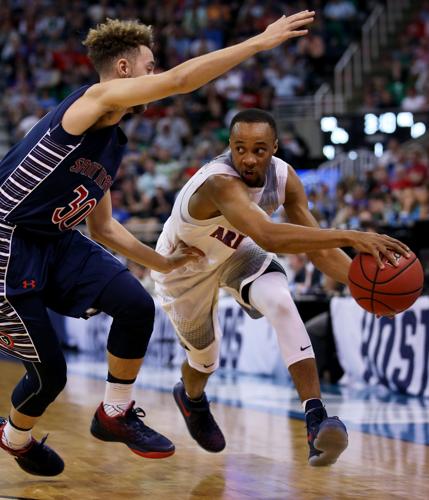
Parker Jackson-Cartwright had a sneaking suspicion after Arizona knocked off UCLA in the Pac-12 Tournament semifinals on March 10.
“We’ve hit a switch, I think,” the UA point guard said that night. “We’ve turned a corner.”
So far, he’s right.
Arizona kept the momentum going into the Pac-12 Tournament final against Oregon and two NCAA Tournament games last weekend, and it heads into the Sweet 16 this week playing probably as well as it has all season.
That momentum, plus the geographical edge they have by playing another weekend in Pac-12 country, suggest making their first Final Four in 16 years is a very real possibility.
Here are five reasons why they might do it:
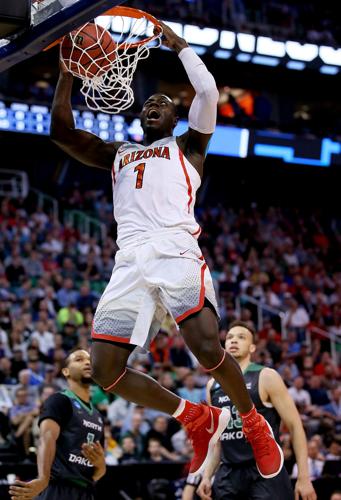
Arizona has averaged 86 points since the start of the Pac-12 Tournament, and that number isn’t just a factor of playing uptempo-minded teams such as UCLA, Oregon and North Dakota.
The Wildcats, who normally play at one of the slower tempos in Division I, are thriving at faster paces and scoring efficiently no matter what the speed limit is.
In short, they can get it done either way.
“Everyone’s different,” Jackson-Cartwright said. “That’s what makes this team so unique. I think we can switch our tempos fast and slow. It’s not about the pace. It’s about doing what makes us good all year.”
The box scores last weekend made that obvious. Both forward Lauri Markkanen and wing Rawle Alkins scored 20 points in the first round against North Dakota, while UA’s three other starters all scored in double figures, too.
Against Saint Mary’s, the only starter who didn’t hit double figures was Alkins, who broke a finger in the first half but was credited with some key inspiration by getting back in the game before halftime.
In both games, UA had Alkins and Kadeem Allen driving in for layups, Allonzo Trier getting to the free-throw line, Dusan Ristic shooting over 50 percent inside, and Markkanen scoring in a variety of ways.
“We can kind of slow it down and throw it inside, to Chance (Comanche) and Lauri and Dusan can make plays down low,” Jackson-Cartwright said. “We’ve got guys in transition who can make plays like Rawle and Deem (Allen) and Kobi (Simmons). We’ve got guys who can do different things.”
The versatility not only helps the Wildcats adjust to their opponents but also gives them ways to survive when somebody like Alkins gets hurt or in foul trouble.
Often, there’s an answer, somehow or some way.
“We’ve been that team all year,” UA coach Sean Miller said. “We’ve had different players play well in different games. We’re a balanced team.”
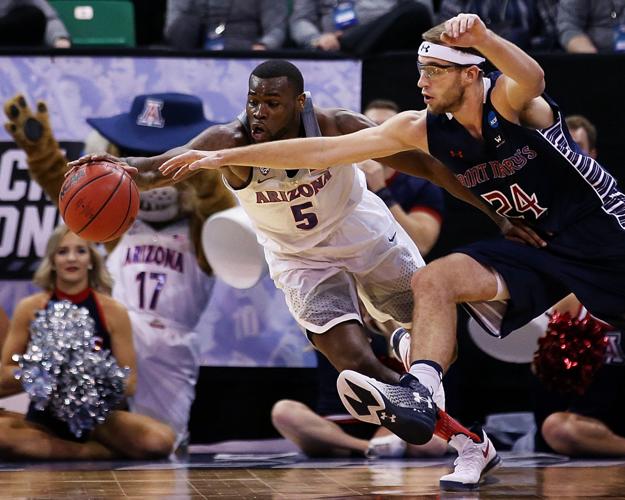
While there’s still some concerns overall with the Wildcats’ defense – which allowed Oregon, North Dakota and Saint Mary’s to all shoot 50 percent or better for a half – Arizona has tightened up in recent weeks.
Their defense is now ranked No. 24 in efficiency, according to kenpom.com, allowing just 94.8 points per 100 opponent possessions. And since UA’s blowout loss in Eugene, Oregon, on Feb. 4, when the Ducks shot 64 percent from 3-point territory, Arizona has kept its opponents under the 33 percent mark from long range in 10 of 12 games.
“Since that loss we’ve had to really buckle down on defense especially,” Jackson-Cartwright said. “Up in Eugene, they played a really good game. We obviously didn’t.”
Last weekend provided a two-part test. Fast-paced North Dakota hit 10 of 22 3-pointers (45.5 percent) in the first round last Thursday.
When Arizona had a chance to settle into its defense more often against slower Saint Mary’s, the Wildcats helped keep the Gaels to just 23.8 percent from 3-point range, despite the heavy screening that had helped Saint Mary’s shoot nearly 40 percent from long range entering the game.
“They were a very difficult team to defend,” Miller said of North Dakota. “I think our players learned a team like that who moves the ball and has such great movement, your margin for error is razor-thin.
“But we really worked on it, really tried to show a lot of film, make that an emphasis.”
Both Miller and Saint Mary’s coach Randy Bennett said the Gaels also just plain missed on some good looks they managed to get, but Bennett said the Wildcats don’t exactly make anything easy.
“They’ll give you 3s, but they’re flying at you when you shoot them and they’re pretty athletic so they can get a big hand up there,” Bennett said. “We had some open ones we needed to make. Sometimes the game comes down to it. A big part of our game is shooting the ball from three and we didn’t shoot it well enough.”
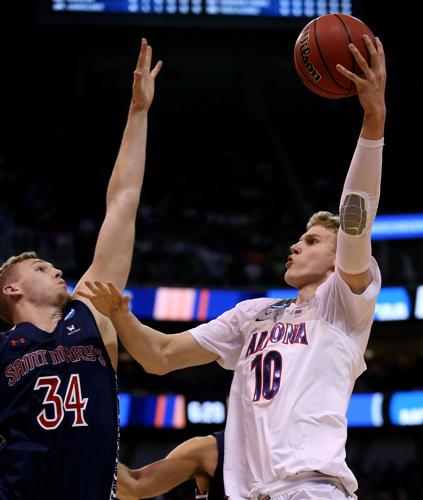
While hitting over half of his 3-pointers through UA’s first 20 games, the Wildcats’ 7-foot Finnish phenom bolted his way up solid lottery pick status in the expected event he turns pro this spring.
But what happened during his perimeter shooting slump in February — he shot 14.2 percent from 3-point range between Feb. 4 and March 4 — ironically may have boosted in his NBA stock.
Because he wasn’t shooting well, Markkanen went inside more often, proving himself around the rim by scoring off rebounds and post ups. He even earned the Pac-12’s Player of the Week award for his production during UA’s mid-February road sweep in Washington, despite the fact that he went a combined 1 for 6 from 3-point range that weekend.
But Markkanen broke out again from deep in the Pac-12 Tournament quarterfinals, hitting 4 of 7 against Colorado. He was 4 of 10 against UCLA the next day.
So now that Markkanen’s shot appears to be largely fixed — he’s 9 of 19 (47.4 percent) from 3-point range since the start of the Pac-12 Tournament — he’s literally a scoring threat from anywhere inside 22 feet.
“He hit a slump, but it just took him that one game, that one shot to really get it back going,” Jackson-Cartwright said. “Since that’s happened I think every part of his game has really flourished since then.”
And that’s just his offense.
What Markkanen has also done, quietly, is improve defensively consistently as the season has gone on. He went from an overly aggressive defender who picked up easy fouls early in the season to a passive defender afraid of fouling while he adjusted from international ball to college officiating. Now, he’s a carefully aggressive defender who blocked two Saint Mary’s shots on Saturday.
While overall defense is sometimes difficult to gauge, the fact that Markkanen defended Saint Mary’s center Jock Landale was telling — earlier this season, Miller might have tried Dusan Ristic or Chance Comanche on the skilled inside scorer.
“Lauri’s post defense was terrific down the home stretch,” Miller said after the Saint Mary’s game.
The funny thing is, you’d hardly know whether things were going well or not by speaking with Markkanen, who is every bit the stoic Finn when asked about his game.
“I did everything same way,” Markkanen said of his slump. “I tried to stay neutral, not get too high, not get too low. It’s a balance that helps me. I think I’m like that as a person not only in sports but everything.”
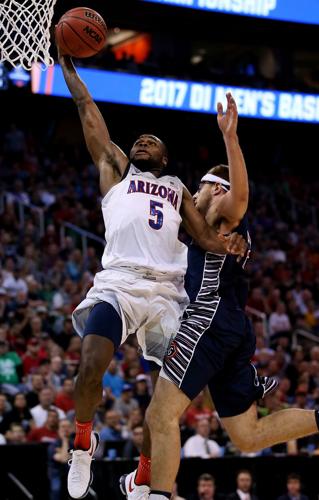
Kadeem Allen is only Arizona’s fifth-leading scorer (8.8 points per game), and his 3.0 assists per game trails Jackson-Cartwright (4.1) for the team lead. He’s also one of the Wildcats’ quietest off-court personalities.
But there isn’t any doubt where Miller looks to his on-court leadership from.
“He’s our team’s heart and soul,” Miller said. “Everybody on our team respects him a great deal because he only cares about winning. He really does. I’ve never, ever had a conversation nor has anybody about how many shots he gets or points. And he’s in this for the right reasons.”
Allen says the confidence his coaches and teammates have given him have also helped his ability to lead, to “carry it on the court and bring it every day for these guys.”
Allen’s leadership also stems from the fact that, at age 24, he’s by far the oldest player on the team. Allen has been in the program as long as anybody else, sitting out as a redshirting junior college transfer in 2014-15 when Jackson-Cartwright and Dusan Ristic played as freshmen.
Back then, you could project Allen to grow into a contributing player but maybe not as a leader.
“If you would have told our team a few years ago that Kadeem Allen would be the great leader he is today, they would have all bet me,” Miller said. “Because he was just trying to make it when he first got to Arizona. You think of a guy like a T.J. McConnell, who became a great leader for us a couple years ago, Kadeem is his equal. He does it in a different way, but he does it by example.
“I can’t say enough good things about him. That’s why we want to keep going because with somebody like him you want this season to grow.”
Before the Pac-12 Tournament, Arizona sat firmly in the middle of the three-seed line behind Oregon in line for a preferential NCAA Tournament spot, having only one win over a Top 25 RPI team at that point.
That meant the Wildcats were likely headed to the South or Midwest regions as a No. 3 seed unless they somehow beat both UCLA and Oregon.
Then they beat the Bruins, in part by holding gunner Bryce Alford to just 1 for 10 shooting from 3-point range, while Oregon learned that standout forward Chris Boucher had torn his ACL earlier that evening against California.
The next day, Arizona beat Oregon by three points — a win that may or may not have been different if Boucher played — and moved past the Ducks and to the No. 2 seed line.
That meant, all of a sudden, the Wildcats were headed to San Jose, California, if they could win their first two tournament games in Salt Lake City.
That meant possibly playing Gonzaga on Saturday, within the Pac-12 footprint and presumably before thousands of their own fans, instead of traveling to Kansas City, Memphis or New York for the right to get to the Final Four.
A Final Four that’s in Glendale, no less.
It would be Miller’s first Final Four after four Elite Eight losses, one at Xavier and three at Arizona. As much as the UA coach talks about the importance of the journey and regular-season accomplishments, he also knows the outside world doesn’t always see it that way.
“At the end of the day all of us are judged by what happens in March,” Miller said. “I think for us to duck that or look at that as not being the case is somewhat unrealistic. For us, it’s ‘you have to advance.’ You want to take advantage of a good seed. You want to play your best basketball in March.
“And if that happens and you still don’t advance or win then, I think all of us walk away with our head held high. And we’ll put our ball away and come back next year.”
Parker Jackson-Cartwright had a sneaking suspicion after Arizona knocked off UCLA in the Pac-12 Tournament semifinals on March 10.
“We’ve hit a switch, I think,” the UA point guard said that night. “We’ve turned a corner.”
So far, he’s right.
Arizona kept the momentum going into the Pac-12 Tournament final against Oregon and two NCAA Tournament games last weekend, and it heads into the Sweet 16 this week playing probably as well as it has all season.
That momentum, plus the geographical edge they have by playing another weekend in Pac-12 country, suggest making their first Final Four in 16 years is a very real possibility.
Here are five reasons why they might do it:
Arizona has averaged 86 points since the start of the Pac-12 Tournament, and that number isn’t just a factor of playing uptempo-minded teams such as UCLA, Oregon and North Dakota.
The Wildcats, who normally play at one of the slower tempos in Division I, are thriving at faster paces and scoring efficiently no matter what the speed limit is.
In short, they can get it done either way.
“Everyone’s different,” Jackson-Cartwright said. “That’s what makes this team so unique. I think we can switch our tempos fast and slow. It’s not about the pace. It’s about doing what makes us good all year.”
The box scores last weekend made that obvious. Both forward Lauri Markkanen and wing Rawle Alkins scored 20 points in the first round against North Dakota, while UA’s three other starters all scored in double figures, too.
Against Saint Mary’s, the only starter who didn’t hit double figures was Alkins, who broke a finger in the first half but was credited with some key inspiration by getting back in the game before halftime.
In both games, UA had Alkins and Kadeem Allen driving in for layups, Allonzo Trier getting to the free-throw line, Dusan Ristic shooting over 50 percent inside, and Markkanen scoring in a variety of ways.
“We can kind of slow it down and throw it inside, to Chance (Comanche) and Lauri and Dusan can make plays down low,” Jackson-Cartwright said. “We’ve got guys in transition who can make plays like Rawle and Deem (Allen) and Kobi (Simmons). We’ve got guys who can do different things.”
The versatility not only helps the Wildcats adjust to their opponents but also gives them ways to survive when somebody like Alkins gets hurt or in foul trouble.
Often, there’s an answer, somehow or some way.
“We’ve been that team all year,” UA coach Sean Miller said. “We’ve had different players play well in different games. We’re a balanced team.”
While there’s still some concerns overall with the Wildcats’ defense – which allowed Oregon, North Dakota and Saint Mary’s to all shoot 50 percent or better for a half – Arizona has tightened up in recent weeks.
Their defense is now ranked No. 24 in efficiency, according to kenpom.com, allowing just 94.8 points per 100 opponent possessions. And since UA’s blowout loss in Eugene, Oregon, on Feb. 4, when the Ducks shot 64 percent from 3-point territory, Arizona has kept its opponents under the 33 percent mark from long range in 10 of 12 games.
“Since that loss we’ve had to really buckle down on defense especially,” Jackson-Cartwright said. “Up in Eugene, they played a really good game. We obviously didn’t.”
Last weekend provided a two-part test. Fast-paced North Dakota hit 10 of 22 3-pointers (45.5 percent) in the first round last Thursday.
When Arizona had a chance to settle into its defense more often against slower Saint Mary’s, the Wildcats helped keep the Gaels to just 23.8 percent from 3-point range, despite the heavy screening that had helped Saint Mary’s shoot nearly 40 percent from long range entering the game.
“They were a very difficult team to defend,” Miller said of North Dakota. “I think our players learned a team like that who moves the ball and has such great movement, your margin for error is razor-thin.
“But we really worked on it, really tried to show a lot of film, make that an emphasis.”
Both Miller and Saint Mary’s coach Randy Bennett said the Gaels also just plain missed on some good looks they managed to get, but Bennett said the Wildcats don’t exactly make anything easy.
“They’ll give you 3s, but they’re flying at you when you shoot them and they’re pretty athletic so they can get a big hand up there,” Bennett said. “We had some open ones we needed to make. Sometimes the game comes down to it. A big part of our game is shooting the ball from three and we didn’t shoot it well enough.”
While hitting over half of his 3-pointers through UA’s first 20 games, the Wildcats’ 7-foot Finnish phenom bolted his way up solid lottery pick status in the expected event he turns pro this spring.
But what happened during his perimeter shooting slump in February — he shot 14.2 percent from 3-point range between Feb. 4 and March 4 — ironically may have boosted in his NBA stock.
Because he wasn’t shooting well, Markkanen went inside more often, proving himself around the rim by scoring off rebounds and post ups. He even earned the Pac-12’s Player of the Week award for his production during UA’s mid-February road sweep in Washington, despite the fact that he went a combined 1 for 6 from 3-point range that weekend.
But Markkanen broke out again from deep in the Pac-12 Tournament quarterfinals, hitting 4 of 7 against Colorado. He was 4 of 10 against UCLA the next day.
So now that Markkanen’s shot appears to be largely fixed — he’s 9 of 19 (47.4 percent) from 3-point range since the start of the Pac-12 Tournament — he’s literally a scoring threat from anywhere inside 22 feet.
“He hit a slump, but it just took him that one game, that one shot to really get it back going,” Jackson-Cartwright said. “Since that’s happened I think every part of his game has really flourished since then.”
And that’s just his offense.
What Markkanen has also done, quietly, is improve defensively consistently as the season has gone on. He went from an overly aggressive defender who picked up easy fouls early in the season to a passive defender afraid of fouling while he adjusted from international ball to college officiating. Now, he’s a carefully aggressive defender who blocked two Saint Mary’s shots on Saturday.
While overall defense is sometimes difficult to gauge, the fact that Markkanen defended Saint Mary’s center Jock Landale was telling — earlier this season, Miller might have tried Dusan Ristic or Chance Comanche on the skilled inside scorer.
“Lauri’s post defense was terrific down the home stretch,” Miller said after the Saint Mary’s game.
The funny thing is, you’d hardly know whether things were going well or not by speaking with Markkanen, who is every bit the stoic Finn when asked about his game.
“I did everything same way,” Markkanen said of his slump. “I tried to stay neutral, not get too high, not get too low. It’s a balance that helps me. I think I’m like that as a person not only in sports but everything.”
Kadeem Allen is only Arizona’s fifth-leading scorer (8.8 points per game), and his 3.0 assists per game trails Jackson-Cartwright (4.1) for the team lead. He’s also one of the Wildcats’ quietest off-court personalities.
But there isn’t any doubt where Miller looks to his on-court leadership from.
“He’s our team’s heart and soul,” Miller said. “Everybody on our team respects him a great deal because he only cares about winning. He really does. I’ve never, ever had a conversation nor has anybody about how many shots he gets or points. And he’s in this for the right reasons.”
Allen says the confidence his coaches and teammates have given him have also helped his ability to lead, to “carry it on the court and bring it every day for these guys.”
Allen’s leadership also stems from the fact that, at age 24, he’s by far the oldest player on the team. Allen has been in the program as long as anybody else, sitting out as a redshirting junior college transfer in 2014-15 when Jackson-Cartwright and Dusan Ristic played as freshmen.
Back then, you could project Allen to grow into a contributing player but maybe not as a leader.
“If you would have told our team a few years ago that Kadeem Allen would be the great leader he is today, they would have all bet me,” Miller said. “Because he was just trying to make it when he first got to Arizona. You think of a guy like a T.J. McConnell, who became a great leader for us a couple years ago, Kadeem is his equal. He does it in a different way, but he does it by example.
“I can’t say enough good things about him. That’s why we want to keep going because with somebody like him you want this season to grow.”
Before the Pac-12 Tournament, Arizona sat firmly in the middle of the three-seed line behind Oregon in line for a preferential NCAA Tournament spot, having only one win over a Top 25 RPI team at that point.
That meant the Wildcats were likely headed to the South or Midwest regions as a No. 3 seed unless they somehow beat both UCLA and Oregon.
Then they beat the Bruins, in part by holding gunner Bryce Alford to just 1 for 10 shooting from 3-point range, while Oregon learned that standout forward Chris Boucher had torn his ACL earlier that evening against California.
The next day, Arizona beat Oregon by three points — a win that may or may not have been different if Boucher played — and moved past the Ducks and to the No. 2 seed line.
That meant, all of a sudden, the Wildcats were headed to San Jose, California, if they could win their first two tournament games in Salt Lake City.
That meant possibly playing Gonzaga on Saturday, within the Pac-12 footprint and presumably before thousands of their own fans, instead of traveling to Kansas City, Memphis or New York for the right to get to the Final Four.
A Final Four that’s in Glendale, no less.
It would be Miller’s first Final Four after four Elite Eight losses, one at Xavier and three at Arizona. As much as the UA coach talks about the importance of the journey and regular-season accomplishments, he also knows the outside world doesn’t always see it that way.
“At the end of the day all of us are judged by what happens in March,” Miller said. “I think for us to duck that or look at that as not being the case is somewhat unrealistic. For us, it’s ‘you have to advance.’ You want to take advantage of a good seed. You want to play your best basketball in March.
“And if that happens and you still don’t advance or win then, I think all of us walk away with our head held high. And we’ll put our ball away and come back next year.”


View this profile on Instagram#ThisIsTucson 🌵 (@this_is_tucson) • Instagram photos and videos
Most viewed stories
-
This Tucson chef has been named a semifinalist for prestigious James Beard Award 🎉
-
Sparkle City: Gem shows season has started — here's what to know
-
30 fun events happening in Tucson January 23-25! 🪩
-
Looking ahead to Tucson's new and cool for '26
-
A saber tooth tiger fossil, gemstone paintings, and more: Here's the low-down on 4 Tucson gem shows! 💎
-
Horchata lattes and breakfast burritos: Tucson's Barista del Barrio opens 2nd location
-
Nearly 50 fun events happening in the month of January! ✨
-
These 2 local restaurants are bringing the wagyu smashburger trend to Tucson 🍔
-
Get ready to eat all the spicy tuna rolls you can at this viral sushi spot 🍣