

Arizona Wildcats, 3 other powers determined to give Final Four a Western flavor
No team from the West has won a national championship since Arizona took it all in 1997.

That the Final Four hasn’t been to a Western site in 22 years is a matter of simple logistics: Until recently, the region hasn’t had a domed facility big enough to host one since the Seattle Kingdome was blown up in 2000.
That the Final Four hasn’t had any Western influence for nearly a decade is another story.
Since UCLA reached college basketball’s pinnacle weekend three straight times from 2006-08, there hasn’t been anybody west of the Rockies good enough to make it, though Arizona (in 2011, 2014 and 2015) came achingly close in Elite Eight losses.
All that history could come to an end in Glendale later this month.
Gonzaga, Arizona, UCLA and Oregon all have a shot at reaching the Final Four at University of Phoenix Stadium, the first Western Final Four site since the Kingdome hosted UCLA’s 1995 championship.
“I hope it happens,” Arizona coach Sean Miller says.
So does former Arizona State and NBA standout Fat Lever. A Tucson legend who starred at Pueblo High School, Lever said he follows the college game closely from his home base in Phoenix.
“Let’s hope it changes,” Lever said at a Final Four event in Phoenix earlier this season. “Let’s hope it changes. I root for all the Pac-12 if ASU’s not there.”
Up to three of the Western teams can conceivably do it — Gonzaga (No. 1) or Arizona (2) have been placed together in the West region — and each of the four teams can build an argument why they will be there.
Actually, folks all over the country are doing the arguing for them this week.
Former UA standout Miles Simon, who led the Wildcats to their 1997 national championship, picked North Carolina to beat Arizona in the championship game. The Sporting News’ Mike DeCourcy picked Arizona to win the West Region, too.
Of ESPN’s “GameDay” crew, Jay Bilas and Jay Williams both picked Arizona to win the West and lose in the national semifinal. Rece Davis put both Gonzaga and Oregon into his Final Four, while former coach Seth Greenberg even had UCLA beating Arizona in the national championship game.
Of the players involved, nobody might be more qualified to discuss the West teams’ chances than sixth-year Oregon senior Dylan Ennis, a Canadian guard who has some perspective: He played at both Rice and Villanova before transferring to the Ducks as a grad transfer in 2015.
And guess what? Ennis is high on everyone’s chances in the region.
“Oh yeah, for sure,” Ennis said last week at the Pac-12 Tournament. “When I was in the Big East, I always had that confidence in the Providences, the Butlers and all them. But coming out here I have that same confidence in the UCLAs and Arizonas. … I definitely think there’s the potential that we’d all meet up somewhere close to the trophy.”
Said UCLA senior Bryce Alford, a four-year starter in the Pac-12: “I think many of us can make it. There’s a lot of talented teams out here.”
All that is the kind of discussion Dan Gavitt can appreciate. Gavitt, the NCAA’s vice president for basketball championships, said his goal is that the best and most-deserving teams make the Final Four, but noted the additional boost a local team can bring.
“If Arizona, UCLA, Gonzaga or Oregon were to advance here, it would bring an extra level of excitement, I would think,” Gavitt said of the Phoenix event.
“It is neat that in particular you’ve got so many Final Four contenders this year and I think it’s something that the committee envisioned and hoped for when they awarded Phoenix the Final Four. This is a way to celebrate basketball in this region and this area.”
Here’s why the West’s best can join the backyard party:
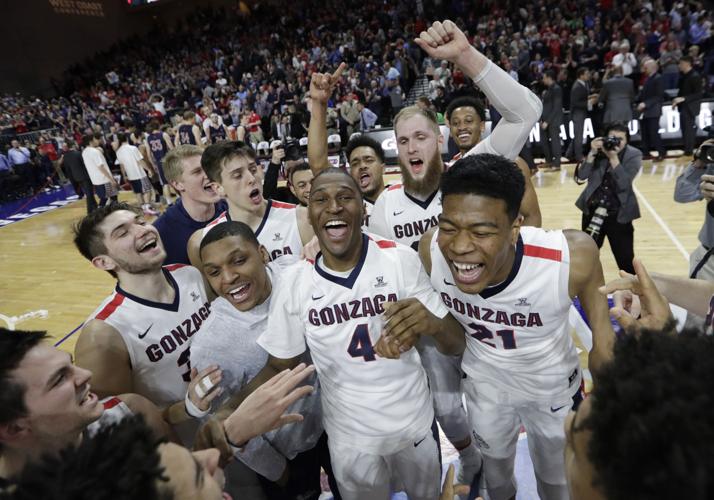
Both The Sporting News and USA Today named Gonzaga’s Mark Few their coach of the year for the job he did not only in leading the Zags to a nearly undefeated season, but also for mixing together a blend of international players, transfers and freshmen.
Gonzaga also proved itself before West Coast Conference play by running the table through a nonconference schedule that included Florida, Iowa State, Tennessee and Arizona (though UA was without guards Allonzo Trier and Parker Jackson-Cartwright for that Dec. 3 game).
The knock on the Zags, of course, is even tougher than the rep Arizona has taken for losing in four straight Elite Eight appearances: Gonzaga has reached 18 straight NCAA Tournaments but has never reached a Final Four.
And Salt Lake City, where Gonzaga will open play along with Arizona on Thursday, may be among the Zags’ worst memories: In 2013, they were seeded No. 1 but struggled in an opener against No. 16 Southern and then lost to Wichita State in the second round of the same arena they will play in Thursday.
But with a veteran group anchored on both ends by the inside dominance of Polish center Przemek Karnowski and the skilled playmaking of point guard Nigel Williams-Goss, this could be a different year.
It could be their year.
“They’re tough,” Ennis said. “A lot of people say their conference isn’t that great, but look what they did in the nonconference. They’re still beating great teams. You have to give them the respect. They’re gonna still be a tough team in the tournament.”
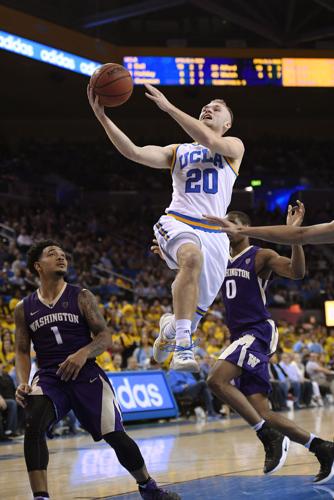
Forget about the Pac-12 Tournament for a second — when UCLA struggled with USC and lost to Arizona in the semifinals — and you just might be looking at the hottest team and the best offense in the country.
The Bruins have the nation’s third-best offensive efficiency (scoring 122.7 points per 100 possessions) — and run at the 13th-fastest tempo.
They’re powered by the uncannily sharp passing and basketball IQ of point guard Lonzo Ball — who suffered a thumb injury while struggling somewhat against Arizona last Friday — and can hit 3s from four positions.
They established all that offense early, even beating Kentucky 97-92 at Rupp Arena on Dec. 3, but the key addition since consecutive losses in late January (to Arizona and USC) has been their defense.
It’s not great but improved … and maybe good enough to support that offense all the way to Glendale.
“Our defense has been on the rise since the beginning of February,” Alford said. “We’ve changed our mindset on that end and figured out how to get stops when we need them. We might not be a team that shuts you down all game, but when we need to get stops, we get stops.”
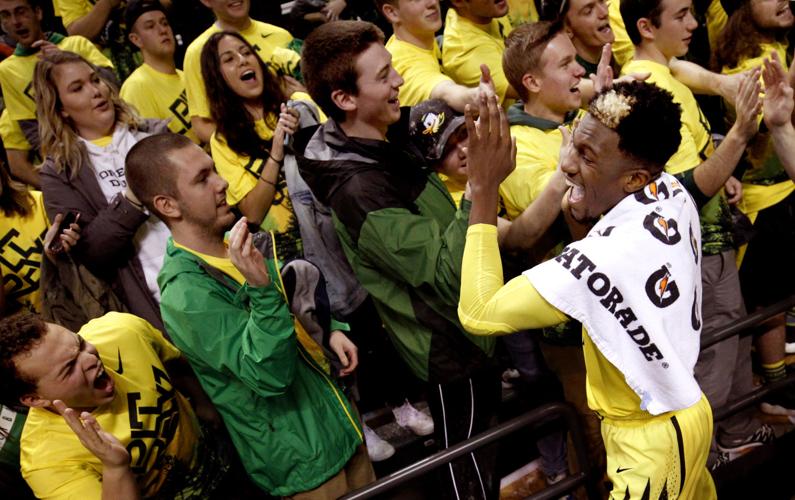
In just two days, the Ducks appeared to go from the West’s No. 1 or No. 2 seed to the No. 3 in the Midwest, casting doubt on their ability to exceed or at least match their Elite Eight run of last season.
First, springy big man Chris Boucher tore his ACL in a Pac-12 Tournament semifinal win over Cal and then the Ducks lost to Arizona in the final. Both appeared to hurt their seeding.
While Oregon still had enough without Boucher to cut Arizona’s 14-point second-half lead all the way down to two points in Saturday’s final, the long-term effect of Boucher’s loss could be significant.
Oregon has another shot-blocker to plug into Boucher’s place, Englishman Kavell Bigby-Williams, but it can’t replace the kind of matchup nightmares Boucher created for the Oregon’s opponents. Boucher is surprisingly athletic at 6-foot-10 and has been hitting his nearly unguardable 3-pointers at a 35 percent rate.
But Miller said he believes the Ducks will get better this week once they have more time to reorganize themselves without Boucher.
And, of course, the Ducks still have Dillon Brooks.
The Pac-12 Player of the Year is known for athletic ability, shooting and intuition that can foil bigger and smaller players alike, a matchup nightmare so bad that the Wildcats started reserve forward Keanu Pinder on Saturday for the sole reason avoiding the potential fouls Lauri Markkanen might pick up if he tried to guard Brooks.
Oregon also proved in the semifinals against Cal that when Brooks has a rough night, they also still have some other guys to turn to. Brooks played only 21 minutes in that game because of foul trouble, but Tyler Dorsey had 23 points, Ennis shot 9 of 9 free throws en route to 16 points, and center Jordan Bell had 15 rebounds and five blocks.
“A lot of reporters and analysts say ‘the Ducks ain’t nothing without Dillon,’ and we show every time that we can play without me,” Brooks said. “Even if we’re having a bad game or I’m having a tough game, guys can pick it up.
“It’s the next man up. It’s a team game.”
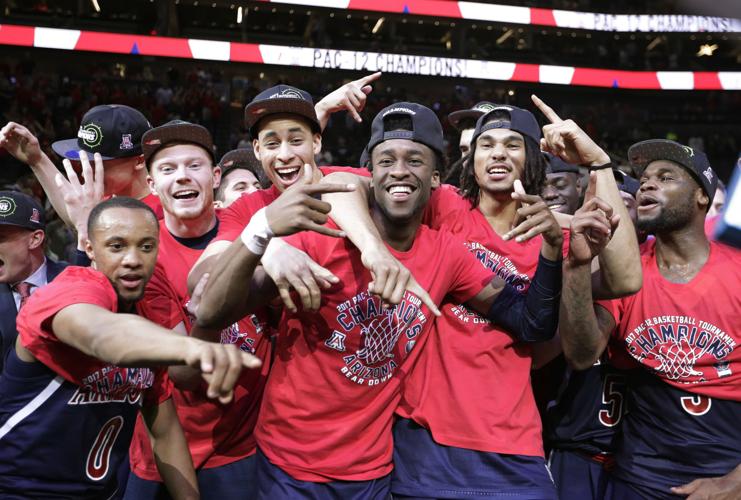
Stuck on a plateau after beating UCLA at Pauley Pavilion on Jan. 21 while they figured out how to fully integrate Allonzo Trier into the rotation, the Wildcats finally began accelerating last week.
At just the right time.
UA knocked off Colorado, UCLA and Oregon to win the Pac-12 Tournament and pick up a pair of Top-10 wins that boosted them to the No. 2 seed line on Selection Sunday.
While Boucher’s absence might have made a difference on Saturday, the more important thing for the Wildcats was that they showed the kind of all-around offensive firepower at every position — especially between Trier and the previously slumping Lauri Markkanen — that Final Four teams are often made of.
“The one asterisk I put next to (Oregon) is Chris Boucher — it’s a shame what happened to him,” Miller said. “I think it would be misrepresenting it if I didn’t mention when we played them he didn’t play.
“But nonetheless we beat them and when you’re able to bet three teams like that on consecutive nights on a neutral court, you have a lot of confidence. For us building on that confidence, and taking that type of confidence with us on a neutral court in Salt Lake City, there’s no question we want to keep it going.”
Maybe all the way to Glendale.
That the Final Four hasn’t been to a Western site in 22 years is a matter of simple logistics: Until recently, the region hasn’t had a domed facility big enough to host one since the Seattle Kingdome was blown up in 2000.
That the Final Four hasn’t had any Western influence for nearly a decade is another story.
Since UCLA reached college basketball’s pinnacle weekend three straight times from 2006-08, there hasn’t been anybody west of the Rockies good enough to make it, though Arizona (in 2011, 2014 and 2015) came achingly close in Elite Eight losses.
All that history could come to an end in Glendale later this month.
Gonzaga, Arizona, UCLA and Oregon all have a shot at reaching the Final Four at University of Phoenix Stadium, the first Western Final Four site since the Kingdome hosted UCLA’s 1995 championship.
“I hope it happens,” Arizona coach Sean Miller says.
So does former Arizona State and NBA standout Fat Lever. A Tucson legend who starred at Pueblo High School, Lever said he follows the college game closely from his home base in Phoenix.
“Let’s hope it changes,” Lever said at a Final Four event in Phoenix earlier this season. “Let’s hope it changes. I root for all the Pac-12 if ASU’s not there.”
Up to three of the Western teams can conceivably do it — Gonzaga (No. 1) or Arizona (2) have been placed together in the West region — and each of the four teams can build an argument why they will be there.
Actually, folks all over the country are doing the arguing for them this week.
Former UA standout Miles Simon, who led the Wildcats to their 1997 national championship, picked North Carolina to beat Arizona in the championship game. The Sporting News’ Mike DeCourcy picked Arizona to win the West Region, too.
Of ESPN’s “GameDay” crew, Jay Bilas and Jay Williams both picked Arizona to win the West and lose in the national semifinal. Rece Davis put both Gonzaga and Oregon into his Final Four, while former coach Seth Greenberg even had UCLA beating Arizona in the national championship game.
Of the players involved, nobody might be more qualified to discuss the West teams’ chances than sixth-year Oregon senior Dylan Ennis, a Canadian guard who has some perspective: He played at both Rice and Villanova before transferring to the Ducks as a grad transfer in 2015.
And guess what? Ennis is high on everyone’s chances in the region.
“Oh yeah, for sure,” Ennis said last week at the Pac-12 Tournament. “When I was in the Big East, I always had that confidence in the Providences, the Butlers and all them. But coming out here I have that same confidence in the UCLAs and Arizonas. … I definitely think there’s the potential that we’d all meet up somewhere close to the trophy.”
Said UCLA senior Bryce Alford, a four-year starter in the Pac-12: “I think many of us can make it. There’s a lot of talented teams out here.”
All that is the kind of discussion Dan Gavitt can appreciate. Gavitt, the NCAA’s vice president for basketball championships, said his goal is that the best and most-deserving teams make the Final Four, but noted the additional boost a local team can bring.
“If Arizona, UCLA, Gonzaga or Oregon were to advance here, it would bring an extra level of excitement, I would think,” Gavitt said of the Phoenix event.
“It is neat that in particular you’ve got so many Final Four contenders this year and I think it’s something that the committee envisioned and hoped for when they awarded Phoenix the Final Four. This is a way to celebrate basketball in this region and this area.”
Here’s why the West’s best can join the backyard party:
Both The Sporting News and USA Today named Gonzaga’s Mark Few their coach of the year for the job he did not only in leading the Zags to a nearly undefeated season, but also for mixing together a blend of international players, transfers and freshmen.
Gonzaga also proved itself before West Coast Conference play by running the table through a nonconference schedule that included Florida, Iowa State, Tennessee and Arizona (though UA was without guards Allonzo Trier and Parker Jackson-Cartwright for that Dec. 3 game).
The knock on the Zags, of course, is even tougher than the rep Arizona has taken for losing in four straight Elite Eight appearances: Gonzaga has reached 18 straight NCAA Tournaments but has never reached a Final Four.
And Salt Lake City, where Gonzaga will open play along with Arizona on Thursday, may be among the Zags’ worst memories: In 2013, they were seeded No. 1 but struggled in an opener against No. 16 Southern and then lost to Wichita State in the second round of the same arena they will play in Thursday.
But with a veteran group anchored on both ends by the inside dominance of Polish center Przemek Karnowski and the skilled playmaking of point guard Nigel Williams-Goss, this could be a different year.
It could be their year.
“They’re tough,” Ennis said. “A lot of people say their conference isn’t that great, but look what they did in the nonconference. They’re still beating great teams. You have to give them the respect. They’re gonna still be a tough team in the tournament.”
Forget about the Pac-12 Tournament for a second — when UCLA struggled with USC and lost to Arizona in the semifinals — and you just might be looking at the hottest team and the best offense in the country.
The Bruins have the nation’s third-best offensive efficiency (scoring 122.7 points per 100 possessions) — and run at the 13th-fastest tempo.
They’re powered by the uncannily sharp passing and basketball IQ of point guard Lonzo Ball — who suffered a thumb injury while struggling somewhat against Arizona last Friday — and can hit 3s from four positions.
They established all that offense early, even beating Kentucky 97-92 at Rupp Arena on Dec. 3, but the key addition since consecutive losses in late January (to Arizona and USC) has been their defense.
It’s not great but improved … and maybe good enough to support that offense all the way to Glendale.
“Our defense has been on the rise since the beginning of February,” Alford said. “We’ve changed our mindset on that end and figured out how to get stops when we need them. We might not be a team that shuts you down all game, but when we need to get stops, we get stops.”
In just two days, the Ducks appeared to go from the West’s No. 1 or No. 2 seed to the No. 3 in the Midwest, casting doubt on their ability to exceed or at least match their Elite Eight run of last season.
First, springy big man Chris Boucher tore his ACL in a Pac-12 Tournament semifinal win over Cal and then the Ducks lost to Arizona in the final. Both appeared to hurt their seeding.
While Oregon still had enough without Boucher to cut Arizona’s 14-point second-half lead all the way down to two points in Saturday’s final, the long-term effect of Boucher’s loss could be significant.
Oregon has another shot-blocker to plug into Boucher’s place, Englishman Kavell Bigby-Williams, but it can’t replace the kind of matchup nightmares Boucher created for the Oregon’s opponents. Boucher is surprisingly athletic at 6-foot-10 and has been hitting his nearly unguardable 3-pointers at a 35 percent rate.
But Miller said he believes the Ducks will get better this week once they have more time to reorganize themselves without Boucher.
And, of course, the Ducks still have Dillon Brooks.
The Pac-12 Player of the Year is known for athletic ability, shooting and intuition that can foil bigger and smaller players alike, a matchup nightmare so bad that the Wildcats started reserve forward Keanu Pinder on Saturday for the sole reason avoiding the potential fouls Lauri Markkanen might pick up if he tried to guard Brooks.
Oregon also proved in the semifinals against Cal that when Brooks has a rough night, they also still have some other guys to turn to. Brooks played only 21 minutes in that game because of foul trouble, but Tyler Dorsey had 23 points, Ennis shot 9 of 9 free throws en route to 16 points, and center Jordan Bell had 15 rebounds and five blocks.
“A lot of reporters and analysts say ‘the Ducks ain’t nothing without Dillon,’ and we show every time that we can play without me,” Brooks said. “Even if we’re having a bad game or I’m having a tough game, guys can pick it up.
“It’s the next man up. It’s a team game.”
Stuck on a plateau after beating UCLA at Pauley Pavilion on Jan. 21 while they figured out how to fully integrate Allonzo Trier into the rotation, the Wildcats finally began accelerating last week.
At just the right time.
UA knocked off Colorado, UCLA and Oregon to win the Pac-12 Tournament and pick up a pair of Top-10 wins that boosted them to the No. 2 seed line on Selection Sunday.
While Boucher’s absence might have made a difference on Saturday, the more important thing for the Wildcats was that they showed the kind of all-around offensive firepower at every position — especially between Trier and the previously slumping Lauri Markkanen — that Final Four teams are often made of.
“The one asterisk I put next to (Oregon) is Chris Boucher — it’s a shame what happened to him,” Miller said. “I think it would be misrepresenting it if I didn’t mention when we played them he didn’t play.
“But nonetheless we beat them and when you’re able to bet three teams like that on consecutive nights on a neutral court, you have a lot of confidence. For us building on that confidence, and taking that type of confidence with us on a neutral court in Salt Lake City, there’s no question we want to keep it going.”
Maybe all the way to Glendale.


View this profile on Instagram#ThisIsTucson 🌵 (@this_is_tucson) • Instagram photos and videos
Most viewed stories
-
Surprise! Wildflower season is starting early. Here's where to find the best blooms 🌼
-
43 events you won't want to miss, February 20-22! 🤠🐎
-
Conservation park for endangered animal could open south of Tucson
-
Jamie vs. Sonoran dogs: Follow me as I take on Visit Tucson's Sonoran Dog Trail 🌭
-
Over 60 fun events happening in Tucson in February 💖🐎
-
A new chapter: Crossroads Restaurant is back open after fire
-
Transplant Pizza, Mosaic Brewing and Marana Serial Grillers close their doors