

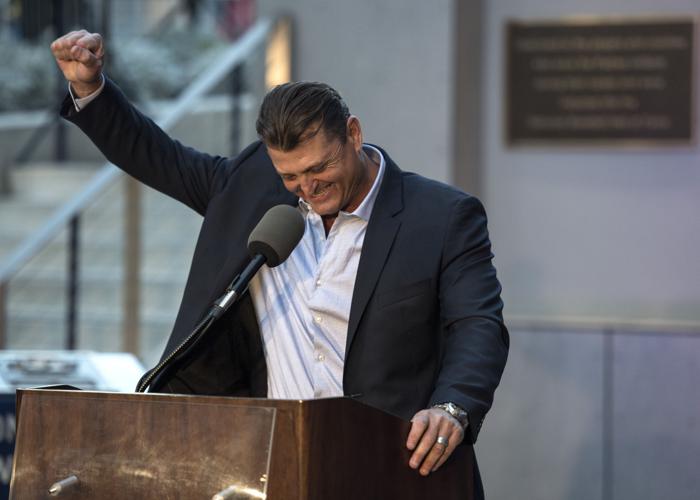


COOPERSTOWN, N.Y. — He will stand on a dais at the edge of a grassy field in a fanciful village where baseball is still romanticized, and he will be cheered.
In part, because he could handle being jeered.
The man who will get a bronze plaque here Sunday and a statue in San Diego next month, we know as one of the game’s most reliable closers. We remember the stories that have been told time and again about his work ethic and leadership and magnanimity.
Trevor.
Padres fans forget at one time they didn’t know him and didn’t want him.
Before those three saves in three days that secured the 1996 division title and before “Hells Bells” and the World Series and the Hall of Fame, Trevor Hoffman was an unknown rookie relief pitcher out of the University of Arizona forged by a fire sale.
“It shows you handled some of those adversities that come your way,” Hoffman said of what he went through at the beginning of a career that is all these years later celebrated for its enduring magnificence.
On June 24, 1993, the Padres sent third baseman Gary Sheffield and reliever Rich Rodriguez to the Florida Marlins for Hoffman and minor-league pitchers Andres Berumen and Jose Martinez.
It was, essentially, the reigning National League batting champion for a right-handed set-up man who had pitched in 28 major-league games.

Former Wildcat infielder and big-league closer Trevor Hoffman will take his place in the Baseball Hall of Fame on Sunday.
It took Hoffman three ballots to get voted into baseball’s hall. Were there a Hall of Fame for implausible success stories and/or cautionary tales about the peril of instant analysis, Hoffman would have been inducted as part of that institution’s inaugural class.
“Some guys would never recover from the start he had in San Diego — just from the pressure of being the main face of a hugely unpopular trade,” said Randy Smith, at the time the new general manager of the Padres who orchestrated the Sheffield-Hoffman swap. “There’s an inner strength in there. That’s why he’s a Hall of Famer. People don’t have that.”
Even a casual fan has probably heard of Hoffman’s failure as a minor-league shortstop and subsequent conversion to pitcher. That he has lived his life with one kidney is well known. The beach volleyball and football accidents in 1994 that caused him to lose velocity on his fastball and hastened development of a wipeout changeup are part of the legend.
So too, we know he became the go-to for the media as much as he was for manager Bruce Bochy and that he visited hospitals and showed up at the weddings of virtual strangers and seemed to know every usher that ever worked at The Murph or Petco Park.
Of course, it is ultimately the 601 saves, second most in history, that have him in Cooperstown.

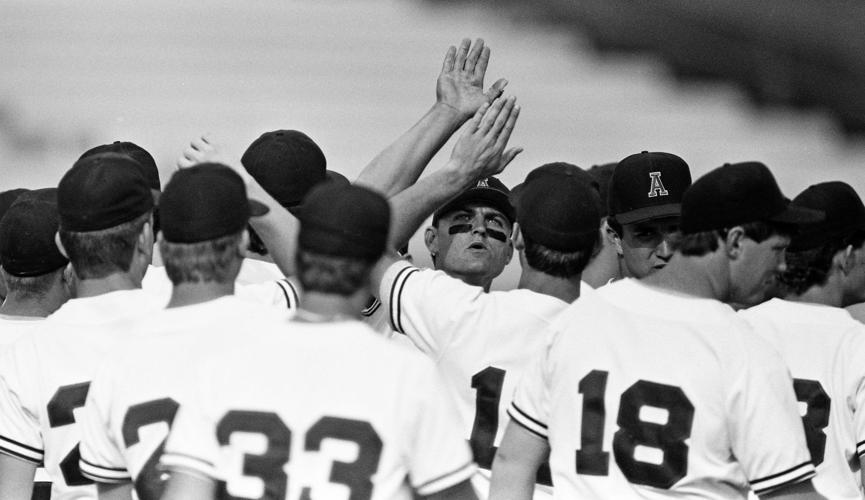
Hoffman, center, played two seasons at Arizona before the Cincinnati Reds drafted him in the 11th round in 1989.
But we don’t know these things if Hoffman was not already that man in 1993 — before we ever knew he was. If not for the ability to persevere through an ignominious start, his career never becomes what it did.
“It took off,” said his brother, Glenn, “because he had that strength in him to overcome it.”
Boos greeted announcement of the trade on the scoreboard of what was then Jack Murphy Stadium. Banners urging Tom Werner to sell the team were confiscated by security.
Hoffman and his wife, Tracy, fresh from Florida, created an emergency plan. If anyone in their new city asked, they would say Hoffman made cookies for a living. Anything, at the time, would have been better than being the guy the Padres got for Sheffield.
When Hoffman allowed three runs and four hits in his Padres debut on June 25 against the Cincinnati Reds, there were more boos.
“They had a right to boo,” Hoffman said that night. “I didn’t perform up to anyone’s expectations, and I have to improve on that. It won’t take much to improve on this performance.”
Except he didn’t for a while.

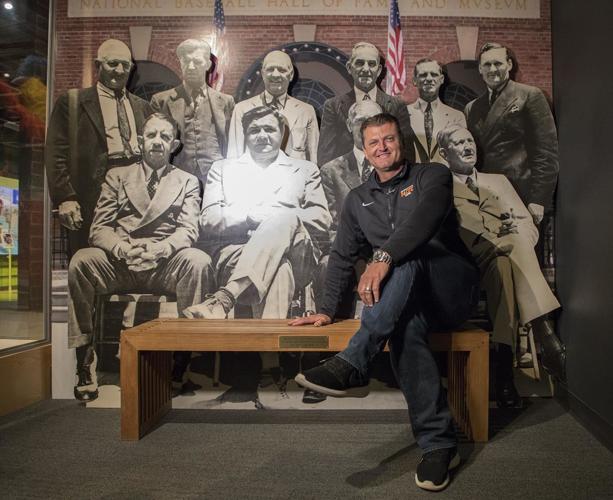
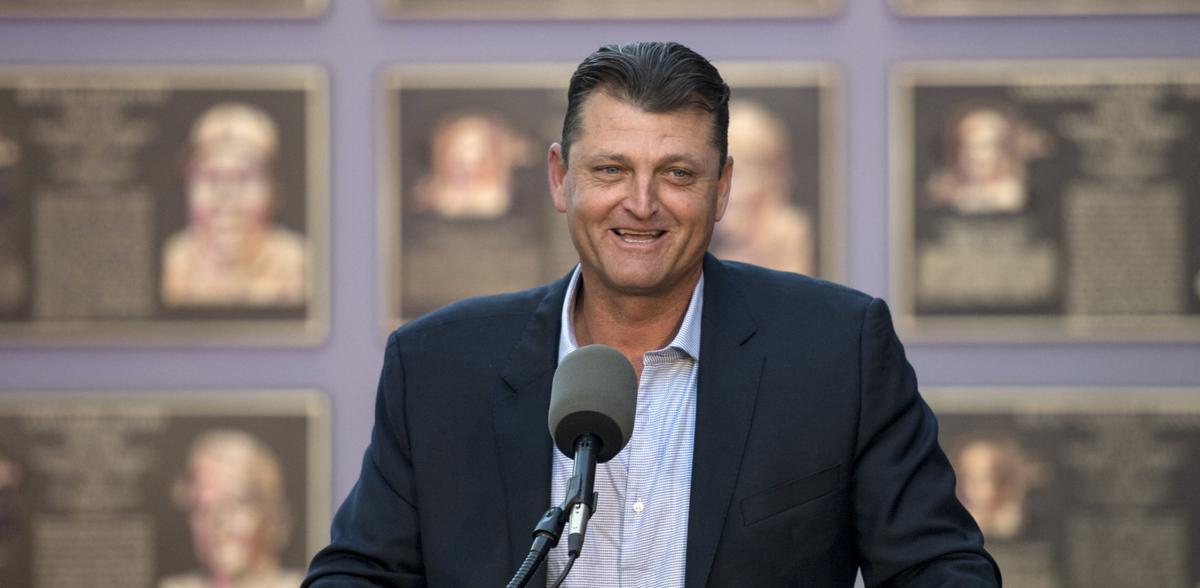
Trevor Hoffman poses in front of a picture of the Baseball Hall of Fame’s first class of inductees. The ex-Cat joins 322 other greats in the hall.
Hoffman would allow the Reds a run in two innings of work two nights later. Two nights after that, against the Cubs, he wouldn’t record an out after entering at the start of the ninth inning, getting pulled four hits and four runs (three earned) later.
Another run on three hits and two walks in Philadelphia on July 2 gave him a 14.54 ERA in his first four Padres appearances and prompted a tearful early morning phone call to Glenn, who had played nine big-league seasons and was at that time managing in the Dodgers farm system.
“Hey man, do I belong here?” is what Trevor Hoffman remembers as the start of that conversation.
Glenn Hoffman, the Padres’ third-base coach since 2006, assured him that he did and that at the very least he needed to make sure he wasn’t left questioning if he had done everything he could to stay.
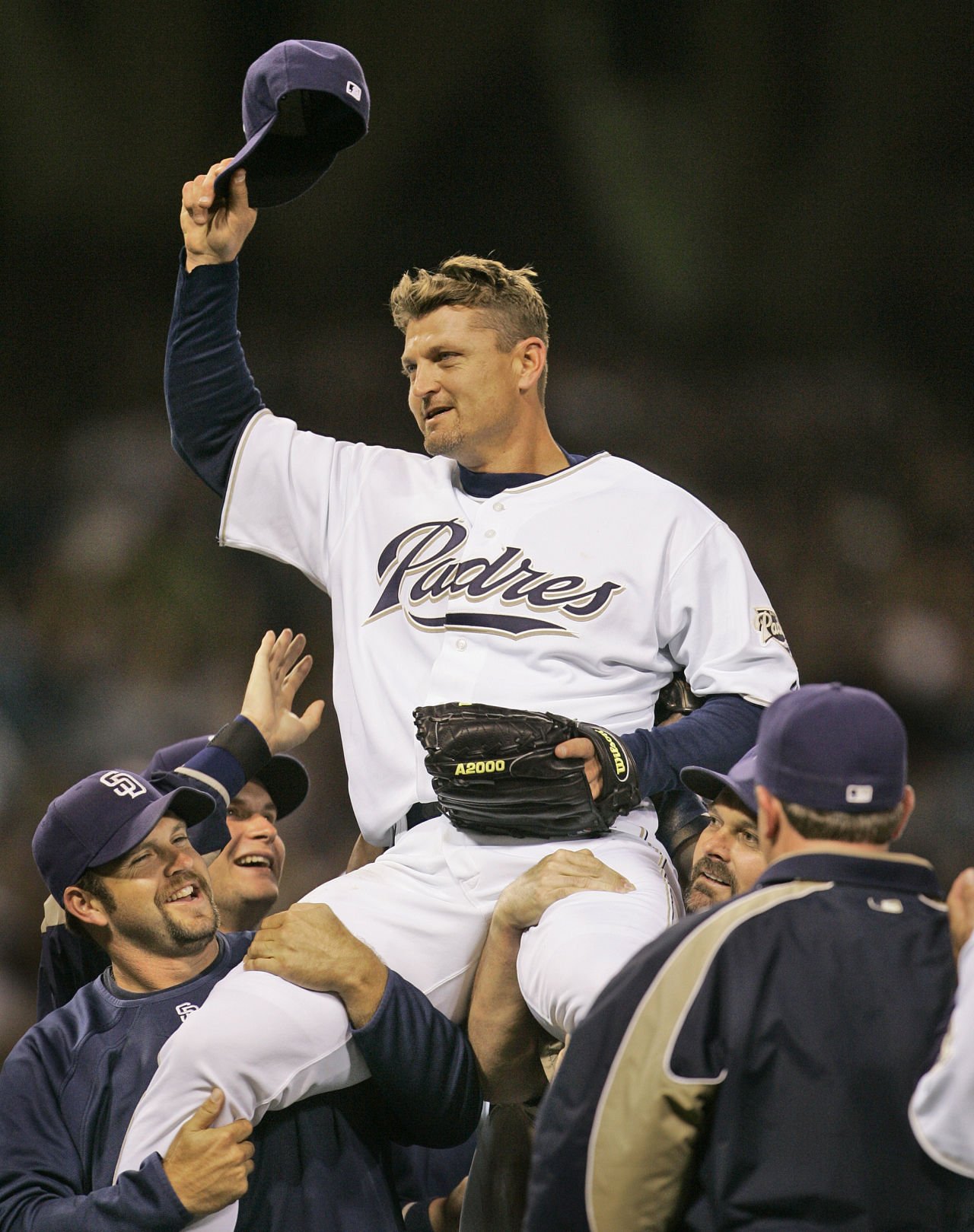
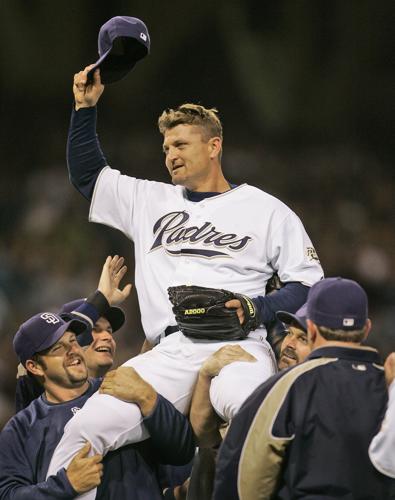
Teammates hoist up Padres closer Trevor Hoffman after he recorded his 500th career save. Hoffman was the only pitcher in major league history to account for two different streaks of four seasons with at least 40 saves.
A scoreless outing in New York was followed by getting knocked around again in two games in Montreal right before the All-Star break.
Hoffman, who assessed at the time he was going through “a dead-arm period,” would finish ’93 allowing just 16 earned runs in 46ª innings (3.11 ERA) over his final 32 appearances. The following February, he signed a three-year contract.
He was eased into the closer’s role in 1994. In 1996, he saved the final three games of the season against the Dodgers as the Padres clinched the NL West title. In the middle of 1998, he began running from the bullpen to the mound accompanied by the AC/DC anthem “Hells Bells,” a song that still induces chills for many San Diegans who witnessed those jogs and the magic that so often came afterward. He saved 53 games in ’98, and the Padres advanced to the World Series. On Sept. 24, 2006, he was mobbed by teammates after becoming Major League Baseball’s all-time saves leader.
Lest that all makes it seem like a fairytale, we know there was the shoulder injury that instantly made his mid-90s fastball run about 90-91 mph and the subsequent surgery and how he developed a change-up that would baffle hitters for much of the rest of his 18 major league seasons.
But with an acknowledgment that comparing the two challenges is a little bit apples and oranges, Hoffman didn’t hesitate to say which was more difficult to work through.

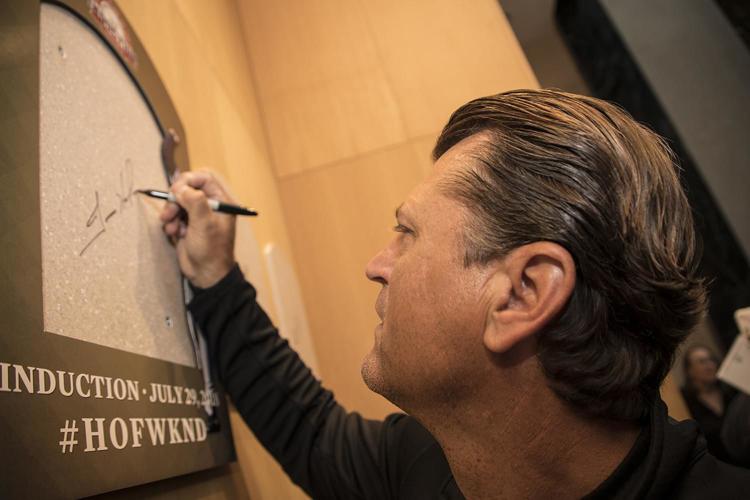
Trevor Hoffman signs his name in the space where his plaque will hang at the Baseball Hall of Fame. The former UA infielder overcame some tough times early in his pro career to finish with the second-most saves in big-league history (601).
“When I hurt myself, it was my own doing, and I was still able to throw,” he said. “Once I had a chance to get it fixed and move forward, I was going to be OK. … The bigger hurdle was getting comfortable in San Diego.”
Hoffman credits being able to watch his brother playing for the Red Sox and his wife for her support and encouragement. But he could not deny, too, he had to have it within himself to emerge strongly from that period.
“I was certainly floundering in the big leagues,” he said. “It was either you go home or you stick it out and fight.”
That is why he will make a speech Sunday and hear the applause and then see his bronze likeness on a wall alongside the mere 322 others who have been enshrined.
Because way back before the rest of us knew it, he was Trevor.