

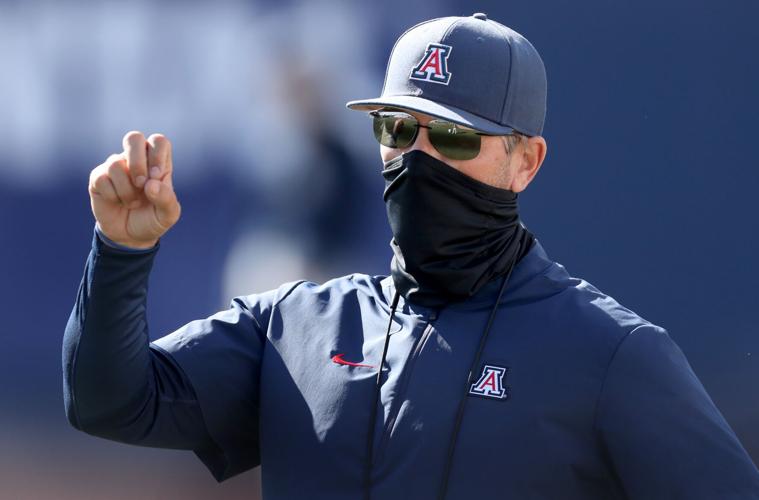
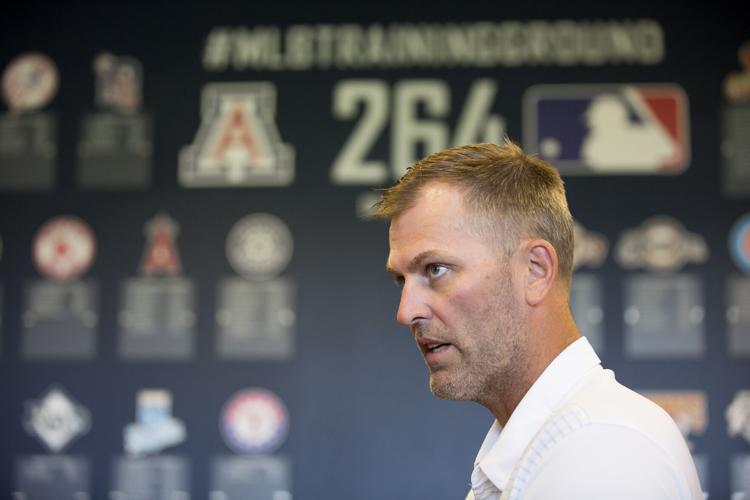

Nate Yeskie has updated his Zoom background.
When Yeskie spoke to a reporter Wednesday, an image of TD Ameritrade Park in Omaha loomed behind the Arizona Wildcats’ pitching coach.
It’s everybody’s dream this time of year. Yeskie knows what it takes to make it a reality.
Yeskie helped Oregon State advance to the College World Series three times during his 11 seasons with the Beavers. They won it all in 2018.
Jay Johnson brought Yeskie to Arizona with similar goals in mind. The Wildcats have put themselves in a favorable position, earning the No. 5 overall seed in the NCAA Tournament and hosting the Tucson Regional starting Friday.
Offense has been Arizona’s calling card under Johnson, and this season is no different; the Wildcats rank among the national leaders in multiple categories.
What’s changed is that the pitching staff is holding up its end.
Every metric has gotten better since Arizona’s last full season in 2019, when the staff posted a 6.21 ERA and a 1.75 WHIP. The Wildcats have a 4.45 ERA and a 1.44 WHIP in their second season under Yeskie. (His first season, 2020, lasted only 15 games because of the pandemic).
Has the staff been flawless? No. Good enough to go 40-15 and win the Pac-12? Yes.
Yeskie discussed his recent return to Corvallis, the progress of his key pitchers, why Arizona’s depth could be advantageous and other topics in an interview with the Star. The conversation has been lightly edited.
What was it like to go back to Oregon State and face your former school for the first time?
A: “It was special. It was unique. There were some people that I hadn’t seen in a while that I had stayed in touch with.
“It’s familiar yet it’s different, just because you’re in the other dugout. But I was in there during many a scrimmage, so that felt a little normal. There were some fans that appreciated seeing me — some that didn’t.
“I got to see a lot of players who were a big part of my life. I’d like to think that I was a big part of theirs. I wish them all the best in everything that they’re doing. Baseball is part of what we do; it’s not who we are. There’s gonna come a day when ... their playing days are done. Those relationships that we have are the most important thing. They’re going to grow up and become husbands and fathers and business owners. I want them to have a successful life.”
Chase Silseth will start one of the first two games. What do you expect to see from him this weekend?
A: “Hopefully a kid that’s enjoying it and attacking the strike zone. You work so hard all year to get into the postseason. And then when you get there, some kids forget to enjoy it. They make it be bigger than it needs to be. We’re certainly not trying to minimize it, but it’s one day in your life. You’ve worked hard for this opportunity, so go out and enjoy it. Seize the opportunity.
“That’s been kind of our message not only to him but a lot of the other guys. There’s a lot of teams at home that aren’t playing anymore, and we’re fortunate enough to be one of those teams that are.”
It sounds like you’re trying to alleviate whatever pressure Chase and others might be feeling.
A: “We don’t view it as pressure. When people use that word, they forget that pressure’s a privilege.
“I can remember sitting in the dugout in the ninth inning of Game 3 in Omaha and just enjoying it, going like, ‘Gosh dang, I’ve spent so many years envisioning what this could be like.’ I found myself wanting to slow the game down and just almost suspend time, because we wanted those kids to be able to continue to play together.
“It’s the same thing for these guys. I want them to play together for as long as they can and enjoy it, because once this season’s over, this’ll be the last time this team plays together. Next year’s team will look different. So I hope that they play for each other and understand that they have to do it together.
“Pressure’s when you’ve got three kids to feed, a mortgage to pay and you don’t have a job ... or you’re dealing with something that’s life and death. This is a game.”
Your other top starter, Garrett Irvin, had a much better second half than first. Aside from him building up his stamina, what changed?
A: “He’s more what he was last year, a guy that can give you a steady mix. He’s going to be competitive with his misses. There’s just more of a sense of who he is now.
“It’s easy to have conversations with him about, ‘We’d like to be able to do this; we’d like to implement some of these things.’ He’s developed more of a sense of awareness (of) when to push and when to pull. Health-wise, he just got out of the gates a little bit slow. We had to get him started a little bit later. Because of that, he’s throwing his best brand of baseball here at the end.”

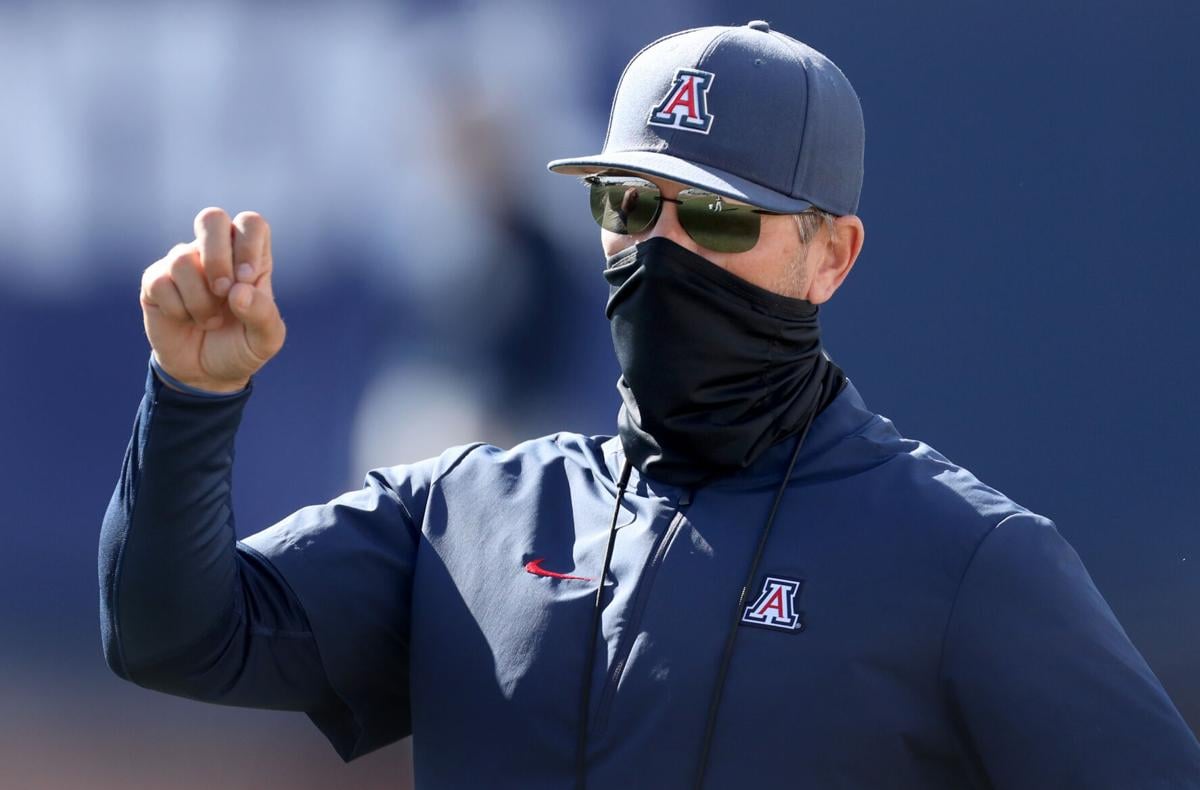
Nate Yeskie will take part in his first NCAA Regionals as Arizona's pitching coach starting Friday, when the fifth-ranked Wildcats take on Grand Canyon at Hi Corbett Field.
Randy Abshier and Gil Luna are having career years out of the bullpen. They’ve always had a ton of ability. What’s been the key to their success?
A: “They’re both more consistent and more comfortable with who they are. I also think that Father Time probably had a little bit to do with it. They all mature at different rates. Some kids mature at 15 because of something that maybe they had to deal with at home. Some kids mature a little bit later, just because it’s always been easy and they’ve never been challenged. And then when they get challenged, now they kind of spiral a little bit trying to figure out some of those things.
“For whatever reason the time is now, and those things have started to come together with them.”
Your staff goes 10-deep, maybe more. How can having that many options help you when you have to play multiple games against multiple teams in one weekend?
A: “You never really know what you’re gonna get. It’d be like a football team being able to run multiple offensive sets or defensive looks, and you’re just not quite sure what they’re throwing at you. To have that kind of depth, that gives us some balance.
“Some teams will work into their game preparation, ‘Well, we know this guy’s gonna finish the game, so we’ve got to get ready for him.’ We just probably created some more work for some teams that are gonna play against us, because they don’t know who we’re going to finish with.”
The stakes are higher this weekend, the intensity greater. Do you do or say anything different because of that? Or do you tell your guys to keep doing what they’ve been doing all season since it’s been working?
A: “You’re not going to reinvent the wheel at this point. Nobody’s going to make any massive jumps with a new pitch or velocity. This is why you try to establish consistency in the fall. You try to establish consistency with their thought process, their routines and look at it as an opportunity when they go out there and play.
“Sometimes people want to put a label on how it’s supposed to feel or how people are supposed to try to handle a situation. At the end of the day, both teams are attempting to fight those types of emotions – or maybe they’re just completely immune to them.
“I’ve had some players in the past where ignorance is bliss. They’re unaware of the situation. The crowd’s going crazy, and their heartbeat stays the same. They don’t look at it as, ‘Man, this is a big pitch or a big moment.’ They just look at it as, ‘Sweet, we’re still playing.’”

