

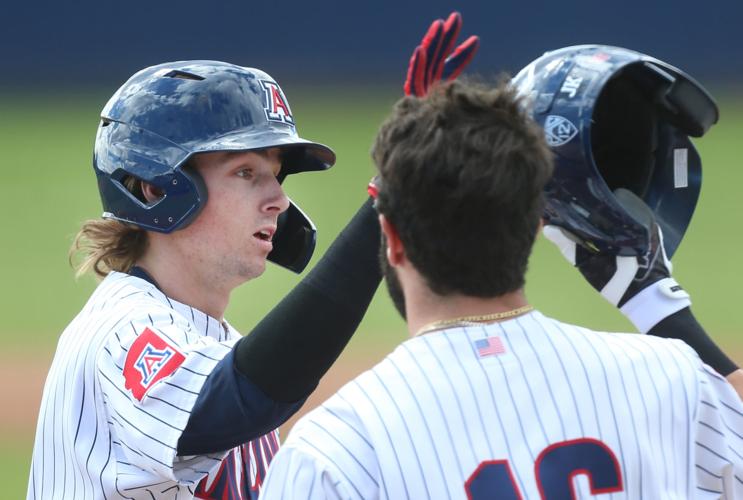
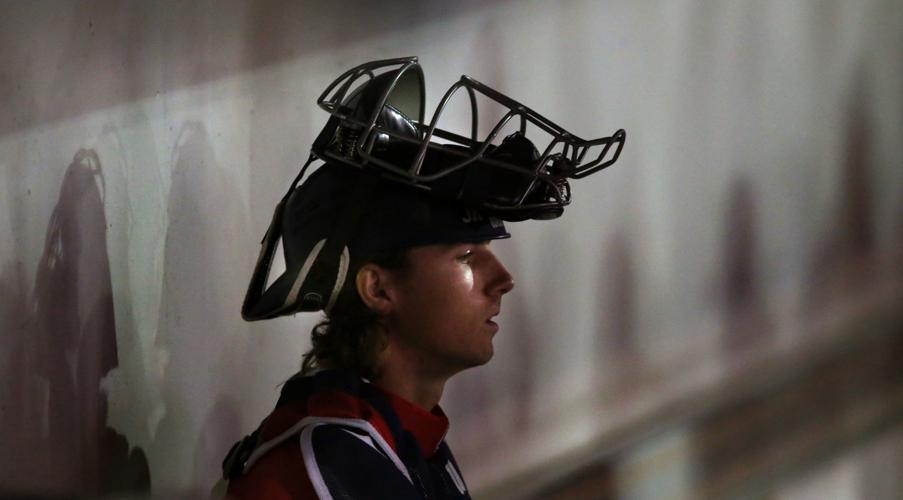

Despite some rankings that suggest otherwise, Matthew Dyer is confident he’ll be selected in this week’s abbreviated MLB draft. But his unwavering belief in himself doesn’t stop there.
“I set out probably a higher goal than most people,” the Arizona Wildcats super-utility player said. “My plan is to get to the big leagues in a year and a half, two years.
“That could be very unachievable. But in my eyes, it’s not. I know what I (can) do, how hard I work and what I bring to the table. I’m not gonna stop until I get to where I want to be.”
Were this a normal year, there’d be no question about Dyer’s draftability. It’d be an issue of when, not if.
This isn’t a normal year. As a cost-saving measure, MLB shrunk the draft from 40 rounds to five.
One hundred sixty college and high school players will be picked Wednesday and Thursday — about 1,000 fewer than usual.
Based purely on pundits’ rankings, Dyer wouldn’t be among them. MLB.com does not rank him in its top 200. Baseball America slots him at No. 333.
Those rankings might not represent reality.
While not guaranteeing that Dyer will be picked, his advisor, Scott Leventhal, said Monday that Dyer is “in a really good position” — especially with MLB clubs wanting to mitigate risk in a draft that offers minimal margin for error.
“Personally, I don’t get caught up in any of those lists,” Leventhal said. “They’re irrelevant.
“This is a draft where, more so than ever before, history and track record matter.”
Dyer has those on his side. The Glendale product, who transferred to Arizona from Oregon, played the equivalent of one season with the Wildcats (57 games). He batted .348 with a .440 on-base percentage.
After a slow start to the truncated 2020 campaign, Dyer ended it with a six-game hitting streak during which he batted .320 (8 for 25) with three home runs and 13 RBIs. Those three homers were one fewer than he hit in 168 at-bats in ’19.

“I’m one of his biggest fans, because I’ve had the opportunity to see what he can do,” said UA coach Jay Johnson of Dyer.
“I don’t know where he ranks on lists or anything like that,” UA coach Jay Johnson said. “I do think the people that know, the people that are making decisions, probably have him higher up than maybe some of the media and baseball-reporting outlets.
“As a baseball player, I’m one of his biggest fans, because I’ve had the opportunity to see what he can do.”
The value of versatility
Perhaps the biggest reason Dyer is in a good position entering the draft is that he can play all of them.
Dyer’s main spot at Arizona was catcher, but he also played first base, second base, third base, left field and right field. He set a goal of playing all eight positions this season but got only halfway there (catcher, second, third, left) in a campaign that lasted only 15 games.
Dyer started at second base in each of Arizona’s final three games, with Jacob Blas moving to shortstop, and it was during that series that the Wildcats’ up-the-middle defense finally gelled.
“I don’t think he’s a natural second baseman, but he did a pretty good job of it,” Johnson said of Dyer, who doesn’t have natural middle-infielder dimensions at 6-4, 195 pounds. “I think he would have gotten better as the year went along.”
Super-utility players have become increasingly valuable in Major League Baseball. Players such as Charlie Culberson, Marwin Gonzalez, Kike Hernandez, Brock Holt, Chris Taylor and Ben Zobrist have carved out lengthy careers thanks largely to their ability to play multiple positions effectively.
None also plays catcher.
“I’m not a typical, average baseball player,” Dyer said. “I don’t play one position; I can play all eight.”
Dyer doesn’t have a preferred spot. More than anything, he loves to hit. His versatility makes it that much easier for a manager to pencil him into the lineup.
Although playing multiple positions enhanced Dyer’s résumé, that wasn’t the main motivation behind his deployment.
“We moved him around this year,” Johnson said, “because it made us a better team.”
Past and future
Dyer had a chance to be drafted and go pro a year ago after a redshirt-sophomore season in which he hit .393 in 42 games. (Dyer sat out the 2018 campaign after transferring and missed the final 12 games of ’19 because of a broken hand.)
Dyer elected to return after not receiving the signing bonus he was seeking — again, betting on himself — and established two primary objectives: improve his draft stock and help Arizona win the College World Series.
He didn’t get a chance to achieve either.
Dyer distinctly remembers the team meeting in mid-March during which Johnson told his players that their season would be ending because of the coronavirus pandemic.
“My heart sank,” Dyer said. “I came back to win a national championship. It was hard.
“I didn’t want to believe it. I didn’t think it was actually going to happen.
“Knowing this could have been my last season and could still possibly be my last season at Arizona … it was just not the way I wanted it to end.”
Dyer and his teammates — including fellow catcher Austin Wells, who could be selected in the first round — were denied the opportunity to pursue their Omaha dreams. Dyer didn’t have a chance to fully reverse a sluggish start that had him hitting .147 through nine games. He finished at .220, and his three home runs and 18 RBIs led the team.
Fifteen games is a tiny sample size in baseball, of course. If he had gone 4 for 5 in his next game, Dyer would have boosted his average to .266.
“Baseball’s a tough game,” Dyer said. “You can’t always expect to go out and be great. You’ve just got to trust what you put in, and I put in the work, I put in the time.
“It didn’t show up at the beginning. I was excited to see what would have happened.”
Dyer feels the same way about this week’s draft. Although he could return to Arizona with two years of eligibility, he’s ready for a new challenge – even if it comes at an uncertain time.
A scouting director for a National League club said “it’s more critical now than ever” to land sure things in the draft. He stopped short of putting Dyer in that category, mainly because of signability concerns.
Leventhal, who wasn’t Dyer’s advisor last June, shares his optimism about what’s to come.
“I don’t think anybody’s willing to bet against Matthew Dyer,” Leventhal said.



