


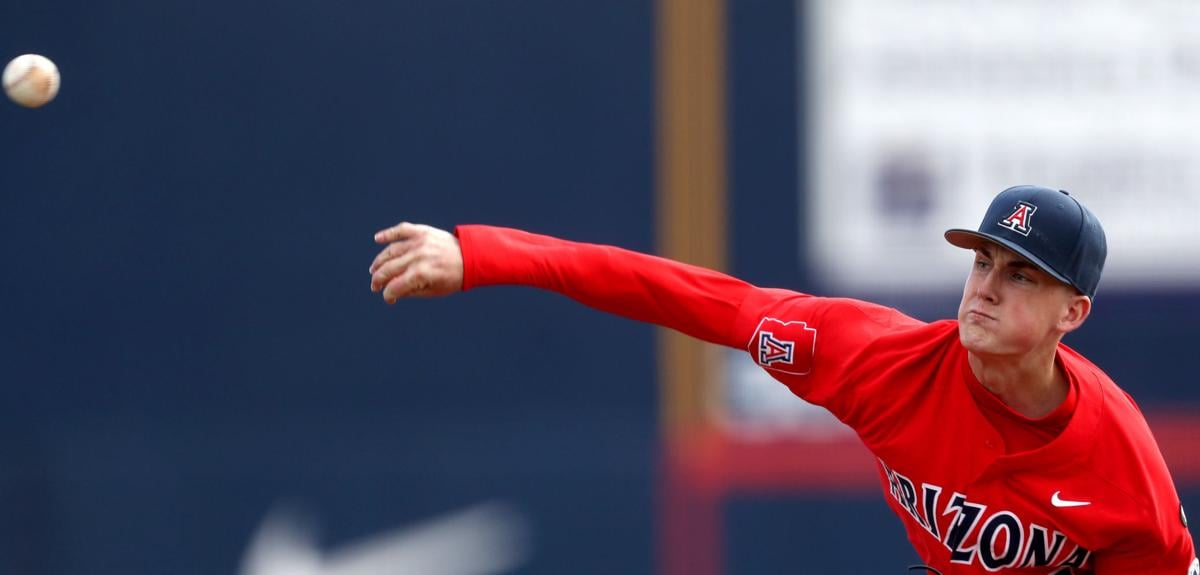
As a sign of how far Arizona’s pitching staff has come, Wildcats coach Jay Johnson said it could be “the strength of the team.”
That’s like saying the running game is the strength of a Mike Leach offense.
OK, maybe that’s a slight exaggeration. But the reality is, since Johnson’s first season at the UA in 2016, the pitching staff has not ranked among the best in the Pac-12 — while the offense consistently has. In 2019, the last complete season the Wildcats played, pitching and defense indisputably held them back.
“There’s no doubt at the end of the 2019 season we were the best offense in college baseball,” said Johnson, whose team is slated to open the 2021 season Friday against Ball State. (Games are closed to fans because of the pandemic.)
“That was a really unique and special group, but you’re never going to outcoach your own bad pitching. And that wasn’t a very good pitching staff.”
The ’19 Wildcats ranked in the top three in the nation in runs per game — an absurd 9.8 — batting average, on-base percentage and slugging percentage. They ranked 249th (out of 297) in ERA and 262nd in WHIP. They did not make the postseason for the second straight year.
The lesson, which Johnson already knew, was driven home: A great offense can only take you so far; a great pitching staff can take you all the way.
“We’ve learned that the hard way,” veteran second baseman Kobe Kato said. “You can’t win every game by just banging the ball around the field. We scored 10 runs and sometimes it wasn’t enough.”
That happened to the 2019 Cats four times. Had they won just one of those games, they might have made the NCAA Tournament.
Johnson knew he had to make changes. The biggest one came that summer, when Johnson hired accomplished pitching coach Nate Yeskie. But it was a process years in the making.
Promising start
When Johnson was considering the UA job after the 2015 season, some of his colleagues advised him not to take it “because the pitching was in such bad shape.”
Johnson was undeterred. Arizona was his dream job.
He enhanced the staff by adding three pitchers who would become key contributors to the ’16 team that fell one win short of winning the College World Series: left-hander JC Cloney and righties Kevin Ginkel and Cody Deason.
Pitching carried the 2016 Wildcats to Omaha and into the CWS finals. The staff ranked second in the Pac-12 in ERA and first in WHIP.
The Wildcats’ 3.18 ERA was their lowest since 1974 (2.07).
But Johnson knew it wouldn’t last.
Ginkel and fellow right-handers Nathan Bannister and Bobby Dalbec were drafted during the 2016 postseason and left after it to play pro baseball. Lefties Cloney and Cameron Ming played one more season before starting pro careers. Deason, a freshman in 2016, joined the Houston Astros organization after the ’18 campaign.
Johnson thought to himself, “We may not be able to line this thing up as quickly as I would like.” He knew he could find quality position players. “But elite pitchers are really hard to get,” he said.
It wasn’t for lack of trying. Johnson secured commitments from several top pitching prospects. But Arizona lost the best one in four consecutive classes. JoJo Romero, Matt Sauer, Matthew Liberatore and Andrew Dalquist were selected in the first four rounds of the MLB draft from 2016-19.
They signed for a combined $8.8 million.
“It doesn’t matter who we have or what the circumstances are, because nobody cares,” Johnson said. “Your job is to get better and to compete.”
The Wildcats made the tournament in 2017. They continued to pump out prolific offenses and MLB draft picks.
But they failed to reach the postseason in ’18, despite a 34-22 record. Then the pitching imploded in ’19. Arizona’s 6.21 ERA ranked 10th in the Pac-12 and was the program’s worst since 2000 (7.48).
The Wildcats ranked last in the league in WHIP (1.75) and walks per nine innings (5.33).
Arizona won its final 10 games to finish 32-24. But the hole the Wildcats had dug was just too deep.
Yeskie effect
Johnson hired Yeskie in July 2019, a moved lauded throughout college baseball. Yeskie had spent the previous 11 seasons at Oregon State. He was named D1Baseball.com’s Assistant Coach of the Year in 2017. The Beavers won the national championship the following season.
“We have a pretty good competitive culture on our team,” Johnson said. “I feel like we’ve always had that from the position-player side of it. That’s what I wanted on the pitching-staff side of it.”
That same offseason, Arizona managed to get three promising pitchers through the draft and onto campus: junior-college left-hander Garrett Irvin and high school righties Dawson Netz and Chandler Murphy.
The three combined to start 11 of Arizona’s 15 games last season. Collectively, they posted a 6-1 record and a 2.86 ERA.
The staff overall improved, albeit in a small sample size. Arizona’s ERA dropped to 3.87. Its WHIP fell to 1.30. Its K/9 ratio jumped from 7.52 to 10.80.
The Yeskie effect was tangible. Even Arizona’s hitters felt it.
“From the moment Coach Yeskie stepped foot on the field, I knew what we’re getting out of him,” center fielder Donta’ Williams said. “It’s just a different nature out there. I feel like every pitcher that gets on the mound, they just have a dog mentality. They don’t care who’s in the box.”
Said Irvin: “You could tell just the presence he had. ... He helped us develop more of an attack mindset.”
The shortened season had a ripple effect. The 2020 draft was reduced to five rounds. Seniors whose eligibility would have expired could return.
The Wildcats added right-handers Chase Silseth and TJ Nichols to the staff. Silseth, a JC transfer, is slated to start the opener. Johnson considers Nichols — a 6-4 freshman who has touched 98 mph — the best pitching prospect he has landed at Arizona.
The Cats’ top two relievers, Vince Vannelle and Preston Price, are back as “super seniors” – two of nine returning pitchers who made four or more appearances last season. In all, 15 pitchers are receiving scholarship money, with about 7.5 of the team’s 11.7 scholarships devoted to the staff.
Veteran righty Quinn Flanagan — who has a 9-5 career record — couldn’t crack the rotation for the first three games. Murphy is scheduled to start on Saturday, Irvin on Sunday.
“It’s by far the best staff we’ve had in my four years here,” veteran shortstop Jacob Blas said.
Experts are bullish on the Wildcats as well. They made every reputable preseason top 25.
Yeskie is hesitant to anoint them just yet. He knows what elite pitching looks like. Oregon State led the Pac-12 in ERA three times under his watch.
But Yeskie is intrigued by the possibilities.
“We like this group,” he said. “They’ve got good energy about them. If they continue to come together as a unit, I’m excited for what’s on the horizon.”


