


LAS VEGAS — It’s been a busy year for Gilbert Arenas.
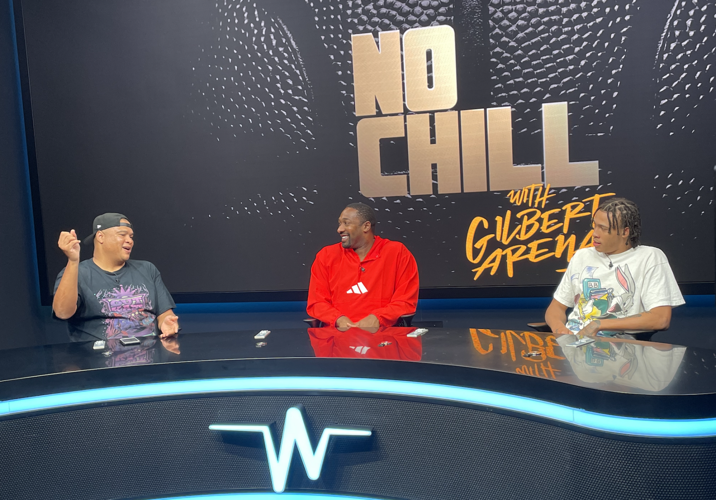
Besides Adidas re-launching the former NBA star’s signature “Gil Zero” shoe this summer, the former Arizona Wildcat also inked a deal with Fubo Sports Network for his “No Chill” podcast.
Adjusting to his new life in the podcasting and sports media realm was initially a challenge for Arenas.
“To be honest, when I first started, the first three episodes I didn’t want aired, due to the fact that I was trying to edit myself,” Arenas said. “When they put it out, they leaked it without my permission. Then I saw the feedback and went, ‘Oh, people actually like this?’ From there, it became having conversations with other athletes versus the typical interview. It became easier, easier and easier.”
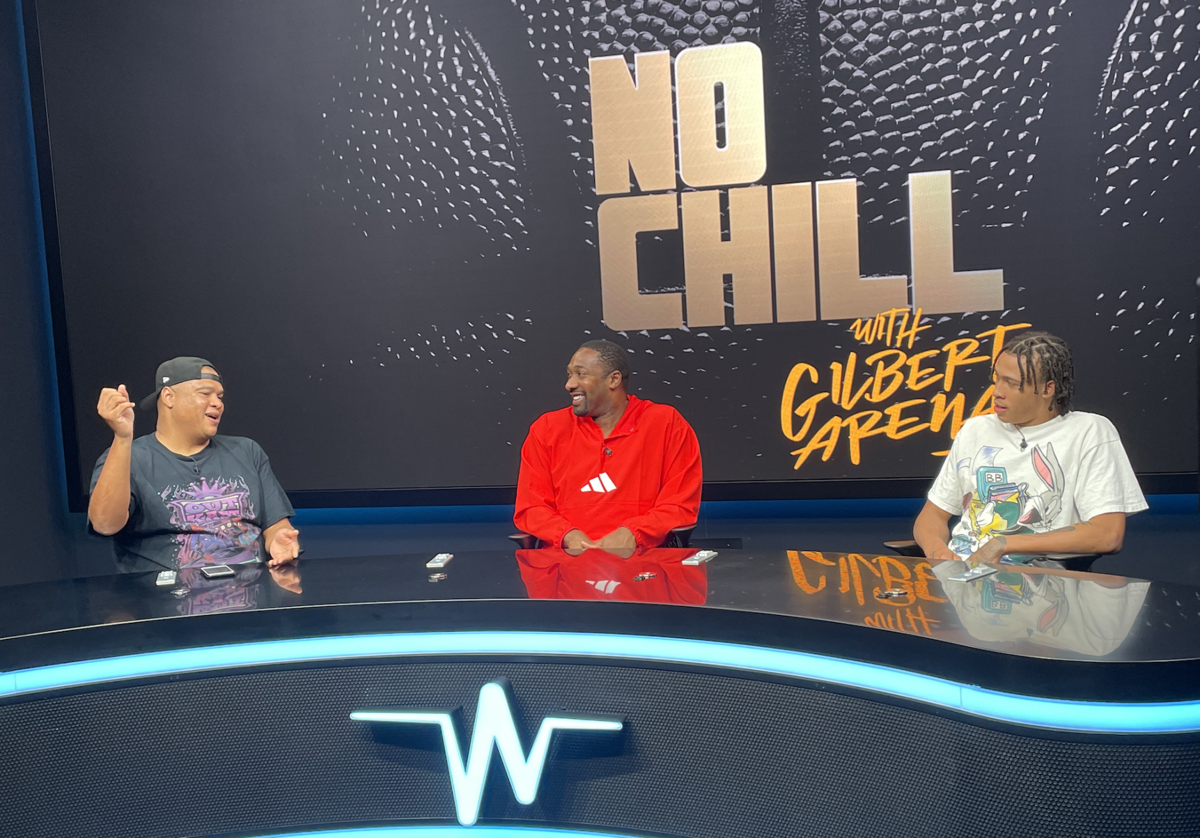
Arenas has teamed up with Danny Corrales, a Tucson native and former UA student assistant under former head coach Lute Olson, who formerly produced at ESPN, and Josiah Johnson, a famous NBA personality on Twitter and former UCLA Bruin.
Like Arenas, Johnson grew up in Los Angeles, where they would face each other as opponents in high school, which bled into the Arizona-UCLA rivalry.
“He came in and dropped 40-something on our heads,” Johnson said of Arenas. “From that moment, I was always rocking with the dude. … We actually lived like a street apart from each other, so I would always see Gil in the neighborhood driving around in a Maybach, and we’d always have to nod and say, ‘What’s up?’ But to be able to work with him and be a part of this has been amazing.”
During their time in college, Johnson said he “always had a tremendous amount of respect for Arizona, because we weren’t with Nike at that point.”
“Going over there and seeing guys with fresh (Jordan’s) and nice kicks definitely had a mental edge on us,” he said. “But being in the Salim (Stoudamire) era, I always had a tremendous amount of respect. Salim is probably my favorite basketball player of all time.
“When I tell people that Salim was on a Steph (Curry) level in terms of shooting, people give me a bunch of (BS). And just Tucson in general. Tucson obviously isn’t the greatest city in the world compared to L.A. just because we have a lot more activities, but my last college game was in Tucson and we played Texas Tech in the tournament, went to Dirtbag’s after the game. I’ve always had a love and respect for Tucson.”
After recording a new episode of “No Chill” with Orlando Magic star R.J. Hampton at Wynn Resort and Casino, Arenas sat down with the Star for a few moments to discuss Lute Olson’s legacy, Bobbi Olson looking out for “Agent Zero,” hustling in Tucson, and the current state of UA basketball:

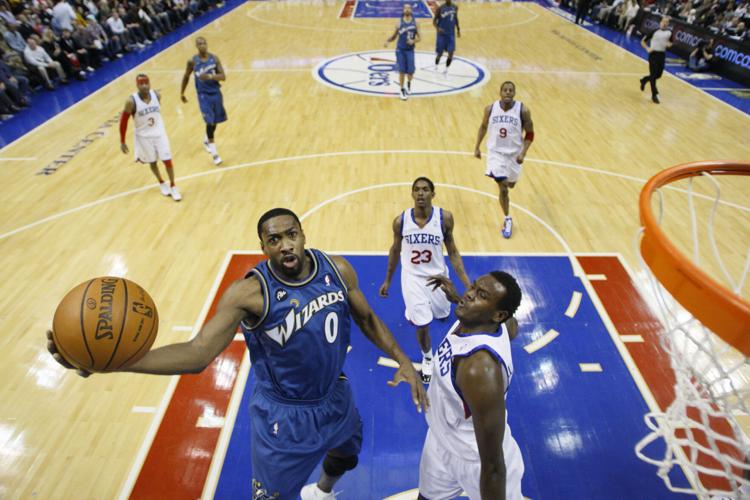
Gilbert Arenas, here driving to the basket in 2010, said he saw feedback about his podcast and said, "Oh, people actually like this?’ From there, it became having conversations with other athletes versus the typical interview. It became easier, easier and easier.”
It’s been nearly two years since the passing of the late Lute Olson. How did he impact your life?
A: “I always tell kids and players who are choosing colleges: ‘Choose a college and a coach that understands you, which means if he understands you, he’s not going to penalize you for being you.’ That’s how Lute was. I hear Richard (Jefferson) say, ‘When I was in Vegas, we got suspended for this and got sent home.’ I was like, ‘Yeah, Lute never did that to me.’ All the stupid stuff I was doing, he was just like, ‘Gil is just being Gil.’ He knew I was young and couldn’t control my immaturity. I was 17 (years old), but I was really like 11 or 12. I did a lot of things that were childish, but when it came to the court, being ready and being in shape, nobody was going to match me.
“He knew that at 6 o’clock in the morning, I’m going to be running five miles. It was like penalizing me was a reward. What are you going to do, have me run sprints all day? OK. Run five miles? OK! Sit in practice for an extra two hours? OK! Penalizing me was kicking me out of the gym, because that’s when I’d throw a temper-tantrum. I’m going to toe the line, but I’ll never be full body and out of control.”
Did you know Olson was going to be as hands-off as he was prior to committing to Arizona?
A: “Nope. Bobbi Olson. Bobbi Olson gave me the green light. I pulled a prank on Eugene Edgerson. I took a koi fish out of the pond and put it in front of his door, so I hit the doorbell and he sees it flapping — and he was someone who I had beef with. He was like my arch-nemesis and I had to let him know that no matter where we go, these are the type of things I’m going to do. They got the call, but Lute Olson wasn’t there, it was Bobbi Olson. She pulled me to the side and said, ‘I got the call. Don’t worry. He talks about you a lot and understands that we’re probably going to get a lot of calls like this. Just make sure no one dies or gets hurt.’ From there, I was trying to control what I do, but they realized that I’m only going to do this here where I’m protected. I’m not going to do this outside in Tucson and outside the arena doing crazy stuff. Anything I do that’s questionable is for the team.”
What’s significant about Bobbi Olson’s renowned apple-cinnamon pancakes?
A: “Think about a kid coming in: We don’t have gourmet meals, but they were good pancakes. They were watered down sometimes, but when she put some love into it, she made pancakes that were to die for. ‘You want me to run 10 miles? OK! Just give me the pancakes.’ She made all of the players feel loved. She was our protection.”
Where did you spend most of your time as a student at the UA?
A: “The mall. Or the Rec Center. If you wanted to find me, I was at the rec, because I wanted to play basketball so much. That was the only thing I thought about. I didn’t care about school, books, food — if basketball was being played, I wanted in. If someone is playing at Pima, I want in. During the season, I was playing in little leagues around Tucson. I would hear someone talking trash, then I was like, ‘I’m going to go down there and play against them.’ There were all these pickup games that I just indulged in, I couldn’t control it. It seemed like that was my classroom.
“Then at the mall, I was changing out my team shoes for some real shoes. Our colorway being the Arizona colorway is what every kid wanted. So, I would trade my shoes in for some Bo Jackson’s. A kid would say, ‘I’ll take them, give you my discount.’ I would just sit at the mall, trade basketballs, shoes. If you look at the (Sports Illustrated) cover with our shoes, you can see those weren’t Arizona-issued. What Luke Walton had on was Arizona-issued, but other than that, those were Foot Locker-issued from the week before they came out.”
Last year during the Arizona coaching search, you were critical of the UA zeroing in on Tommy Lloyd as the program’s next head coach and said “he doesn’t have the credentials” and that Gonzaga “played an AAU schedule.” Has your perception of Lloyd changed after one season?
A: “When we call ourselves a family, that’s how players really look at it. It’s family. We’re on a thread — and the thread was worse than you could imagine. (Andre) Iguodala, Damon Stoudamire, we’re all there. I don’t know who came in, but they said, ‘We need you guys to be on board with the coaching.’ I was like, ‘They’re not going to say it, but I’m going to say it, (expletive) no! This is Arizona basketball! This isn’t Gonzaga, we don’t do that prissy basketball (expletive) they got going on down there. This is the elite program and you have all these NBA players, all of these great basketball minds, and you’re telling me you’re going to go outside of it? Why? You have Miles Simon, Damon, (Reggie) Geary, Richard Jefferson. Heck, even Luke Walton had a job.’ But if they added any of them, who would they add to the list of players? You’re going to have a college team with all pro players as a coaching staff.
“Now think about recruiting. We wanted to turn Arizona back into a prominent program. But the coach did well. We can’t complain. I had kids tell me, ‘If you’re an assistant coach (at Arizona), I’m coming. I had two top guards ready to come.”
So, you were trying to join Arizona’s staff as an assistant coach?
A: “Yeah.”

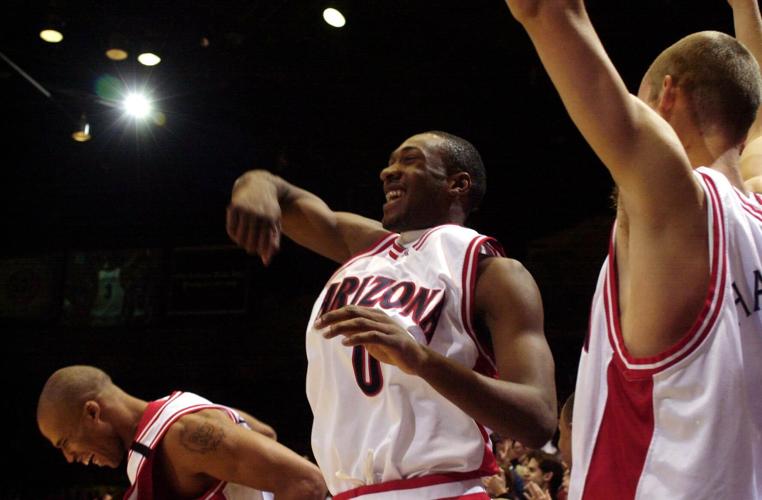
Gilbert Arenas, center, cheers on his teammates during a 2000 game. Arenas was a focal point during the team's 2001 run to the national championship game.
Now that a year has passed, how do you evaluate Lloyd?
A: “It’s a different offense, but I look at it like this: Did the players like the move? Did they like the situation they’re in now compared to the last one? If they say yes, then I have to agree with the players. It’s about making the players better, making the program better and it’s about having a place where kids can come in — this is a pro place. That was the main reason why I went to Arizona, because Lute Olson said, ‘You come here, you’re going to be a pro.’ We were thinking the Jason Terry route, but he was the first coach who said, ‘You’re going to be a pro.’ If you keep the lineage where this place is going to be producing pros, I’m all for it.’
What’s your evaluation of some of the players who just left the program for the NBA in Bennedict Mathurin, Dalen Terry and Christian Koloko?
A: “I could never pre-judge, that’s the wrong thing to do, because college players are college players. Their success is going to depend on how fast they can turn their college game into the pro game. Some kids are just great as college players. Some are decent college players but better pros because of how they game is laid out. Who can turn it over faster and understand that this isn’t college anymore and you have to learn the rules. Once that happens, and you’ll realize this at Arizona, basketball-wise we’re a little smarter than average. We pick up the game pretty fast.”
Do you see any similarities between Bennedict Mathurin and yourself?
A: “He’s definitely more athletic. But it’s all work ethic. I tell this to every player who’s coming in: ‘Understand that you have no school. Use that job as a way to get better. You have a bunch of free time, so use that for your own little program. Get a schedule, stick to that schedule and that’ll guide you to wherever you want to go.’”

