


The last time the world interrupted March Madness, at least for a moment, most current Arizona Wildcats had yet to reach kindergarten.
But associate head coach Jack Murphy was a newly minted UA graduate working on the staff of Lute Olson’s program back on March 19, 2003, when the Wildcats traveled to Salt Lake City to prepare for a first-round NCAA Tournament game … the same day that American forces invaded Iraq and then-President George W. Bush declared war.
That memory stuck with Murphy and popped vividly back up Thursday when the Pac-12 and NCAA canceled their postseason tournaments.
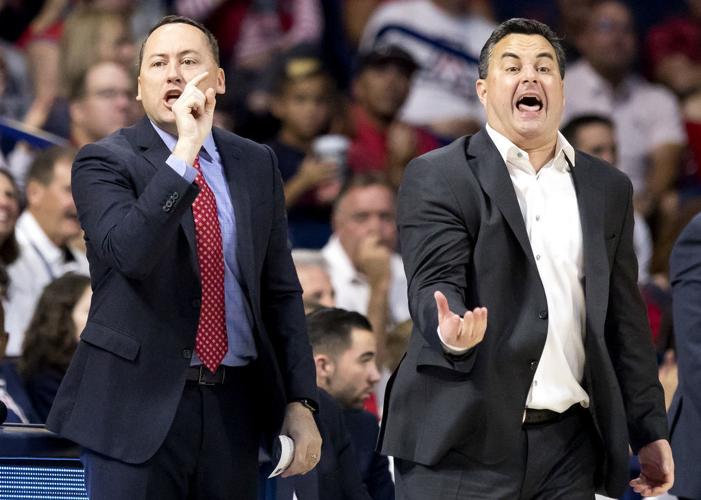
“Obviously, this (has been) really surreal,” Murphy said Thursday afternoon, before the Wildcats left Las Vegas. “It reminded me of 2003. We’re getting ready for the tournament and we’re having an Iraq invasion going on. It just seems like there’s world issues going on that are bigger than basketball, and it’s just unfortunate that it impacts all of life but obviously there’s a lot of things that are much more important than basketball right now.”
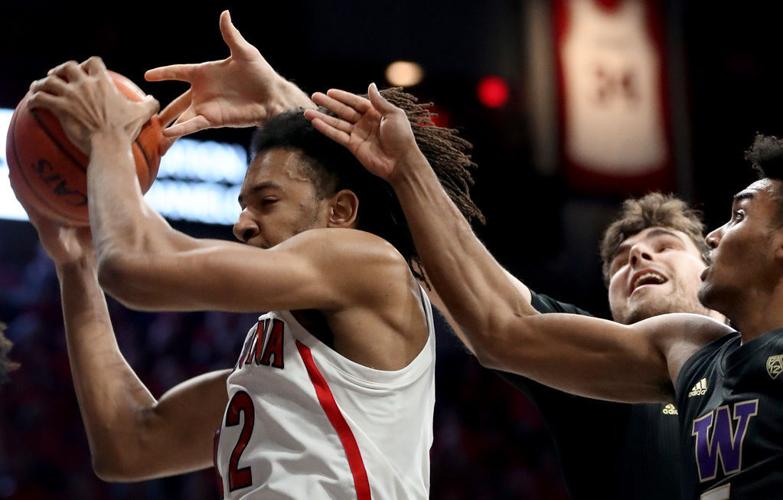
Chase Jeter, who was just 5 when the Iraq War began, received a similar feeling this week.
“This news, you see it and it’s like it doesn’t feel real until something like this happens,” Jeter said. “We know what’s happening in other countries, but now that it’s finally gotten to the States and there’s cases of it and people are catching the virus. So we have to take the proper precautions for everybody’s safety now.”
The public safety concerns, of course, are the biggest difference between then and now. While the 2020 NCAA Tournament was permanently called off because of coronavirus concerns, the 2003 NCAA Tournament went on as scheduled.
Then-UA senior Luke Walton said he heard that U.S. troops wanted the games to go on — “you give them something else to think and talk about,” he said then — while Olson offered perspective.
“It should make all of us think about the fact that the NCAA Tournament is fun and games,” Olson said in 2003. “We need to recognize that this is a very unimportant thing compared to what these people are having to face. I don’t think there will be a player or coach in the tournament who won’t feel that way.”
The Wildcats wound up delivering plenty of entertainment in Salt Lake City that weekend, with a commanding first-round win over Vermont and a classic double-overtime win over Gonzaga in the second round.
The following weekend, the Wildcats also went down to the wire in a memorable Elite Eight game with Kansas, just missing the Final Four in a 78-75 loss.
They were memories the Wildcats, their fans, and even the troops, may still have today.
But there will be no memories created this year. Just hypotheticals.
As the NCAA considered Friday whether to announce a never-to-be-played 2020 bracket, so that at least teams might be recognized for their achievements, the bracket projections were already out and final.
All of the major ones had the Wildcats firmly in the 7-9 seed range, meaning they were expected to definitively make the field of 68 but probably not reach the Sweet 16.
The compilation of picks on the Bracket Matrix had the UA slotted for a No. 7, which was precisely what ESPN’s Bracketology gave the Wildcats in the West Region, with a first-round game against No. 10 Texas Tech in Sacramento. The winner would have faced either No. 15 UC Irvine or No. 2 San Diego State in the second round.
CBS’ Bracketology was slightly less optimistic, giving UA a No. 9 seed in the South, with a first-round game against No. 8 Marquette in Omaha, with the winner likely facing No. 1 Baylor in the second round.
A Sportsline simulation of CBS’ projected bracket played the games out, finding the Wildcats “beat” Marquette but then “lost” to Baylor, as UA did on Dec. 7 at Waco, Texas.
Adding to those hypotheticals is the fact that UA might have been able to move up a seed line or two if it beat USC in the quarterfinals of the Pac-12 Tournament on Thursday and Oregon in semifinals Friday, potentially giving the Wildcats a better NCAA Tournament path and more likely appearance in the second weekend.
But nobody will ever know. About this weekend, next weekend or even the weeks ahead into the postseason.
There were just questions. Many questions.
The NCAA was reportedly pushing for spring sport athletes to have the option of an extra year of eligibility since their seasons were also called off this week, and there was a possibility winter sports athletes might also be included.
But if so, who would pay for the scholarships? And how would that affect the incoming recruits signed to replace them?
And what about the new recruiting? Already having shaken up the recruiting calendar drastically last year in the wake of the federal investigation into college basketball, the NCAA said the recruiting dead period would extend at least through mid-April.
Two successive weekends of evaluation-allowed events are still scheduled for late April as of now. They’re potentially critical events for programs like Arizona that flip over half a roster every spring.
Murphy said Thursday afternoon that he didn’t know how any of it would play out.
All he knew is that the Wildcats’ bus was leaving Las Vegas at 3 p.m.
“It’s changing hour to hour,” Murphy said. “We don’t know what’s happened. I’ve heard that we’re not supposed to go on the road recruiting and not supposed to have visits for a couple weeks. I really don’t know.
“So right now we’re just playing everything by ear and making sure that our guys are safe. And obviously, we hope everyone else out there stays safe.”




