

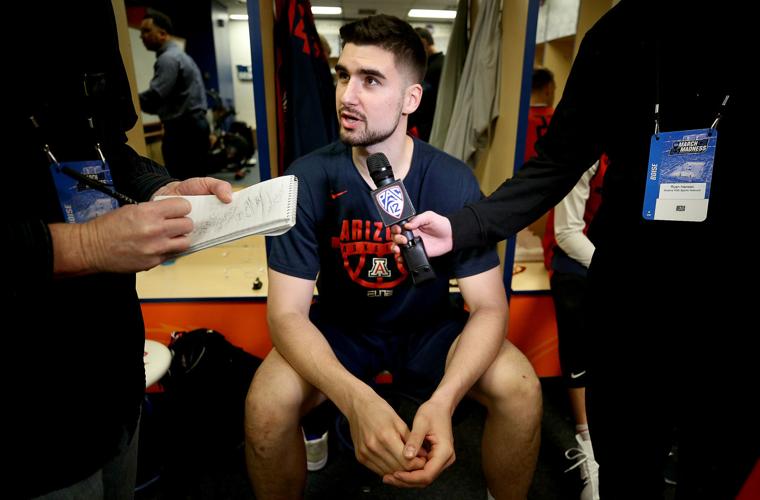
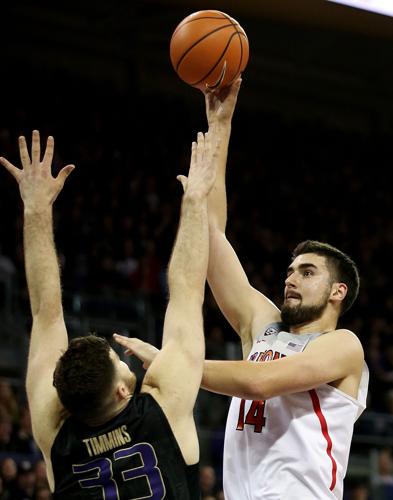
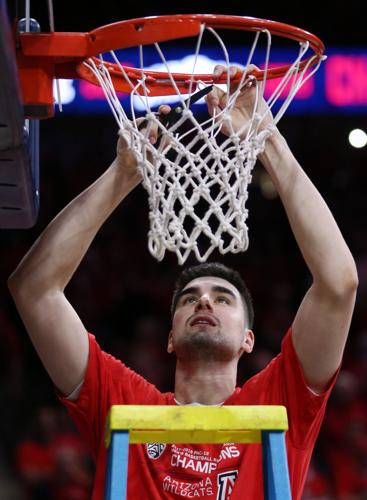
Of the many theories about why coronavirus trajectories differ between the United States and Europe these days, Dusan Ristic has experienced a couple of them first-hand.
For one, the former Arizona center says, countries within the European Union are smaller and with the power to firmly close their borders, airports or businesses as they see fit.
“They have their own rules, and it’s easier to control the people,” Ristic says. “In the States, it’s a huge country, lots of different people, and it’s hard to control.”
Then there’s this: Sometimes the rules in Europe and Asia involve turning certain people into prisoners of sorts.
Like Ristic.
Shortly after the NBA postponed its season March 11, the VTB United League (“Russian League”) that Ristic played in last season did the same. Except Ristic’s team in Astana, Kazakhstan — which has been officially known as Nur-Sultan since March 2019 — didn’t let its foreign players leave until the entire VTB season was canceled, which wasn’t for another two weeks.
By then, all international flights had been canceled out of Astana, located roughly 2,300 air miles away from both Ristic’s Serbian home and Beijing.
He was stuck.
“I was pretty much alone in my apartment, just trying to do something,” Ristic said. “I did some workouts in my apartment. I was watching movies, reading books. It was pretty different because at that time I didn’t know when the next flight was going to be available.
“I thought I would be able to go home any day, but it turned out it was almost two months.”
Kazakstan and Serbia both were issuing tight restrictions. In Kazakhstan, Ristic said he wasn’t allowed to leave his apartment after 8 p.m., while all gyms, restaurants and malls were closed.
Serbia, meanwhile, kept anyone other than essential workers from leaving their homes on certain days of the week in March and April.
Flying between those two countries was not an option for a while.
For much of the spring, there were only domestic flights out of Astana, Ristic said, and the airport in Serbia’s capital of Belgrade was shut down completely.
So he had to simultaneously become his own travel agent, advocate and sleuth.
After about a month, a few of his American teammates found a way out through Russia or Belarus. Ristic had no such luck.
“I was talking to multiple airline companies, sending them emails every day, just trying to find some information about the flights,” he said. “It was pretty crazy.”
Finally, on May 11, Ristic found a roundabout way home, with few flight connections available and none at all to Belgrade, where the airport did not open until May 18.
It took him nearly 24 hours.
“I had to fly from Astana to Frankfurt, Germany, and then to Sofia, Bulgaria, the bordering country to Serbia,” Ristic said. “Then I had to call my embassy. They took me from the airport to the Serbian border, where my dad was waiting for me.”
The restrictions didn’t stop there. Upon arriving in Serbia, Ristic had to take a coronavirus test and quarantine for over a week in a wing of his parents’ house in Novi Sad, about an hour from Belgrade.
Saying hello to his grandparents was not an option. Still hasn’t been, really.
“As soon as I was cleared with the PCR (COVID-19) tests, I went to Belgrade to stay away from my family, because my grandparents live nearby, and I didn’t want to put them in danger,” Ristic said. “I tried to stay as isolated as possible. Even the workouts that I was doing, I tried to stay isolated from other people.”
Even now, with Serbia (8.3) and Kazakhstan (4.3) having reported lower coronavirus deaths per 100,000 people than the United States (47.2), according to Johns Hopkins, Ristic has found life at home in Serbia still far from normal.
Ristic says he stayed away from indoor spaces, mostly working out and taking trips outdoors with his girlfriend to nearby mountains and rivers, trying to at least somewhat replicate a relaxing offseason away from basketball.
He’s had plenty of time to reflect on a career that, otherwise, has been arcing upward.
Upon finishing his four-year career at Arizona in 2018, Ristic signed a three-year contract with Belgrade’s Red Star club, but played a reserve role much of his rookie season. So after the 2018-19 season, Ristic said he spoke with club executives, who agreed the best thing for his development might be to place him somewhere he could play a bigger role.
Before long, Astana’s head coach called Ristic, saying he was impressed while watching him play at Arizona.
“He told me, ‘You will play a lot of minutes; I know your basketball qualities,’ ” Ristic said. “I liked his story, and it turned out it was the right decision.”
The Red Star loaned Ristic for 2019-20 to Astana, where Ristic played a starting role in Kazakhstan national league and VTB games. He averaged 15.7 points and 10.9 rebounds in 18 VTB games.
“It was a great experience for me,” Ristic said. “Probably after the Spanish league, it’s probably the best league in Europe. When you play in that league, you get a lot of exposure. A lot of scouts from other teams watch you every game.”
That helped propel Ristic to the Italian league, where Brescia Leonessa essentially bought out the final year of his Red Star contract for next season. Ristic is expected to play a starting role for Brescia and compete in EuroCup competition. He’ll likely face former UA teammate Kaleb Tarczewski, who extended his contract with Olimpia Milano for next season.
EuroCup games “were one of the reasons I chose the Italian team,” Ristic said. “It’s another opportunity for me to be playing top-level clubs.”
It might also be another place for more growth off the court. Even before the coronavirus hit, basketball has provided Ristic some unique cultural experiences.
Ristic said the adjustment going from Serbia to Kazakhstan was actually more different than going from Serbia to the United States, a move he made as a high school senior.
Among the top challenges in Kazakhstan were language, communication and the weather — sometimes all at the same moment.
“I learned some phrases, but nobody there speaks English, so I had difficulties in communicating,” Ristic said. “And nobody had a car. We all had drivers. They drive a little faster, and the rules are a little different, so I guess the management felt more comfortable with us having drivers. Especially because it’s really cold there.
“I think the temperature was negative-30 Fahrenheit once. It was super, super cold, and I’ve never experienced anything like it.
“And just the simple things. I can’t remember all the details, but if I learned something different in America, it was completely different here. The buildings are completely different. They invest a lot in architecture, and bridges and big monuments, city halls. It’s just a completely different style.”
Apparently. Noting how its modern architecture contrasted with the vastness of the surrounding steppe, a 2012 CNN story called Astana “The world’s weirdest capital city.”
Astana features a presidential palace that is modeled after the White House but eight times larger. Then there’s the nearby Baiterek observational tower, which a 2017 Guardian story described as “a golden orb at the top of a splayed white steel tree, like a Ferrero Rocher chocolate nestling in an upturned shuttlecock.”
OK, then. But the people were nice, Ristic said.
“I had a really great relationship with everybody,” Ristic said. “The food was good, too. Even though there were some comments that it was different than Western food, I didn’t have any problems with it. Also, I went to Moscow multiple times, and it’s a beautiful city, with a lot of history behind it.
“Comparing the States and Russia is completely different. It was kind of cool to be able to live in the two different societies. Now I have a better understanding of life, how some people perceive life and what their lifestyles are.
“I’m really grateful for the experience.”



