

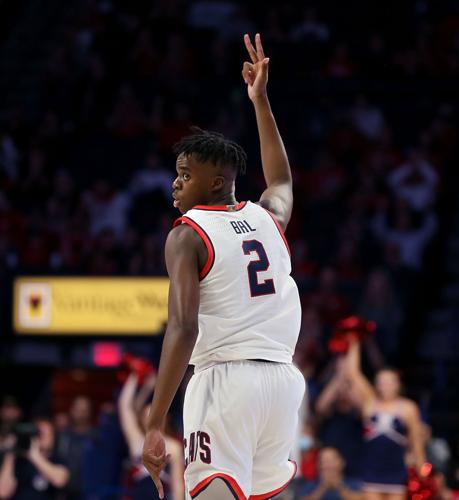
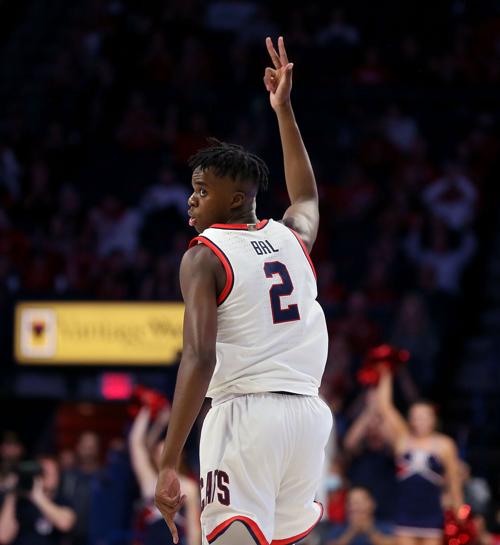
If there’s one statistic that might best encapsulate the Arizona Wildcats so far this season — the harmonious passing, weaving and shooting that has helped lift them to a No. 4 national ranking — it’s effective field goal percentage.
This stat, known in basketball geekery as “eFG,” simply divides all field goals made by attempts but gives 50% more credit for a made 3-pointer.
“That’s one of the No. 1 stats that I look at, because I think it’s a blend,” says Utah coach Craig Smith. “It just tells you exactly where you’re at.”
Three weeks into the regular season, this is where Utah and Arizona are at:
Arizona is No. 1 in eFG at 67.4.
Utah is No. 4 in eFG … defense, keeping opponents to just 38.6%.
Clearly, something’s gotta give when Arizona and Utah open their Pac-12 seasons Thursday at Salt Lake City’s Huntsman Center.
And, while Smith says he’s proud of how the Utes are defending so far this season, he also expressed that the Wildcats’ offense is something else all together.
“They are elite that way,” Smith said Wednesday on a Zoom media call to preview the game. “They were last year and they certainly are this year. … They just they can score it in every way. Obviously, super elite in transition. It all starts with a transition and, they’re very unique the way they rim run, and their bigs run hard. I mean, essentially every time down the floor and .. they trust each other.”
While preparing for Thursday’s game, Smith appeared to run into the same kind of problem Creighton coach Greg McDermott ran into last week in the Maui Invitational final against the Wildcats: Which player do you try to stop first?
McDermott chose to respect Arizona’s perimeter shooters, but left center Oumar Ballo in single coverage — and Ballo threw down 30 points in UA’s 81-79 win en route to Maui Invitational MVP honors. And that was two days after power forward Azuolas Tubelis threw down his own 30 points in the first round against Cincinnati.
“Their big guys are the real deal,” Smith said. “Ballo has really improved. I feel like his conditioning is a lot better. He’s more agile. He can play a lot longer. And he’s so big and physical. I mean, you’ve just got to find a way to figure it out. They expose you that way.”
Smith went on, noting that Arizona has all five starters in double-digits with a sixth player, Cedric Henderson, just 0.2 points away at 9.8.
So if it’s not Ballo or Tubelis inside, it’s Pelle Larrson, Courtney Ramey and Henderson attacking from the wing, or point guard Kerr Kriisa hitting a team-high 18 3-pointers so far at a 51.4% rate.
“All their guards can just absolutely shoot,” Smith said. “I mean, Kriisa is on fire. It’s just to the point where when he shoots it, you feel like it’s going in and obviously Ramey just getting into the lineup in Maui is playing at a really, really high level. Pelle Larsson can do it all. You just go right down the line. They have a great blend. They’re just so balanced.”
But while Utah hasn’t played nearly as tough a schedule as Arizona — the Utes’ nonconference slate is ranked the 313th hardest by Kenpom, while the Wildcats’ rose to 120 after the Maui Invitational — the Utes are running a more promising defense than a year ago.
In Smith’s first season, Utah won just four Pac-12 games, prompting Smith to turn toward a more youth-oriented lineup in the second half of the season. They ranked in the middle of Division I in both eFG defensive (49.4%) and overall defensive efficiency (allowing 103.5 points per 100 opponent possessions).
Then he added a few key pieces in the offseason, including forward Ben Carlson (Minnesota) and guard Mike Saunders (Cincinnati) and three contributing freshmen.
As a result, the Utes have mopped up four low-major opponents and lost to then-undefeated Sam Houston at home, while beating Georgia Tech and losing to Mississippi State in a Florida event last week.
“I think we’re just scratching the surface of where we can be,” Smith says. “We’ve got a lot of newness on our team. A lot of young guys, a lot of inexperience, even the transfers … It’s just experience, it’s continuity, playing with each other, understanding our system and what we’re trying to do.”
So far, Utah still has allowed their seven opponents to shoot just 25.6% from 3-point range and 38.7% from two.
UA assistant head coach Riccardo Fois, who has scouted Utah since last season, says he isn’t a big believer in looking at 3-point percentage defense, because it doesn’t break down all the kinds of 3s that can be taken. But he credited the Utes’ solid interior defense and their ability to prompt opponents into taking difficult shots from the perimeter.
“I don’t think there’s a big plan on how you make the other team miss 3s other than make them take the 3s that you want them to take,” Fois said, “and I think they’ve been doing a good job of that.”
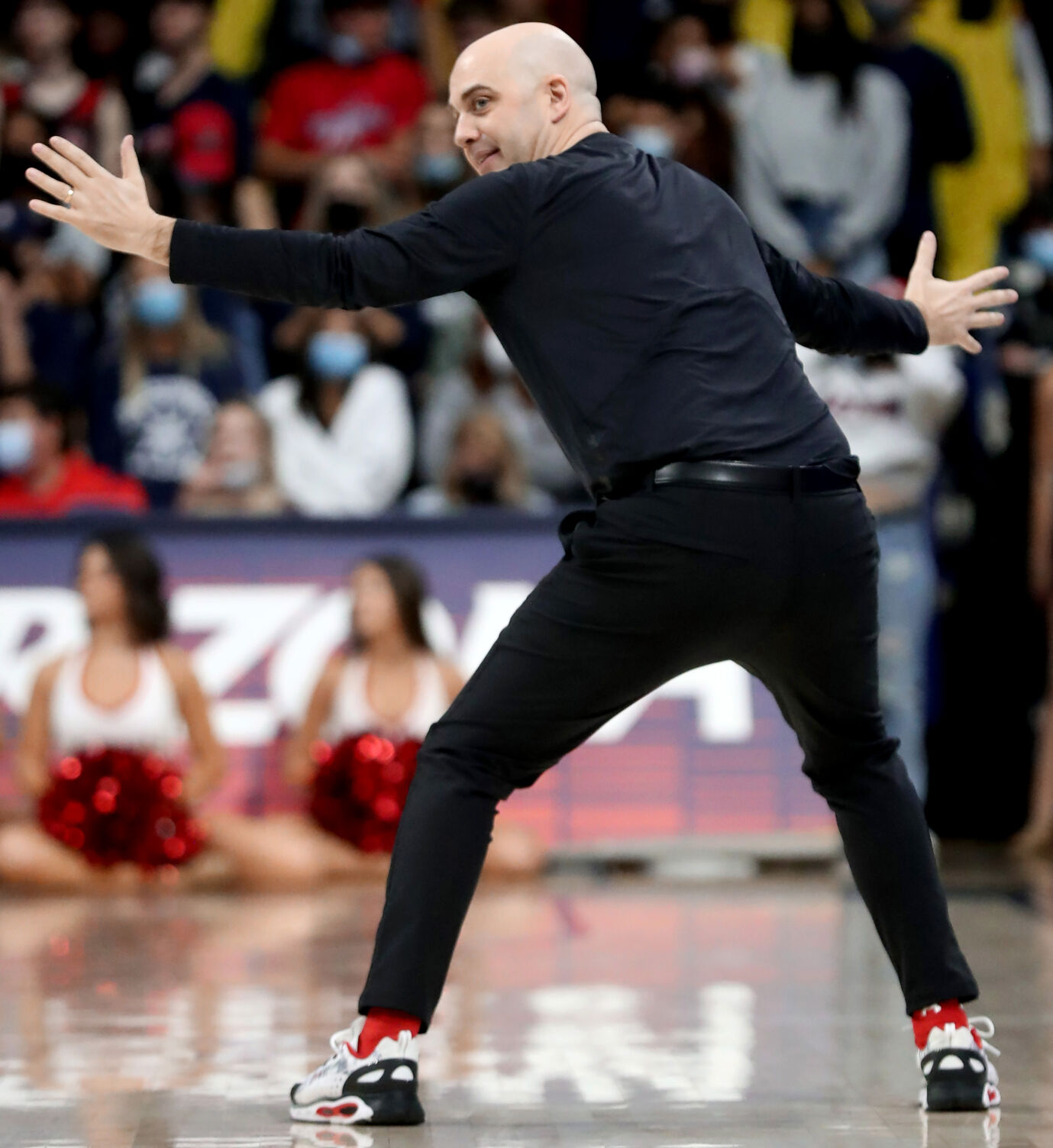
Utah coach Craig Smith has more weapons this season after adding transfers and highly touted freshmen.
Fois said the Utes stay in front of the ball and won’t over-help to contest a shot, and statistics indicate the Utes don’t gamble defensively. Utah steals the ball just 5.4% of its opponents possessions – ranking No. 354 nationally — and turn the ball over on just 15.7% of opponents’ possessions.
“They’re very solid,” Fois said. “They don’t beat themselves.”
But, as Smith noted, any number of Wildcats could beat them instead.
“Most teams have a guy or two you can really kind of play soft on or you can pick your poison and take your chances,” Smith said. “It’s just really difficult to do that with this team because they can just do it in so many ways.”
McKale Center was built at the University of Arizona in the early 1970s. There have been updates through the years.

