

There was a time, Arizona coach Tommy Lloyd says, when an NCAA official sat in his office to warn him about adding players who had already changed colleges.
He said, “'Don’t recruit double-transfers. They’re not gonna be eligible,'” Lloyd said. “OK. We didn’t recruit double transfers.”
That conversation was during the summer of 2023. Eons ago, that is, in a college basketball world that continues to shift abruptly and awkwardly into professionalization.
The conversation happened several months before double-transfers were, in fact, allowed. It happened long before G League players could sign up to play college basketball, as two of them did last fall, and long before Baylor acquired a former NBA Draft pick, James Nnaji, last week.
In a landscape without pro-style collective bargaining guardrails, lawsuits and threatened lawsuits continue to chip away at the NCAA’s eligibility powers at a dizzying pace.
“It's so crazy right now,” Lloyd says. “I guess the only thing that I would say is frustrating is you just don't know what direction things are coming from. Why doesn't everybody know what's going to be allowed and what's not going to be allowed? Why are we surprised by things?”

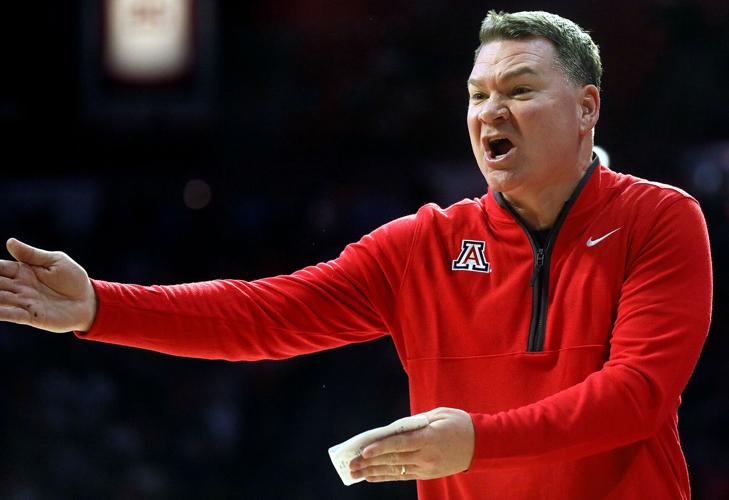
Arizona Wildcats head coach Tommy Lloyd has some words for a referee in the second half during a game at McKale Center in Tucson on Nov. 7, 2025. Arizona won 93-67.
Lloyd found out in December 2023 that second-time transfers were actually OK, and the lines have continued to shift since then.
It used to be that anybody who transferred had to sit out a year, allowing both the athlete and coach to adjust to each other for a year in practice. Then it was just second-time transfers who had to sit out, until they didn’t.
That’s why former UA recruiting target Adam Miller, who had already played at Illinois and LSU before transferring to ASU in 2023, was suddenly able to throw on a Sun Devils uniform in December of that year. He averaged 12.0 points the rest of the 2023-24 season, played another year at ASU last season and is now playing for Gonzaga.
All without sitting out a year, of course.
It also used to be that international players who had signed professional contracts might not be eligible for the NCAA at all, or at least subject to ineligibility for varying periods depending on the nature of the contract. Estonian guard Kerr Kriisa became one of those guys when he joined Arizona for the 2020-21 season and was forced to sit out the Wildcats' first 17 games that season because of a pro deal he signed in Lithuania.

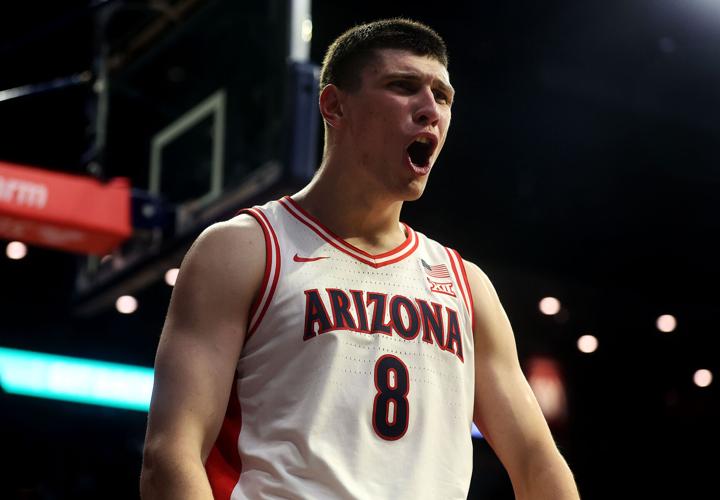
Arizona Wildcats forward Ivan Kharchenkov yells out after making a basket and a foul called against South Dakota State in the second half during a game at McKale Center on Dec. 29, 2025. Arizona won 99-71.
But five years later, Ivan Kharchenkov joined the Wildcats despite having signed a professional contract in Germany that had locked him up until 2027 before it was bought out last spring. That's been a more common sight lately, developing European pros moving to college basketball, while things still keep shifting further.
The commitments of G League players Thierry Darlan (Santa Clara) and London Johnson (Louisville) to colleges, and then Nnaji's move to Baylor, kept the shock waves rolling.
“Santa Claus is delivering midseason acquisitions,” UCOnn coach Dan Hurley posted to X on Christmas Eve, when Nnaji’s signing became public, “…this s*** is crazy!!”
Baylor coach Scott Drew defended his move by telling ESPN that “we don’t make the rules,” and that coaches are paid to put their teams in the best positions to be successful.
But what are the rules? In a statement it sent to the Field of 68, the NCAA said its eligibility rules “have been invalidated by judges across the country wreaking havoc on the system and leading to fewer opportunities for high school students, which is why the Association is asking Congress to intervene in these challenges.”
The next barrier to fall might be seeing somebody who actually played in an NBA game join a college team, and it might not be far ahead: Several colleges have been reportedly pursuing a two-way player who has appeared in eight NBA games, Trentyn Flowers.
Before long, the only eligibility restriction left may be the limit of playing no more than four years in college (barring injury, which can lead to a fifth or sometimes even a sixth year).
Saying he was "not playing that game" when asked about the Nnaji acquisition earlier this week, Lloyd also declined to say if he thought things could escalate to where an NBA player joins a college team.
“Done. Not talking about it,” Lloyd said. “I don't want to be a quote on that stuff. I want to be a quote on Arizona basketball, what we have going right now. Let’s stay locked into the main thing, Arizona basketball, and Arizona football winning the Holiday Bowl. That’s as deep as I can go in my Rolodex right now.”
Maybe that changes once Arizona travels to play at Baylor on Feb. 24. Or maybe the Nnaji story has been bumped off the news cycle by Flowers, or another NBA player who is jumping to the college level.

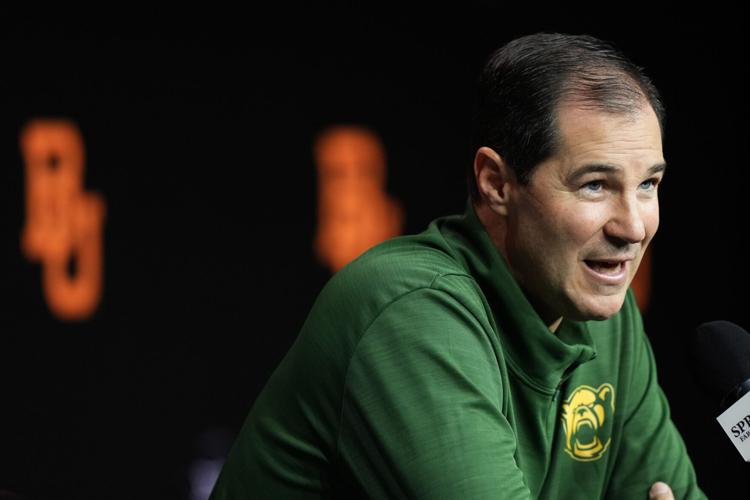
Baylor head coach Scott Drew addresses the media during Big 12 Men’s Basketball Media Day on Oct. 23 in Kansas City, Missouri.
Who knows?
“I equate it to the speed limit,” Drew told CBS Sports. “You go through a construction zone, it changes. You get on the highway, it changes. Right now, the NCAA has speed limits, and it changes. I don't blame the NCAA because a lot of it's about what they feel they can win in the courtroom. To me, until we get to collective bargaining, there's not going to be a solution.”
But, the way Lloyd describes it, the speed limit signs are barely being posted before things change again. Lloyd says maybe it’s a “me fault” for not paying attention to the rapid changes via social media, but wondered if there’s a better way to at least follow that shifting line in the sand.
“I think it should be a little more obvious what is going to be allowed and not allowed,” he said. “If you're talking about a real level playing field, let's start with that.”
Cheaper tickets fill McKale
A promotion for $13 upper-level seats appeared to help fill McKale Center to near-capacity for the Wildcats’ past two home games.
Despite its early-season success, UA has sold out only one of its eight home games so far, on Dec. 6 against Auburn, and attracted an announced crowd of just 13,092 in 14,688-seat McKale on Dec. 22 against Abilene Christian.
But UA slashed the price of its remaining $35 corner upper-level seats to $13 for its Dec. 22 game with Bethune-Cookman and Dec. 29 game against South Dakota State, for fans willing to buy online in advance or within an hour of tipoff at the McKale Center box office.
Arizona wound up with announced crowds of 14,375 against Bethune-Cookman and 14,501 for South Dakota State, their second and third biggest crowds of the season.
“The last couple of games we’ve been close,” Lloyd said, after thanking fans who did show up. “There were a couple of hundred tickets still available, and we’ll fight for a real sellout. We don’t need to short ourselves.
“I just want our fans to know that. I’m sure there were a couple hundred people who said 'Man, I wish we had tickets to the game'… well, if you’re not able to buy online, come wait in line. Let’s make it a thing where everybody gets to be a part of it. That’s what we want.”
The $13 promo was expected to include UA’s next home game, on Jan. 7 against Kansas State, but the school’s seat map showed only two single seats available at that price as of earlier this week.
Dybantsa picks up Big 12 honor
After posting only the second triple-double with 30 points in Big 12 history, BYU freshman AJ Dybantsa picked up the Big 12’s Player and Newcomer of the Week awards.
Dybantsa had 33 points, 10 rebounds and a career-high 10 assists to lead BYU over Eastern Washington on Dec. 22. It was the only game BYU played in a light scheduling week for all Big 12 teams.
Dybantsa was joined by Baylor’s Tounde Yessoufou, Cincinnati’s Baba Miller, Iowa State’s Joshua Jefferson and Texas Tech’s Christian Anderson on the league’s “starting five” weekly honor roll. UA had nominated freshman Koa Peat for both Player and Newcomer of the Week, after Peat had 14 rebounds against South Dakota State and averaged 15.0 points against South Dakota State and Bethune-Cookman.

