


Back in the Pac-12’s more symmetrical days, the midpoint of the conference season was easy to identify.
Five weeks into what was an 18-game schedule, sometime around late January or early February, each Pac-12 team had usually played exactly half of them.
Now, with the Pac-12 playing 20 games by adding two in early December, it’s muddled. And the COVID pauses, postponements and makeup games made it virtually impossible to tell when the midway point arrived.
So now, is the midseason after exactly 10 games, which would have been Friday for Arizona? Is it midway between the Wildcats’ Dec. 1 conference opener and their season finale on March 4 (mid-January for Arizona)? Does it include the Pac-12 Tournament, which is technically part of the regular season, which means it hasn’t happened yet?
Or is the midway point of conference play now, the end of January, like it used to be?
Whatever the case, here’s our “Pac-12 midseason” report about the Wildcats:
MVP: Azuolas Tubelis
Not only is the Wildcats’ speedy post player from Lithuania their best player, posting seven double-doubles in seven of 11 conference games, but he’s emerging as a frontrunner in the Pac-12 Player of the Year race.
Tubelis leads the Pac-12 in both scoring (20.4) and rebounding (10.6) in conference games, neither by a small margin. Washington’s Keion Brooks is second in scoring at 19.0, while Utah’s Branden Carlson is third at 17.6.
In rebounding, Tubelis averages 1.9 more than the second top rebounder, which just happens to be teammate Oumar Ballo (8.7). Tubelis is also an improved defender, taking on centers and power forwards, while making WSU’s mobile Mouhamed Gueye work hard for his 15 points last Thursday (6-for-19 shooting).
“He’s a really good player, and he’s figuring this thing out,” UA coach Tommy Lloyd said.
Tubelis on Monday was one of 20 players named to the Wooden Award’s late-season watch list.
Most improved: Ballo
Maybe it wasn’t always obvious last year, when Ballo played behind Pac-12 Defensive MVP Christian Koloko, but the big man from Mali actually made a big leap last season from the seldom-used freshman he was at Gonzaga in 2020-21.
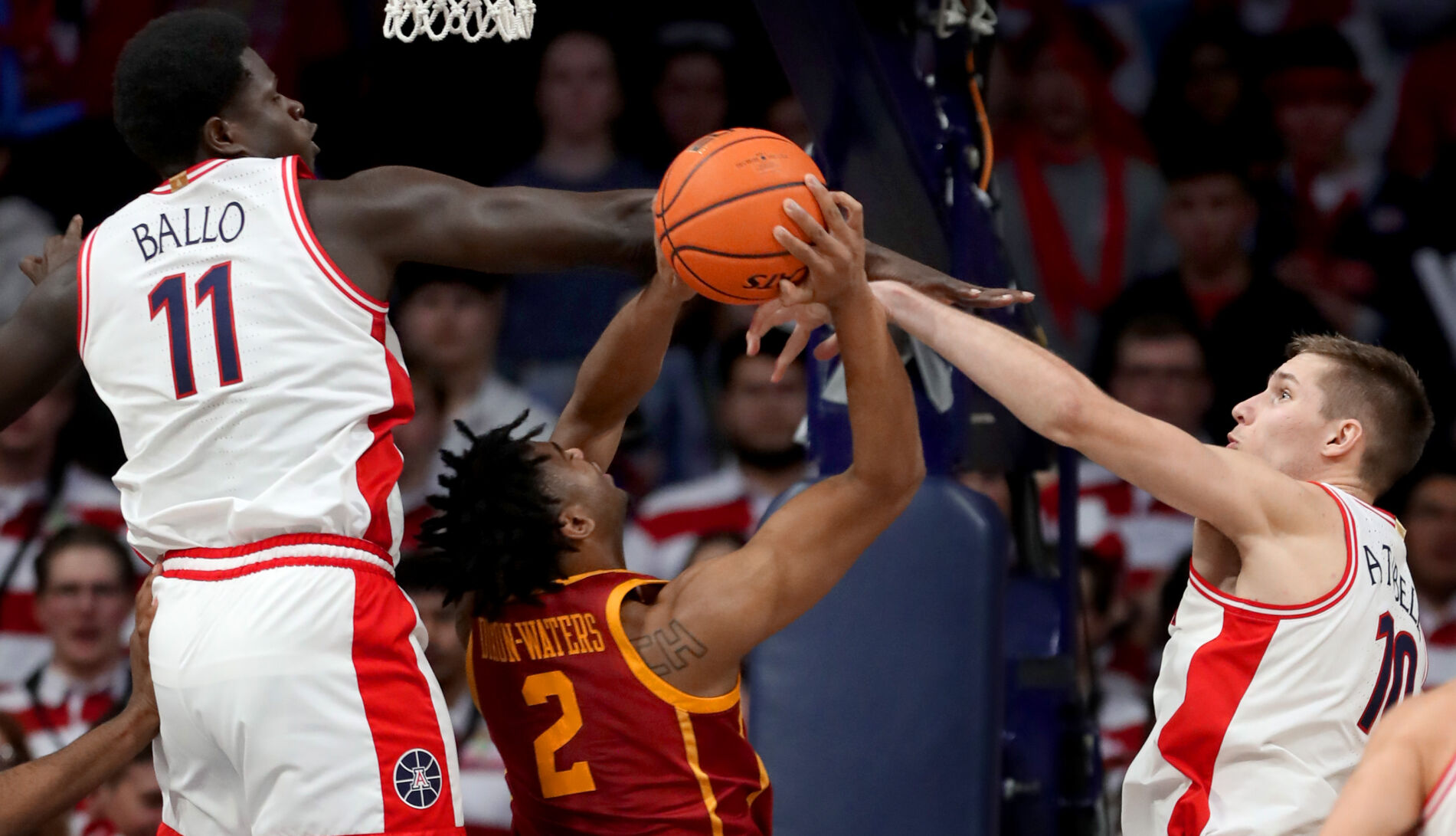
This season, Ballo has pretty much obliterated any previous version of himself. The Maui Invitational MVP back in November, after he collected 63 points and 32 rebounds over three games while shooting 79.4%, Ballo has continued progressing in conference play.
Ballo is not only the Pac-12’s second-leading rebounder but also ranks fifth in shooting percentage (57.0) and is fourth in blocks with an average of 1.9. He also has just 19 turnovers in 11 conference games despite handling the ball often in UA’s system.
Finally, Ballo has drawn 6.9 fouls per 40 minutes in all games this season, the 16th-highest amount in Division I, but doesn’t take nearly full advantage of them. He has made only 55.1% of his free throws in conference games.

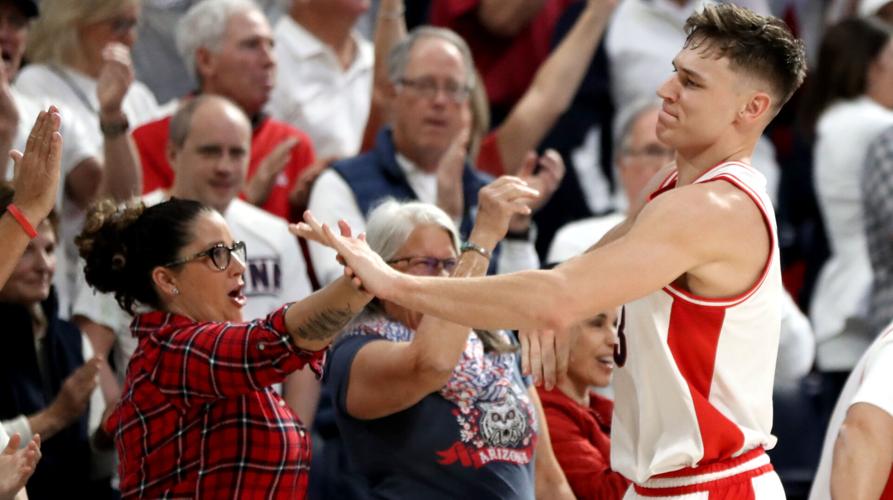
Arizona guard Pelle Larsson gets high-fives from the crowd after the Wildcats held on down the stretch for a 58-52 win against UCLA at McKale Center on Jan. 21, 2023.
Most versatile: Pelle Larsson
The Wildcats’ junior wing from Sweden not only can fill up a box-score line, but he’s especially valuable on the defensive end, able to guard pretty much any position except center. That helps give the Wildcats flexibility to handle tricky matchups with the many hybrid power forwards around the Pac-12.
In conference play, Larsson has been nearly perfect at the line. He has missed only one free throw in 34 attempts, with his percentage of 97.1 leading the league. Among the Wildcats, in conference games, Larsson is their third-leading rebounder (4.7) and fifth-leading scorer (7.8 points). He’s also third on the team in assists (2.2) and second in steals (1.2).
Critically, Larsson also showed a willingness — and adaptability — in accepting a move from the starting lineup to the bench after Arizona lost at Oregon on Jan. 14. Already the Pac-12’s Sixth Man of the Year last season, Larsson has brought more energy to the bench while his replacement, Cedric Henderson, received a confidence boost as a starter.
The only problem for Larsson: He won’t be able to win another sixth-man award because he started Arizona’s first seven conference games, one more than players are allowed to have.
Top newcomer: Courtney Ramey
While freshman Kylan Boswell is flashing all-conference potential at age 17, Ramey has brought the Wildcats defense, shooting, ballhandling — and plenty of experience — at age 23.
Ramey has been a high-major starter since January 2019, starting 3½ seasons at Texas before transferring to Arizona last summer to play a fifth season of college basketball after testing the NBA draft last spring. Not surprisingly, he carries himself with confidence and positivity, no matter the circumstance.
Ramey hit a New Year’s shooting slump, shooting a combined 2 for 14 from 3-point range over three games against ASU, Washington and Washington State, contributing only two points in 24 minutes in the Wildcats’ Jan. 7 loss to the Cougars. But since then he’s shot 43.4% from 3 while averaging 11.5 points a game.
Ramey also has the second-best assist-to-turnover ratio (2.93) in Pac-12 games, behind only Utah’s Rollie Worster (3.5).

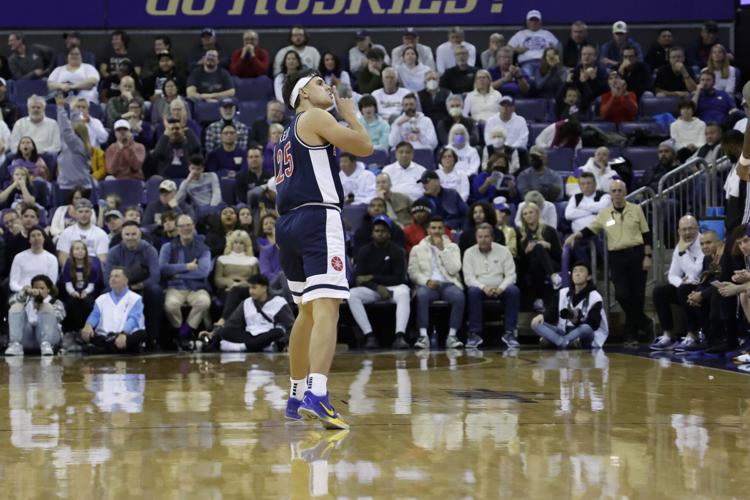
Arizona guard Kerr Kriisa gestures toward the Washington cheering section after sinking a 3-point basket during the second half.
X-factor: Kerr Kriisa
Arizona’s polarizing point guard has been mostly consistent as the driver of the Wildcats’ pass-happy offense, one reason Lloyd has repeatedly supported the Estonian junior. “He’s one of the best point guards in the country, bar none,” Lloyd said after UA beat Washington on Saturday.
But the Wildcats have swung notably to wherever Kriisa’s shooting goes.
Kriisa has made only 4 of 23 3-pointers in UA’s three Pac-12 losses, and he was also just 2 of 8 in the Wildcats’ one-possession win over Washington on Jan. 5. But he was also a big reason Arizona melted the defenses of Washington State and Washington in a road sweep last weekend.
Kriisa hit 5 of 10 3s at WSU and 6 of 11 at UW, earning UA’s nomination for the Pac-12 Player of the Week award even while Tubelis posted a pair of double-doubles.
Biggest puzzle: Adama Bal
It has long been an axiom in college basketball that a player’s improvement is typically the biggest between his freshman and sophomore seasons, since the player has had a year to see what is demanded at the new level and an offseason to work on any deficits.
And when Bal played quality minutes in the Pac-12 Tournament last season while Kriisa was out with a severely sprained ankle, that suggested Bal would grow into a bigger role this season, especially without Bennedict Mathurin and Dalen Terry around. Bal also played well for his native France in U20 play last summer.
But Bal has been squeezed almost entirely out of UA’s playing rotation lately. Lloyd shrunk it down to just seven players, indicating Bal and freshman center Henri Veesaar simply aren’t playing well enough.
Bal didn’t play at all against UCLA on Jan. 21 nor at WSU on Jan. 26, while playing only 90 seconds at Washington on Saturday after the game was decided.
The tight rotation has worked for the Wildcats so far but, if injuries or foul trouble hits, it probably won’t be sustainable.
“I know we’re gonna have to play more than that at some point,” Lloyd said.
Statistical trend
The nation’s top team in offensive efficiency through the first two months of the season, Arizona has slipped in Pac-12 play. The trend started in the 81-66 loss at Utah on Dec. 1 and picked up again after Pac-12 play resumed on New Year’s Eve, when ASU held the Wildcats in the 60s.
Arizona now ranks 14th nationally in offensive efficiency and just fifth among Pac-12 teams in conference games.
But the Wildcats have offset that problem by becoming an improved defensive team, climbing from the 60s in Kenpom defensive-efficiency rankings to No. 31 as of Monday. They are fourth in the Pac-12 during conference play behind UCLA, Utah and Colorado.
Among other components, Lloyd says Ramey has meshed well with his defensive system after initially bringing over some habits from Texas that didn’t fit UA’s philosophy; and all the Wildcats have made more subtle adjustments to playing without rim-protector Koloko.

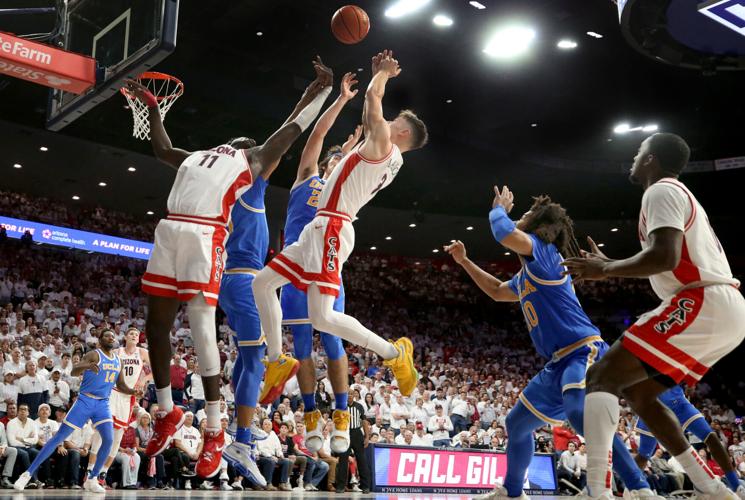
Arizona center Oumar Ballo, left, and guard Pelle Larsson go up in the paint for an offensive rebound against UCLA in their Pac-12 game at McKale Center on Jan. 21, 2023.
Most important win: UCLA, Jan. 21
Arizona took its identity flip to an extreme against UCLA, winning a game while scoring in the 50s for the first time since 2014-15. The Wildcats shot only 36.9% from the field in what would have been a doomsday scenario earlier in the season, but they survived by holding UCLA to just 31.3% shooting.
In particular, the Wildcats made UCLA standouts Tyger Campbell (5 for 18) and Jaime Jaquez (5 for 17) labor just to hit double-digit scoring.
“I think we proved that we can win low-scoring games,” Kriisa said. “Everyone keeps talking about offense and offense and offense, but nobody really talks about how good our defense is.”
Most costly loss: WSU, Jan. 7
Arizona’s loss at Utah hasn’t looked too bad with age: The defensive-minded Utes are now in a loss-column tie with Oregon for fourth place after being picked to finish 10th, while UA rebounded from the visit to Salt Lake City by beating Indiana and Tennessee in nonconference play.
But when WSU snapped the Wildcats’ 28-game homecourt winning streak on Jan. 7, Arizona staggered backward.
The Wildcats shot just 4 of 25 from 3-point range, while Ballo struggled in his second game back after being hospitalized with a bacterial infection. Ballo was 4 for 11 from the field, 3 of 10 from the line and, combined with Arizona’s other post players, allowed Gueye to stomp all over the court with 24 points and 14 rebounds.
Lloyd said the Wildcats were also “kind of sluggish in all facets of the game” and that he hoped it didn’t harm their mojo. But it did, at least for another week: On Jan. 14, the Wildcats were crushed 87-68 at Oregon.
The next day, Lloyd said he decided to swap Henderson for Larsson in the lineup, pending his players’ approval, and the Wildcats haven’t lost since.
Rim shot
After its weekend sweep in Washington, Arizona moved up one spot to No. 5 in the Associated Press Top 25 poll. UCLA dropped from No. 8 to 9 after losing at USC. In the computer metrics as of Monday, Arizona ranked No. 7 in Sagarin, No. 9 in Torvik, No. 10 in NET and No. 11 in Kenpom.

