


Nearly 34 years have passed since Arizona last lured Duke into McKale Center, and there’s no telling if it will ever happen again.
Their matchup may simply be too valuable for a campus site, at least in the current environment.
After the Wildcats host the Blue Devils on Friday, the teams are next scheduled to renew their cross-country rivalry during the 2027-28 season … in Las Vegas … in a football stadium.
Similarly, Arizona and UCLA opted to recreate their old Pac-12 rivalry this season with a nonconference game ... on the Phoenix Suns' homecourt, not at McKale Center or Pauley Pavilion. They also agreed to future matchups in Las Vegas and a neutral site in Los Angeles, but not on either campus.
Combined with the emergence of 20-game conference schedules and annual “multi-team events,” big neutral-site games have threatened the existence of traditional “home and home” series in which teams play only at each other’s campus sites - even as Arizona says it remains committed to holding top-shelf nonconference games at McKale every season.

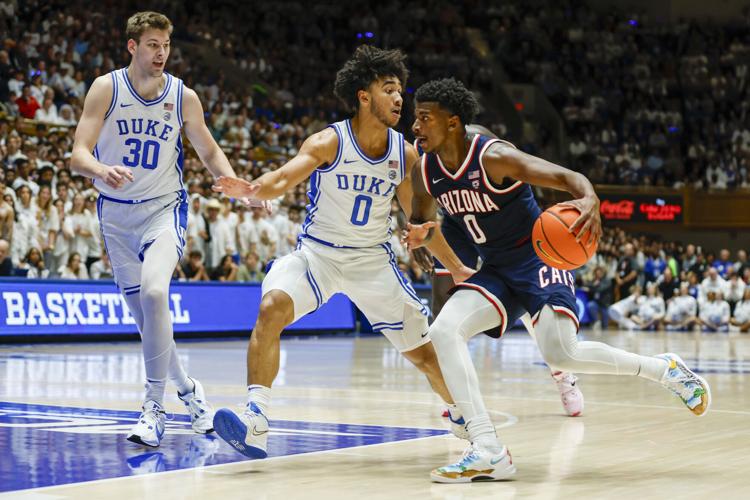
Arizona guard Jaden Bradley, right, brings the ball up court against Duke guard Jared McCain (0) and center Kyle Filipowski (30) in the first half on Nov. 10, 2023, in Durham, N.C.
Like so many aspects of college sports today, NIL and future revenue sharing needs appear to be behind the increased shift.
Neutral-site games are typically assembled by outside promoters who can bake in opportunities for the teams’ NIL collectives and/or pay athletic departments directly with money that they can forward to players under revenue-sharing agreements that could begin as early as next season.
While Arizona is expected to gain significant revenue-sharing funds by facing Duke in Las Vegas, its games with UCLA are creating NIL activity from both teams' collectives.
“Those collectives aren’t going to go backwards,” ESPN analyst Seth Greenberg said Wednesday, while discussing nonconference scheduling on a media conference call. “They’re only going to continue to go forwards in terms of valuation that you’re going to need. I mean, two years ago, a good NIL collective was $2 million. Last year, it was $5.5, $6 million. That’s a one year jump. Now think about that.”
Still, the Wildcats may be able to have it both ways. Their collective, Arizona Assist, is selling hospitality packages around the Dec. 14 UCLA game for $5,000 and $10,000, with the proceeds filtering down to compensation for players.
But at the same time, Arizona is continuing to seek two home-and-home series to be a part of every 31-game regular season, preferably with one big matchup at McKale and another at an opposing campus site every season.
“That’s the model we want to keep,” says UA assistant coach TJ Benson, who handled scheduling until his promotion from a special assistant this season.
For this season, UA’s home-and-home contracts produced the Wildcats’ game at Wisconsin on Nov. 15 and Friday’s game against Duke at McKale.
Future home-and-home series are planned but not contracted yet, and UA president of basketball operations Matt King said he's excited about the possibilities.
"We're still very committed to really high-quality home and homes, and that won't ever change," King said. "We don't want our season ticket holders to ever believe there that we're not going to try to make sure there are some big time games.
"It's going to be an amazing night on on Friday night, and a big part of that is because the game's being played at McKale. We recognize that the building has a lot of history and tradition in it, and it also has some magic."

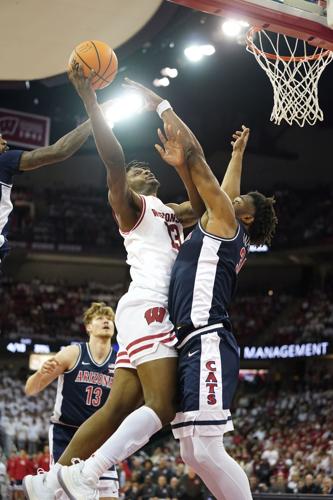
Wisconsin forward Xavier Amos scores against Arizona forward Tobe Awaka during the second half Nov. 15, 2024, in Madison, Wis.
Arizona actually has to hold at least six nonconference games at McKale Center every season anyway, on top of two exhibitions and 10 conference home games, because of the school’s self-imposed 18-game minimum at McKale for budgeting and season-ticket purposes.
So of those six games, one can be a major matchup that is part of a home-and-home while the other five can be “buy” games, those where a mid- or low-major opponent is paid about $80-90,000 to show up once at McKale.
Arizona could also receive two more home nonconference opportunities if the Big 12 moves back to an 18-game schedule next season; it is experimenting with 20 games this season in a move that Kansas coach Bill Self has opposed.
Meanwhile, the home-and-home games of the future may work out just as well financially on campus as anywhere else. Greenberg says big home matchups “are going to turn into NIL games” that won't have to be played on a neutral site.
“Outside promoters are going to end up getting those games, and they’ll be still played on college campuses,” Greenberg said. “They’ll work on some type of deal that will benefit both teams through an outside NIL opportunity, whether it’s autograph signing, clinics, reading programs or whatever. I think these things are going to be more the norm at the highest level than the exception.”

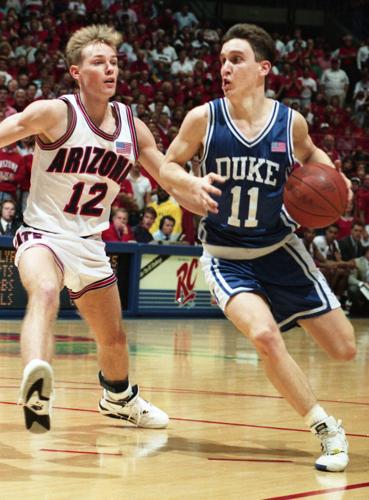
Duke guard Bobby Hurley drives past Arizona’s Matt Othick on Feb. 24, 1991, in Tucson. Duke is returning to McKale Center for the first time in nearly 34 years.
Fellow college basketball analyst Jay Bilas, who is scheduled to work Friday’s game for ESPN2, said the North Carolina-Kansas series that began at Kansas on Nov. 15, as well as the Arizona-Duke and Arizona-Wisconsin series, are proof that big home-and-homes can still happen.
That’s good for TV, for fans and, Bilas said, for the teams involved.
“Last year, (Arizona) played Wisconsin at McKale and they beat the hell out of them,” said Bilas, who worked that game. “Then this year, they go to Wisconsin and return the game (and lose) — I can’t see that as being anything but a huge positive for Arizona. There is no denying that tape for the players. They watch that tape, they know exactly what they need to work on and it’s an early-season reality check.”
Players also enjoy the big games, Bilas said, noting that he “would have loved” the chance to experience McKale while playing for Duke in the mid-1980s. However, Bilas played at Duke before the schools began a home-and-home series with UA that started in Durham in 1989-90 and finished at McKale in 1990-91.

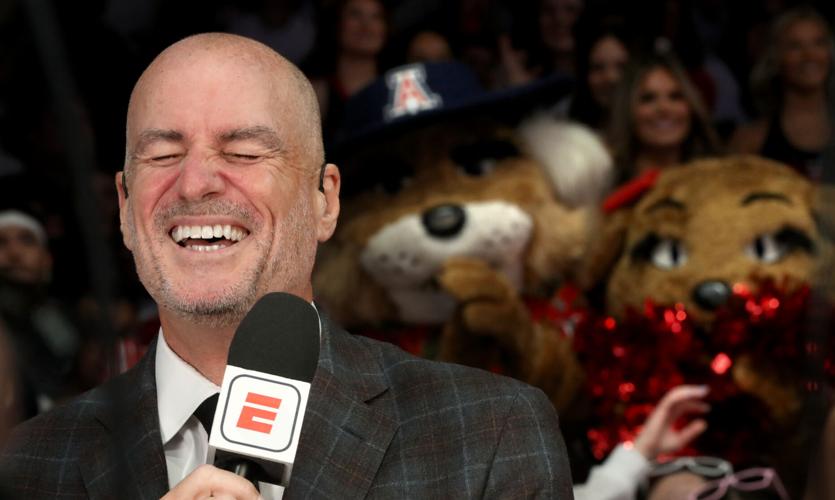
ESPN’s Jay Bilas cracks up while doing a remote pre-game from the Zona Zoo student section hours before Arizona went against UCLA at McKale Center on Jan. 21, 2023.
While Bilas said he didn’t know whether media companies could influence whether bigger matchups are played on campuses or at neutral sites, he left no doubt that they want them one way or another.
“I don’t know exactly what’s going to happen with regard to these type of matchups where they’re home-and-home, but my sense is that they’re going to happen more often, rather than than less often,” Bilas said. “This is not to denigrate any sort of these smaller conference teams, but the players don’t want to play in those games. The fans don’t really want to see them.
“Television doesn’t value them as highly as they do a game like Duke and Arizona, especially when it’s played on a home site. Those are valuable games wherever they’re played, but the home sites really add something to it.”

