


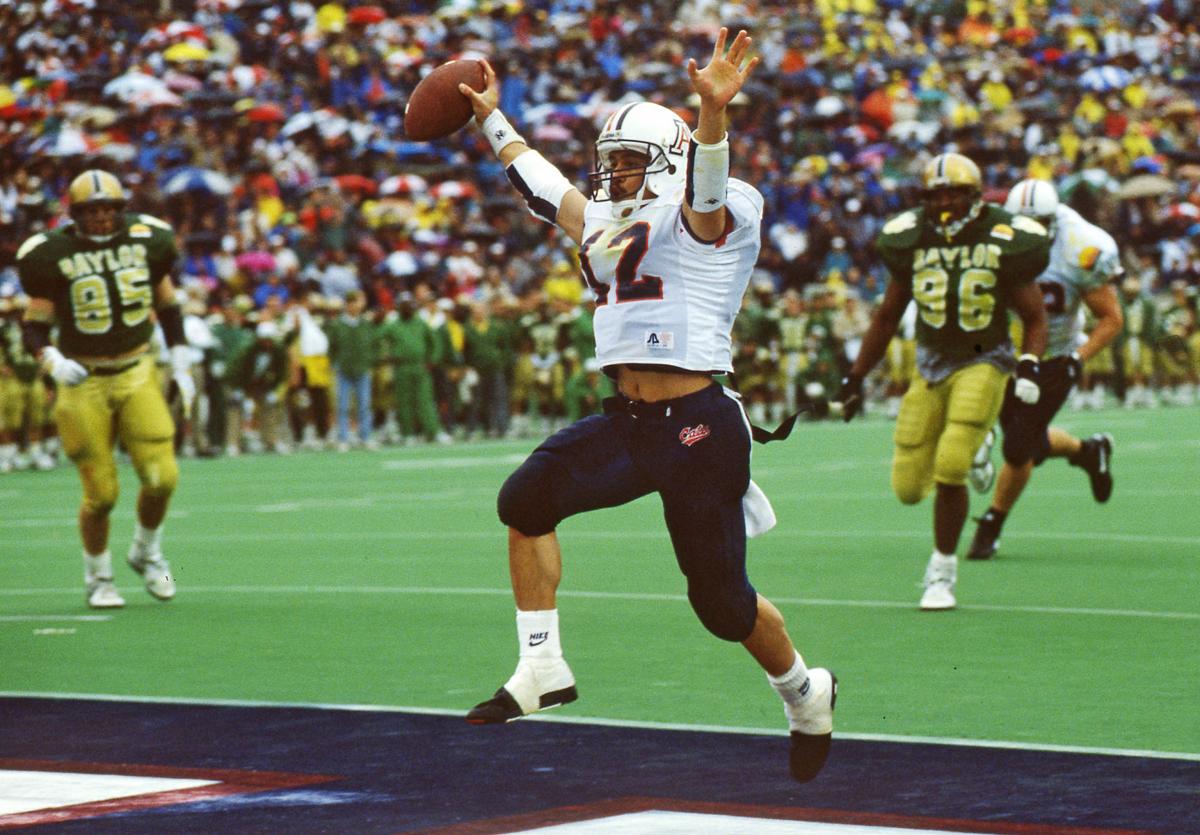
For years in the 1980s and 1990s, the Arizona Wildcats had a pipeline to Polynesian football players. It helped that their coach, Dick Tomey, had previously been the head coach at Hawaii.
The Wildcats have recently struggled to recruit players in the island and Polynesian communities in California, Washington and Utah. But with the help of a former Arizona quarterback, the UA could rebuild that connection.
Arizona is hosting a two-day Polynesian college showcase starting today. The football skills camp will help high school football players get noticed and evaluated by the colleges running the camp. Coaches from the UA, BYU, Illinois, Fresno State and Fordham will be in attendance.
Arizona’s first Polynesian-based summer camp came about largely because of George Malauulu, the president of the AIGA Foundation. His nonprofit group has helped players with Polynesian backgrounds land scholarships since 1997.
Malauulu, who played quarterback at Arizona from 1989-1992, is close with UA graduate assistant Davy Gnodle. It was just the connection he needed to return home.
“It’s always good to come back home to Arizona, and to bring something like this is a special thing for me,” Malauulu said. “It’s one of the ways we can bring back some excitement to the campus with some fresh recruits.”
More than 100 players will take part in the camp, Malauulu said, though only 15 of them have multiple college scholarship offers.
Some of the attendees include UA targets, including linebacker M.J. Tafisi from Alta High School in Utah, safety Denaylan Fuimaono from Carson Senior High School in California and Apu Ika, a defensive tackle and BYU commit from Salt Lake City.
“Arizona has always been a special place for me,” Malauulu said. “That’s my own backyard. If I can do something to help out the process of bringing the kids back, it’s a win-win not only for them but for me as well.”
The Star spoke with Malauulu on Wednesday about the upcoming camp and his organization
.
On the changing exposure and interest for Polynesian recruits: “In the past, going outside of the Pac-12 was OK. You could go as far as Colorado. Anything past Colorado, you wouldn’t see anybody going out to Alabama as well as all those other schools in the SEC and the East Coast. Now you’ve got Polynesians going everywhere. You’ve got (quarterback) Tua Tagovailoa at Alabama. Over the years we’ve had kids at Auburn and Tennessee.”
More on exposure: “It was just a matter of time when the Polynesians were going to bust open and now we have kids lining up as early as the ninth- and 10th-grade years because they know for a fact: ‘I want to start, I want to play and if the Pac or anybody in the West won’t allow that, I want to find another home somewhere else where I can play.’”
On competition at the camp: “This will allow all the kids that do come in to say: ‘OK, there’s a kid here that has five (scholarship) offers. If I come in and I compete just as good as him, I’ll be in front of Fresno State, Illinois, BYU, Arizona, Fordham.’ The fact that we have Fordham brings about a whole different light as far as allowing for a lesser school — not as far as academics, as far as athletics — to come out there. There’s a spot for everybody, it’s just a matter of who’s going to hone in and say, ‘Hey, I like that kid,’ and give that kid an opportunity to go ahead and get an education.”
On his role at the camp: “I’m going to sit back. NCAA has their rules, so my responsibility is from afar, bringing it together. But when the lights, camera, action and the curtain opens, all of the college coaches are going to be responsible for everything on the field. All I’m going to be doing is watch the thing take course and I’ll be out there writing some notes and whenever somebody wants to ask what I see, I’ll show the kids so they can benefit from some of our critiques.”

