


SAN DIEGO — Pierre Cormier walks into a restaurant and heads straight to the patio. He sits down at a large table near the bar.
There’s a game on nearby, and Cormier checks it out.
A bandage wraps around Cormier’s right arm, scars from a recent pickup basketball game. His arms are chiseled and muscular. Cormier’s in the best shape of his life. He runs, he lifts, and it shows.
Cormier looks like a football player, certainly. Once upon a time, he was a 5-foot-10-inch, 175-pound Madison High School running back and the widely viewed replacement for Arizona Wildcats star Ka’Deem Carey. He’d be a senior now.
But Cormier’s playing career ended two years ago, before he ever played a down of college football.
His life was upended, his future interrupted. He’s been trying to pick up the pieces ever since.
• • •
At first, Cormier just stared blankly.
What?
What?
How?
Cormier had spent his whole life getting to this point. All the two-a-days, the up-downs, the hard practices, the nights spent studying the playbook, the workouts, the weightlifting, over and over, repeat. He worked years upon years for a chance to wear the UA football jersey.
Now, it was over. The doctor told him that his football career was over. Cormier had blood clots in his lungs, a serious medical issue that, if unchecked, could’ve been life-threatening.
Cormier had just completed his first season of spring drills for Arizona. His redshirt year was almost over and Carey was gone, off to the NFL. This was Cormier’s time.
“I remember after the spring game I called my mom and was like, ‘Mom, I didn’t even do that good but the game is slowing down for me,’” Cormier said. “I didn’t do as good as I should’ve, so in my mind I’m thinking, ‘When the fall comes I’ll be ready to compete.’
“Then, a week later, it happened.”
Cormier had been bothered by a sharp pain in his ribs. He figured it was indigestion and bought some over-the-counter medicine.
Then the pain got worse, and he told the UA’s trainers.
There’s no history of blood clots in Cormier’s family. He had pneumonia at age 16, but was able to play football a week later.
Doctors in Tucson, San Diego and Los Angeles couldn’t figure out what caused the clotting. They told Cormier it was too risky for him to keep playing a contact sport without knowing the cause.
“When they told me I was just like, ‘What are you talking about?” Cormier said. “I just sat there. I had the blankest stare, I had no emotions.”
• • •
But how do you give up your passion? Your lifelong dream?
To get that close and have to call it quits … what does that do to a person?
Cormier was 19 when doctors told him he’d never play again. For months, he was depressed. He gained 20 pounds.
“When I found out, for a long time I was just eating to take up time,” he said. “Eating, playing video games. I was sitting around, eating, not knowing what to do with my day since I had so much free time.”
He stayed at the UA for summer classes but rarely left his room. Everything reminded him of football.
“It sucked,” said Nate Phillips, a UA receiver who lived next to Cormier in the dorms. “I lived by him, he lived with Samajie (Grant), and we had fun together. But it was sad, you know, it was something he couldn’t control. It’s not like he was injured playing or anything like that, and it was sad to see him go through that.”
Overweight, alone, depressed. Cormier didn’t want to talk to anyone or be around anyone. What would he say, anyway?
He called his mother, Missy. On the phone, she stayed strong.
“I told him that I was sorry,” she said. “I told him that everything happens for a reason and that God has a different plan for him, and that he’s going to have to find something else that he loves.”
Missy hung up the phone. Then she sobbed.
• • •
Cormier watched this year’s NFL draft with added interest. He was excited when the Rams selected Cal quarterback Jared Goff No. 1 overall.
“It’s cool that he went first pick,” Cormier said. “There’s some ties between me and him competitively.
“I beat him.”
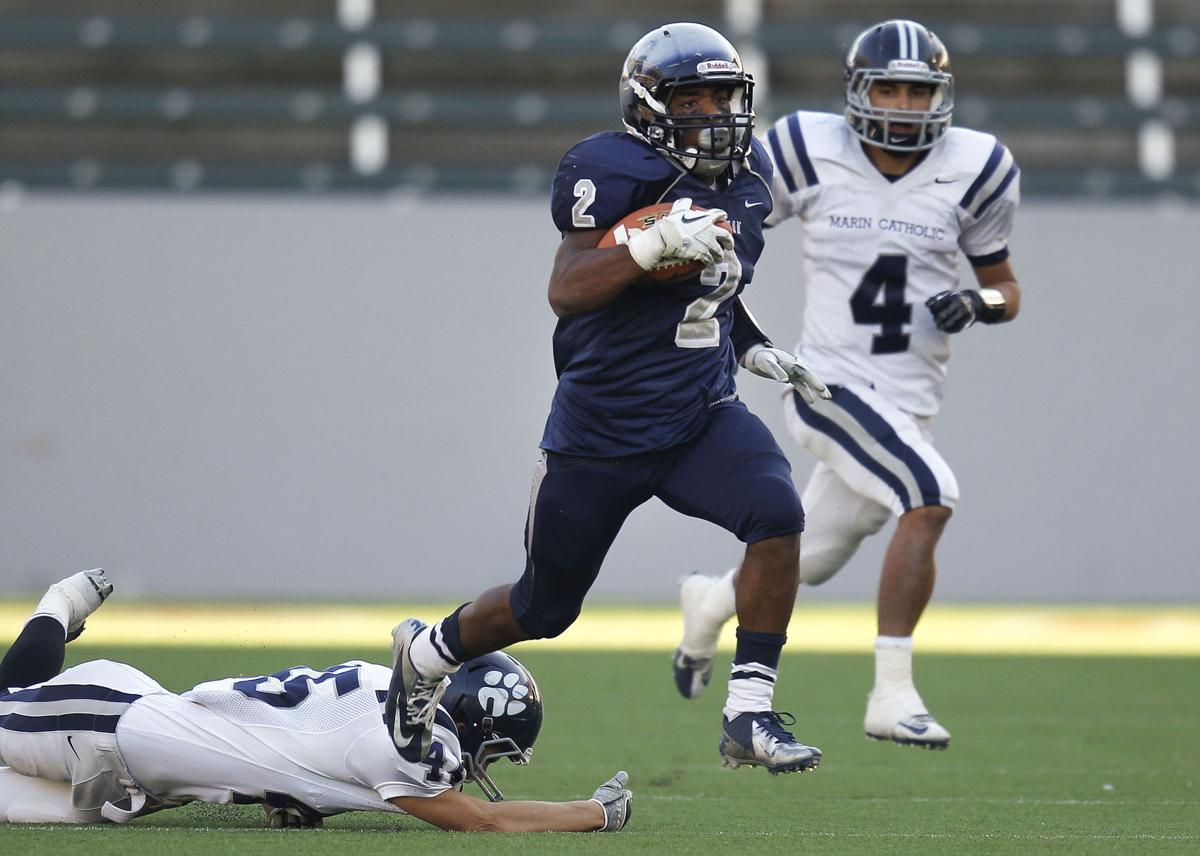
Goff’s Marin Catholic team and Cormier’s Madison squad squared off in a Division III Bowl Championship Game back in 2012.
Marin Catholic took an early 21-0 lead, and Goff was on fire. Then, things turned.
After a remarkable play from Madison’s quarterback, a 50-yard touchdown to former Arizona football commit Lee Walker on a broken play, Cormier took over.
Cormier finished with 296 yards and three touchdowns, including a game-clinching 79-yarder with seven minutes left. Madison won 38-35.
Cormier’s mother was in the crowd, along with a host of other family and friends. Some wore shirts with a picture of Cormier on the front, his number (No. 2) on the back. Some painted the No. 2 on their face, and everyone shook pompoms.
“It was really exciting,” Missy said. “That was a great game. What made it so exciting at first, they were losing and my sister said, ‘Did we come all this way to watch them lose?’
“Then right after that, Pierre made one touchdown after another.”
Cormier did a lot of that as a senior, amassing 2,233 rushing yards and 29 touchdowns.
Colleges noticed well before then. Scouting services labeled Cormier a four-star recruit, and more than 20 colleges offered scholarships. Cormier chose Arizona over UCLA, thanks largely to his relationship with UA assistant Rod Smith.
He verbally committed before his senior season. It wasn’t until the last game of his high school career, however, that Arizona truly saw Cormier’s potential.
“The timing was good, and that was a fun day. We got a ring. That was a fun, fun day, something I’ll take with me to my grave,” Cormier said of the state title.
“That was the last real game I played of my life, and it winds up being the best game I ever played.”
• • •
In January, Cormier saw a doctor at UCLA. It was his last chance, his Hail Mary pass to play football again.
The doctors said they still didn’t know where the blood clot came from. For Cormier’s safety, they recommended he never play football again.
At this point, Cormier was ready to move on.
Arizona’s coaching staff honored his scholarship and he was making the most of it, majoring in sociology and minoring in psychology. Cormier is on track to graduate in December 2017. He’d like to coach; in fact, he plans to pursue a job once he returns to school later this month.
Cormier’s mom will make her first trip to Tucson for graduation. She had planned earlier visits, but Cormier wouldn’t let her come. Not yet.
“From my perspective, it was hard to see Pierre go through that,” Missy said. “He’s in a great place now, he’s come a long way, physically and emotionally. I told Pierre I admire his strength.”
Now, Cormier is happy to see his old teammates. He watched every game last year on TV, analyzed every play.
“He was sad about not playing, but after a while you saw his spirit lift up and realize, OK, it’s gone now,” Phillips said. “I’m done playing football.”
But he’s not done with football, not yet. He can’t be.
It’s in his blood.
“For so long I was trying to run away from football because everybody saw me my whole life as the running back,” Cormier said. “But my love for football has increased since I stopped playing. I just needed the game from a different perspective. It’s done so much for me, it opened up so many doors, allowed me to make great friends, to have memories I’ll have for the rest of my life.
“I can’t run away from football. I love it too much.”

