



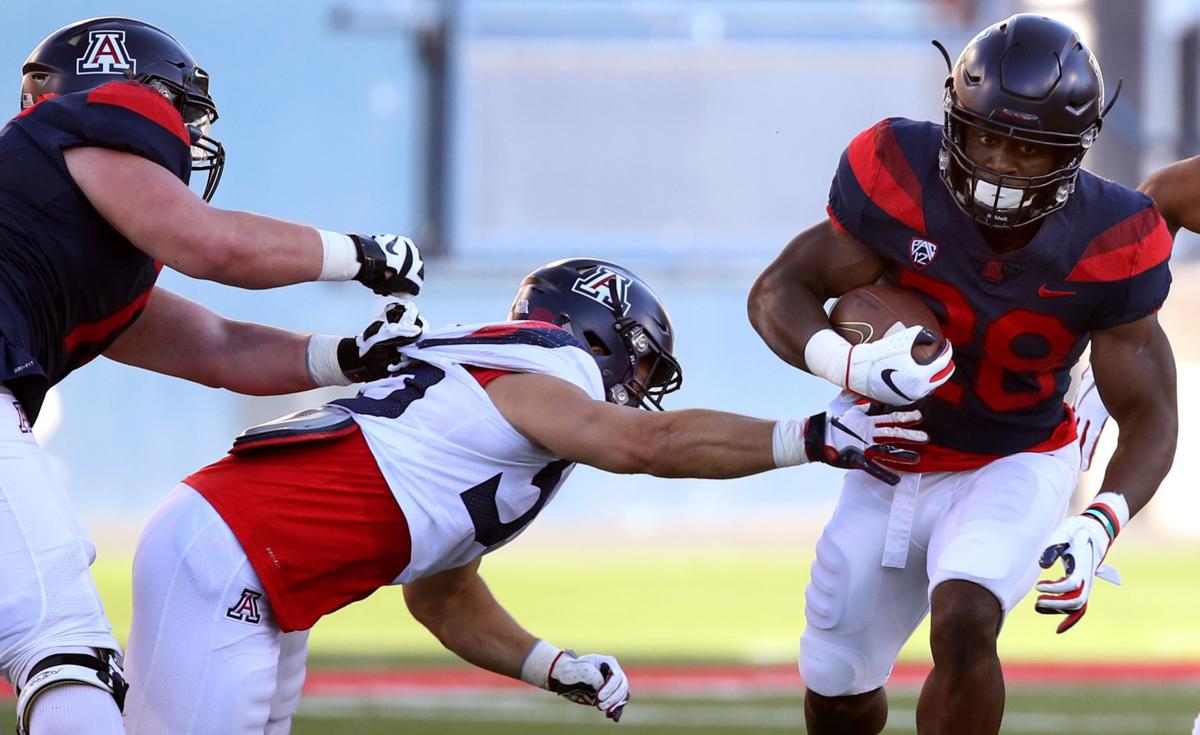
Football in the Pac-12 is so ridiculously competitive that before Arizona could complete its spring camp last week, it had been one-upped by Utah, Arizona State and by, of all things, the UA’s women’s basketball program.
The few people — maybe 2,500 — who sat in the Zona Zoo section of Arizona Stadium reacted more enthusiastically to the public address announcer’s pitch to buy tickets for the 2019-20 women’s basketball season than to any of the 147 plays run by Kevin Sumlin’s football team.
That’s not totally unexpected. Arizona is at the beginning of its fourth rebuilding project of the last 20 years, a period in which it has gone 67-106 in conference games.
Faith and support for UA football? Win a few games and we’ll see.
A few hours before the Pac-12 Network began its broadcast of Arizona’s spring game on Saturday, it televised the conclusion to Utah’s spring camp. The Utes were so impressive that quarterback Tyler Huntley delivered a warning to the Pac-12 South:
“The sky’s the limit because we got playmakers from Depth 1 to Depth 2 to Depth 3, so it’s going to be a great season,” he told reporters. “We’ve got so many players. We got Demari Simpkins. We got Devonta’e Henry-Cole. We got Zack Moss. We got Britain Covey. We got Samson Nacua. We got Bryan Thompson. Man, I could keep naming them. We got so many playmakers, you know what I’m saying?”
There was none of that sky’s-the-limit talk at Arizona Stadium. The Wildcats haven’t had time to fully introduce those who might someday turn Sumlin’s team into a contender — pass rusher Jalen Harris, receivers Tre Adams and Boobie Curry, defensive back Christian Roland-Wallace.
Not only that, Utah announced that a Salt Lake City automobile dealer had donated $17.5 million so that the Utes can add 5,000 seats to Rice-Eccles Stadium, which has sold out for 57 consecutive games.
There’s some envy involved — Arizona has sold out just two games since 2014.
The Utes’ happy news came 24 hours after it became known that ASU offered scholarships to the state’s 13 leading prospects from the Class of 2022, an unprecedented piece of recruiting gamesmanship in Arizona.
It’s a shot-across-the-bow signal that the Sun Devils — also working on a fourth rebuilding project in 20 years — won’t idly watch division rivals like Utah go unchallenged.
The next move is up to Arizona, and athletic director Dave Heeke is prepared. Moments before the spring game, he ambitiously talked about the school’s most compelling construction project since McKale Center was built in 1972.
“Our goal is probably to completely tear down the west side and build a whole new experience,” said Heeke. “More premium seats, huge upgrades underneath on the concourses.”
Unlike the recent three-year, $305 million reconstruction of Sun Devil Stadium, it would take Arizona two years to tear down and remake the west side of Arizona Stadium, established in 1929.
“We need better amenities for fans so we can sell this place out,” said Heeke.
“People want more than just a seat. They want to walk around. They want an ‘experience.’”
Heeke’s predecessors have known for 30 years that the west side of Arizona Stadium would be the mother of all projects in the athletic department. But it goes beyond the tens of millions of dollars required to do so. Can the Wildcats still play home games while construction is in progress? Would they be able to play two seasons with possibly as few as 35,000 available seats?
So it’s not like Arizona would have to put football in neutral while it reconditions the stadium. ASU used a makeshift setup to keep Sun Devil Stadium active during the 2015-2018 process.
Nor did it damage the Wildcats in 2012, when they played a season during the building of the $72 million Lowell-Stevens Football Facility in the north end zone. The dust and construction cranes didn’t keep fans away — the Wildcats sold out late-season games against ASU and Colorado, albeit with capacity cut from 56,000 to 51,000.
The west-side project would be bolder and far more costly, but the UA can’t afford to wait much longer. In the Pac-12, only portions of Colorado’s Folsom Field and Oregon State’s Reser Stadium are as overdue for restoration.
“It’s priority A for us; this really the heart and soul of our program,” said Heeke. “We need to look for ways to increase revenue streams and keep up with the national landscape.”
Heeke hasn’t yet identified an architect, a title donor, established a payment plan or set start and finish dates. But if it takes tearing down the 90-year-old west side of Arizona Stadium to build up the school’s unexceptional football program, the sooner the first shovel hits the ground, the better.


