


For 48 hours in early January, the Big Ten was on the brink of roster anarchy. Washington quarterback Demond Williams had just announced on social media that he planned to enter the transfer portal — this, despite having signed a revenue-sharing contract with the Huskies reportedly worth $4 million.
The news was stunning — and ominous.

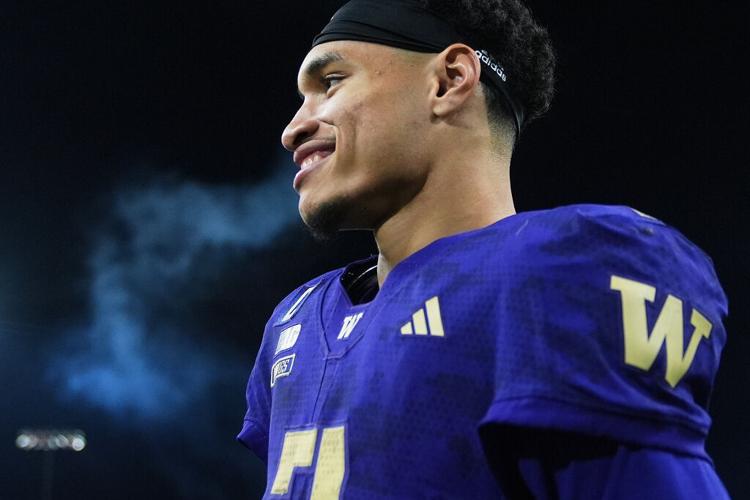
Washington quarterback Demond Williams Jr. smiles after a win against Purdue, Nov. 15, 2025, in Seattle.
“The stakes are enormous,” an industry source said at the time. “If we can steamroll signed contracts, we don’t have anything. The players would have month-to-month deals.”
Washington fought back by refusing to enter Williams’ name into the transfer portal and holding him to the terms of the agreement.
Or as UW athletic director Pat Chun said in a public statement during the whirlwind: “It is critical in this … revenue-sharing environment that contracts with student-athletes are not only enforced but respected by everyone within the college sports ecosystem.”
The Huskies had a not-so-secret weapon, courtesy of the Big Ten: A rev-share contract that required Williams to pay a $4 million buyout if he joined another team. Two days after his initial announcement, Williams reversed course and was welcomed back by UW coach Jedd Fisch, who Williams followed to Washington after previously signing with Arizona as a four-star recruit.
The system had survived due, in large part, to a contract that proved airtight.
“The entire agreement,” Big Ten chief legal officer and general counsel Anil Gollahalli later explained, “is designed to be legally enforceable against both parties to the contract to ensure agreed-to obligations are respected by both sides.”
Why did the Big Ten feel compelled to provide its schools with templates for rev-share deals? (The SEC has not done the same for its members.)
What safeguards were included to prevent marauding schools and rapacious attorneys from finding loopholes?
And how did the Huskies succeed in keeping Williams while, weeks later, Duke lost quarterback Darian Mensah (to Miami) despite the existence of a signed contract?
Gollahalli agreed to answer questions from the Hotline via email about the Big Ten’s strategy, not the Williams situation specifically.
But the story began months before the Big Ten finalized the template Washington would use with Williams.
It began last winter, when Wisconsin safety Xavier Lucas withdrew from school — despite a signed NIL agreement — and enrolled at Miami. The Big Ten supported the Badgers and issued a public statement on the matter, but ultimately could do little to prevent Lucas from moving on. (Wisconsin subsequently filed a lawsuit, alleging tortious interference. The case is ongoing.)
At the time, the House v. NCAA lawsuit had not been settled. Revenue-sharing was six months from implementation across the land, and the Big Ten hadn’t crafted contract templates for its schools. But the Lucas case showed the need for an airtight deal.
As the June House settlement date approached, Gollahalli and his legal team worked to finalize language that would create consistency across the conference but, he wrote, “afford each campus flexibility and autonomy to individually negotiate economic and other campus-specific considerations.”
The document, he added, outlines the rights of each contracting party and includes “provisions of accountability and enforceability.”
As an example, here is a section from a boilerplate Big Ten contract, published by the Seattle Times, that Washington used with its athletes in 2025:
“If the Student-Athlete transfers prior to the end of a Payment Period set forth in Annex A, the Institution reserves the right to have the Student-Athlete reimburse the Institution a prorated portion of the License Fee, equal to the amount paid by the Institution for the remainder of the Payment Period. The Institution, in its sole discretion, may agree to accept a buyout payment from a transferee school (on the Student-Athlete’s behalf) or the Student-Athlete or otherwise mutually agree to terminate the Agreement.”

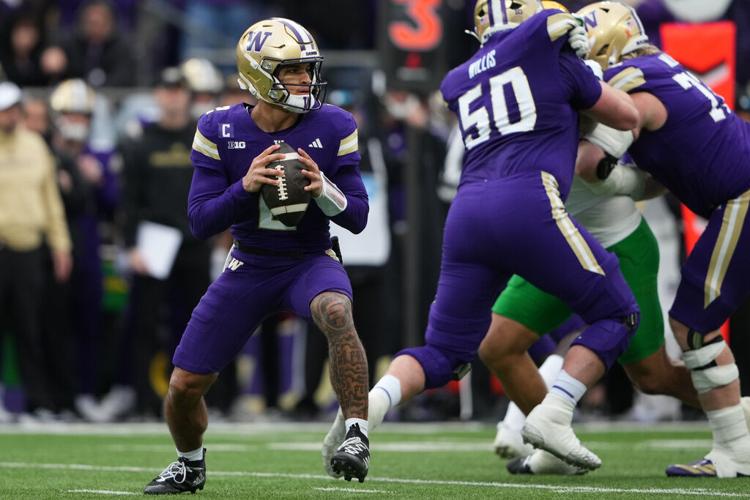
Washington quarterback Demond Williams Jr. (2) looks to throw against Oregon during the first half of a game, Nov. 29, 2025, in Seattle.
To be clear, the rev-share contracts don’t bind athletes to the school — they cannot be stopped from withdrawing from one university and enrolling at another (as Lucas did 13 months ago). Instead, the teeth of the agreement can be found in the financial component. If Williams left Washington, he would owe the school a $4 million buyout.
Moving on would be cost-prohibitive.
“The key goal of the Big Ten’s template agreement is to clearly set forth the rights and responsibilities of each contracting party,” Gollahalli wrote, “specifically the NIL rights granted and the authorized use of those rights.”
(In contrast, Mensah’s contract with Duke had a loophole large enough that the Blue Devils agreed to a settlement and allowed Mensah to leave for Miami.)
While the Big Ten provided the contracts, the enforcement components lie with its schools. After all, Williams signed a deal with the Huskies, not the Big Ten. Had a lawsuit been required, UW would have initiated the process.
“The decision on how to enforce the contract rests with the University as the Conference is not a party to those agreements,” Gollahalli wrote.
“That said, the Big Ten believes abiding by contractual commitments is critical to the stability of the college framework and will support our member institutions appropriately.”
That support, like the contract itself, could shift over time.
Many believe the revenue-sharing era created by the House lawsuit is merely the latest step in a broader evolution of college sports that will eventually lead to athletes being declared employees, forming unions and bargaining collectively with the conferences.
As Gollahalli wrote:
“We acknowledge new circumstances can and will arise as this new structure matures and stabilizes …
“The Big Ten NIL template agreement is based on a passive license to a student-athlete’s intellectual property (i.e., NIL rights).
“Should the law develop towards an employment model, the Conference would work with our members to account for the changed institution/student-athlete relationship.”

