


The Star’s Michael Lev presents five storylines of interest as the Arizona Wildcats face Cal on Saturday at Arizona Stadium. Kickoff is slated for 12 p.m. The game will air on Pac-12 Arizona:
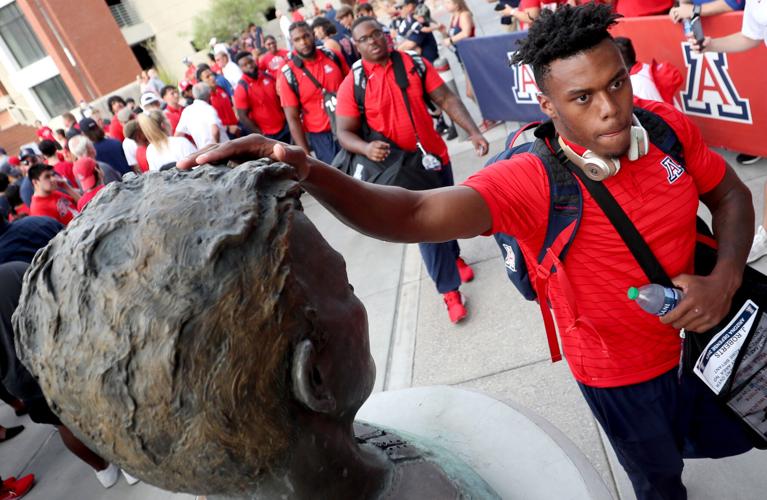
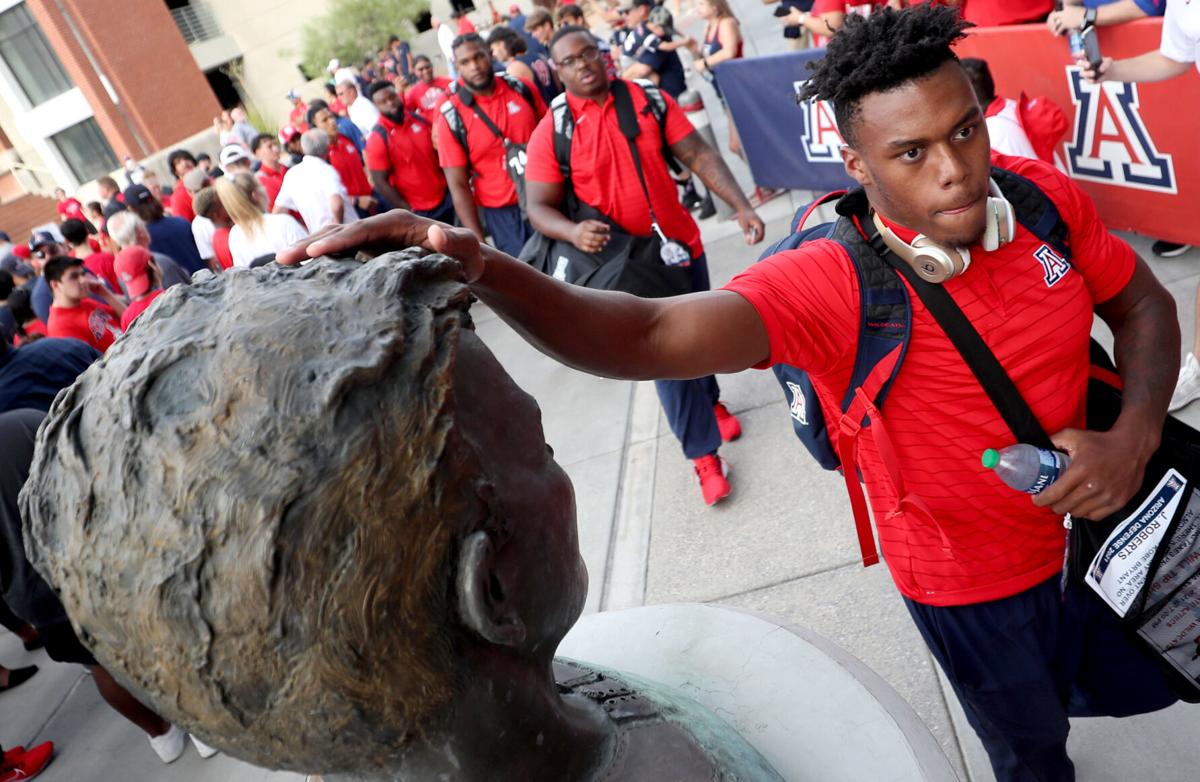
Arizona MLB Jerry Roberts was ready when his opportunity arose
Like every other transfer across the country, Jerry Roberts came to Arizona with the intention of playing right away. The Wildcats needed a veteran presence at linebacker. Roberts had appeared in 20 games at Bowling Green.
One problem, though: Arizona also brought in Treshaun Hayward from Western Michigan. When the season began, Hayward started at middle linebacker and played the majority of the snaps.
Despite barely getting on the field, Roberts remained patient and poised.
“I'm a very religious person,” he said. “I said, ‘God brought me here for a reason.’ I've just kept my faith in Him. And when the opportunity presented itself ... I was ready to step in.”
The opportunity arose in mid-October. Hayward left the team because of what UA coach Jedd Fisch described as “personal issues.” Roberts made his first start for Arizona in Game 6 against Colorado, and he’s been a fixture in the lineup ever since.
Roberts, a fifth-year junior, has 17 tackles and a sack over the past two weeks. He’s set to make his fourth straight start when Arizona hosts Cal on Saturday.
“When his number was called, he answered the bell,” UA defensive coordinator Don Brown said. “He jumped right in and played at a very capable level. He's not perfect. That's why you coach them. But he’s certainly been a nice surprise for us.”
The key for Roberts was staying ready despite not getting many first-team practice reps. He took mental reps instead. He watched film. He studied the playbook.
“I was doing everything that the starter was doing except for actually getting the reps,” Roberts said. “In my head, I was playing the role.”
Roberts had been preparing for a chance like this all his life. His father, also named Jerry, played linebacker at Edinboro (Pa.) University. The elder Roberts later became a member of the defensive coaching staff at Cathedral Preparatory School in Erie, Pennsylvania, where the younger Roberts played.
“He's coached me my entire life,” Roberts said. “He taught me the fundamentals of the game. He taught me the ins and outs of the game. He taught me everything. ... I would not be here without him.”
Despite helping the Ramblers win a state championship, Roberts didn’t have any Power Five offers. He landed at Bowling Green, where he started 15 times over the past two seasons, recording 92 tackles.
Roberts wanted to prove that he could play Power Five football, so he entered the transfer portal. His father sent his game film to Brown.
“Coach Brown liked what he saw,” Roberts said. “Then it kind of took off from there.”
Roberts played both inside and outside at Bowling Green. He prefers the “Mike” linebacker spot and the mental challenges and leadership responsibilities that come along with it.
Roberts was credited with only one tackle in his first UA start. He has been much more involved the past two weeks.
“Colorado was my first start, and it was kind of a surprise,” Roberts said. “I literally knew the day before the game that I'd be out there starting. So I had to get my mindset right. But I feel like overall I've grown, just being more comfortable out there.”
‘War daddy’ Jalen Harris making contributions beyond sacks
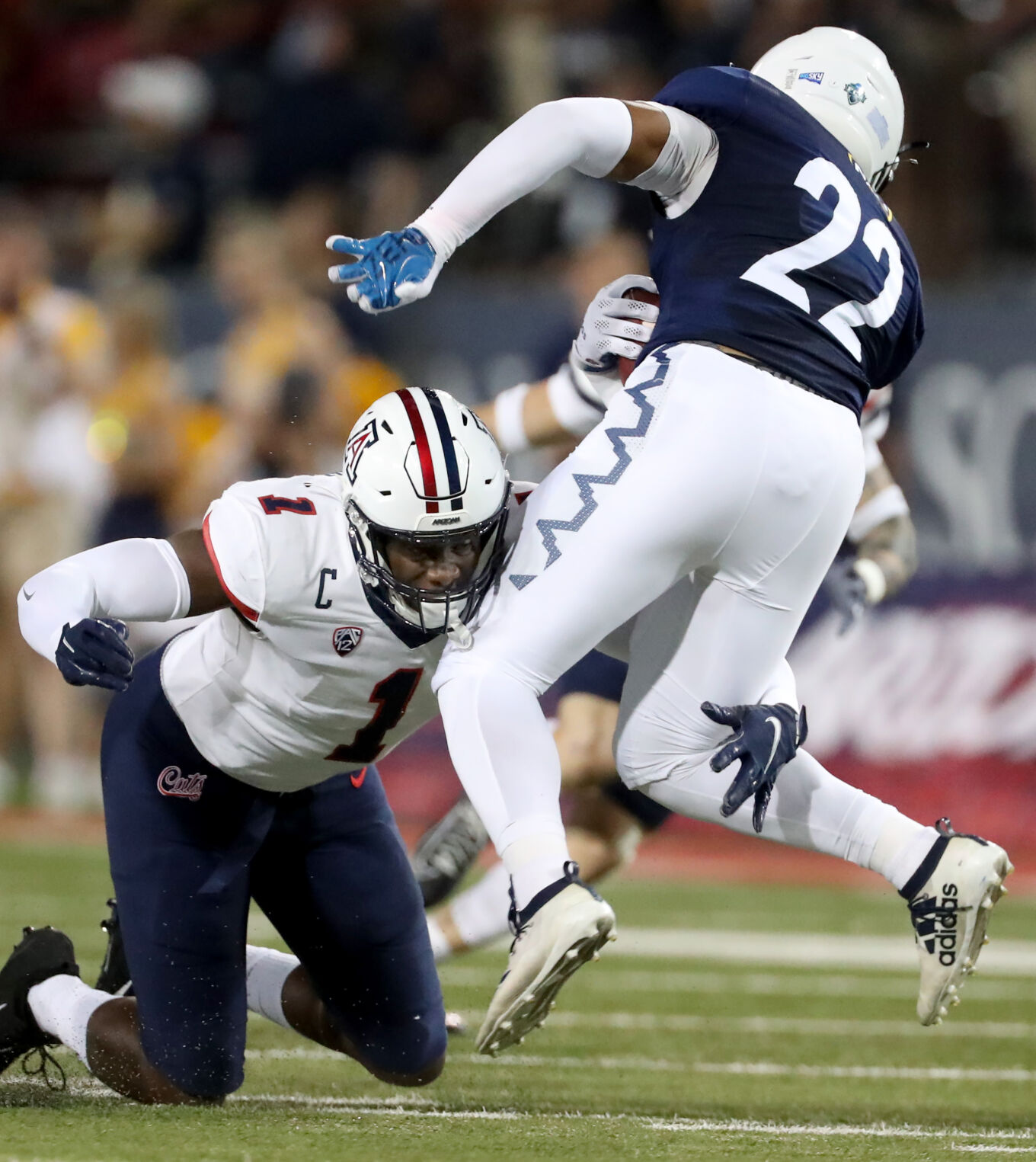
Arizona defensive lineman Jalen Harris (1) manages to make a tackle for a loss on Northern Arizona running back Kevin Daniels (22) on his knees in the first quarter of their game at Arizona Stadium, Tucson, Ariz., September 18, 2021.
It’s easy to notice when a linebacker makes a splashy play in space, such as Anthony Pandy’s pick-six against USC last week. Defensive ends usually don’t get that kind of notoriety unless they’re sacking the quarterback.
Arizona defensive end Jalen Harris has only two sacks this season. But his coaches are fully aware of the ways he’s contributing to the cause.
Harris played a career-high 83 snaps against the Trojans and notched six quarterback pressures, according to Pro Football Focus. That matched his total in four games last season.
“If you look at the way Jalen Harris has not only improved all year but led all year, he is a war daddy,” UA coach Jedd Fisch said. “He took 83 snaps in the game. That was incredible for a defensive lineman.
“I can't say enough about the way he's competing. He's a captain, rightfully so. Quiet leader, does everything right on the practice field. And hopefully we'll have him back next year.”
Harris could return in 2022 as a sixth-year senior, but the way he’s trending, the NFL might be his next stop. Harris’ six pressures vs. USC gave him nine in the past two weeks. He had four in Arizona’s first six games.
While sacks have been hard to come by, Harris has been sound against the run. Listed at 6-5, 254 – 42 pounds higher than his weight as a true freshman – Harris is strong enough to hold up inside yet mobile enough to track down ball-carriers on the perimeter.
“His play in the spread run game, understanding the conflicts between the running back and the quarterback, prioritizing what is his responsibility, knowing how to pup and dent based on the blocks that you get on the perimeter ... this guy is a bright guy,” UA defensive coordinator Don Brown said.
“He's been able to decipher the information, and he's brought it to the field. A lot of guys can do it in drill work, but they can't bring it to the field. This guy brings it to the field, so that's a nice thing.”
Brown likened Harris’ coachability to that of Kwity Paye, whom Brown coached at Michigan. Paye was a first-round pick in this year’s NFL draft.
Harris has 33 tackles, the most among Wildcats defensive linemen. He is Arizona’s third-highest-graded defensive player, per PFF.
TE Alex Lines took circuitous path back to his home state
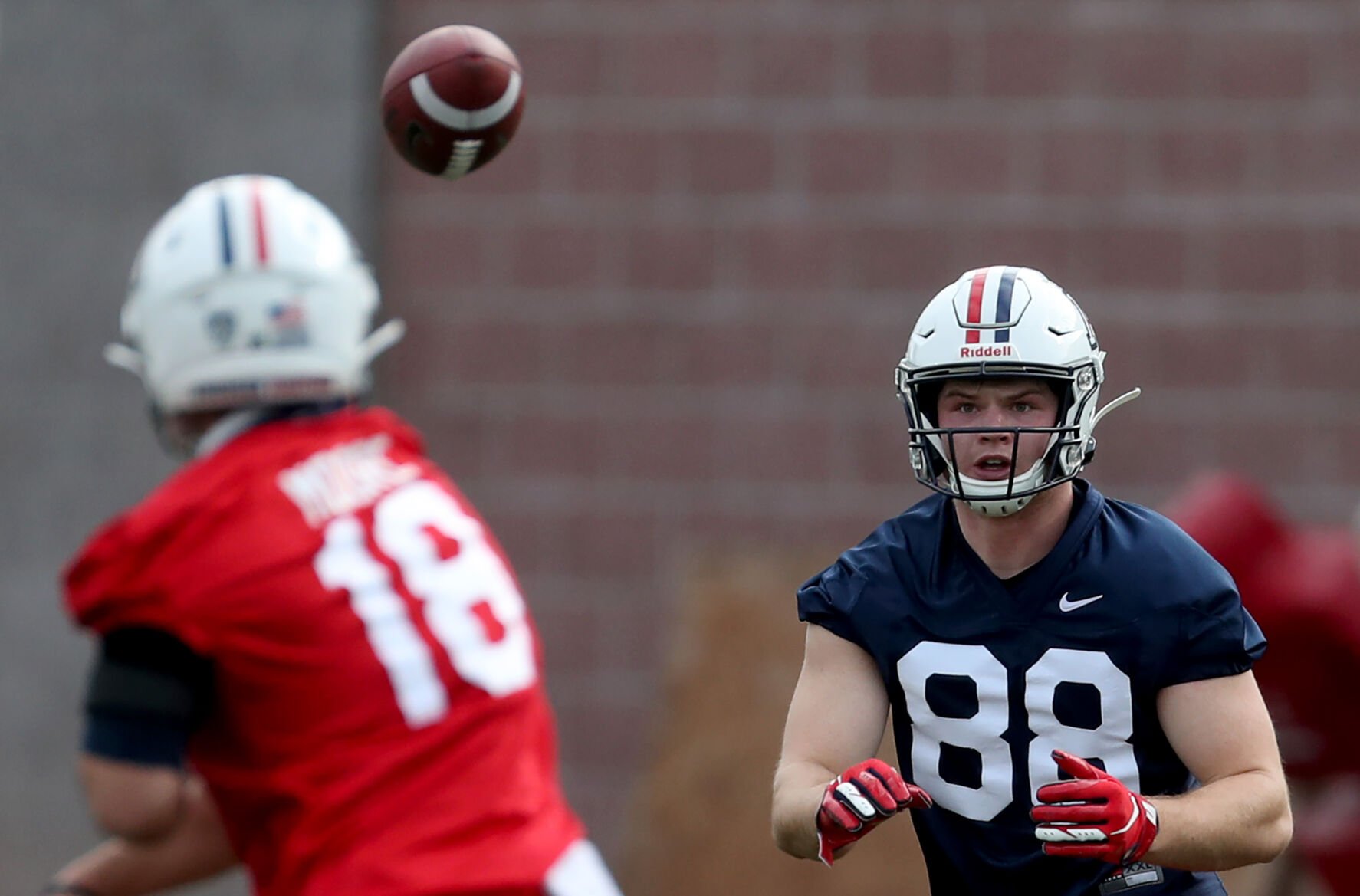
Tight end Alex Lines tracks a throw from Nick Moore as the two work on their routes during a drill for Arizona spring football on March 25, 2021.
When he was being recruited out of Gilbert Higley High School, tight end Alex Lines wanted to experience something different. He elected to attend school out of state, at UNLV.
After the pandemic hit, Lines had a change of heart. He wanted to come home. He entered the transfer portal after one season and signed with Arizona, returning to the city in which he was born.
“It's just crazy times,” Lines said. “I wanted to be close to my family, help support them. And then Arizona reached out. It's just one that I couldn't turn down.”
Many things have changed at the UA since the time Lines was being recruited. The offense under Jedd Fisch features at least one tight end on the field almost every play. That group is now coached by Jordan Paopao, who happened to be Lines’ lead recruiter and position coach at UNLV.
“It just happened that Paopao was here,” said Lines, a second-year freshman. “So it just kind of fit together.”
Paopao’s presence helped ease Lines’ transition to a new school and a new offense. Unlike the rest of the tight ends in the room, Lines knew exactly what to expect from Paopao. And Paopao knew precisely what he was getting in Lines.
“There's that relationship and familiarity of how you coach a guy,” UA coach Jedd Fisch said. “You don't have to necessarily get to learn the person. Now you're just teaching the scheme knowing the guy, knowing how he picks things up, knowing ... his personality in a meeting room.”
Lines has started seven of Arizona’s eight games. He notched career highs with four catches for 56 yards in last week’s game at USC. He played a season-high 74 snaps, per Pro Football Focus, tying for the team lead on offense. He also had his highest combined blocking grade, per PFF.
“He's tough, assignment-sound, doesn't make a lot of mistakes,” UA offensive coordinator Brennan Carroll said. “He's been great for us.”
Arizona-Cal matchups inevitably end in chaos

Arizona wide receiver Austin Hill, center, hauls in the game-winning touchdown pass in the Wildcats’ 2014 victory over Cal at Arizona Stadium.
“Normal” games between Arizona and Cal are a rarity. In that context, the Golden Bears having to contend with a COVID issue heading into Saturday’s game isn’t surprising.
Most of the oddities have taken place on the field. Each of the past six matchups has been decided by eight or fewer points. Five have featured some sort of unusual occurrence. Let’s take a quick look at those five:
2009: Cal 24, Arizona 16
Oddity in a sentence: The Bears scored the winning touchdown on a 61-yard run by Shane Vereen after Nick Foles threw an illegal forward pass that knocked Arizona out of range for the go-ahead field goal.
2010: Arizona 10, Cal 9
Oddity in a sentence: The Wildcats took their first and only lead with 1:11 remaining on a 3-yard touchdown pass from Foles to Juron Criner – the only TD of the game.
2014: Arizona 49, Cal 45
Oddity in a sentence: Anu Solomon’s 47-yard Hail Mary to Austin Hill – aka, the “Hill Mary” – capped a 36-point fourth quarter and completed a comeback from a 15-point deficit in the final period.
2017: Arizona 45, Cal 44 (2OT)
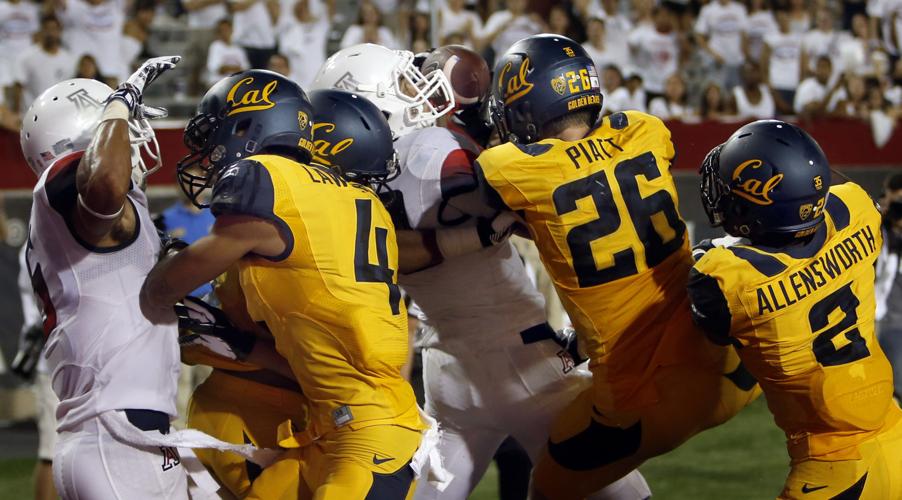
Oddity in a sentence: A game in which 5-foot-6 tailback J.J. Taylor was ejected for targeting a 6-4 linebacker ended in double overtime when UA linebacker Colin Schooler broke up a 2-point conversion attempt in the end zone.
2018: Arizona 24, Cal 17
Oddity in a sentence: The go-ahead and put-away touchdowns came on second-half pick-sixes, including an interception by Schooler that was fumbled and run into the end zone by teammate Azizi Hearn.
Just in case: A refresher on Pac-12’s forfeiture rules

Cal announced Thursday that “multiple” football players were in COVID protocol and wouldn’t be available to play Saturday at Arizona. What would have happened if the Golden Bears couldn’t play at all?
In August, the Pac-12 Conference reinstituted its forfeiture policy, which was amended last season amid the pandemic. Here’s the key section:
“If an institution is unable to play a contest through its own fault, it shall forfeit such contest to its opponent. Any forfeited contest shall be regarded as a conference loss for the team making the forfeit and a conference win for its opponent. The Pac-12 rule provides the commissioner with discretion to determine whether an institution is at fault or primarily at fault for an inability to play a contest based on the facts of the situation.”
Whether Cal would have been “at fault” in this specific situation is unclear. The league’s administrative policies for “unusual circumstances” do enable “the appropriate administrative representatives from the participating athletics departments” to “work toward a mutual agreement.” That would seem to suggest that making up the game on, say, Dec. 4, at least would have been a possibility.



