

These 17 Arizona Wildcats will make the biggest impact on the gridiron in 2017
- Updated
The Star's Michael Lev counted down the 17 most valuable football players as training camp opens.
Who will be the most valuable Arizona Wildcats football players of 2017?
That’s what we’re aiming to find out over the next few weeks.
It’s a completely subjective exercise, of course, and it’s important to note that everyone on the roster – from the starting quarterback to the scout-team walk-ons – has value. But it’s informative to project who the most valuable players will be, and that’s what we’ll attempt to do in this series.
Before we begin the countdown, some disclaimers:
“Most valuable” does not necessarily mean “best.” Rather, we’re defining it as the contributions and traits that most influence winning football. They include talent, leadership and projected role and production.
Newcomers were not eligible for the list. Although many might become major contributors this year, especially on defense, their roles are just too difficult to predict in June.
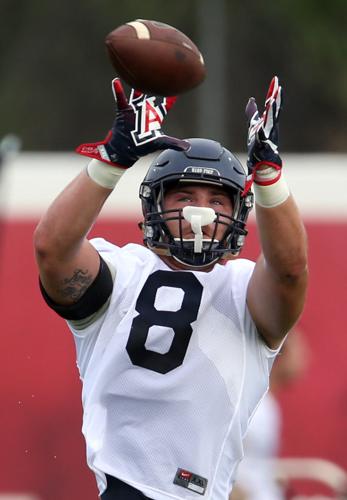
NO. 17: TE TREVOR WOOD
Ht/Wt/Yr: 6-6, 265, redshirt junior
Comment: Tight ends play a lot in Rich Rodriguez’s offense. They just haven’t caught a lot of passes.
Wood led the way last season with seven catches for 49 yards. Hardly the stuff of MVP lists.
But change might be afoot this season – and yes, I know what you’re thinking: We’ve heard this story before, and it never has come true. Why will this year be any different?
Well, a couple of reasons. One is that Rodriguez specifically mentioned in spring that the tight ends are being trained to stay on the field more. They’re lining up in new and different places so that Arizona doesn’t have to sub as much when it goes to its “four-wide” package.
The other main factor is that Calvin Magee – Rodriguez’s most trusted confidante – is now coaching tight ends in addition to running backs. If anyone has Rodriguez’s ear, it’s Magee. If Magee were to push for more passes to the tight ends, it’s likely Rodriguez would listen at the very least.
We saw glimpses of it during the first open spring scrimmage: multiple passes to the tight ends, resulting in multiple touchdowns.
Of course, scrimmages – especially in spring – aren’t necessarily harbingers. More often, they’re fool’s gold.
But the Wildcats really seemed to make a concerted effort to involve the tight ends that night. And Wood is an inviting target at 6-foot-6. It would be a waste to not utilize him more, especially in the red zone.
Wood was inconsistent as a blocker last season but has the frame and athleticism to become an asset in that area. That also would enhance his value.
How many catches/touchdowns would Wood need to justify his spot in this ranking? Would 20 and four be enough?
Those seem like reasonable objectives. Now it’s up to Wood, the coaches and the quarterbacks to make it happen.
NO. 16: CB DANE CRUIKSHANK
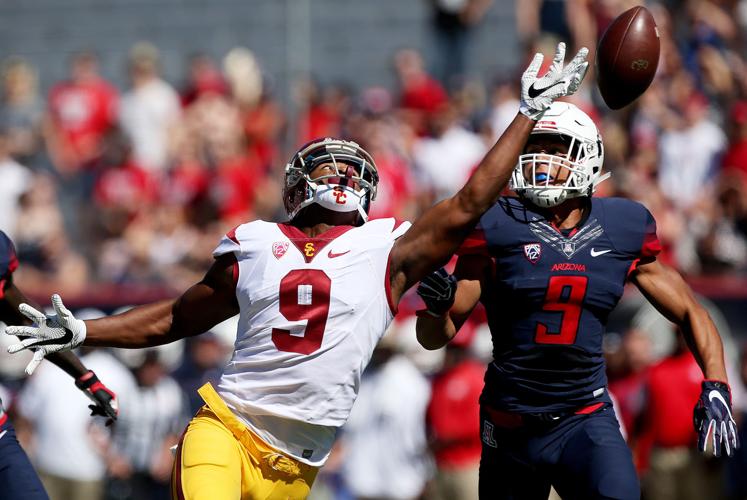
Ht/Wt/Yr: 6-1, 204, redshirt senior
Comment: From a purely physical standpoint, Cruikshank has everything you’d want in a top college cornerback. He has excellent size and very good speed for his size.
The question is whether Cruikshank can convert those attributes into consistent production.
Cruikshank accumulated promising raw numbers last season, his first as a member of Arizona’s active roster. (Cruikshank transferred from Citrus College in 2015 and redshirted that season.) Starting all 12 games, Cruikshank had 60 tackles (including 53 solos), seven passes breakups (second on the team) and two interceptions (tied for first).
What those stats don’t reveal is how often Cruikshank was in perfect position to defend a pass … but had trouble locating the ball. It happened repeatedly, and it has to be the aspect of his game that Cruikshank works on the most this offseason.
Which leads to more questions …
Is that something that can be fixed? Can Cruikshank be taught techniques that will enable him to get his head around, locate the ball and knock it away at the last instant? Or is that an instinctive skill that Cruikshank simply doesn’t possess?
You’d like to think it’s the former – that new cornerbacks coach Marcel Yates can train Cruikshank through countless practice reps to improve his play and ball recognition. If Yates – Arizona’s defensive coordinator, who this offseason shifted from coaching linebackers to defensive backs, his longtime forte – can work his magic, Cruikshank can become one of Arizona’s most valuable contributors in 2017.
You’d also like to think Cruickshank will be more comfortable being a Wildcat this season. Although he was a redshirt junior in ’16, it was his only his second year in the program and the first in which he played a meaningful role. There’s an adjustment period associated with that. Cruikshank should be well past that stage when training camp starts in late July. He should be ready to become a leader.
As mentioned, Cruikshank has all the measurables, which enable him to be physical near the line and to run with just about anyone down the field. He has the potential to be Arizona’s No. 1 cornerback. But as of now, that's all it is - potential.
NO. 15: RB NICK WILSON
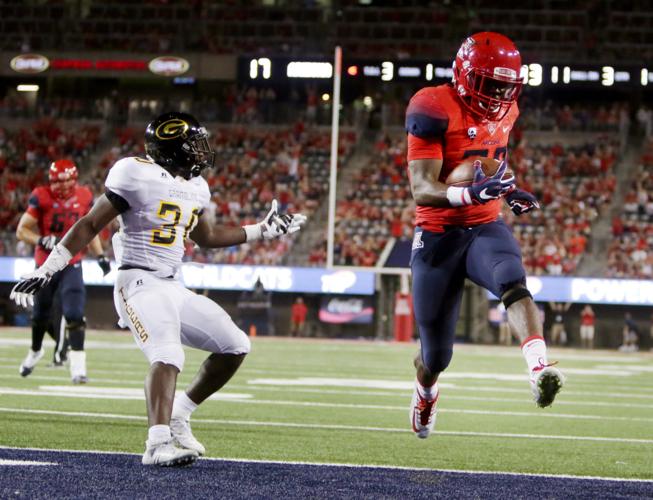
Ht/Wt/Yr: 5-10, 208, senior
Comment: If you could guarantee that Wilson would be healthy for 12 games – even 10 – he’d rank much higher on this list. Even if he were in a timeshare, he’d have top-five potential.
Unfortunately, Wilson’s health is far from a guarantee. After a promising – heck, brilliant – freshman campaign, injuries undermined his sophomore and junior seasons. The stats tell the story:
- In 2014, Wilson played in 13 games and started eight. He had double-digit carries 11 times, rushed for at least 86 yards nine times and scored at least one touchdown nine times. His final line: 236-1,375-16.
- In 2015, Wilson started at a similar pace. He had double-figure carries in each of the first six games, rushed for 78 or more yards in five and scored at least once in four. But he hurt his foot in the sixth game, against Oregon State, and was a nonfactor thereafter. Wilson appeared in only three games in the second half of the season, totaling 18 carries for 42 yards.
- In 2016, Wilson again got off to a great start. In the first two games, he rushed 41 times for 254 yards and three scores. Then he hurt his ankle against Hawaii, and the rest of the season looked a lot like the second half of the previous year. Wilson left the Hawaii game with two carries and 3 yards. He made two additional appearances, rushing 12 times for 63 yards, before suffering a season-ending knee injury vs. USC.
Despite playing several times when he clearly wasn’t 100 percent, Wilson averaged 5.5 yards per carry as a sophomore and 5.8 as a junior – the latter matching his freshman mark. When healthy the past two seasons, he was the same player who earned multiple all-freshman accolades. He just couldn’t stay healthy.
The question moving forward is whether Wilson can shake the injury bug and finish his college career the way he started it. He’s well aware of the label – injury-prone – and misfortune that now follow him like a linebacker. The knee injury against USC came at the end of a 39-yard run.
“I was like, ‘Man, I can’t catch a break,’ ” Wilson said in spring. “It’s one of those things. You’ve just got to keep fighting through. I know it’s not an issue of my body breaking down. I think it’s just more of an issue of me catching bad luck, getting put in awkward situations, being tackled awkwardly.”
Whether Wilson is brittle or simply unfortunate is impossible to say. He has one more season to prove he can stay on the field.
Even if he can, a repeat of 2014 is unlikely. J.J. Taylor is too good to not be heavily involved in the offense. But a healthy Wilson getting 15 touches per game easily would be one of Arizona’s 15 most valuable players.
NO. 14: DL PARKER ZELLERS
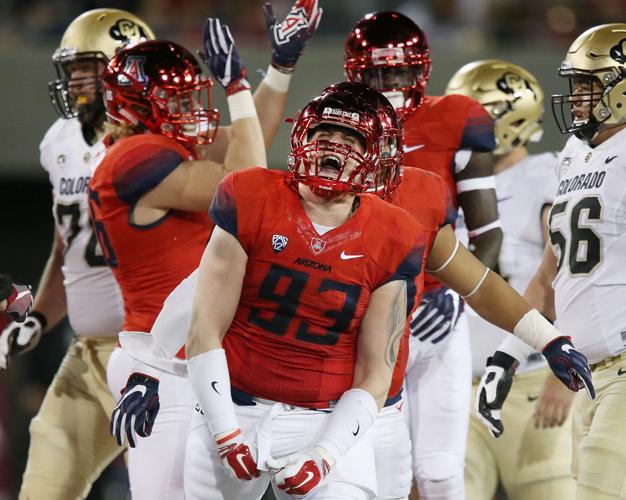
Ht/Wt/Yr: 6-1, 247, senior
Comment: Arizona has spent considerable resources trying to find needed upgrades along the defensive line. Yet one of the players the UA has sought to replace happens to be one of its most irreplaceable players.
At 6-1, 247, Zellers has no business playing nose tackle in the Pac-12, at least not in 2017. But Zellers worked his way from walk-on to starter. Defensive line coach Vince Amey runs a meritocracy, and Zellers earned his spot by outplaying bigger, more sought-after players (which would be just about everybody else).
Which isn’t to say Zellers is an All-Pac-12 performer. He had 12 tackles in nine games last season. Three of those were sacks. That tied for the team lead. His two forced fumbles gave him solo top honors in that category.
None of those numbers are worth bragging about – not that Zellers would do so anyway. He’s a self-made, team-first guy, and that’s where his true value lies – as a leader and inspiration to his teammates.
Remember what Rich Rodriguez said recently about Zellers? I had asked the UA coach in April which defensive players stood out most in spring. He said this:
“You talk about a guy like Parker Zellers. He came here as an unrecruited walk-on that nobody knew anything about. Undersized. And he made himself into a player. This spring he was even better (despite missing time while rehabbing a shoulder injury). He’s a guy you’ve got to throw out of drills. That’s an example of that edge we’ve got to keep fostering.”
What’s strange about Zellers’ role on the team – the Parker Paradox, if you will – is that he’ll be even more valuable if he plays less. Zellers isn’t built for 80-90 plays. He and the rest of Arizona’s undersized defensive front wore down as games progressed on a regular basis last year.
It’s imperative that the Wildcats develop two complete D-line units that the coaches are confident in deploying. Despite losing some possible rotation players for one reason or another (Justin Holt, Gaelin Elmore, Dereck Boles), the staff is working toward that end.
One player Arizona did add is 300-plus-pound nose tackle Sione Taufahema, a stout junior-college transfer who would complement Zellers well. Placing Zellers into a third-down role – where he could utilize his quickness and not have to worry as much about stopping the run – would enhance his effectiveness. He’s already a respected contributor in so many other ways.
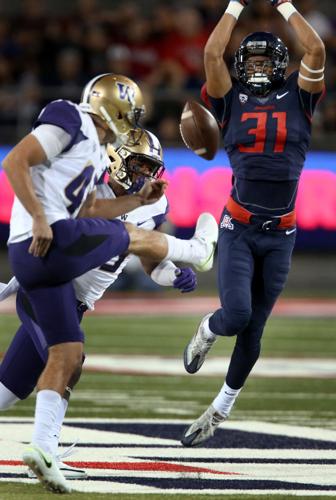
NO. 13: S TRISTAN COOPER
Ht/Wt/Yr: 6-1, 180, sophomore
Comment: When asked during spring practice what he was focusing on during the offseason, Cooper rattled off a lengthy inventory. The items on his to-do list included improving in man coverage, “triggering” faster, being less timid, cleaning up his technique and keeping his head up when he tackles.
That’s a lot, and it almost makes it seem as if Cooper was an ineffective player last season, his first at the UA. He was not. Appearing in 11 games at the “Spur” safety position, including five starts, Cooper accumulate 35 tackles, a sack, a pass breakup and a forced fumble. Not bad for a relatively unheralded freshman from the one part of Texas – El Paso – that isn’t known for football.
What Cooper’s offseason agenda illustrates is that he has plenty of room for improvement and already is mature enough to acknowledge that fact. Cooper’s makeup and upside firmly position him among the top 17 MVP candidates for the 2017 Wildcats.
Cooper is the favorite to start at Spur, joining fellow sophomore Isaiah Hayes and junior Demetrius Flannigan-Fowles in what has the makings of a strong safety group. Cooper will be bigger in 2017 after playing at around 180 pounds as a freshman. He’ll also be wiser.
“At first I was just a robot,” Cooper said. “I just knew my plays. I didn’t know anybody else’s, their jobs. Knowing everybody’s position, where they’re going to (be), it helps.”
Despite his claims of timidity as a freshman – “uncertainty” or “hesitancy” might be better terms – Cooper established a physical presence last year. He and Hayes play without fear. Now it’s a matter of using that aggression for good.
Cooper needs to make more impact plays, and he certainly seems capable of it. Look for defensive coordinator Marcel Yates – who liked Cooper’s game from the get-go – to set him up for success. Yates is coaching the cornerbacks and Spurs this season, and Cooper believes that’ll make him more adept in coverage. His eyes, hips and feet improved in just 15 spring practices.
But if he’s going to make his mark – and achieve his potential value – Cooper must do most of his damage in the box. He’s a powerful hitter … when he makes contact. An additional year of experience should boost Cooper’s batting average. His profile will rise accordingly.
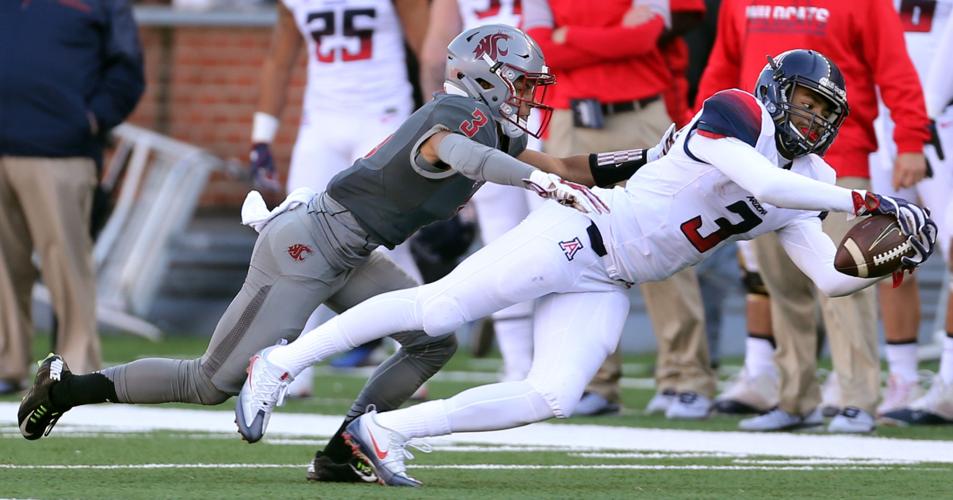
NO. 12: WR CAM DENSON
Ht/Wt/Yr: 5-11, 187, senior
Comment: Let’s begin with the premise that the Wildcats’ passing game will be better than it was last season because, well, it has to be, right?
Not attempting a pass in the second half of the Territorial Cup was cool and all, but it wouldn’t have transpired that way if Rich Rodriguez had more faith in the pass game. With Brandon Dawkins and Khalil Tate having more seasoning – and Donavan Tate possibly ramping up the competition – it’s reasonable to project more production through the air.
Meanwhile, the receiving corps is in the midst of a major overhaul. Three of last year’s top four pass catchers – trusted vets Nate Phillips, Trey Griffey and Samajie Grant – are gone. No. 2 and No. 5 return. Opportunities for Shun Brown and Denson should be plentiful.
We’ll get to Brown at a later date. For now the focus is on the supremely talented Denson, who hasn’t lived up to his high school hype as of yet – but has one more season to remind Tucsonans what all the fuss was about.
Denson seemed destined for stardom after earning all-state and All-American accolades at Salpointe Catholic. Then he took a detour at his hometown university, spending two seasons at cornerback before switching to receiver in the spring of 2016.
Denson wasn’t much of a factor in the first half of the season, catching only four balls. Over the next five games, he showed flashes of what he could become.
Denson caught 11 passes over a five-game stretch preceding the Territorial Cup. (Arizona completed only three passes in that game – two to Phillips, one to Josh Kern.)
Even more significant, Denson averaged 18.8 yards per grab. He had a 51-yard reception against USC and a 47-yard touchdown against Washington State (perhaps the lone UA highlight in an otherwise miserable game).
Denson showed glimpses of the big-play form he regularly displayed in high school. He showed that he finally was getting it – that he was figuring out what it took to succeed at a higher level. Denson was used to being the best athlete on the field. It took him some time to adapt to being one of many.
Denson seemed to be building on that successful stretch in spring practice before suffering a foot injury a little past the halfway point. He still was wearing a walking boot more than a month later at Arizona’s April 22 fan event. That Denson was dancing in the Wildcats’ uniform-unveiling video Tuesday has to be considered a positive sign.
Assuming he’s healthy, Denson will be the favorite to secure the No. 2 receiver spot behind Brown. Assuming he keeps improving, Denson has a chance to be a difference maker in that role.
We’re assuming a lot here, but Denson has the talent and the opportunity to be one of Arizona’s most valuable players this season. He has a real shot to put the past behind him.
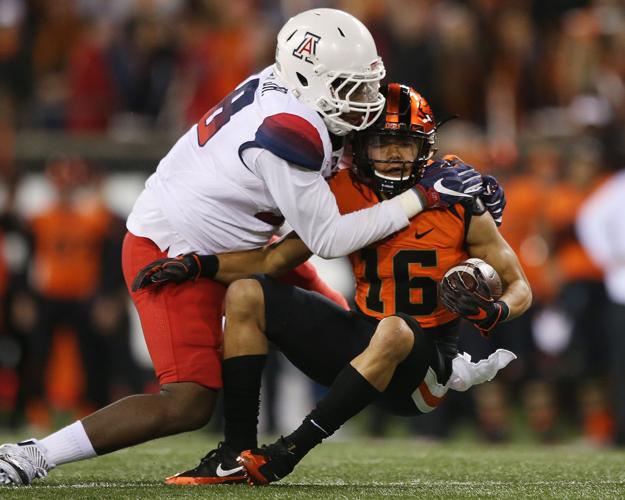
NO. 11: DL LARRY THARPE JR.
Ht/Wt/Yr: 6-5, 275, redshirt junior
Comment: Of the defensive lineman who’ve played actual games for Arizona, Tharpe has the highest upside. He flashed it repeatedly over the second half of last season, when he forced his way into a prominent role.
Tharpe should continue to improve this season, when he’ll have several things going for him that he didn’t have a year ago. Tharpe joined the team when fall 2016 classes started, so he didn’t have the benefit of training camp. This year he’ll have a full offseason on campus – weight-room and conditioning workouts, spring practice and training camp – before suiting up for the Sept. 2 opener against Northern Arizona.
Despite arriving late as a walk-on from Tyler (Texas) Junior College, Tharpe compiled some respectable numbers. In eight games, he accumulated 16 tackles, including 2.5 for losses, and three pass breakups. The latter were the most for any non-defensive back on the UA roster.
Tharpe was one of the few bright spots in lopsided losses to Washington State (two tackles, one TFL) and Oregon State (four tackles, one TFL). He was even better in the Territorial Cup, totaling a career-high five tackles and one pass breakup in Arizona’s 56-35 victory over Arizona State.
Beyond the numbers, Tharpe showed the ability to make plays – despite not necessarily knowing what he was doing. His knowledge of the playbook and his technique should be significantly sharper after spending a year in the system absorbing the teachings of DL coach Vince Amey.
Tharpe possesses physical traits that most of Arizona’s other defensive linemen simply lack – namely, size and length. Tharpe is listed at 6-5, 275, and he has enough quickness and agility to maneuver past offensive linemen to get into the backfield and make plays.
It’s no secret that the defensive front remains the Wildcats’ biggest area of concern. The unit simply did not make enough plays last season, and efforts to upgrade the talent there largely failed this offseason.
JC transfer Sione Taufahema, a nose tackle, is likely to be a rotation player. Incoming freshman My-King Johnson, a defensive end, could become one as well. But transfers Gaelin Elmore and Dereck Boles elected to play elsewhere. Both almost certainly would have been immediate contributors.
Unlike linebacker, where almost everyone will be new, the interior of the defensive line mostly will consist of holdovers. For the unit to improve, the returning players must improve.
None is in a better position to take a major step forward than Tharpe. He doesn’t need to be an all-conference performer. But if he can be a consistent threat, he can make a significant impact on a defense in desperate need of difference-makers. There’s considerable value in that.
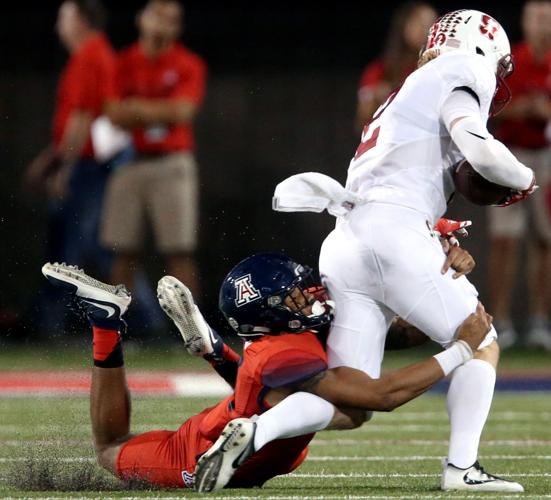
NO. 10: S ISAIAH HAYES
Ht/Wt/Yr: 6-0, 180, sophomore
Comment: Hayes is the second sophomore safety to crack the top 17, joining classmate Tristan Cooper. Both are up-and-coming players and projected starters who will be expected to take on meatier roles this season.
As the projected free safety – the traffic-directing literal last line of defense – Hayes will play a particularly important part.
He wasn’t completely ready to take on that responsibility last year … but ended up doing it anyway. Hayes displaced veteran Jarvis McCall Jr. in the fifth game and started seven of the final eight contests.
Despite missing large chunks of two of those starts because of injuries, Hayes ranked sixth on the team with 36 tackles, including 2.5 for losses. He did not have an interception or a pass breakup; that’s an area where he clearly can improve.
Hayes also has room for physical growth. He was about 160 pounds when he enrolled at Arizona in January 2016, played at about 180 and was encroaching on 190 during spring practice. He missed portions of the previous spring – on the field and in the weight room – because of a shoulder injury.
Referring to Hayes and his fellow safeties, position coach Jahmile Addae said: “When we got him in the fall and he’s fresh off a high school field and we put him out against 22-year-old, 23-year-old grown men, there’s a difference there. The weight room is probably going to be the biggest difference for my room. And then on the field, they’re starting to see things a lot faster than they have in the past. They’re playing proactively, not reactively, so they’re seeing things before they happen. I’m pleased so far with our progression. We’re not where we want to be. But if we continue at this pace, we’ll be in a good place.”
Hayes is the son of former NFL defensive back Chris Hayes, who told me last October that Isaiah always has had a “little-man complex” from trying to keep up with his older brother. Despite not being as strong as he needed to be, Hayes played with reckless abandon as a freshman.
“Size is overrated in my mind,” he said. “It depends on your heart, what you have inside and up top. It’s really how you approach it, if you come in 100 miles per hour downhill.
“All my life, I’ve never really been the big guy on the field. But I’ve always had the heart and the mindset that I was the biggest on the field.”
Coaches would rather work with an overly aggressive player than the alternative; as Rich Rodriguez has stated many times, he’d rather tell them “whoa” than “sic ’em.”
Hayes has the desired aggressiveness. If the game slows down a bit for him – which it typically does for second-year players – he can play with more control. That would help him stay healthy – and make more plays.
Assuming the former comes to pass, the latter should follow, making Hayes one of the 10 most valuable Wildcats of 2017.
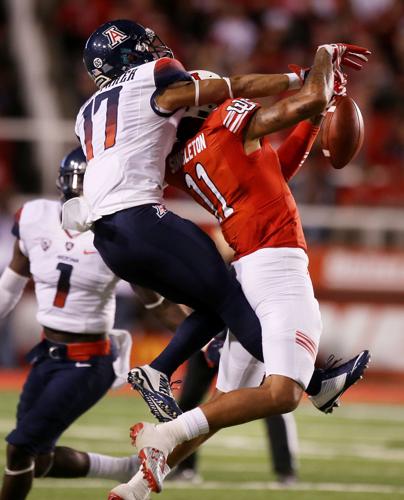
NO. 9: CB JACE WHITTAKER
Ht/Wt/Yr: 5-11, 180, junior
Comment: Whittaker is the ninth player we have profiled in this series, and he’s the fourth defensive back. That should tell you something about the composition of the UA defense.
Its strength undeniably can be found on the back end, where Whittaker is one of several upperclassmen with starting experience on his résumé. Whittaker also possesses the poise, presence and perspective desirable in a veteran leader.
Whittaker enters this year as Arizona’s most accomplished returning cornerback. Despite not becoming a starter until the sixth game, Whittaker led the team with 11 pass breakups. He had five in his first start, at Utah on Oct. 8, the most by a UA player since Antoine Cason had five in 2007.
But Whittaker didn’t talk like a player who had a job locked up when we interviewed him during spring practice. Regarding the idea that the Wildcats will have more depth at corner this season – something they badly need – Whittaker said the following:
“Those guys want to take my spot. I’m not saying I have a spot right now. But those guys, they definitely are hungry. They push me. It’s a great thing.”
That doesn’t stop Whittaker from helping the younger players. Lorenzo Burns, who will be a redshirt freshman this year, said Whittaker, senior Dane Cruickshank and redshirt sophomore Malcolm Holland (who played pro baseball before coming to Arizona) regularly make themselves available to their less experienced teammates.
“I go to them, ask for advice,” Burns said. “Ask them how I looked on the field.”
Whittaker wouldn’t give an overall assessment of the secondary in spring. He’s been around long enough to know that any conclusions reached in March or April are premature.
“We’re warming up right now,” Whittaker said. “We can’t be satisfied with what we’ve done so far.”
Whittaker approaches his individual game with the same mindset. Yes, the numbers were nice last year; besides those 11 pass breakups, he had 35 tackles (31 solos) and an interception.
But Arizona’s defense struggled in every facet, and that included the secondary. Whittaker had trouble at times with bigger receivers. He also needs to turn more of those pass breakups into picks.
Whittaker easily was the Wildcats’ most consistent corner, though, and he should continue to get better. Meaningful playing time and another offseason in the weight room only can help in that regard.
Whittaker doesn’t have to play like he did in the Utah game to be one of Arizona’s most valuable players. But that performance showed what he’s capable of if everything clicks.
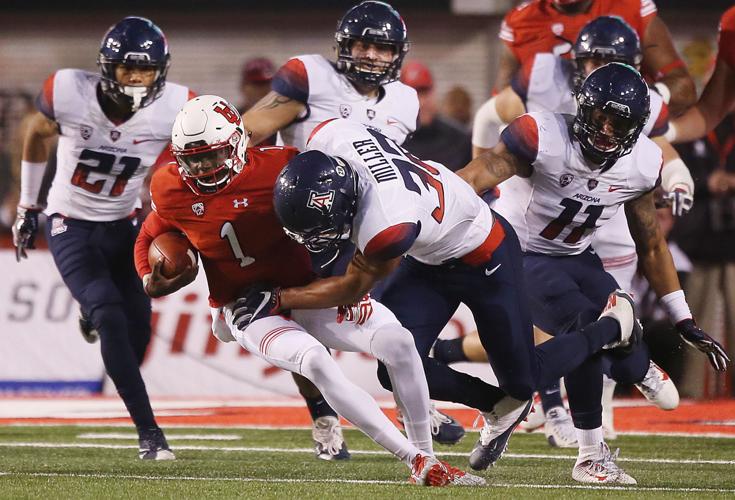
NO. 8: DE-LB DEANDRE’ MILLER
Ht/Wt/Yr: 6-3, 236, redshirt senior
Comment: Few UA players have a wider range of potential outcomes this season than Miller. His value is predicated largely – if not exclusively – on his health.
That essentially makes Miller the Nick Wilson of the defense – the talented veteran who’s important to the team’s success but can’t seem to stay on the field. Except that Miller might have a higher upside than Wilson (No. 15 on our list) in 2017 because there isn’t as much direction competition for playing time at his position.
Arizona lists four other players at defensive end/linebacker – a long way of saying “Stud” – on its online roster. Freshman Jose Ramirez also played at that spot in spring. None is to rushing the passer as J.J. Taylor is to rushing the football.
In other words, barring a major leap from a youngster, Miller will get the majority of the snaps at Stud … if he’s available to play. It’s one of the biggest “ifs” of 2017 for the Wildcats.
Miller showed great promise last season before getting hurt. In the first three games of the season, he accumulated 13 tackles, two sacks and two additional tackles for losses. He had just five more stops of any sort the rest of the season.
Miller appeared in six more games but never was quite right after suffering a high ankle sprain against the Rainbow Warriors. I learned in my time covering USC that no injury is more debilitating for a pass rusher. It happened to future pro Nick Perry in August of 2010, and he wasn’t himself the entire season.
Unfortunately, the injury bug isn’t unfamiliar to Miller. He missed 11 games in 2014 (resulting in a redshirt), two in ’15 and three last year because of various ailments. That’s 23 games played and 16 missed – not to mention all the ones he participated in last year at less than 100 percent. Kudos to Miller for playing in pain, but as even he conceded, he wasn’t helping the team.
Miller is determined to change that this year. As of spring, he had added almost 10 pounds of muscle to his listed 236-pound frame. He has everything you could want in a pass rusher – athleticism, burst, length – and no Wildcat is more motivated to prove himself.
If he can stay healthy – there’s that word again – Miller easily could work his way into the top three of the MVP rankings by season’s end. It’s just impossible to make that call right now given his history.
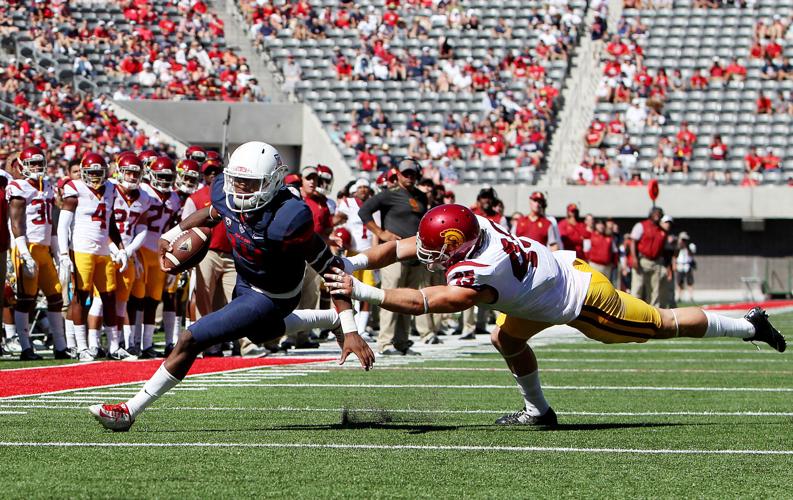
NO. 7: QB KHALIL TATE
Ht/Wt/Yr: 6-2, 212, sophomore
Comment: It wasn’t easy figuring out where to place Tate on this list.
He’ll enter training camp in a battle for the starting quarterback job with incumbent Brandon Dawkins and newcomer Donavan Tate (no relation). It’s entirely possible Khalil Tate will win the job, in which case he’d be a candidate for team MVP. It’s also possible he’ll be relegated to backup duty – which wouldn’t preclude him from playing a meaningful role at some point.
Let’s assume for the moment that Rich Rodriguez picks Dawkins or Donavan Tate as the starter. Given Dawkins’ aggressive style and Tate’s injury history as a baseball player, it’s reasonable to assume neither would last the entire season. So even if Khalil Tate is the No. 2 quarterback – or even if he’s No. 3 – he probably will play.
The likelihood that more than one quarterback will see action – combined with the general uncertainty surrounding the position – leads us to a strange place: having more than one QB in the top seven. (Spoiler alert: Dawkins will be among the top six.) Tate’s talent and upside make him an enticing candidate.
Both were on full display in Arizona’s final spring scrimmage, when Tate stole the show. According to my unofficial accounting, he completed 16 of 19 passes for 245 yards and a touchdown. It was a significant step forward – and somewhat easy to forget amid Dawkins’ preseason magazine covers and Donavan Tate’s fascinating past.
Obviously, there’s a huge difference between a scrimmage and a real game. Just because Khalil Tate displayed poise and accuracy in front of a smattering of fans on a Friday night in late March against the UA defense doesn’t mean he’s ready to do the same in front of 50,000 on a September Saturday against someone else.
But we have every reason to believe Tate will make major progress this year. He wasn’t remotely ready to play last season, when he didn’t turn 18 until October. Although he struggled when forced to start, Tate gained plenty from the experience. He’ll have a much better idea what to expect the second time around. He’ll also have a superior grasp of the playbook.
Physically, Tate has the ideal skills and measurables to run Rodriguez’s offense. Tate possesses a powerful arm, excellent speed and innate elusiveness. He also has a naturally thick frame, which should enable him to withstand punishment.
Whereas we might have seen Dawkins’ ceiling as a passer, we have no idea how good Tate can be. Will we get to find out this season? That’s a question no one, including Rodriguez, is capable of answering in mid-July. And that’s what makes determining Tate’s value for 2017 an educated guess at best.
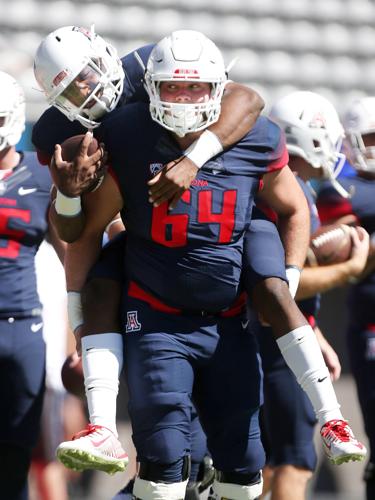
NO. 6: C NATHAN ELDRIDGE
Ht/Wt/Yr: 6-3, 290, redshirt sophomore
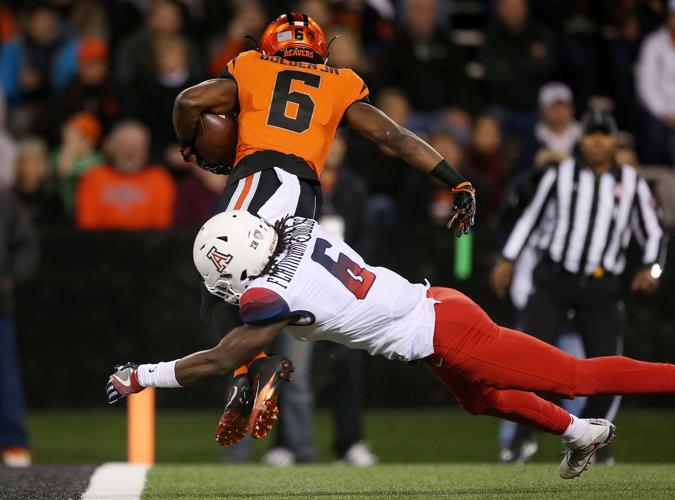
Comment: Eldridge ranking this high on a projected MVP list would have been inconceivable a year ago. But a tragic set of circumstances forever altered his career path.
Eldridge entered last year’s training camp as a projected backup. But just days into camp, senior center Zach Hemmila passed away in his sleep (It was later determined that Hemmila, 22, died from a toxic combination of prescription drugs.)
Someone had to step up and start at center. That someone was Eldridge, who had redshirted the previous year, as most incoming offensive linemen do.
Eldridge probably wasn’t completely ready, but he had no choice and did his best. The offensive line contributed heavily to the Wildcats’ overall offensive struggles last season, and Eldridge – as the traffic-directing pivot – bore some of the blame.
But there’s no question Eldridge was a better player in Game 12 than Game 1; see Arizona’s school-record 511 rushing yards in the Territorial Cup. (The UA also ended up leading the Pac-12 in rushing, at 235 yards per game.)
With a full season to learn from – and a full offseason to prepare – Eldridge should be one of the Wildcats’ most improved players this year. He and OL coach Jim Michalczik discussed the areas where Eldridge has advanced the most back in March. They include reading defenses, being more balanced and carrying himself with more confidence.
Eldridge will be in a completely different and better place mentally when this season gets underway. Instead of trying to play catchup and fit in with a mostly veteran group, he’s one of those veterans now.
Eldridge has the work ethic, sturdy frame and athletic background to become a top college center. He wrestled in high school, in addition to playing football. The skills learned on the mat often translate to football’s trenches.
If Eldridge indeed makes a leap this season – and Arizona’s offensive line is one of the team’s biggest strengths, which it should be – it stands to reason he will be one of the Wildcats’ most valuable performers.
- Michael Lev Arizona Daily Star
- Updated
NO. 5: S DEMETRIUS FLANNIGAN-FOWLES
Ht/Wt/Yr: 6-2, 199, junior
Comment: If you had to pick one UA defensive player who’s poised to earn all-Pac-12 honors, you’d pick Flannigan-Fowles.
As a sophomore, the Tucson product emerged as one of the defense’s premier playmakers. Flannigan-Fowles ranked second on the team with 78 tackles (including a team-best 59 solos) and tied for first with two interceptions. He also ranked in the top four in tackles for losses (four) and pass breakups (six).
No Arizona defender enters 2017 with a more jam-packed résumé. As the “Bandit” in Marcel Yates’ scheme, Flannigan-Fowles is asked to do a lot, from defending the run to covering tight ends and receivers. He’ll take on a bigger leadership role this year with several veteran defensive players having departed – and the other projected starting safeties (Tristan Cooper and Isaiah Hayes) entering their true sophomore seasons.
Besides his experience, role and past production, what makes Flannigan-Fowles a top-five MVP candidate is that he still has plenty of room for growth.
Remember, Flannigan-Fowles was ruled ineligible to play his senior year of high school after transferring from Tucson High to Mountain View. He had only one career start before last season. And he’s still growing into his 6-foot-2 frame. (He recently told the Star he’s up to 210 pounds.)
If there’s one area where Flannigan-Fowles can get better in 2017, it’s becoming more consistent.
Flannigan-Fowles was not as effective in the second half of last season. His didn’t have an interception after Week 3, and his tackling form suffered at times. If Flannigan-Fowles can create more takeaways and improve his tackling fundamentals, all-conference recognition becomes a realistic outcome.
Flannigan-Fowles did rebound at the end of the season; he had a career-high 13 tackles, including one TFL, at Oregon State and a potpourri of production against Arizona State: four tackles, including one TFL, and two pass breakups.
It’ll be interesting to see if Yates expands Flannigan-Fowles’ responsibilities this year. The Wildcats are desperate for pass rushers. Flannigan-Fowles has yet to record a sack. Occasionally unleashing him on quarterbacks would add a wrinkle to Arizona’s defense and further enhance his value.
Either way, Flannigan-Fowles is the leading contender to become the Wildcats’ defensive MVP – especially if he continues to improve. Of the returning defenders with extensive starting experience, his ceiling is as high as anyone’s.

- Michael Lev Arizona Daily Star
- Updated
NO. 4: OG JACOB ALSADEK
Ht/Wt/Yr: 6-7, 315, redshirt senior
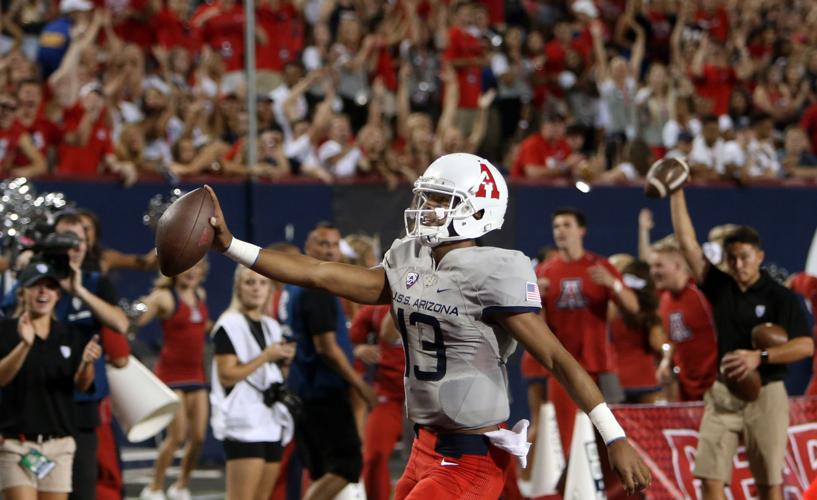
Comment: If this were a ranking of Arizona’s best leaders, Alsadek would sit atop the list.
The veteran offensive lineman stood tall during the program’s lowest, bleakest moments last year – and we’re not just saying that because he’s 6-foot-7. When someone needed to represent the offensive line after the sudden, shocking death of center Zach Hemmila, Alsadek stepped up. His composure under the circumstances was remarkable.
“He would always smile,” Alsadek said, maybe 24 hours after Hemmila was found dead. “When I’m at practice, I’m very serious. I’m really into everything. I’m really hard on myself. He would always look at me and tell me to smile. That’s something I will never forget from him.”
You couldn’t help but respect Alsadek after that interview, which had to be incredibly difficult for him. (Just check out the video: Alsadek’s voice cracks, he sniffles, he wipes away tears, he smiles, he laughs – the full range of human emotions.)
Alsadek remains the spokesman for the offensive line – and maybe the entire team. He’s one of two UA representatives at Pac-12 Media Days, and rumor has it that he was giddy about the assignment.
Alsadek’s enthusiasm and work ethic make him a role model for every Wildcat. Coach Rich Rodriguez lauded Alsadek’s character in spring, essentially portraying him as a self-made player.
“Jacob is not a big rah-rah guy, but he’s a natural leader just by the way he works,” Rodriguez said. “There’s nobody in our program that it’s more important to than Jacob Alsadek. It’s been that way since the day he walked on campus.”
There’s a difference between “loving football and liking football,” Rodriguez continued. “It’s a hard sport, so you better love it. Jacob is a great example. Here’s a guy that loves being a football player.”
He happens to be a good one. Alsadek and left tackle Layth Friekh were Arizona’s most consistent offensive linemen last season. Alsadek started 10 games at right guard, bringing his career total to 33. Arizona wouldn’t have led the Pac-12 in rushing or dominated Arizona State without him.
NFLDraftScout.com ranks Alsadek as the No. 22 guard for 2018, a sign that he’s on the league’s radar. He told the Star earlier in the offseason that he’s been working out regularly with former UA standout Glenn Parker, a sign that Alsadek remains motivated to elevate his game another notch or several.
As posited in the comment section for center Nathan Eldridge, our No. 6-ranked MVP candidate, the offensive line should be one of the Wildcats’ primary strengths. If Alsadek is the best player on what could be the team’s best unit, that makes him, indisputably, one of the most valuable players on the team overall.
- Michael Lev Arizona Daily Star
- Updated
NO. 3: QB BRANDON DAWKINS
Ht/Wt/Yr: 6-3, 210, redshirt junior
Comment: As was the case with fellow quarterback Khalil Tate, it was difficult to determine exactly where to place Dawkins on this list.
If he were the clear-cut starter, Dawkins would be No. 1, no questions asked. But he isn’t, and therein lies the challenge.
Dawkins is the favorite to start. It might be by a 51-49 margin, but if you had to pick a Week 1 starter today, it’d be Dawkins. That makes him a rock-solid top-five MVP selection.
What’s keeping Dawkins from the top spot is precisely what precludes him from owning the job outright: It remains to be seen whether he can make significant progress as a passer.
Dawkins trended in the opposite direction last season, his first as the most-of-the-time starter. In his first three games – against Grambling State, Hawaii and Washington – Dawkins completed 61.7 percent of his passes, had a 3-1 touchdown-to-interception ratio and averaged 7.72 yards per pass attempt. In his final seven games, those numbers dropped to 47.5, 5-5 and 7.16.
In his defense, Dawkins was banged up for much of the latter portion of the season. First he injured his ribs; then he suffered a concussion.
One of Dawkins’ main goals during the offseason was to get bigger and stronger to withstand the hits he’s bound to take as an ultra-aggressive runner. His speed and desire helped him average 94.4 rushing yards per game, the most by any quarterback in the Pac-12. Dawkins is a threat to score every time he takes off and runs. He’s also susceptible to injury because of his upright running style and disdain for sliding or going out of bounds.
Dawkins said and did all the right things in spring, acknowledging the areas where he needs to get better. Becoming a more adept pocket passer ranks atop that list.
On multiple occasions last year – as documented in the Star’s weekly review of each Arizona game telecast – Dawkins failed to locate open receivers. In most of those instances, Dawkins eschewed easy completions in favor of running.
That’s the area where he must improve. At the very least, Dawkins has to become adept at finding the No. 2 target in the progression of any given play. The question is whether that’s a skill he can learn or whether he lacks the vision most top passing quarterbacks possess.
The latter is the crux of the argument that Dawkins has peaked as a passer. Those who make it cite the fact that he’s been in the system for three years yet managed a tepid 53.8 percent completion rate in his first extended action, among other issues.
The counterargument is that last year was Dawkins’ first as a starter, he battled injuries, his backfield mates struggled to stay healthy and his protection was inconsistent. We know at least one of the above won’t apply in 2018; it’s possible none won’t.
If everything goes right, Dawkins certainly possesses the talent to become the most valuable Wildcat of 2017. There’s just too much uncertainty at this point to make that case.
- Michael Lev Arizona Daily Star
- Updated
NO. 2: WR SHUN BROWN
Ht/Wt/Yr: 5-8, 175, junior
Comment: There’s a ton of uncertainty around the Arizona program, from the future of the head coach to the identity of the starting quarterback.
There’s no disputing who the Wildcats’ No. 1 wide receiver is.
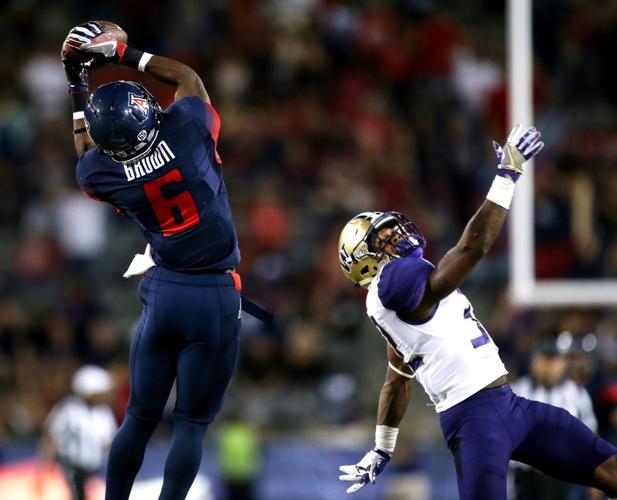
Brown is by far Arizona’s most accomplished returning pass catcher. You could make the case he was the UA’s top target a year ago as a sophomore, even though he didn’t lead the team in receptions.
Brown finished second with 29, which is about three games’ worth for a Washington State wideout. But bear in mind that Arizona finished last in the Pac-12 with 157 completed passes. That number is likely to go up in 2017, and Brown should corral an even greater percentage.
The receiver room’s leaders from 2016 are gone: Nate Phillips (33 reeptions), Trey Griffey (23) and Samajie Grant (22). Brown topped them all in yardage (521) by a wide margin. He also tied for the team lead with three touchdown receptions. And now he won’t have nearly as much competition for catches.
That can be a positive and a negative. Brown is bound to get more balls thrown his way. He’s also bound to get more defensive attention, especially after averaging a team-best 18.0 yards per catch and registering 12 plays of 20-plus yards, including four pass plays of 50-plus.
If other threats don’t emerge, Brown could be smothered by double teams. More likely, Rich Rodriguez and his staff will find ways to feature Brown and take advantage of his big-play ability.
Brown possesses speed, quickness, toughness and smarts. He doesn’t have size, but that hasn’t stopped previous pint-sized wideouts from putting up big numbers in Rodriguez’s system. In 2013, Phillips (5-7, 186) caught 51 passes for 696 yards and seven touchdowns. In ’14, Grant (5-9, 180) put up a 45-718-6 line.
Brown did most of his work out of the slot last season, but he’s capable of playing all the receiver positions. He’s also an adept runner, gaining 62 yards on two rushes in 2016. Brown even averaged 29.0 yards on two kickoff returns; every other Wildcat was under 20 yards.
It’s not inconceivable that Brown will double his 2016 receiving numbers this season – at least the catches and touchdowns. (Odds are, Brown’s average per catch will fall with defenses devoting more resources to stopping him. There were times last year – such as the first play of the Utah game – when he was left all but uncovered.)
We’re assuming some degree of advancement from Arizona’s passing game, regardless of who the quarterback ends up being. The fact that we don’t know who the starter is yet helped Brown inch past incumbent Brandon Dawkins in the MVP rankings.
Whether it’s Dawkins, Khalil Tate or Donavan Tate behind center, the Wildcats’ passing efficiency must improve for the team to enjoy any semblance of success. If it does, Brown will play a huge part in it.
- Michael Lev Arizona Daily Star
- Updated
NO. 1: RB J.J. TAYLOR
Ht/Wt/Yr: 5-6, 170, redshirt freshman
Comment: Taylor has appeared in only four games. He has started only once. He is listed on the roster as a redshirt freshman, which in most cases means a player has yet to even make his college debut.
But in the minimal time he did play, Taylor flashed so much ability and promise that there simply was no other choice: The diminutive, dynamic tailback is the no-brainer pick for 2017 team MVP.
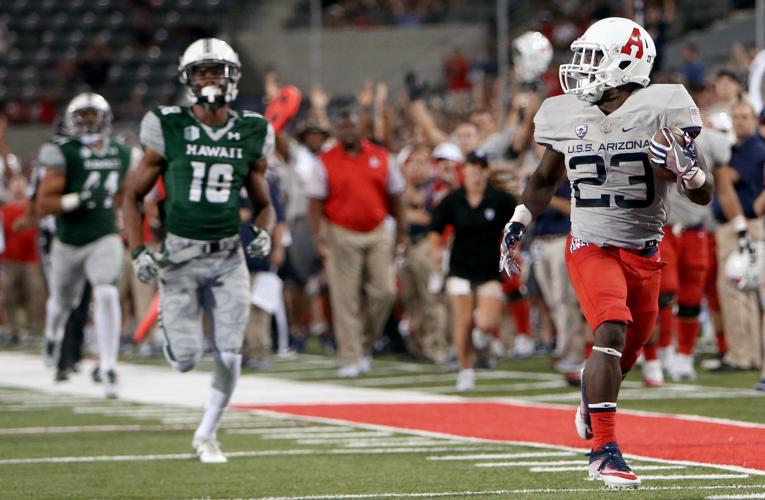
Taylor flashed through Tucson like a lightning storm last September. Replacing the injured Nick Wilson about midway through the first quarter of Game 3 against Hawaii, Taylor rushed for 168 yards on just 18 attempts. He made moves that appeared to defy physics (see second slide above).
Taylor came back the following week against a considerably tougher opponent in Washington. The Huskies couldn’t stop him either, yielding 97 yards on 19 carries through three quarters. On one run, Taylor made UW star safety Budda Baker look like an end-of-the-roster walk-on (see above). Baker ended up being the Cardinals’ second-round draft pick.
Unfortunately, near the end of the third quarter, Taylor’s brief, brilliant star turn came to an end. He got rolled up on a play that probably should have been whistled dead and suffered a season-ending broken left ankle.
A little over five months later, Taylor returned to the same Arizona Stadium turf and put on a show. Taylor dashed through the UA defense during an open scrimmage. It was as if he were moving at a different speed from everyone else. He said afterward that he felt only 80 percent recovered – a frightening thought for future Arizona foes.
Taylor enters the 2017 season with genuine superstar potential … assuming he stays healthy. Although the injury he suffered against the Huskies could be categorized as fluky, it’s fair to question Taylor’s durability simply because he hasn’t made it through a full college season.
But don’t make the mistake of diminishing his chances because of his size. As Mike Riley once said of former Oregon State tailback Jacquizz Rodgers, “He’s not small. He’s just short.” The same applies to Taylor.
When we last spoke to him in spring, Taylor had bulked up to 180 pounds. He looked sturdy and strong. Being short – which makes it easier to play low to the ground – actually can be advantageous for a running back.
Rodgers was listed at 5-7, 191. He starred in the Pac-12 and made it to the NFL. Likewise former UCLA standout Maurice Jones-Drew, who was listed at 5-8, 205. Darren Sproles – listed at 5-6, 190 – is still playing at age 34.
Arizona used Taylor only sparingly the first two games last season – the only time he and Wilson were healthy at the same time. It’s reasonable to assume they will split time this year, with Taylor getting more than a 50 percent share. Devising ways to feed him the ball 15-20 times per game has to be a priority for Rich Rodriguez and his staff.
Let’s say it’s the lower end, and Taylor averages 15 carries per game. Let’s also say he averages 6.0 yards per attempt, down about a yard from last year’s 6.9. That’d be 90 yards a game, or 1,080 over a 12-game season.
Taylor also should be a factor in the pass game (although the offense has gone away from throwing to backs in recent years) and could be one of the Wildcats’ kick returners as well. Something in the neighborhood of 1,500 all-purpose yards isn’t out of the question.
Over the past two seasons, no UA runner or receiver has come close to that mark. Even at 5-6, it’s well within Taylor’s reach.
Who will be the most valuable Arizona Wildcats football players of 2017?
That’s what we’re aiming to find out over the next few weeks.
It’s a completely subjective exercise, of course, and it’s important to note that everyone on the roster – from the starting quarterback to the scout-team walk-ons – has value. But it’s informative to project who the most valuable players will be, and that’s what we’ll attempt to do in this series.
Before we begin the countdown, some disclaimers:
“Most valuable” does not necessarily mean “best.” Rather, we’re defining it as the contributions and traits that most influence winning football. They include talent, leadership and projected role and production.
Newcomers were not eligible for the list. Although many might become major contributors this year, especially on defense, their roles are just too difficult to predict in June.
NO. 17: TE TREVOR WOOD
Ht/Wt/Yr: 6-6, 265, redshirt junior
Comment: Tight ends play a lot in Rich Rodriguez’s offense. They just haven’t caught a lot of passes.
Wood led the way last season with seven catches for 49 yards. Hardly the stuff of MVP lists.
But change might be afoot this season – and yes, I know what you’re thinking: We’ve heard this story before, and it never has come true. Why will this year be any different?
Well, a couple of reasons. One is that Rodriguez specifically mentioned in spring that the tight ends are being trained to stay on the field more. They’re lining up in new and different places so that Arizona doesn’t have to sub as much when it goes to its “four-wide” package.
The other main factor is that Calvin Magee – Rodriguez’s most trusted confidante – is now coaching tight ends in addition to running backs. If anyone has Rodriguez’s ear, it’s Magee. If Magee were to push for more passes to the tight ends, it’s likely Rodriguez would listen at the very least.
We saw glimpses of it during the first open spring scrimmage: multiple passes to the tight ends, resulting in multiple touchdowns.
Of course, scrimmages – especially in spring – aren’t necessarily harbingers. More often, they’re fool’s gold.
But the Wildcats really seemed to make a concerted effort to involve the tight ends that night. And Wood is an inviting target at 6-foot-6. It would be a waste to not utilize him more, especially in the red zone.
Wood was inconsistent as a blocker last season but has the frame and athleticism to become an asset in that area. That also would enhance his value.
How many catches/touchdowns would Wood need to justify his spot in this ranking? Would 20 and four be enough?
Those seem like reasonable objectives. Now it’s up to Wood, the coaches and the quarterbacks to make it happen.
NO. 16: CB DANE CRUIKSHANK
Ht/Wt/Yr: 6-1, 204, redshirt senior
Comment: From a purely physical standpoint, Cruikshank has everything you’d want in a top college cornerback. He has excellent size and very good speed for his size.
The question is whether Cruikshank can convert those attributes into consistent production.
Cruikshank accumulated promising raw numbers last season, his first as a member of Arizona’s active roster. (Cruikshank transferred from Citrus College in 2015 and redshirted that season.) Starting all 12 games, Cruikshank had 60 tackles (including 53 solos), seven passes breakups (second on the team) and two interceptions (tied for first).
What those stats don’t reveal is how often Cruikshank was in perfect position to defend a pass … but had trouble locating the ball. It happened repeatedly, and it has to be the aspect of his game that Cruikshank works on the most this offseason.
Which leads to more questions …
Is that something that can be fixed? Can Cruikshank be taught techniques that will enable him to get his head around, locate the ball and knock it away at the last instant? Or is that an instinctive skill that Cruikshank simply doesn’t possess?
You’d like to think it’s the former – that new cornerbacks coach Marcel Yates can train Cruikshank through countless practice reps to improve his play and ball recognition. If Yates – Arizona’s defensive coordinator, who this offseason shifted from coaching linebackers to defensive backs, his longtime forte – can work his magic, Cruikshank can become one of Arizona’s most valuable contributors in 2017.
You’d also like to think Cruickshank will be more comfortable being a Wildcat this season. Although he was a redshirt junior in ’16, it was his only his second year in the program and the first in which he played a meaningful role. There’s an adjustment period associated with that. Cruikshank should be well past that stage when training camp starts in late July. He should be ready to become a leader.
As mentioned, Cruikshank has all the measurables, which enable him to be physical near the line and to run with just about anyone down the field. He has the potential to be Arizona’s No. 1 cornerback. But as of now, that's all it is - potential.
NO. 15: RB NICK WILSON
Ht/Wt/Yr: 5-10, 208, senior
Comment: If you could guarantee that Wilson would be healthy for 12 games – even 10 – he’d rank much higher on this list. Even if he were in a timeshare, he’d have top-five potential.
Unfortunately, Wilson’s health is far from a guarantee. After a promising – heck, brilliant – freshman campaign, injuries undermined his sophomore and junior seasons. The stats tell the story:
- In 2014, Wilson played in 13 games and started eight. He had double-digit carries 11 times, rushed for at least 86 yards nine times and scored at least one touchdown nine times. His final line: 236-1,375-16.
- In 2015, Wilson started at a similar pace. He had double-figure carries in each of the first six games, rushed for 78 or more yards in five and scored at least once in four. But he hurt his foot in the sixth game, against Oregon State, and was a nonfactor thereafter. Wilson appeared in only three games in the second half of the season, totaling 18 carries for 42 yards.
- In 2016, Wilson again got off to a great start. In the first two games, he rushed 41 times for 254 yards and three scores. Then he hurt his ankle against Hawaii, and the rest of the season looked a lot like the second half of the previous year. Wilson left the Hawaii game with two carries and 3 yards. He made two additional appearances, rushing 12 times for 63 yards, before suffering a season-ending knee injury vs. USC.
Despite playing several times when he clearly wasn’t 100 percent, Wilson averaged 5.5 yards per carry as a sophomore and 5.8 as a junior – the latter matching his freshman mark. When healthy the past two seasons, he was the same player who earned multiple all-freshman accolades. He just couldn’t stay healthy.
The question moving forward is whether Wilson can shake the injury bug and finish his college career the way he started it. He’s well aware of the label – injury-prone – and misfortune that now follow him like a linebacker. The knee injury against USC came at the end of a 39-yard run.
“I was like, ‘Man, I can’t catch a break,’ ” Wilson said in spring. “It’s one of those things. You’ve just got to keep fighting through. I know it’s not an issue of my body breaking down. I think it’s just more of an issue of me catching bad luck, getting put in awkward situations, being tackled awkwardly.”
Whether Wilson is brittle or simply unfortunate is impossible to say. He has one more season to prove he can stay on the field.
Even if he can, a repeat of 2014 is unlikely. J.J. Taylor is too good to not be heavily involved in the offense. But a healthy Wilson getting 15 touches per game easily would be one of Arizona’s 15 most valuable players.
NO. 14: DL PARKER ZELLERS
Ht/Wt/Yr: 6-1, 247, senior
Comment: Arizona has spent considerable resources trying to find needed upgrades along the defensive line. Yet one of the players the UA has sought to replace happens to be one of its most irreplaceable players.
At 6-1, 247, Zellers has no business playing nose tackle in the Pac-12, at least not in 2017. But Zellers worked his way from walk-on to starter. Defensive line coach Vince Amey runs a meritocracy, and Zellers earned his spot by outplaying bigger, more sought-after players (which would be just about everybody else).
Which isn’t to say Zellers is an All-Pac-12 performer. He had 12 tackles in nine games last season. Three of those were sacks. That tied for the team lead. His two forced fumbles gave him solo top honors in that category.
None of those numbers are worth bragging about – not that Zellers would do so anyway. He’s a self-made, team-first guy, and that’s where his true value lies – as a leader and inspiration to his teammates.
Remember what Rich Rodriguez said recently about Zellers? I had asked the UA coach in April which defensive players stood out most in spring. He said this:
“You talk about a guy like Parker Zellers. He came here as an unrecruited walk-on that nobody knew anything about. Undersized. And he made himself into a player. This spring he was even better (despite missing time while rehabbing a shoulder injury). He’s a guy you’ve got to throw out of drills. That’s an example of that edge we’ve got to keep fostering.”
What’s strange about Zellers’ role on the team – the Parker Paradox, if you will – is that he’ll be even more valuable if he plays less. Zellers isn’t built for 80-90 plays. He and the rest of Arizona’s undersized defensive front wore down as games progressed on a regular basis last year.
It’s imperative that the Wildcats develop two complete D-line units that the coaches are confident in deploying. Despite losing some possible rotation players for one reason or another (Justin Holt, Gaelin Elmore, Dereck Boles), the staff is working toward that end.
One player Arizona did add is 300-plus-pound nose tackle Sione Taufahema, a stout junior-college transfer who would complement Zellers well. Placing Zellers into a third-down role – where he could utilize his quickness and not have to worry as much about stopping the run – would enhance his effectiveness. He’s already a respected contributor in so many other ways.
NO. 13: S TRISTAN COOPER
Ht/Wt/Yr: 6-1, 180, sophomore
Comment: When asked during spring practice what he was focusing on during the offseason, Cooper rattled off a lengthy inventory. The items on his to-do list included improving in man coverage, “triggering” faster, being less timid, cleaning up his technique and keeping his head up when he tackles.
That’s a lot, and it almost makes it seem as if Cooper was an ineffective player last season, his first at the UA. He was not. Appearing in 11 games at the “Spur” safety position, including five starts, Cooper accumulate 35 tackles, a sack, a pass breakup and a forced fumble. Not bad for a relatively unheralded freshman from the one part of Texas – El Paso – that isn’t known for football.
What Cooper’s offseason agenda illustrates is that he has plenty of room for improvement and already is mature enough to acknowledge that fact. Cooper’s makeup and upside firmly position him among the top 17 MVP candidates for the 2017 Wildcats.
Cooper is the favorite to start at Spur, joining fellow sophomore Isaiah Hayes and junior Demetrius Flannigan-Fowles in what has the makings of a strong safety group. Cooper will be bigger in 2017 after playing at around 180 pounds as a freshman. He’ll also be wiser.
“At first I was just a robot,” Cooper said. “I just knew my plays. I didn’t know anybody else’s, their jobs. Knowing everybody’s position, where they’re going to (be), it helps.”
Despite his claims of timidity as a freshman – “uncertainty” or “hesitancy” might be better terms – Cooper established a physical presence last year. He and Hayes play without fear. Now it’s a matter of using that aggression for good.
Cooper needs to make more impact plays, and he certainly seems capable of it. Look for defensive coordinator Marcel Yates – who liked Cooper’s game from the get-go – to set him up for success. Yates is coaching the cornerbacks and Spurs this season, and Cooper believes that’ll make him more adept in coverage. His eyes, hips and feet improved in just 15 spring practices.
But if he’s going to make his mark – and achieve his potential value – Cooper must do most of his damage in the box. He’s a powerful hitter … when he makes contact. An additional year of experience should boost Cooper’s batting average. His profile will rise accordingly.
NO. 12: WR CAM DENSON
Ht/Wt/Yr: 5-11, 187, senior
Comment: Let’s begin with the premise that the Wildcats’ passing game will be better than it was last season because, well, it has to be, right?
Not attempting a pass in the second half of the Territorial Cup was cool and all, but it wouldn’t have transpired that way if Rich Rodriguez had more faith in the pass game. With Brandon Dawkins and Khalil Tate having more seasoning – and Donavan Tate possibly ramping up the competition – it’s reasonable to project more production through the air.
Meanwhile, the receiving corps is in the midst of a major overhaul. Three of last year’s top four pass catchers – trusted vets Nate Phillips, Trey Griffey and Samajie Grant – are gone. No. 2 and No. 5 return. Opportunities for Shun Brown and Denson should be plentiful.
We’ll get to Brown at a later date. For now the focus is on the supremely talented Denson, who hasn’t lived up to his high school hype as of yet – but has one more season to remind Tucsonans what all the fuss was about.
Denson seemed destined for stardom after earning all-state and All-American accolades at Salpointe Catholic. Then he took a detour at his hometown university, spending two seasons at cornerback before switching to receiver in the spring of 2016.
Denson wasn’t much of a factor in the first half of the season, catching only four balls. Over the next five games, he showed flashes of what he could become.
Denson caught 11 passes over a five-game stretch preceding the Territorial Cup. (Arizona completed only three passes in that game – two to Phillips, one to Josh Kern.)
Even more significant, Denson averaged 18.8 yards per grab. He had a 51-yard reception against USC and a 47-yard touchdown against Washington State (perhaps the lone UA highlight in an otherwise miserable game).
Denson showed glimpses of the big-play form he regularly displayed in high school. He showed that he finally was getting it – that he was figuring out what it took to succeed at a higher level. Denson was used to being the best athlete on the field. It took him some time to adapt to being one of many.
Denson seemed to be building on that successful stretch in spring practice before suffering a foot injury a little past the halfway point. He still was wearing a walking boot more than a month later at Arizona’s April 22 fan event. That Denson was dancing in the Wildcats’ uniform-unveiling video Tuesday has to be considered a positive sign.
Assuming he’s healthy, Denson will be the favorite to secure the No. 2 receiver spot behind Brown. Assuming he keeps improving, Denson has a chance to be a difference maker in that role.
We’re assuming a lot here, but Denson has the talent and the opportunity to be one of Arizona’s most valuable players this season. He has a real shot to put the past behind him.
NO. 11: DL LARRY THARPE JR.
Ht/Wt/Yr: 6-5, 275, redshirt junior
Comment: Of the defensive lineman who’ve played actual games for Arizona, Tharpe has the highest upside. He flashed it repeatedly over the second half of last season, when he forced his way into a prominent role.
Tharpe should continue to improve this season, when he’ll have several things going for him that he didn’t have a year ago. Tharpe joined the team when fall 2016 classes started, so he didn’t have the benefit of training camp. This year he’ll have a full offseason on campus – weight-room and conditioning workouts, spring practice and training camp – before suiting up for the Sept. 2 opener against Northern Arizona.
Despite arriving late as a walk-on from Tyler (Texas) Junior College, Tharpe compiled some respectable numbers. In eight games, he accumulated 16 tackles, including 2.5 for losses, and three pass breakups. The latter were the most for any non-defensive back on the UA roster.
Tharpe was one of the few bright spots in lopsided losses to Washington State (two tackles, one TFL) and Oregon State (four tackles, one TFL). He was even better in the Territorial Cup, totaling a career-high five tackles and one pass breakup in Arizona’s 56-35 victory over Arizona State.
Beyond the numbers, Tharpe showed the ability to make plays – despite not necessarily knowing what he was doing. His knowledge of the playbook and his technique should be significantly sharper after spending a year in the system absorbing the teachings of DL coach Vince Amey.
Tharpe possesses physical traits that most of Arizona’s other defensive linemen simply lack – namely, size and length. Tharpe is listed at 6-5, 275, and he has enough quickness and agility to maneuver past offensive linemen to get into the backfield and make plays.
It’s no secret that the defensive front remains the Wildcats’ biggest area of concern. The unit simply did not make enough plays last season, and efforts to upgrade the talent there largely failed this offseason.
JC transfer Sione Taufahema, a nose tackle, is likely to be a rotation player. Incoming freshman My-King Johnson, a defensive end, could become one as well. But transfers Gaelin Elmore and Dereck Boles elected to play elsewhere. Both almost certainly would have been immediate contributors.
Unlike linebacker, where almost everyone will be new, the interior of the defensive line mostly will consist of holdovers. For the unit to improve, the returning players must improve.
None is in a better position to take a major step forward than Tharpe. He doesn’t need to be an all-conference performer. But if he can be a consistent threat, he can make a significant impact on a defense in desperate need of difference-makers. There’s considerable value in that.
NO. 10: S ISAIAH HAYES
Ht/Wt/Yr: 6-0, 180, sophomore
Comment: Hayes is the second sophomore safety to crack the top 17, joining classmate Tristan Cooper. Both are up-and-coming players and projected starters who will be expected to take on meatier roles this season.
As the projected free safety – the traffic-directing literal last line of defense – Hayes will play a particularly important part.
He wasn’t completely ready to take on that responsibility last year … but ended up doing it anyway. Hayes displaced veteran Jarvis McCall Jr. in the fifth game and started seven of the final eight contests.
Despite missing large chunks of two of those starts because of injuries, Hayes ranked sixth on the team with 36 tackles, including 2.5 for losses. He did not have an interception or a pass breakup; that’s an area where he clearly can improve.
Hayes also has room for physical growth. He was about 160 pounds when he enrolled at Arizona in January 2016, played at about 180 and was encroaching on 190 during spring practice. He missed portions of the previous spring – on the field and in the weight room – because of a shoulder injury.
Referring to Hayes and his fellow safeties, position coach Jahmile Addae said: “When we got him in the fall and he’s fresh off a high school field and we put him out against 22-year-old, 23-year-old grown men, there’s a difference there. The weight room is probably going to be the biggest difference for my room. And then on the field, they’re starting to see things a lot faster than they have in the past. They’re playing proactively, not reactively, so they’re seeing things before they happen. I’m pleased so far with our progression. We’re not where we want to be. But if we continue at this pace, we’ll be in a good place.”
Hayes is the son of former NFL defensive back Chris Hayes, who told me last October that Isaiah always has had a “little-man complex” from trying to keep up with his older brother. Despite not being as strong as he needed to be, Hayes played with reckless abandon as a freshman.
“Size is overrated in my mind,” he said. “It depends on your heart, what you have inside and up top. It’s really how you approach it, if you come in 100 miles per hour downhill.
“All my life, I’ve never really been the big guy on the field. But I’ve always had the heart and the mindset that I was the biggest on the field.”
Coaches would rather work with an overly aggressive player than the alternative; as Rich Rodriguez has stated many times, he’d rather tell them “whoa” than “sic ’em.”
Hayes has the desired aggressiveness. If the game slows down a bit for him – which it typically does for second-year players – he can play with more control. That would help him stay healthy – and make more plays.
Assuming the former comes to pass, the latter should follow, making Hayes one of the 10 most valuable Wildcats of 2017.
NO. 9: CB JACE WHITTAKER
Ht/Wt/Yr: 5-11, 180, junior
Comment: Whittaker is the ninth player we have profiled in this series, and he’s the fourth defensive back. That should tell you something about the composition of the UA defense.
Its strength undeniably can be found on the back end, where Whittaker is one of several upperclassmen with starting experience on his résumé. Whittaker also possesses the poise, presence and perspective desirable in a veteran leader.
Whittaker enters this year as Arizona’s most accomplished returning cornerback. Despite not becoming a starter until the sixth game, Whittaker led the team with 11 pass breakups. He had five in his first start, at Utah on Oct. 8, the most by a UA player since Antoine Cason had five in 2007.
But Whittaker didn’t talk like a player who had a job locked up when we interviewed him during spring practice. Regarding the idea that the Wildcats will have more depth at corner this season – something they badly need – Whittaker said the following:
“Those guys want to take my spot. I’m not saying I have a spot right now. But those guys, they definitely are hungry. They push me. It’s a great thing.”
That doesn’t stop Whittaker from helping the younger players. Lorenzo Burns, who will be a redshirt freshman this year, said Whittaker, senior Dane Cruickshank and redshirt sophomore Malcolm Holland (who played pro baseball before coming to Arizona) regularly make themselves available to their less experienced teammates.
“I go to them, ask for advice,” Burns said. “Ask them how I looked on the field.”
Whittaker wouldn’t give an overall assessment of the secondary in spring. He’s been around long enough to know that any conclusions reached in March or April are premature.
“We’re warming up right now,” Whittaker said. “We can’t be satisfied with what we’ve done so far.”
Whittaker approaches his individual game with the same mindset. Yes, the numbers were nice last year; besides those 11 pass breakups, he had 35 tackles (31 solos) and an interception.
But Arizona’s defense struggled in every facet, and that included the secondary. Whittaker had trouble at times with bigger receivers. He also needs to turn more of those pass breakups into picks.
Whittaker easily was the Wildcats’ most consistent corner, though, and he should continue to get better. Meaningful playing time and another offseason in the weight room only can help in that regard.
Whittaker doesn’t have to play like he did in the Utah game to be one of Arizona’s most valuable players. But that performance showed what he’s capable of if everything clicks.
NO. 8: DE-LB DEANDRE’ MILLER
Ht/Wt/Yr: 6-3, 236, redshirt senior
Comment: Few UA players have a wider range of potential outcomes this season than Miller. His value is predicated largely – if not exclusively – on his health.
That essentially makes Miller the Nick Wilson of the defense – the talented veteran who’s important to the team’s success but can’t seem to stay on the field. Except that Miller might have a higher upside than Wilson (No. 15 on our list) in 2017 because there isn’t as much direction competition for playing time at his position.
Arizona lists four other players at defensive end/linebacker – a long way of saying “Stud” – on its online roster. Freshman Jose Ramirez also played at that spot in spring. None is to rushing the passer as J.J. Taylor is to rushing the football.
In other words, barring a major leap from a youngster, Miller will get the majority of the snaps at Stud … if he’s available to play. It’s one of the biggest “ifs” of 2017 for the Wildcats.
Miller showed great promise last season before getting hurt. In the first three games of the season, he accumulated 13 tackles, two sacks and two additional tackles for losses. He had just five more stops of any sort the rest of the season.
Miller appeared in six more games but never was quite right after suffering a high ankle sprain against the Rainbow Warriors. I learned in my time covering USC that no injury is more debilitating for a pass rusher. It happened to future pro Nick Perry in August of 2010, and he wasn’t himself the entire season.
Unfortunately, the injury bug isn’t unfamiliar to Miller. He missed 11 games in 2014 (resulting in a redshirt), two in ’15 and three last year because of various ailments. That’s 23 games played and 16 missed – not to mention all the ones he participated in last year at less than 100 percent. Kudos to Miller for playing in pain, but as even he conceded, he wasn’t helping the team.
Miller is determined to change that this year. As of spring, he had added almost 10 pounds of muscle to his listed 236-pound frame. He has everything you could want in a pass rusher – athleticism, burst, length – and no Wildcat is more motivated to prove himself.
If he can stay healthy – there’s that word again – Miller easily could work his way into the top three of the MVP rankings by season’s end. It’s just impossible to make that call right now given his history.
NO. 7: QB KHALIL TATE
Ht/Wt/Yr: 6-2, 212, sophomore
Comment: It wasn’t easy figuring out where to place Tate on this list.
He’ll enter training camp in a battle for the starting quarterback job with incumbent Brandon Dawkins and newcomer Donavan Tate (no relation). It’s entirely possible Khalil Tate will win the job, in which case he’d be a candidate for team MVP. It’s also possible he’ll be relegated to backup duty – which wouldn’t preclude him from playing a meaningful role at some point.
Let’s assume for the moment that Rich Rodriguez picks Dawkins or Donavan Tate as the starter. Given Dawkins’ aggressive style and Tate’s injury history as a baseball player, it’s reasonable to assume neither would last the entire season. So even if Khalil Tate is the No. 2 quarterback – or even if he’s No. 3 – he probably will play.
The likelihood that more than one quarterback will see action – combined with the general uncertainty surrounding the position – leads us to a strange place: having more than one QB in the top seven. (Spoiler alert: Dawkins will be among the top six.) Tate’s talent and upside make him an enticing candidate.
Both were on full display in Arizona’s final spring scrimmage, when Tate stole the show. According to my unofficial accounting, he completed 16 of 19 passes for 245 yards and a touchdown. It was a significant step forward – and somewhat easy to forget amid Dawkins’ preseason magazine covers and Donavan Tate’s fascinating past.
Obviously, there’s a huge difference between a scrimmage and a real game. Just because Khalil Tate displayed poise and accuracy in front of a smattering of fans on a Friday night in late March against the UA defense doesn’t mean he’s ready to do the same in front of 50,000 on a September Saturday against someone else.
But we have every reason to believe Tate will make major progress this year. He wasn’t remotely ready to play last season, when he didn’t turn 18 until October. Although he struggled when forced to start, Tate gained plenty from the experience. He’ll have a much better idea what to expect the second time around. He’ll also have a superior grasp of the playbook.
Physically, Tate has the ideal skills and measurables to run Rodriguez’s offense. Tate possesses a powerful arm, excellent speed and innate elusiveness. He also has a naturally thick frame, which should enable him to withstand punishment.
Whereas we might have seen Dawkins’ ceiling as a passer, we have no idea how good Tate can be. Will we get to find out this season? That’s a question no one, including Rodriguez, is capable of answering in mid-July. And that’s what makes determining Tate’s value for 2017 an educated guess at best.
NO. 6: C NATHAN ELDRIDGE
Ht/Wt/Yr: 6-3, 290, redshirt sophomore
Comment: Eldridge ranking this high on a projected MVP list would have been inconceivable a year ago. But a tragic set of circumstances forever altered his career path.
Eldridge entered last year’s training camp as a projected backup. But just days into camp, senior center Zach Hemmila passed away in his sleep (It was later determined that Hemmila, 22, died from a toxic combination of prescription drugs.)
Someone had to step up and start at center. That someone was Eldridge, who had redshirted the previous year, as most incoming offensive linemen do.
Eldridge probably wasn’t completely ready, but he had no choice and did his best. The offensive line contributed heavily to the Wildcats’ overall offensive struggles last season, and Eldridge – as the traffic-directing pivot – bore some of the blame.
But there’s no question Eldridge was a better player in Game 12 than Game 1; see Arizona’s school-record 511 rushing yards in the Territorial Cup. (The UA also ended up leading the Pac-12 in rushing, at 235 yards per game.)
With a full season to learn from – and a full offseason to prepare – Eldridge should be one of the Wildcats’ most improved players this year. He and OL coach Jim Michalczik discussed the areas where Eldridge has advanced the most back in March. They include reading defenses, being more balanced and carrying himself with more confidence.
Eldridge will be in a completely different and better place mentally when this season gets underway. Instead of trying to play catchup and fit in with a mostly veteran group, he’s one of those veterans now.
Eldridge has the work ethic, sturdy frame and athletic background to become a top college center. He wrestled in high school, in addition to playing football. The skills learned on the mat often translate to football’s trenches.
If Eldridge indeed makes a leap this season – and Arizona’s offensive line is one of the team’s biggest strengths, which it should be – it stands to reason he will be one of the Wildcats’ most valuable performers.
NO. 5: S DEMETRIUS FLANNIGAN-FOWLES
Ht/Wt/Yr: 6-2, 199, junior
Comment: If you had to pick one UA defensive player who’s poised to earn all-Pac-12 honors, you’d pick Flannigan-Fowles.
As a sophomore, the Tucson product emerged as one of the defense’s premier playmakers. Flannigan-Fowles ranked second on the team with 78 tackles (including a team-best 59 solos) and tied for first with two interceptions. He also ranked in the top four in tackles for losses (four) and pass breakups (six).
No Arizona defender enters 2017 with a more jam-packed résumé. As the “Bandit” in Marcel Yates’ scheme, Flannigan-Fowles is asked to do a lot, from defending the run to covering tight ends and receivers. He’ll take on a bigger leadership role this year with several veteran defensive players having departed – and the other projected starting safeties (Tristan Cooper and Isaiah Hayes) entering their true sophomore seasons.
Besides his experience, role and past production, what makes Flannigan-Fowles a top-five MVP candidate is that he still has plenty of room for growth.
Remember, Flannigan-Fowles was ruled ineligible to play his senior year of high school after transferring from Tucson High to Mountain View. He had only one career start before last season. And he’s still growing into his 6-foot-2 frame. (He recently told the Star he’s up to 210 pounds.)
If there’s one area where Flannigan-Fowles can get better in 2017, it’s becoming more consistent.
Flannigan-Fowles was not as effective in the second half of last season. His didn’t have an interception after Week 3, and his tackling form suffered at times. If Flannigan-Fowles can create more takeaways and improve his tackling fundamentals, all-conference recognition becomes a realistic outcome.
Flannigan-Fowles did rebound at the end of the season; he had a career-high 13 tackles, including one TFL, at Oregon State and a potpourri of production against Arizona State: four tackles, including one TFL, and two pass breakups.
It’ll be interesting to see if Yates expands Flannigan-Fowles’ responsibilities this year. The Wildcats are desperate for pass rushers. Flannigan-Fowles has yet to record a sack. Occasionally unleashing him on quarterbacks would add a wrinkle to Arizona’s defense and further enhance his value.
Either way, Flannigan-Fowles is the leading contender to become the Wildcats’ defensive MVP – especially if he continues to improve. Of the returning defenders with extensive starting experience, his ceiling is as high as anyone’s.
NO. 4: OG JACOB ALSADEK
Ht/Wt/Yr: 6-7, 315, redshirt senior
Comment: If this were a ranking of Arizona’s best leaders, Alsadek would sit atop the list.
The veteran offensive lineman stood tall during the program’s lowest, bleakest moments last year – and we’re not just saying that because he’s 6-foot-7. When someone needed to represent the offensive line after the sudden, shocking death of center Zach Hemmila, Alsadek stepped up. His composure under the circumstances was remarkable.
“He would always smile,” Alsadek said, maybe 24 hours after Hemmila was found dead. “When I’m at practice, I’m very serious. I’m really into everything. I’m really hard on myself. He would always look at me and tell me to smile. That’s something I will never forget from him.”
You couldn’t help but respect Alsadek after that interview, which had to be incredibly difficult for him. (Just check out the video: Alsadek’s voice cracks, he sniffles, he wipes away tears, he smiles, he laughs – the full range of human emotions.)
Alsadek remains the spokesman for the offensive line – and maybe the entire team. He’s one of two UA representatives at Pac-12 Media Days, and rumor has it that he was giddy about the assignment.
Alsadek’s enthusiasm and work ethic make him a role model for every Wildcat. Coach Rich Rodriguez lauded Alsadek’s character in spring, essentially portraying him as a self-made player.
“Jacob is not a big rah-rah guy, but he’s a natural leader just by the way he works,” Rodriguez said. “There’s nobody in our program that it’s more important to than Jacob Alsadek. It’s been that way since the day he walked on campus.”
There’s a difference between “loving football and liking football,” Rodriguez continued. “It’s a hard sport, so you better love it. Jacob is a great example. Here’s a guy that loves being a football player.”
He happens to be a good one. Alsadek and left tackle Layth Friekh were Arizona’s most consistent offensive linemen last season. Alsadek started 10 games at right guard, bringing his career total to 33. Arizona wouldn’t have led the Pac-12 in rushing or dominated Arizona State without him.
NFLDraftScout.com ranks Alsadek as the No. 22 guard for 2018, a sign that he’s on the league’s radar. He told the Star earlier in the offseason that he’s been working out regularly with former UA standout Glenn Parker, a sign that Alsadek remains motivated to elevate his game another notch or several.
As posited in the comment section for center Nathan Eldridge, our No. 6-ranked MVP candidate, the offensive line should be one of the Wildcats’ primary strengths. If Alsadek is the best player on what could be the team’s best unit, that makes him, indisputably, one of the most valuable players on the team overall.
NO. 3: QB BRANDON DAWKINS
Ht/Wt/Yr: 6-3, 210, redshirt junior
Comment: As was the case with fellow quarterback Khalil Tate, it was difficult to determine exactly where to place Dawkins on this list.
If he were the clear-cut starter, Dawkins would be No. 1, no questions asked. But he isn’t, and therein lies the challenge.
Dawkins is the favorite to start. It might be by a 51-49 margin, but if you had to pick a Week 1 starter today, it’d be Dawkins. That makes him a rock-solid top-five MVP selection.
What’s keeping Dawkins from the top spot is precisely what precludes him from owning the job outright: It remains to be seen whether he can make significant progress as a passer.
Dawkins trended in the opposite direction last season, his first as the most-of-the-time starter. In his first three games – against Grambling State, Hawaii and Washington – Dawkins completed 61.7 percent of his passes, had a 3-1 touchdown-to-interception ratio and averaged 7.72 yards per pass attempt. In his final seven games, those numbers dropped to 47.5, 5-5 and 7.16.
In his defense, Dawkins was banged up for much of the latter portion of the season. First he injured his ribs; then he suffered a concussion.
One of Dawkins’ main goals during the offseason was to get bigger and stronger to withstand the hits he’s bound to take as an ultra-aggressive runner. His speed and desire helped him average 94.4 rushing yards per game, the most by any quarterback in the Pac-12. Dawkins is a threat to score every time he takes off and runs. He’s also susceptible to injury because of his upright running style and disdain for sliding or going out of bounds.
Dawkins said and did all the right things in spring, acknowledging the areas where he needs to get better. Becoming a more adept pocket passer ranks atop that list.
On multiple occasions last year – as documented in the Star’s weekly review of each Arizona game telecast – Dawkins failed to locate open receivers. In most of those instances, Dawkins eschewed easy completions in favor of running.
That’s the area where he must improve. At the very least, Dawkins has to become adept at finding the No. 2 target in the progression of any given play. The question is whether that’s a skill he can learn or whether he lacks the vision most top passing quarterbacks possess.
The latter is the crux of the argument that Dawkins has peaked as a passer. Those who make it cite the fact that he’s been in the system for three years yet managed a tepid 53.8 percent completion rate in his first extended action, among other issues.
The counterargument is that last year was Dawkins’ first as a starter, he battled injuries, his backfield mates struggled to stay healthy and his protection was inconsistent. We know at least one of the above won’t apply in 2018; it’s possible none won’t.
If everything goes right, Dawkins certainly possesses the talent to become the most valuable Wildcat of 2017. There’s just too much uncertainty at this point to make that case.
NO. 2: WR SHUN BROWN
Ht/Wt/Yr: 5-8, 175, junior
Comment: There’s a ton of uncertainty around the Arizona program, from the future of the head coach to the identity of the starting quarterback.
There’s no disputing who the Wildcats’ No. 1 wide receiver is.
Brown is by far Arizona’s most accomplished returning pass catcher. You could make the case he was the UA’s top target a year ago as a sophomore, even though he didn’t lead the team in receptions.
Brown finished second with 29, which is about three games’ worth for a Washington State wideout. But bear in mind that Arizona finished last in the Pac-12 with 157 completed passes. That number is likely to go up in 2017, and Brown should corral an even greater percentage.
The receiver room’s leaders from 2016 are gone: Nate Phillips (33 reeptions), Trey Griffey (23) and Samajie Grant (22). Brown topped them all in yardage (521) by a wide margin. He also tied for the team lead with three touchdown receptions. And now he won’t have nearly as much competition for catches.
That can be a positive and a negative. Brown is bound to get more balls thrown his way. He’s also bound to get more defensive attention, especially after averaging a team-best 18.0 yards per catch and registering 12 plays of 20-plus yards, including four pass plays of 50-plus.
If other threats don’t emerge, Brown could be smothered by double teams. More likely, Rich Rodriguez and his staff will find ways to feature Brown and take advantage of his big-play ability.
Brown possesses speed, quickness, toughness and smarts. He doesn’t have size, but that hasn’t stopped previous pint-sized wideouts from putting up big numbers in Rodriguez’s system. In 2013, Phillips (5-7, 186) caught 51 passes for 696 yards and seven touchdowns. In ’14, Grant (5-9, 180) put up a 45-718-6 line.
Brown did most of his work out of the slot last season, but he’s capable of playing all the receiver positions. He’s also an adept runner, gaining 62 yards on two rushes in 2016. Brown even averaged 29.0 yards on two kickoff returns; every other Wildcat was under 20 yards.
It’s not inconceivable that Brown will double his 2016 receiving numbers this season – at least the catches and touchdowns. (Odds are, Brown’s average per catch will fall with defenses devoting more resources to stopping him. There were times last year – such as the first play of the Utah game – when he was left all but uncovered.)
We’re assuming some degree of advancement from Arizona’s passing game, regardless of who the quarterback ends up being. The fact that we don’t know who the starter is yet helped Brown inch past incumbent Brandon Dawkins in the MVP rankings.
Whether it’s Dawkins, Khalil Tate or Donavan Tate behind center, the Wildcats’ passing efficiency must improve for the team to enjoy any semblance of success. If it does, Brown will play a huge part in it.
NO. 1: RB J.J. TAYLOR
Ht/Wt/Yr: 5-6, 170, redshirt freshman
Comment: Taylor has appeared in only four games. He has started only once. He is listed on the roster as a redshirt freshman, which in most cases means a player has yet to even make his college debut.
But in the minimal time he did play, Taylor flashed so much ability and promise that there simply was no other choice: The diminutive, dynamic tailback is the no-brainer pick for 2017 team MVP.
Taylor flashed through Tucson like a lightning storm last September. Replacing the injured Nick Wilson about midway through the first quarter of Game 3 against Hawaii, Taylor rushed for 168 yards on just 18 attempts. He made moves that appeared to defy physics (see second slide above).
Taylor came back the following week against a considerably tougher opponent in Washington. The Huskies couldn’t stop him either, yielding 97 yards on 19 carries through three quarters. On one run, Taylor made UW star safety Budda Baker look like an end-of-the-roster walk-on (see above). Baker ended up being the Cardinals’ second-round draft pick.
Unfortunately, near the end of the third quarter, Taylor’s brief, brilliant star turn came to an end. He got rolled up on a play that probably should have been whistled dead and suffered a season-ending broken left ankle.
A little over five months later, Taylor returned to the same Arizona Stadium turf and put on a show. Taylor dashed through the UA defense during an open scrimmage. It was as if he were moving at a different speed from everyone else. He said afterward that he felt only 80 percent recovered – a frightening thought for future Arizona foes.
Taylor enters the 2017 season with genuine superstar potential … assuming he stays healthy. Although the injury he suffered against the Huskies could be categorized as fluky, it’s fair to question Taylor’s durability simply because he hasn’t made it through a full college season.
But don’t make the mistake of diminishing his chances because of his size. As Mike Riley once said of former Oregon State tailback Jacquizz Rodgers, “He’s not small. He’s just short.” The same applies to Taylor.
When we last spoke to him in spring, Taylor had bulked up to 180 pounds. He looked sturdy and strong. Being short – which makes it easier to play low to the ground – actually can be advantageous for a running back.
Rodgers was listed at 5-7, 191. He starred in the Pac-12 and made it to the NFL. Likewise former UCLA standout Maurice Jones-Drew, who was listed at 5-8, 205. Darren Sproles – listed at 5-6, 190 – is still playing at age 34.
Arizona used Taylor only sparingly the first two games last season – the only time he and Wilson were healthy at the same time. It’s reasonable to assume they will split time this year, with Taylor getting more than a 50 percent share. Devising ways to feed him the ball 15-20 times per game has to be a priority for Rich Rodriguez and his staff.
Let’s say it’s the lower end, and Taylor averages 15 carries per game. Let’s also say he averages 6.0 yards per attempt, down about a yard from last year’s 6.9. That’d be 90 yards a game, or 1,080 over a 12-game season.
Taylor also should be a factor in the pass game (although the offense has gone away from throwing to backs in recent years) and could be one of the Wildcats’ kick returners as well. Something in the neighborhood of 1,500 all-purpose yards isn’t out of the question.
Over the past two seasons, no UA runner or receiver has come close to that mark. Even at 5-6, it’s well within Taylor’s reach.
Tags
As featured on
Arizona also added junior college defensive lineman Dereck Boles to the roster for the fall.

News and notes from UA coach Rich Rodriguez's interactions with reporters in Hollywood.


View this profile on Instagram#ThisIsTucson 🌵 (@this_is_tucson) • Instagram photos and videos
Most viewed stories
-
Surprise! Wildflower season is starting early. Here's where to find the best blooms 🌼
-
43 events you won't want to miss, February 20-22! 🤠🐎
-
Conservation park for endangered animal could open south of Tucson
-
Jamie vs. Sonoran dogs: Follow me as I take on Visit Tucson's Sonoran Dog Trail 🌭
-
Over 60 fun events happening in Tucson in February 💖🐎
-
A new chapter: Crossroads Restaurant is back open after fire
-
Transplant Pizza, Mosaic Brewing and Marana Serial Grillers close their doors