


The stereo thumps one story above, where a few hundred fans, three-quarters with Native American faces, have gathered to watch a basketball game.
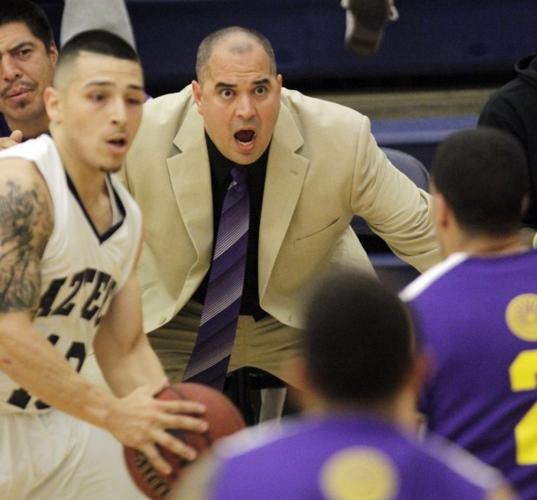
I'm wedged between the whiteboard and the wall, watching the coach in a new khaki suit tell his first-year team to play zone defense against an inbounds pass.
The opponent, Pima College, will try an alley-oop, the coach predicted pregame Wednesday. The host Aztecs might feel cocky, he said, after landing players from all over the country.
"Well, we got some guys," coach Matthew Vargas says, his voice gaining a syrupy Southern lilt as it rises. "We got some guys from Covered Wells! We got some guys from Libya! We got some guys from Sells! We got guys from Japan!"
Tohono O'odham Community College boasts basketball players from the O'odham reservation - from Sells and Covered Wells and Queens Well - but also Navajos and Yaquis.
Its players were born in Tucson, Tripoli and Okinawa. There are Louisianians and Oregonians.
There are 13 Native Americans, plus black, white and hispanic players, that range in age from 18 to 37.
Many are fathers.
Together, they've have formed the first sports team in the history of the 11-year-old college, whose 300-person student body is 97 percent Native American.
A contest this summer gave them a name: the Jegos, an O'odham word for the dust storm that rises before monsoon rain.
They wear purple and gold, colors of the O'odham Nation's flag.
"I'm playing for the people," said Roland Ramon, a sharpshooting 35-year-old father of four from Sells. "For the youth that's around here that has the same dreams that I have.
"I want them to see that it can be done by native people."
The Jegos have proven that already, despite a 2-10 record as an independent team in the National Junior College Athletic Association.
I dare you to find a better local example of the good that sports can do.
Vargas estimates 18 of his 20 players wouldn't be in school were it not for the lure of the team.
Forward Manalito Jose, 37, works 40 hours as a maintenance man in Sells but still makes every 6:30 a.m. practice.
A dropout from Sells Baboquivari High School, he now attends 12 hours of classes on his lunch break and after work.
"At first, the reason I had to take classes was just to play," he said. "Now, after being in school, I plan on staying."
Forward Jeff Juan, who was the Jegos' best player in Wednesday's 107-83 loss at Pima, scoring 29 points, serves as the team's van driver.
He meets 10 other Tucson-based players at 5 a.m. at a Taco Bell on the south side and loads them into the 15-person van for a quiet 90-minute drive to Sells.
They return to the parking lot at the end of the day, sometimes as late as 7 p.m.
The 25-year-old married father of three quit his job running youth sports leagues to chase his dreams.
"It's a passion, representing our nation," Juan said, "to play for the people on the reservation that don't have a chance to go to college."
Louisiana native Jesmon Walker, who had never seen a Native American before coming to campus, is still amazed by how close his team has become.
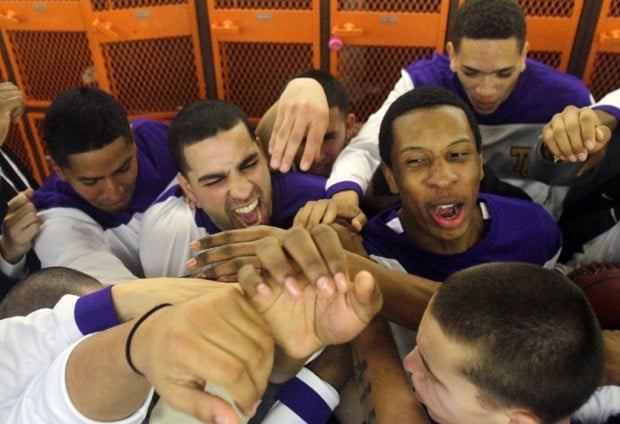
"We listen to the same music, do the same things," he said.
They need their coach, and their coach needs them.
Vargas, a former Pima basketball staffer who became the O'odham Nation's recreation manager, has been sober for almost seven years.
The experience helps him mentor players going through their own troubles.
"It's about the struggle," he said, "but it's not a crutch."
He pitched the team as a way to keep college-aged kids out of trouble and to inspire younger ones.
The idea gained momentum a year ago, when a team of hand-picked O'odham players beat Pima in a scrimmage at a packed Baboquivari High School.
The team was approved over the summer. Donations and support from the nation offset the $35,000 budget; the team wears shiny Nike jerseys and shoes as part of the company's N7 Fund.
Jim Vander Hooven, the school's new president, said benefits "are obvious" for players and the community.
TOCC will add a women's basketball team next year when it becomes a full-fledged member of the Arizona Community College Athletic Conference, Vander Hooven said.
The teams could shine. Dorms on a new phase of campus could help attract players in the coming years. TOCC currently sits on small, modular buildings.
The team's impact has been immeasurable, he said.
"Qualitatively, it's been immense - the return has been enormous," Vander Hooven said. "When you walk into the gym and see the people that have made a decision to bring their families to the game … it really is awesome."
It's why Vargas quietly slipped Pima's ticket-taker $45 Wednesday so Baboquivari Middle School students could fill the front row for free.
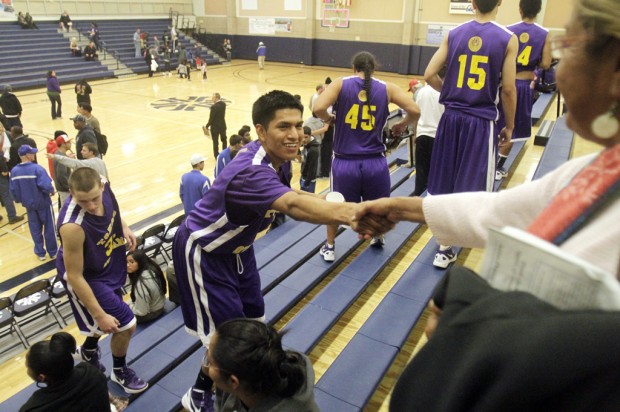
And why after every game, out of respect, the team walks into the crowd to thank its fans before running into the locker room.
"People talk to you and see you out and about," Jose said. "The community has given us great support."
Pima's gym was three-quarters filled with TOCC fans Wednesday.
They saw the Jegos struggle with a some basics. Vargas' scouting report identified Pima's best shooter, but the Jegos left him wide open to start the game. He made two three-pointers.
The team had trouble hearing defensive calls made from the bench and did a poor job passing the ball to Juan in the first half.
The team is already at a disadvantage.
Five players, Vargas guessed, were the best players on their high school teams. Only two had ever played by college rules - with a deeper three-point arc and a shot clock - before this year.
That's no excuse.
"We're not a cute story," Vargas said. "Dammit, we're a college basketball team.
"If you want to be in the best, you've got to get in the ring with the best.
"I guess it goes back to me getting sober: You've got to dream, and you've got to dream big.
"These kids need this."
The Jegos, who host an exhibition at Baboquivari tonight at 7:30, know they'll get a playoff shot.
NJCAA rules stipulate each member gets a chance to make the national tournament. The Jegos, therefore, are owed a play-in game as the No. 5 seed in the ACCAC tournament.
Win three straight then, and the Jegos would become one of the most unlikely stories in American sports.
If not, though, the first season won't be a failure.
A gym full of fans Wednesday night would attest to that.
"If you froze time and went to halfcourt and looked around, Tohono O'odham Nation won," Vargas said. "We had the fans there, the children there.
"And 20 student-athletes."

