

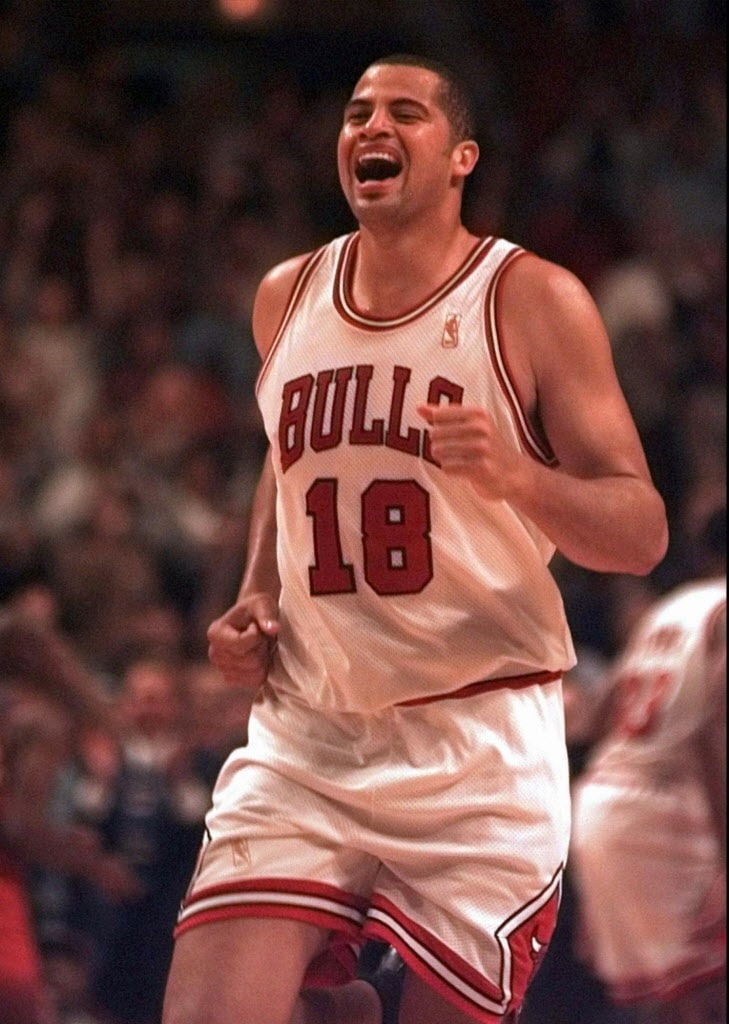
Brian Williams was quite a story.
If his life were made into movie — and there’s plenty of material to do that — it might be called “The Curious Case of Bison Dele,” or “Brian Williams’ Series of Unfortunate Events.”
He played his Arizona career as Brian Williams, changing his name to Dele at the tail end of his professional career to honor his Native American and African heritage.
As talented as any big man to ever play for Lute Olson, Williams was on the Gilbert Arenas spectrum in terms of personality.
Teammates nicknamed him “The Terminator.”
He played the saxophone, violin and trumpet and got a pilot’s license, and after retiring from basketball, he often traveled to Lebanon, the Mediterranean and the Australian Outback. He eventually purchased a catamaran to sail the South Pacific.
Early in his NBA career, he dealt with blackouts due to a heart ailment, and was once arrested for possession of marijuana.
Dele tragically lost his life at sea, on his catamaran, killed by his twin brother. Miles Dabord then proceeded to assume his name and purchase more than $150,000 in gold.
As a basketball player, though, his talent was never in question. And coming out of Arizona, he was a top-10 pick.
Here’s a look back at Bison Dele’s path to the NBA draft:
At Arizona: Brian Williams quickly showed his talent in his first year of college basketball — it just wasn’t spent at Arizona.
The Santa Monica (Calif.) High School product started his college career at Maryland, where he averaged 12.6 points and 6.0 rebounds per game as a freshman.
After the season, Williams announced his intent to transfer because of “philosophical differences” with coach Bob Wade.
He picked Arizona over offers from UCLA, Duke and Loyola Marymount.
After sitting out one year to meet transfer rules, Williams started right away as a sophomore, although it was a year mired in criticism due to inconsistent effort.
Before the season, ESPN analyst Dick Vitale picked Williams as an All-American. That didn’t quite pan out — he averaged 10.6 points per game with 5.7 rebounds. The NCAA tournament showed him both at his best — he scored 28 points against South Florida in the first round — and at his worst: Williams played 14 minutes and did not score against Alabama in the second round.
“He gets the bad rap because he’s so talented, but he played so inconsistently,” UA forward Matt Muehlebach told the Star in 1990. “There were all kinds of rumors about whether he was part of the team. But it wasn’t all his fault. The blame has to go to everyone.”
The next season, Williams got his act together and thrived. He was an All-Pac-10 selection and honorable mention All-American after getting 14.0 points per game, 7.8 rebounds and shooting 61.9 percent from the field. The Wildcats made the Sweet 16 that season before losing to Seton Hall.
The draft: As a 6-foot-10-inch big man with athleticism and tantalizing talent, it didn’t come as too much of a shock when Williams left one year early for the NBA draft.
“I know a lot of people in Tucson are sad, especially those who looked forward to seeing me play next year,” Williams said, “but I’m comfortable with my decision because I believe I am major league. I’m ready to move on.”
Williams was projected as a lottery pick, with some people projecting him as high as No. 6 overall to the Dallas Mavericks or No. 7 to the Minnesota Timberwolves.
On draft day, he fell past Dallas and Minnesota before being picked up by the Orlando Magic at No. 10
From the archives: “It’s a good feeling. I’m going to make Orlando proud. In a few years they’re going to look back at this draft and say what a success it was.” — Williams to the Star
As a pro: Williams’ pro career got off to a rocky start. He held out until the regular season had already started, demanding more money than the Magic were offering; at one point, he even requested a trade.
He made his debut with the Magic eight games into the season and finished his rookie season averaging 9.1 points per game.
Williams’ second year was cut short because of injuries and other issues, and he played just 21 games on a team that included rookie Shaquille O’Neal and a young Steve Kerr.
Orlando soon traded Williams to the Denver Nuggets for Anthony Cook, another former Wildcat. Williams played there for two years before being traded again to the Los Angeles Clippers.
His lone season in Los Angeles was the best of his career, as he tallied career-highs with 15.8 points, 7.6 rebounds and 1.9 assists per game. He signed with the Chicago Bulls in the offseason and was part of a team that won the 1997 NBA championship.
Finally, he signed a $40 million contract with the Detroit Pistons, where he spent his final two seasons. Williams changed his name to Bison Dele before abruptly retiring with $36.45 million left on his deal.

