

Sean Kenny wasn’t planning to leave Iowa.
Kenny and his wife, Marissa, liked Iowa City. Their families are both from the Midwest. The Hawkeyes’ pitching staff thrived under Kenny’s direction last season.
“Iowa was the place that we were going to stay,” Kenny said. “We had some other opportunities when Iowa came up and chose Iowa for a reason.”
But when Arizona calls, you have to listen. And when Trip Couch recruits you, it’s hard to say no.
Kenny and Couch go way back. They were recruiting rivals in the SEC, at Georgia and South Carolina, respectively.
This time, Couch was trying to persuade Kenny to join him in Tucson. The Wildcats had lost pitching coach John DeRouin to the New York Mets. The season was starting in about two months.
Arizona wasn’t a difficult place to sell.

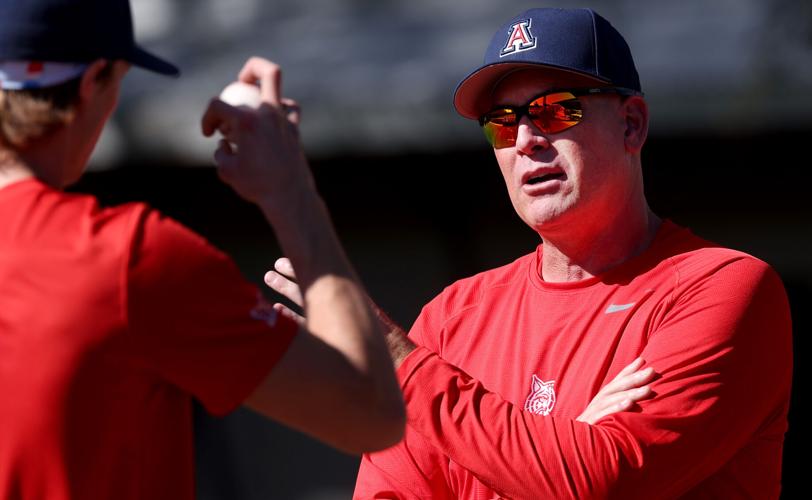
New pitching coach Sean Kenny, right, works with Owen Kramkowski in the Hi Corbett Field bullpen as Arizona players start their afternoon workout, Feb. 3, 2026, in Tucson.
“It's tradition, it's a chance to win at a really high level, it's talent,” Kenny said. “Once you sit down, take a deep breath and think about it, it's really not a tough decision.”
Kenny took the job, officially becoming a Wildcat on Dec. 22. He stepped into a good situation — a team coming off a College World Series berth that returns its top two starting pitchers in Owen Kramkowski and Smith Bailey. (Kenny also had hoped to have the services of All-American closer Tony Pluta, but Pluta will miss the season because of an elbow injury.)
Kenny hasn’t instituted sweeping changes. If anything, he has just tried to fit in.
“I'm sure there'll be some small philosophical things, but I would just like to maintain the momentum that they have,” Kenny said. “I joke, but I don't: My main job is not to screw it up.”
UA coach Chip Hale is confident that Kenny will not only not screw it up but will elevate the staff’s performance.
“I was excited,” Hale said. “Especially Smith and Owen, I feel like their stuff is complete; it's big-league stuff. But maybe the stuff out there (on the field) needed to get refined — the holding of runners, just the intricacies of being a pitcher at the next level. He can give them that.”
Kenny, 53, will begin his 30th season as a college assistant when Arizona faces Stanford on Friday in the College Baseball Series in Surprise. He spoke about his coaching philosophy and journey in an exclusive interview with the Star. The conversation has been lightly edited.
You’ve moved around quite a bit the last few years. Is this a place where you’d like to plant roots and stick around for a while?
A: “The last few years have been transient, and that's not really who I have been before that. It was six years at Georgia, it was five years at Michigan, it was six at Pepperdine and five at San Diego. The last (few years) is probably a little more of an outlier situation. I think if it was up to my wife, this would be the last move ever.”

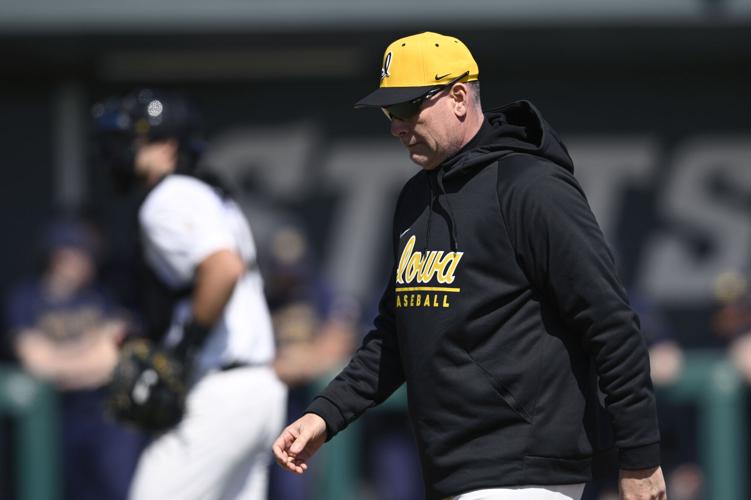
Iowa pitching coach Sean Kenny, right, walks back to the dugout after visiting the mound against Notre Dame, Feb. 21, 2025, in DeLand, Fla.
What are the most important things to you as a pitching coach?
A: “Culture for one, and that's really healthy here. It's noticeable. Routine, preparedness, those things are already there. I'm used to having to talk to them about developing healthy routines and consistent routines, and learning how to prepare. When I say that to (Arizona’s pitchers), they kind of look at me like, ‘Yeah, we know.’
“The best players I've ever coached are just absolute animals to their day-to-day routine and staying with it; nothing changes that. I've been really happy with this group because that's the sense I get from them already.”
What is your philosophy in terms of having set starters go a certain number of innings or using your closer exclusively in the ninth?
A: “We like consistency in the rotation. Last year, what made us so good, we had the same three starters in the same order. Our Sunday starter missed one start, and then he was right back in there. We knew exactly what we were going to get Friday, Saturday, Sunday, and that's our goal here.
“The closer ... that's a really good question. When I first started, it was like, ‘Your closer is pitching the ninth.’ I just don't think in college baseball that's the case anymore. You have to pick and choose when the pocket is that could affect the game the most. Maybe you don't use your closer in the sixth, but I absolutely think there are situations where you use him in the seventh or eighth if that's going to determine the game.
“Perfect world, you have two other guys that bridge it to the closer. But I'd hate to lose a game by holding out your best guy.”
Owen Kramkowski and Smith Bailey are set as the top two starters. Where do things stand beyond those two?
A: “I think any route we go is a healthy route. Part of it, too, is who of that group is a little more adaptable to the bullpen — who's more comfortable maybe piggybacking that starter.
“Anytime you think about freshman starters, which would be (Jack) Lafflam, can he go wire to wire physically, mentally? He very well may be able to do that. So all that stuff factors in.”
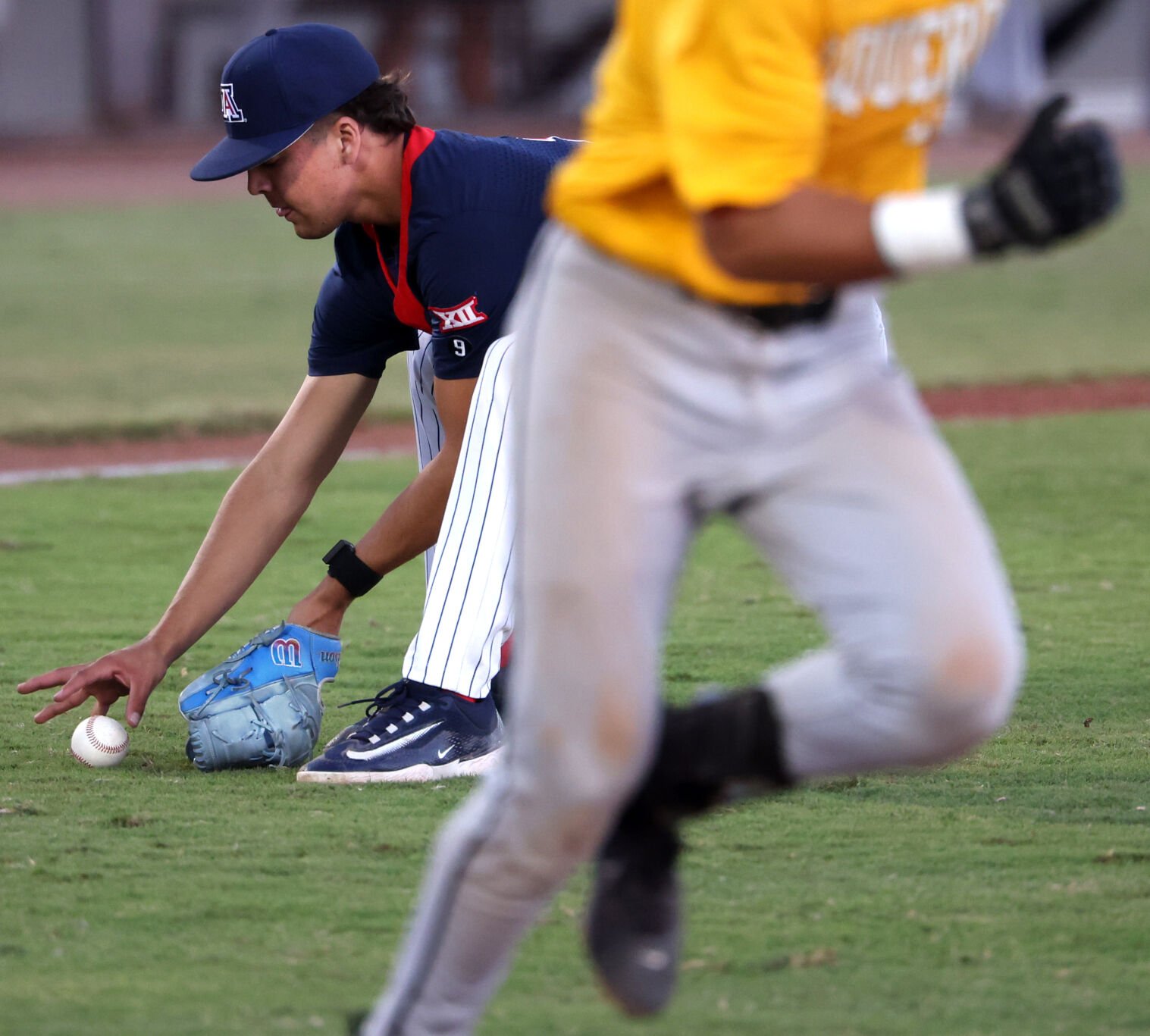
Arizona pitcher Benton Hickman (11) scoops up a sacrifice bunt by Central Arizona's Cannon Albright in the eighth inning of a fall exhibition game, Oct. 25, 2025, at Hi Corbett Field.
What are your overall thoughts on the staff so far?
A: “It's why I wanted to come here, honestly. Because of that — the talent and the experience.
“I feel like depth, maybe, is our strength, if you start going through the numbers. And we're excited about one of our freshmen, Benton Hickman, who is, in my opinion, probably our future closer. We have some mix-and-match ability in that bullpen, where if one guy has a bad day, I don't think that's going to be the end of the world.”
Arizona has a pitching lab. Your predecessors were advocates of using data and technology. So is Chip. When you were interviewing, was that a non-negotiable?
A: “This is my 30th year of coaching baseball. What's really been fun for me in the last 10 years or so is that the game's completely changed, and I love it. I love the use of the tech. I love what it does to the players’ confidence. I love what it does for the coach-player interaction. They didn't have to sell me. I knew about it. It's what I wanted. I wanted to be part of that.

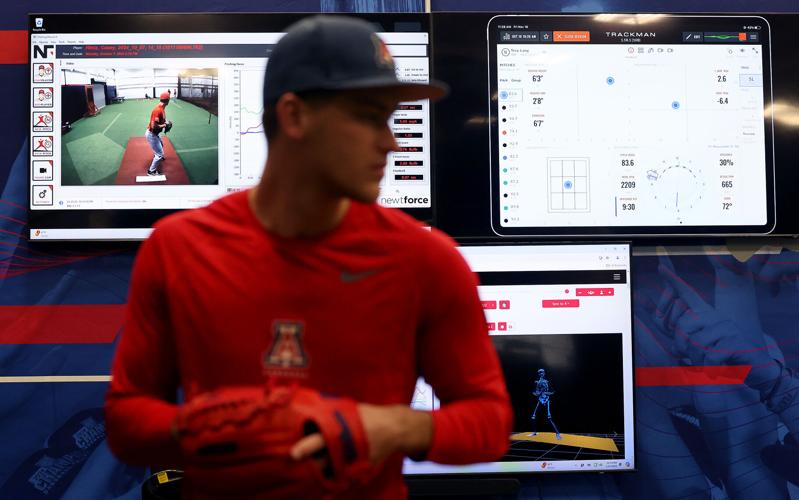
Right-hander Casey Hintz stands on the NewtForce mound to demonstrate the technology used to help pitchers improve their craft in the new Arizona Baseball Pitching Wing in the back of the Terry Francona Hitting Center at Hi Corbett Field.
“I'm going back to school now, trying to get a little more proficient in the higher-end tech — KinaTrax, the NewtForce mound. The players love it, they need it and it's what separates this program. That was the other thing I assured our players: We will not change our philosophy and how we coach and develop — the lab will be a huge part of it.”
You pitched for three years in the Mets organization. Why did you decide to hang 'em up? And why did coaching appeal to you?
A: “They hung 'em up for me. I got released in '96. I could have maybe knocked around the independent leagues a little bit, but went back to school.
“I was just looking for something to not go into the real world right away. I thought I'd coach high school, something. But just like everything in life, right place, right time, met the right people.
“I got a job at the University of San Diego because there was no money. If there was money, they would have hired somebody older. So it's just weird how things work out. And now I've done it so long, I have no other skills, so I don't have a choice.”
Who was your biggest mentor as a young coach?
A: “Rich Hill, who is now at the University of Hawaii, he was at the University of San Diego. Probably the greatest thing that he ever did for me was to not tell me how to do it. ‘Hey, you're going to be the recruiting coordinator, the pitching coach, the travel guy, the equipment guy, go get 'em.’
“He did it on purpose, and I learned how to recruit, and that's the job. I've always said the day that I don't want to recruit anymore, I'll retire.”
Arizona is primarily a recruit-and-develop program. Does that jibe with your beliefs?
A: “Every place I've been has had that same philosophy. When we were out the door at the University of Georgia, you could feel it changing where that was going to be about who has the most money. But before then, in every other place, everybody that I've worked for ... we're going to make our players better, whatever that may be. And I think we will even do that in the portal. We're gonna find a fit and then make them better.”
You majored in literature in college. What were you planning to do with that degree?
A: “I thought I was going to teach and coach in high school. Eastern Michigan has one of the best education schools in the country. Plus, the truth of the matter is, I was not very good at math — but I could write a paper about anything. There's no right or wrong answers. You just gotta sell it. There was some strategy with that for sure.”

