

KANSAS CITY, Mo. — When he was just 36 years old in 2007, Tony Bennett took over his father's Washington State program and, during his first season, led the Cougars to their first NCAA Tournament appearance in 13 years.
At age 49, Bennett won an NCAA title with Virginia.
At age 55, earlier this month, he called it quits.
“The game and college athletics is not in a healthy spot,” Bennett said at his retirement press conference on Oct. 18. “There needs to be change.”
Bennett's career ascent and relatively young age for a head coach made the move even more surprising than that of Jay Wright, who retired as Villanova’s head coach at age 60 in 2022, as NIL was beginning to turbocharge the transfer portal, and especially more of a shock than the retirements of legends Roy Williams (North Carolina, 2021) and Mike Krzyzewski (Duke, 2022).

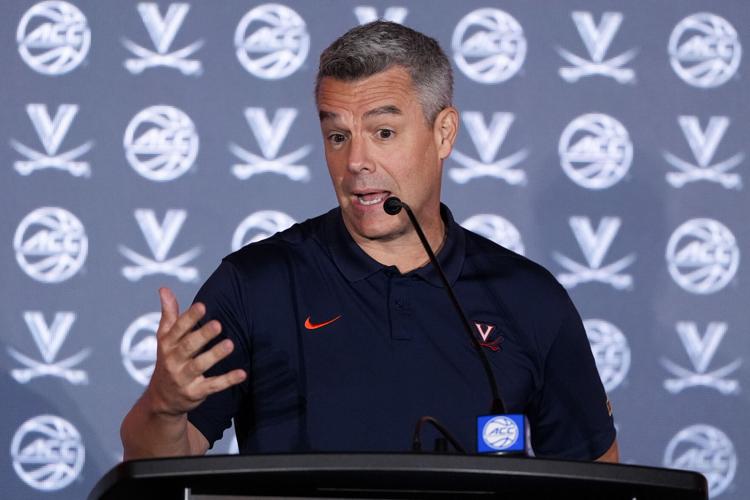
Virginia head coach Tony Bennett speaks during the ACC's Men's Basketball Media Day event on Oct. 10 in Charlotte, N.C., Eight days later, Bennett stepped down from his post atop the Cavalier program, retiring effective immediately.
Bennett's move was also surprising in that he had just signed an extension with Virginia in June.
That’s why, even though Bennett spent his head coaching career solely in the Pac-10 and ACC, his name surfaced just as much during the Big 12 Conference's Men's Basketball Media Day interviews Wednesday as ones such as Kansas' Bill Self, Houston's Kelvin Sampson, Baylor's Scott Drew and even Arizona's Tommy Lloyd.
While Lloyd commended Bennett on deciding to leave if he didn’t feel he could give his team what it needed, the UA coach and his new peers around the Big 12 addressed the off-court issues that have significantly changed today’s game almost as often as they spoke of their challenges ahead on the court.

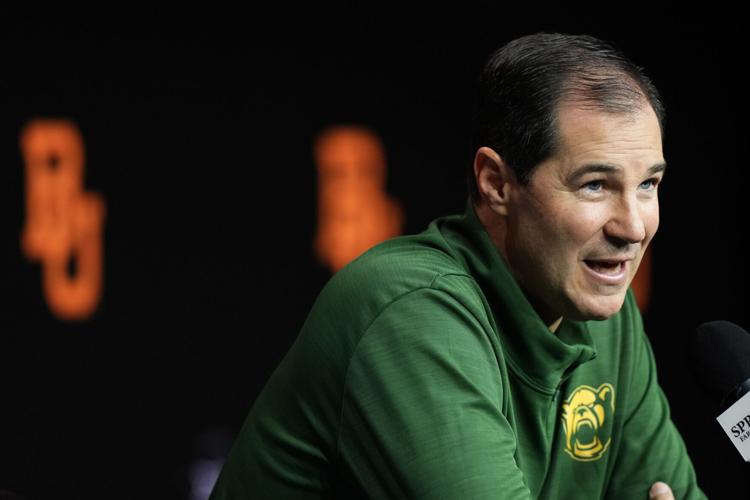
Baylor head coach Scott Drew addresses the media Wednesday at the Big 12 Men’s Basketball Media Day event in Kansas City, Missouri.
“In any profession, there's always going to be change, and we just had an enormous amount in the last couple of years,” said Drew when asked about Bennett’s sudden departure. "Human nature is we all prefer more certainty than uncertainty. You want to know what the rules are, what to do, and how to do your job.
“It's probably going to take a little time ’til everything does settle, and you hate losing good coaches in the process.”
The blurry college basketball landscape today includes a transfer portal that spins faster every spring, now allowing players to transfer annually without penalty, and a loosely regulated NIL structure in which collectives around major programs are doling out an average of over $3 million to pay a high-major college basketball team, according to math presented by NIL technology firm Opendorse.
All those forces also work together to create leverage that results in players receiving 1.7 times more money on average if they transfer for an upcoming season than if they return to their current school, according to Opendorse’s 2024 NIL report.

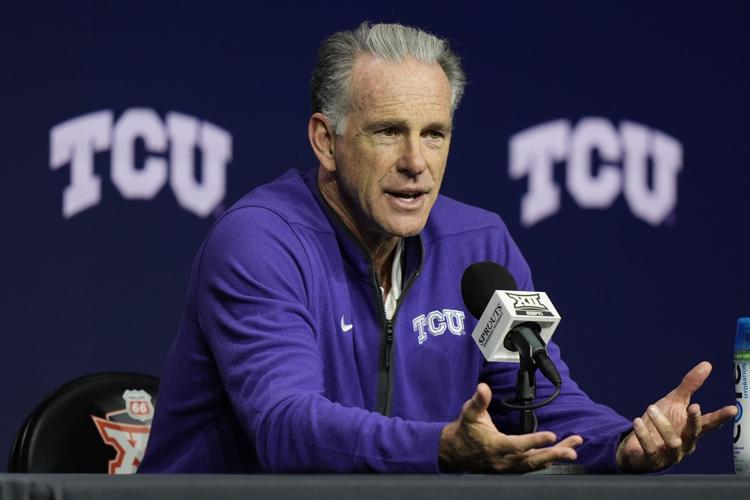
TCU head coach Jamie Dixon addresses the media Wednesday at the Big 12 Men’s Basketball Media Day event in Kansas City, Missouri.
“We're in a whole different world where (recruits) can like you a whole lot, but they're going to look at what the best opportunity is,” said TCU’s Jamie Dixon, while discussing his roster.
Today, recruits are often represented by agents, not just parents, handlers or club-ball coaches. They’ll sign NIL agreements with a collective as well as scholarship papers with a school.
College coaches, meanwhile, are stuck in the awkward, sometimes desperate, spot of needing to help their collectives raise money but not allowed to officially be part of them.
“Ten years ago, coaches were never GMs, fundraisers, negotiators with agents,” Drew said. “You've had a lot more put on your plate, and at the end of the day, that can add to a Tony Bennett or somebody stepping away if it is too taxing.”
There’s more to come, too. A landmark court case opened the door in May for a revenue-sharing agreement in which schools of major programs could directly pay athletes over $20 million a year starting as early as next season.
There's no obligation to do so, but Arizona and other power-conference schools likely won't have much choice if they want to stay competitive in recruiting.

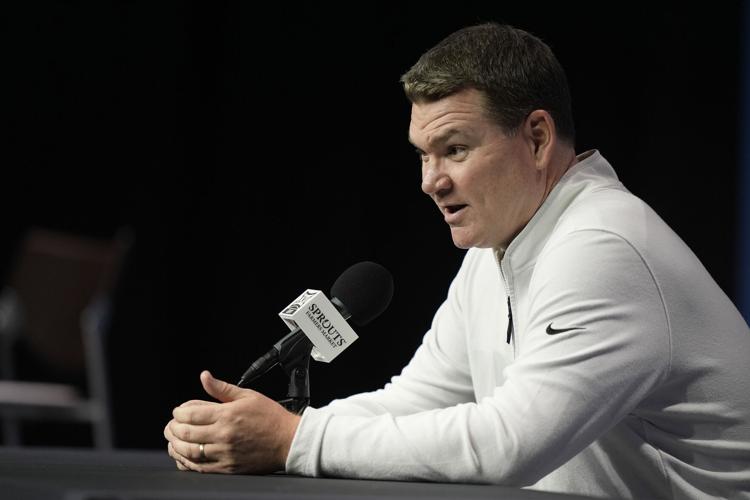
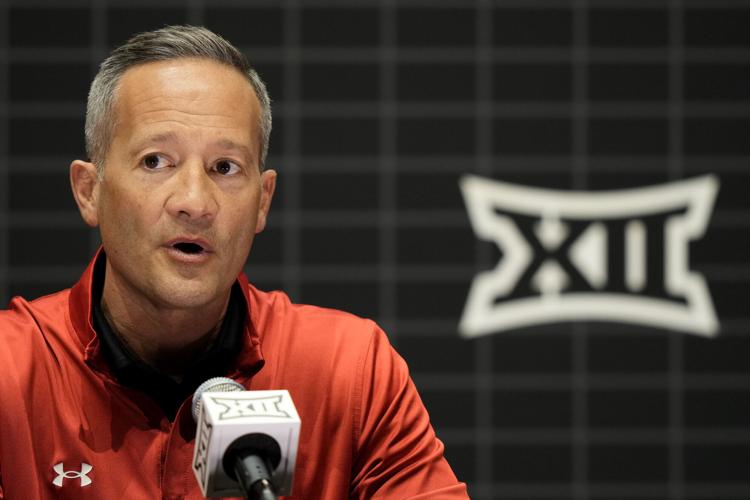
Texas Tech coach Grant McCasland speaks to the media at the Big 12 Men’s Basketball Media Day event in Kansas City, Missouri.
For "places that are serious about competing at the highest level, it's just the baseline,” Texas Tech coach Grant McCasland said. “There's no other way to approach this if you want to be successful.”
What’s more, even for those schools that can afford to hit the max every year, other legal challenges and Title IX considerations could make it difficult to decide exactly how everything gets divided up.
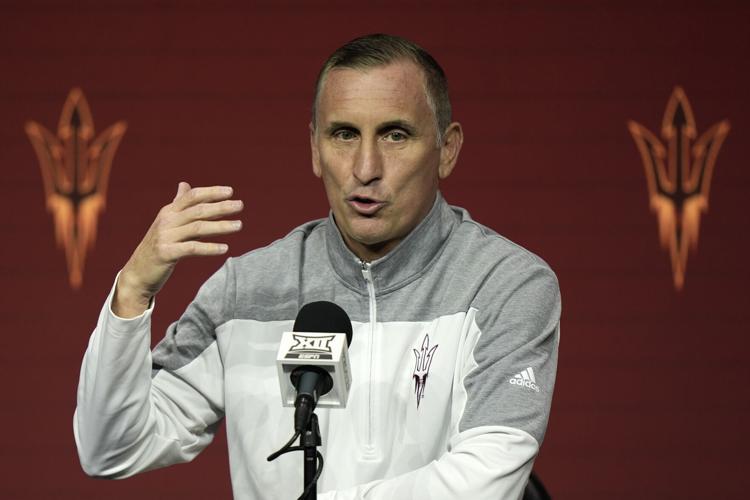
“I think we're still in a little bit of a gray area," ASU coach Bobby Hurley said. "I've educated myself a little bit on the settlement, but I'm not 100% sure what it’s going to look like."

Arizona State head coach Bobby Hurley addresses the media Wednesday at the Big 12 Men’s Basketball Media Day event in Kansas City, Missouri.
In college sports media-rights deals, about 80% of revenues are typically attributed to football, and McCasland said that formula is a “starting point” to determine how a school-provided revenue share should be divided. He said revenue share would likely be tied to what a program brings in on Texas Tech's campus.
“I think that it's going to be pretty practical in that regard,” McCasland said. “That's kind of where we're leaning at times, but I do think it's changing, and no one knows.”
UA women's basketball coach Adia Barnes, speaking at the Big 12's Women's Basketball Media Day the day before the men's gathering, said she's heard from other power-conference schools that one likely possibility is giving football players 75% of the revenue-sharing pot, with 15% going to men's basketball, 5% to women's basketball and 5% to all other sports collectively.
But there's also the chance that top-level football programs break off into even smaller elite conferences — or maybe from the NCAA entirely — creating even more possibilities.

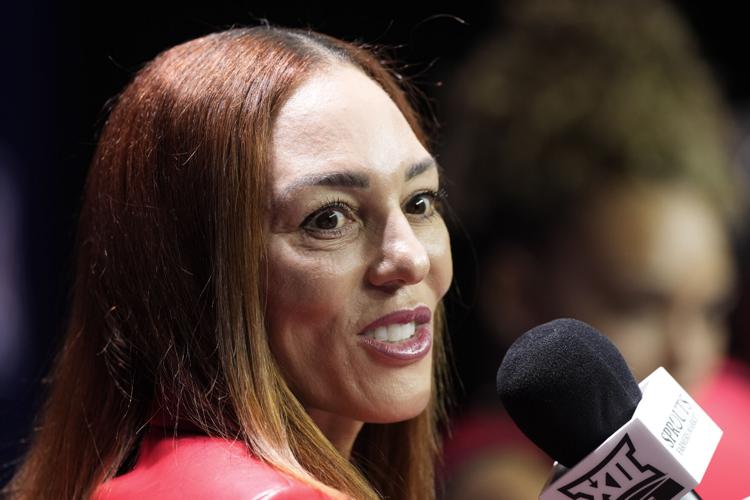
Arizona head coach Adia Barnes addresses the media Tuesday at the Big 12 Women's Basketball Media Day event in Kansas City, Missouri.
"I think in the next three to five years, our game is gonna change completely," Barnes said. "There's going to be so much stuff around this revenue sharing. Schools have so much pressure to raise 20 to 25 million."
When Lloyd was asked what sort of revenue-sharing number he needed for the UA men's basketball program, he said he would wait until whatever is finalized instead of projecting ahead about what might happen.
“I’m a little more pragmatic about it,” Lloyd said.
That wasn’t too different than how Lloyd routinely responds to the hypothetical or events that are too far ahead. He responded to one question about the Wildcats' Big 12 challenges ahead by speaking of Monday's exhibition game with Division II Point Loma and a Nov. 15 date at Wisconsin.
"Guys, I'm simple," Lloyd said. "What's now? What's next? That's literally what I'm focused on."
Lloyd, who worked with McCasland on the USA Basketball U18 staff last summer, indicated that there’s so much uncertainty off the court in the game that it’s almost pointless to obsess about it.

Arizona head coach Tommy Lloyd addresses assembled media Wednesday at the Big 12 Men’s Basketball Media Day event in Kansas City.
“I think you could let that dominate your bandwidth,” Lloyd said. “You're just looking for everything to change, sitting around and wanting to complain. That's not how I’m wired. I'm like, `You tell me how the game's gonna be played, and we're gonna figure out a way to play that game.’
“Because this is what I know: I love coaching and teaching basketball. I have the opportunity of a lifetime at the University of Arizona, and I'm not going to let some outside distractions or changes in the game knock me off my path. So that's how I've approached it.”
Like many schools, UA has hired a “general manager” of sorts in new president of basketball operations Matt King, helping take pressure off Lloyd. In addition to his other business-side duties, King is expected to oversee any future revenue-sharing from UA to its players.
At the same time, discussions about all the changes are unavoidable to some extent. Lloyd acknowledged having conversations within the UA athletic department about revenue sharing possibilities and, of course, coaches talk shop between themselves.
Those change quickly, too. Questions from coaches to other coaches have evolved past "how big is your collective?" and into "what is your rev-share number gonna be?" or any number of other ever-changing issues.
“The conversations aren't even in the same ballpark than with what we were doing five years ago,” McCasland said. “I think the relevant part of this is what we're experiencing in change. You can just see it's wearing on people. If you have a relationship with someone, you actually get to that before you get to the answers. Because I don't think there are a lot of answers that we're actually directly involved in."
But there is one coach who just made sure he doesn't have to worry about it, or talk to anyone about it, anymore.
“We're playing Virginia in the Bahamas,” Drew said, referring to a possible second-day matchup Baylor could face with Bennett's old team in the Baha Mar Championship. “He'll be on the beach, though. That'll be the difference.”

