


Starkville, Miss. — Arizona football storylines for the Wildcats' road opener at Mississippi State: The "ear-splitting ringing" cowbells of Davis Wade Stadium, Jayden de Laura's running since last season, the "turnover sword," gambling and more.
1. QB Jayden de Laura more balanced in second go-round
When the Arizona Wildcats face Mississippi State on Saturday, UA junior quarterback Jayden de Laura will strive to take a different approach against the Bulldogs.
For starters, three of de Laura's Pac-12-worst 13 interceptions a year ago were against the Bulldogs defense in Arizona's 39-17 loss to MSU in Tucson. Current Mississippi State head coach Zach Arnett, then the Bulldogs' defensive coordinator, deployed blitzing linebackers and safeties and forced de Laura to make quick decisions in the pocket.

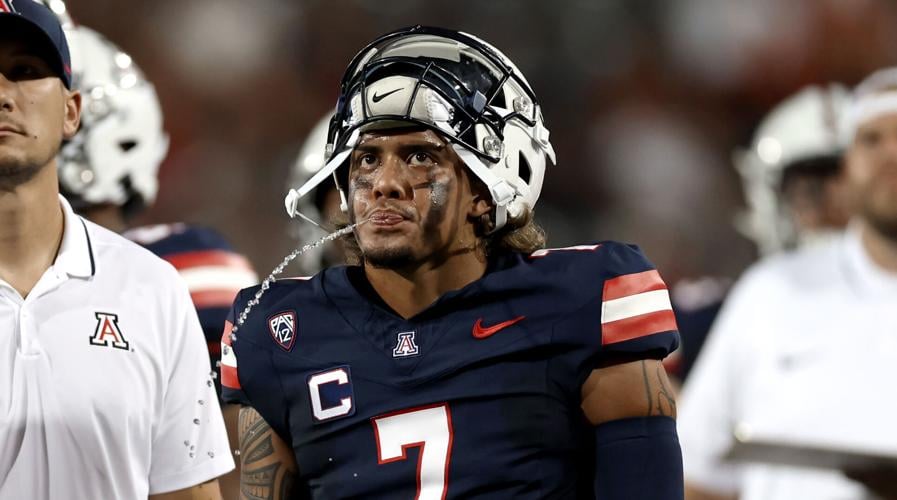
Arizona quarterback Jayden de Laura watches the replay on the scoreboard, waiting for the final decision on Jonah Coleman’s touchdown run in the second quarter of UA’s season-opening win on Sept. 2, 2023, against NAU.
De Laura, who finished that night with a 54.8 overall grade by Pro Football Focus, was reluctant to run and was sacked twice for minus-25 rushing yards. Mississippi State dared de Laura to run and potentially extend drives, but the Arizona quarterback didn't budge from his pocket-only attack.

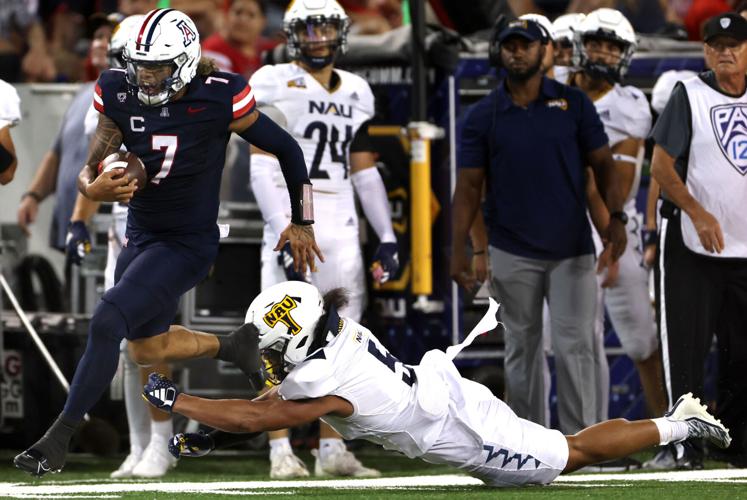
Arizona quarterback Jayden de Laura skips out of the reach of Northern Arizona linebacker Heston Lameta on his way to the end zone for a 53-yard touchdown run last weekend.
Arizona head coach Jedd Fisch said at the time de Laura's failure to use his legs "is something we talked about." The following week? De Laura had 10 carries for a then career-high 50 yards.
"He's always learning, always growing," said Arizona offensive coordinator Brennan Carroll. "I think he saw that and then a couple games following that he ran the ball a little bit more."
Carroll added de Laura has "never been against" running, "he was classically trained to stay in the pocket and throw the ball."
"It's an element to his game that he definitely has, and we're excited about it," he said.
In Arizona's season-opening victory over Northern Arizona, de Laura evaded one missed tackle and peeled off down the Lumberjacks' sideline for a 53-yard touchdown.
"That was a great run. I thought he was flying," Fisch said. "I didn't know he had that in him."
De Laura — whose favorite NFL team is the Philadelphia Eagles for his fandom of Michael Vick, one of the NFL's top dual-threat quarterbacks of all time — credited his improvement in getting "faster, strong and more confident in my running" to strength and conditioning coach Tyler Owens.
"I don't know if he was as fast as he is now," Fisch said. "I don't know if he had that same burst as he does now.
"We always talk about how good of a job our strength staff does, and I think that's another indication. Not only did Jayden get bigger, stronger, faster, he got all three," Fisch added.
Although "he's been coached to stay in the pocket as much as he can, as long as he can," Arizona senior wide receiver Jacob Cowing, de Laura's top target, said, "one of the main things I've seen (him) improve on" is improvising and running when needed.
"When he needs to scramble, he knows when to scramble," Cowing said. "When he needs to stay in the pocket a tad bit longer, he can stay in the pocket and deliver a good pass and then just continue to move the ball."
2. Running backs 'open up the passing game a lot more'
While de Laura has improved as a runner, his running backs are improving pass-catchers.

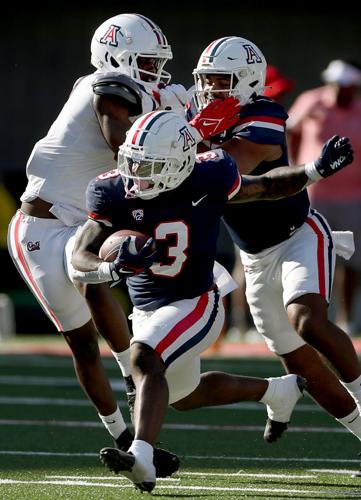
UA running back Jonah Coleman finds a seam to get upfield on a carry late in the Arizona football program’s spring game at Arizona Stadium on April 15.
Arizona senior running back Michael Wiley, who is 99 yards shy of 1,000 career receiving yards, led the Wildcats with six catches for 57 yards against NAU, while sophomore running back Jonah Coleman was second with three catches for 59 yards and a touchdown. Coleman (90.5) and Wiley (87.6) had the top two PFF grades in the pass game.
"When you've got running backs that can catch out of the backfield, that opens up the passing game a lot more for us receivers," Cowing said. "They can't really point out one guy or double-team one guy.
"We've got running backs that can catch out of the backfield and do something with it."
The Wiley-Coleman tandem dazzled in Arizona's opening offensive possession and gained the Wildcats 57 yards in five plays, including a 37-yard catch by Coleman to set up Cowing's 4-yard touchdown catch. Coleman's 37-yarder beat his season total (24) as a freshman.
"You can see the development from Year 1 to Year 2. He looks faster, stronger, quicker," Carroll said of Coleman. "He could always catch the ball really well, so it was nothing that we didn't expect, but it was great seeing it live. It wasn't a surprise to us he could do all that. He's been showing us that all camp and we're excited for it."
Cowing said Coleman has "gotten into his playbook a lot more."
"He understands the offense and understands what his role his, he knows what the scheme is," Cowing said. "At this point, he can go out there and relax a little bit and just play his game."
De Laura said he's "very confident" in running backs' pass-catching abilities.
"Our running backs can really do a lot of things and I trust them. I trust them to make plays and play football," de Laura said.
3. Wildcats educated on ramifications of gambling
When Iowa and Iowa State kick off on Saturday, the Cyclones and Hawkeyes will both be without multiple players due to their involvement in mobile sports gambling.
Following an investigation into Iowa State's program, ISU quarterback Hunter Dekkers and four other players connected to both schools were found gambling underage. Dekkers allegedly placed 366 wagers worth nearly $2,800, including 297 bets — 26 on Iowa State sporting events — before he turned 21 years old. Dekkers pleaded guilty to underage gambling on Wednesday and will pay a $645 fine.

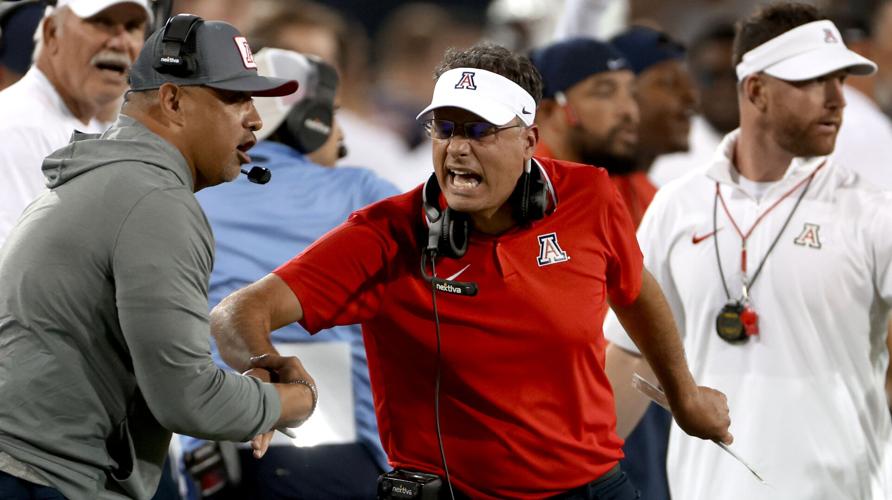
Arizona head coach Jedd Fisch tries to get his sideline under control during the first quarter against of the Wildcats’ 38-3 win over Northern Arizona last week at Arizona Stadium.
Fisch called Iowa and Iowa State's gambling scandal "a strange situation," but it's a teachable example for the Wildcats football program.
"But I will tell you that we've constantly reminded our players that you just can't gamble," Fisch said. "Just don't try to figure out a way to do it. 'What if it's UFC fighting? Or what if it's blackjack?' or whatever — how about you just don't do it? Don't do it. If you don't do it, you have a great chance of not getting in trouble for doing it."
During the offseason, Fisch said the Wildcats brought in speakers, a former FBI agent "regarding gambling to talk about how it gets monitored and how aware you must be," along with UA chief security officer Steve Patterson and general managers of NFL teams "to talk about how it works in the league."
"We have made a clear-cut decision that we must educate our players," Fisch said.
When Arizona defensive tackle Bill Norton was asked about the lesson he learned from the guest speakers about gambling as a college athlete, the message was clear.
"Don't do it," he said. "Stay as far away from that as possible and you're going to have nothing to worry about."
De Laura said "it's not (tempting)" to gamble, because "it's not something we can do."
He added: "Sometimes I'll look at the TV and go, 'Wow, someone won a lot of money on this game.' But I know we can't do it, so I'm not going down that street."
Former Arizona wide receiver and Tucson native Stanley Berryhill III is suspended for the first six games of the NFL season for online gambling at the Detroit Lions team facility. Berryhill attended one of Arizona's training camp practices last month and talked to the players about his suspension and lessons learned.
"He opened up to me and he talked about his situation," de Laura said of Berryhill. "He talked about how he would've went through certain situations differently now that he's gone through what he's gone through."
4. Turnover sword back for another season
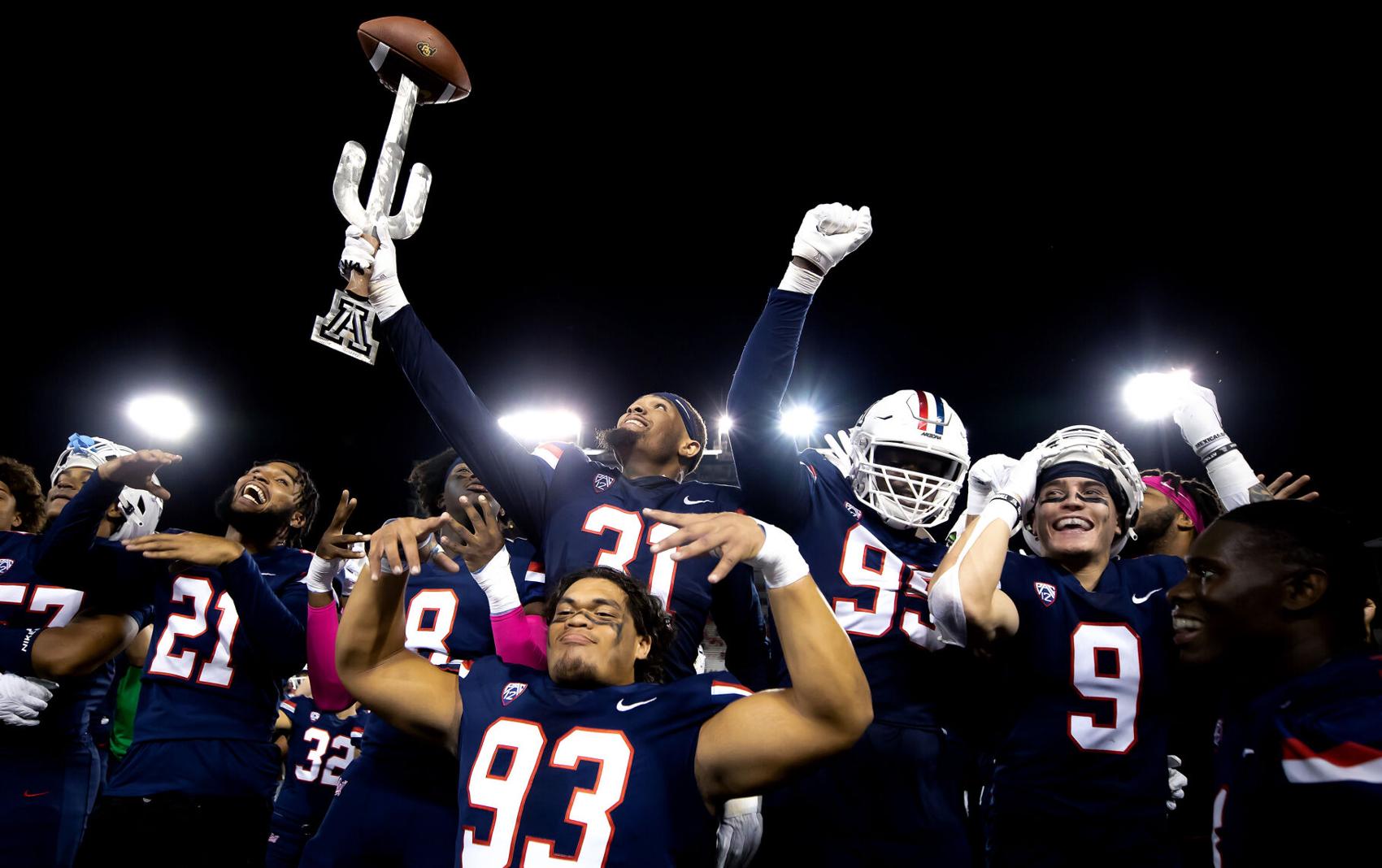
Hunter Echols, a senior on last year’s UA team, holds up Arizona’s turnover sword after causing a Colorado fumble during the Wildcats’ 43-20 win over the Buffaloes on Oct. 1, 2022.
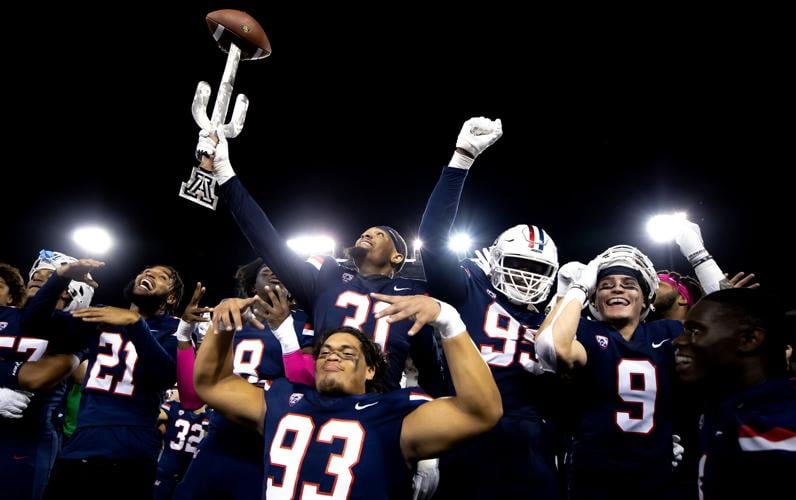
In celebration of turnovers, Arizona unsheathed the "turnover sword," a saguaro cactus-shaped metal sword, last season. It's Arizona's version of the recent turnover celebration trend that uses props, similar to UNLV's turnover slot machine, Oregon State's chainsaw, Miami's turnover chain or Pittsburgh's turnover basketball hoop.
Whether it's a fumble or interception, whoever has the football following a takeaway runs to the Arizona sideline to use the turnover sword to stab the football and hoist it towards the crowd. Against Mississippi State in Tucson last season, the Wildcats had three takeaways — two fumbles and one interception.
"The kids love it, and then all of a sudden (during) the Mississippi State game, everybody started talking about it because we were stabbing balls. I wasn't even paying attention, I was worried about calling the defense. And then I see one the (MSU) student assistants running across (the field) and then one of our managers tackled them on the sideline," UA defensive coordinator Johnny Nansen said. I'm like, 'What the heck is going on?' They're like, 'You guys are stabbing the ball.' 'I don't know what's going on,' so... I like it."

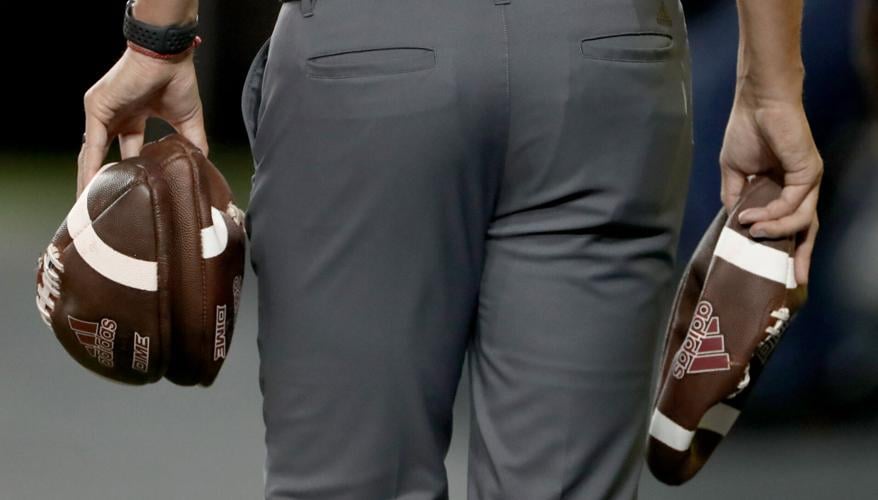
A Mississippi State staffer heads back to the his bench after retrieving the three game balls punctured by the Arizona Wildcats’ turnover sword in celebration of three turnovers during last year’s matchup in Tucson.
Last week against Northern Arizona, UA safety Dalton Johnson recorded the Wildcats' first forced fumble of the season, with middle linebacker Daniel Heimuli recovering the loose ball.
5. More (or less) cowbell
Some of the confounding noises from the Dick Tomey Practice Fields on the UA campus this week were in preparation for the thousands of cowbell sounds the Wildcats will endure at Davis Wade Stadium on Saturday.
Mississippi State fans are renowned for rattling their cowbells at MSU football games, but there's an exception — also known as the "cowbell compromise," according to Mississippi Sports Talk host Brian Hadad.
Fans are only allowed to wave the cowbells up until the point the center puts his hand on the ball.
"You will hear a noticeable change from that ear-splitting ringing noise to just cheering," Hadad said. "But when those bells are ringing, it's something that's unique in college football. You can't replicate that sound. You can't get it anywhere else. It's really loud."

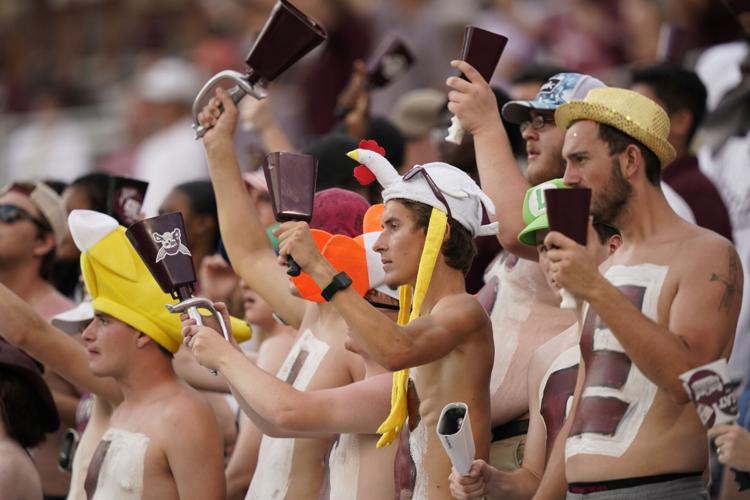
Mississippi State students ring their cowbells as they cheer on their team during the second half of a game against Louisiana Tech in Starkville, Mississippi on Sept. 4, 2021.
Although the Wildcats piped in cowbell sounds over their loudspeakers during team periods in practice, "it's very difficult to replicate that sound," Hadad said.
"It's just so difficult to replicate what 30,000-40,000 cowbells — on top of 50,000 fans — sounds like," he said.
Fisch said the Wildcats "have to be alert for" the cowbell effects on Saturday.
"The cowbells aren't allowed to be ringing when you're in formation. They're allowed to be ringing while you're in the huddle or when you're in between plays," Fisch said. "When you're going through the cadence, there's no cowbells. I know they're very disciplined on that because it's a penalty. But other than that, I know they're going to be loud.
"I know it's something we need to be aware of," he added. "We're going to look forward to the energy that an SEC game brings."

