

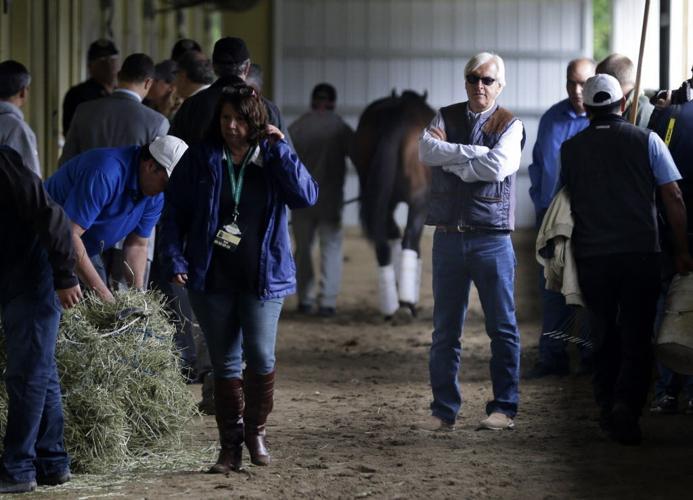
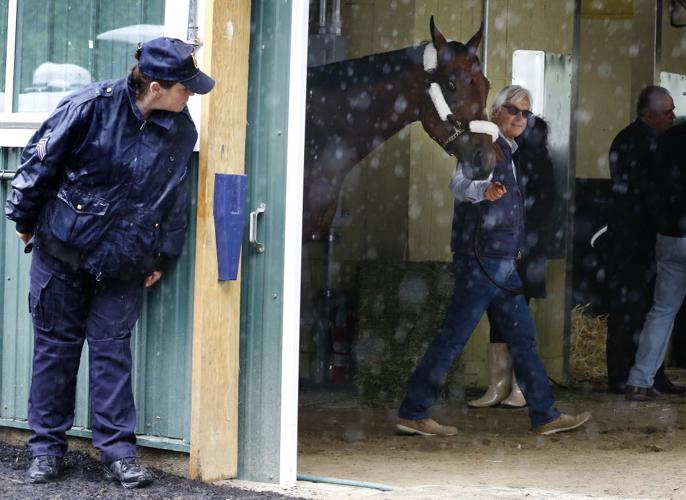

Bill Baffert answered his cellphone in Tuscany, which isn’t a fancy way to misspell Tucson. He’s in Italy, on vacation, and had just exchanged text messages with his well-known brother, Bob.
Usually, when you see Bob Baffert at the horse track, you see Bill Baffert. They stand together at Churchill Downs, singing “My Old Kentucky Home.” On each of the three occasions Bob’s thoroughbreds have lined up to win the Triple Crown, Bill has been at his side.
And each time, Silver Charm, Real Quiet and War Emblem lost the Belmont Stakes.
History beckons again, but on Saturday the Baffert brothers won’t be together for the first time in forever.
“I’m bad luck,” Bill Baffert, a Tucson real estate executive, was saying Wednesday morning. “I’m the big stopper. All of our brothers and sisters, all of the family will be at the Belmont, but I’ll be watching on my iPad at 12:30 in the morning in Italy. Maybe that’s the secret.”
The Baffert brothers laugh a lot. If you read Bob’s 1999 book “Dirt Road to the Derby,” you wonder if the sons of William G. and Elinora Baffert long ago exceeded the legal limit for fun.
“For a long time, writers would ask Bob what he majored in at Arizona. He would say ‘Campus Wildlife,’” says Mac McBride, director of media at the splendiferous Del Mar Thoroughbred Club near San Diego. “They would write it down and report it.”
That’s the image of Bob Baffert. If he is not the most entertaining interview in sports, who is?
When I went to the 2010 Kentucky Derby, standing outside Lookin At Lucky’s stable, Bob told me a story about selling chickens in Nogales.
“My dad had 20,000 chickens and put me in charge of the operation,” he said, the twinkle in his eye covered by his ever-present sunglasses. “I would sell 25 cases of eggs a day, at $10 a case. I’d gather the eggs, deliver them and sell them wholesale to people around Nogales. On weekends, I’d take the profit, drive to Tucson to buy the latest bell-bottom pants. I was the best-dressed guy at Nogales High School.”
I looked at Bill, standing nearby.
Is that true?
“Every word,” he said.
Before he became world famous, Bob Baffert was a jockey, a schoolteacher in Nogales, and for a while worked the 9-to-5 shift for the old Walco veterinary supply store in Tucson. He won races in Sonoita, Globe, Prescott, Flagstaff and at Rillito Downs.
He has never discouraged the Fun R’ Us image. In his book, he writes frankly about drugs and drinking, even the “art” of discarding empty beer cans, but when you get to the brink of sports history as the world’s premier thoroughbred trainer, the funny stuff is no longer the story.
“Bob is a very, very sharp horseman,” says McBride. “He plays the good-old-boy card, but there’s so much more.”
Baffert was among the first to establish a walkie-talkie system with his jockeys and exercise riders. He was among the first to get all the pertinent information, much like a baseball statistics analyst. He is one of the few prominent trainers who is bilingual, speaking fluent Spanish in a sport dominated at the lower levels by Hispanic grooms, jockeys and exercise riders.
“Nothing gets lost in translation with Bob,” says McBride. “He controls everything directly. He’s got this Svengali thing going with everybody: owners and people in his barn. I tell you what, no one underestimates him.”
Baffert became a media celebrity 20 years ago and didn’t discourage that angle. Now he’s 62, father of five and survivor of a near-fatal heart attack. His mother and father died in Nogales over the last five years, and who knows if this is his last chance at a Triple Crown?
“This is a very serious business and a super-consuming job,” his brother says. “Everybody’s gunning for him and it’s awesome the way he stands up to it. He told me in a text today that his cellphone never stops buzzing.”
Bob Baffert’s once-brown hair started to turn white before he was 25. It was about that time he made an impact training Love N Money and Kellys Coffer, two of the most successful horses in Tucson history, working for Rulon Goodman, who operated a string of modest Lucky grocery stores in Southern Arizona.
Now Baffert trains American Pharoah for an Egyptian owner who has sold the horse’s post-race stud rights for $20 million. At any time, he has 150 very expensive thoroughbreds under his command.
“Bob’s a seven-day-a-week guy, it never stops,” Bill Baffert says. “I’d tell him he should take two weeks off and come to Italy with me, but that’s not him. He’s not going to come to Italy. He’s got something more important to do.”

