

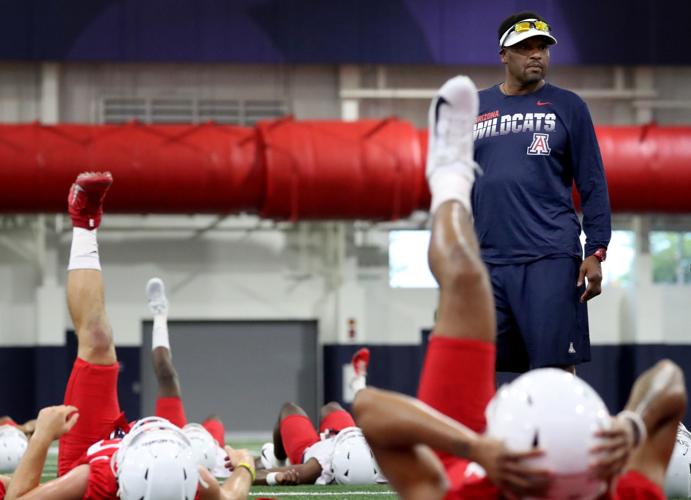

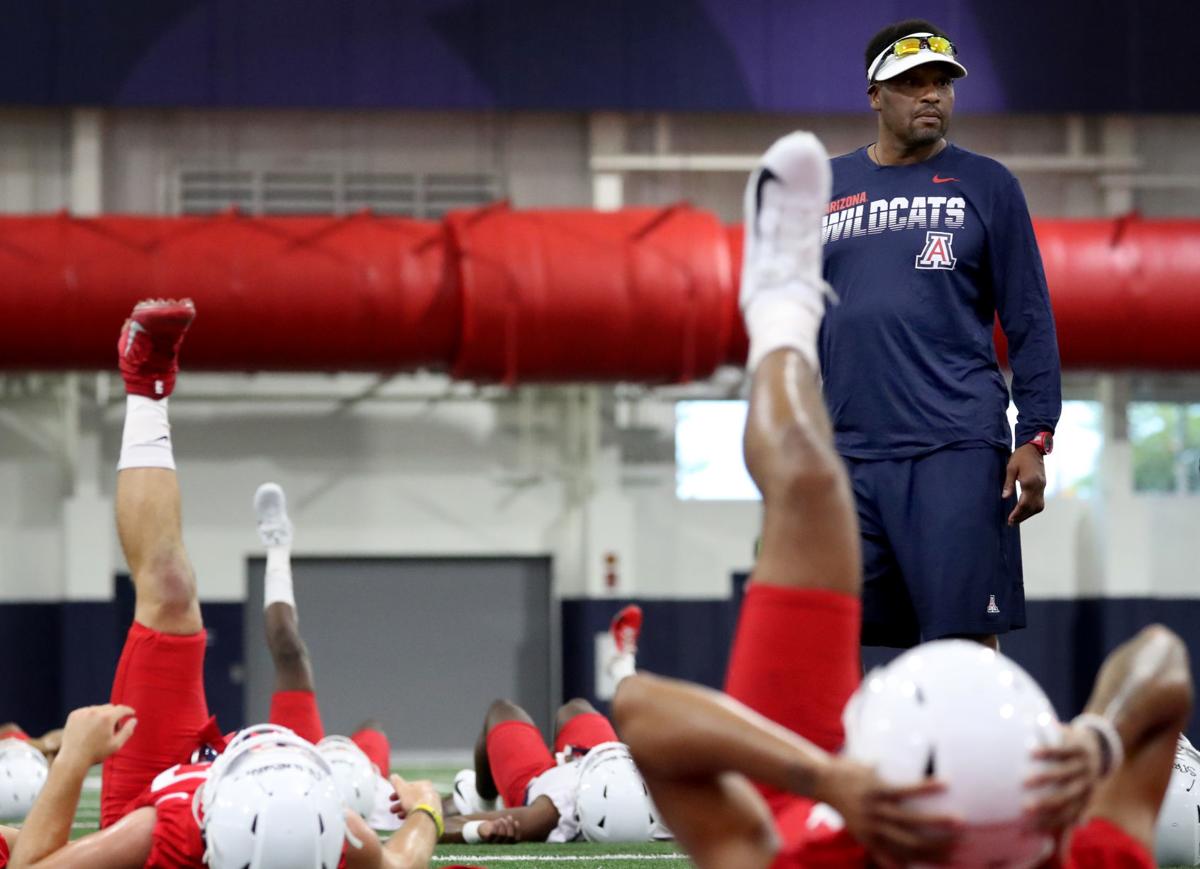
Kevin Sumlin is the football coach at Arizona for three reasons.
1. His 2011 Houston Cougars led the nation in scoring, at 49.3 points per game.
2. His 2012 Texas A&M Aggies were No. 4 in scoring, at 44.5 points per game.
3. His 2013 Aggies were No. 5 in scoring, at 44.2 points per game.
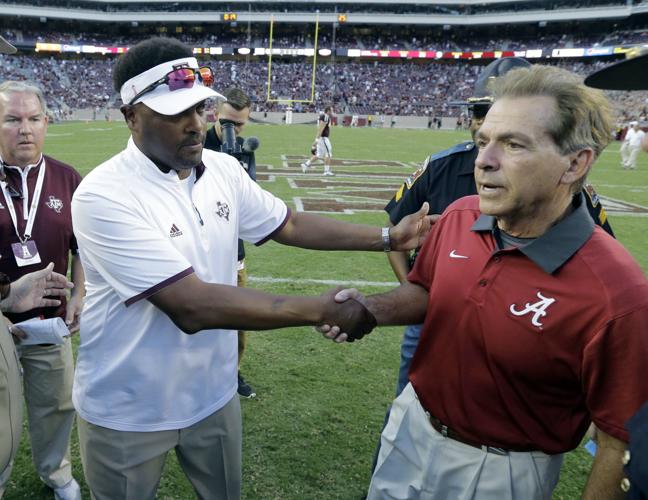
Forget that Sumlin’s final four A&M teams couldn’t keep that pace, never finishing higher than 28th in the nation in scoring. Forget that Texas A&M fired him in 2017 because he couldn’t beat LSU and Alabama. I mean, who can?
For three years, 2011-13, Sumlin was a game-changer, the SEC’s version of Oregon’s Chip Kelly, an innovator who spread out opposing defenses like few coaches in college football history.

Kevin Sumlin came to Arizona from Texas A&M, where his first two teams finished in the top five nationally in scoring. The rest of his teams were unable to keep pace among the SEC superpowers.
A reputation like that lasts forever in college football, and for a middle-of-the-pack school like Arizona, the chance to reboot its long-suffering football operation with a man of Sumlin’s background was irresistible.
Sumlin delivered immediately.
In 2018, Arizona led the Pac-12 in total offense — 457 yards per game — for only the third time in 40 years.
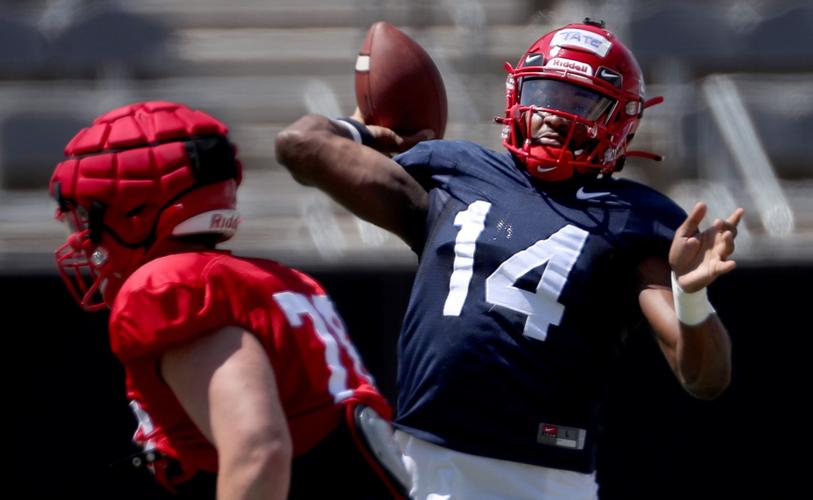
Sumlin’s offense — let’s call it Open Spaces — was so effective that the Wildcats forced defenses to make 88 solo tackles, No. 1 in all of Power 5 conference football. And that happened even though quarterback Khalil Tate struggled from start to finish, undisciplined at times, injured at times, a man unable to rediscover the magic of October 2017, when he was the best quarterback in college football.
Here’s my prediction for the 2019 season: Arizona will again lead the Pac-12 in total offense. It may average 500 yards per game because I am buying the training camp rhetoric from Sumlin, offensive coordinator Noel Mazzone and Tate that 2018 was a freakish, break-in season and that all is well and harmony reigns at Open Spaces U.
Unless Tate gets hurt and can’t perform with full physical ability, I believe Arizona will produce an unprecedented 500/7,000 season — 500 yards per game and 7,000 yards for the season. Arizona averaged 31.3 points last season; that total could grow to 40.
Perspective: Sumlin’s mighty 11-2 A&M juggernaut of 2012 averaged 558 yards and gained 7,264 yards. It averaged 44.5 points per game. True, Heisman Trophy winner Johnny Manziel was A&M’s quarterback, but isn’t a healthy and, we believe, more mature Khalil Tate in the same category?
Even Pro Football Focus, the kingpin of statistics and analytics in college football, ranks Tate as the nation’s No. 10 overall quarterback entering this season, reviving chatter that the Tate of 2019 could become what the Tate of ’18 was expected to be.
The other variables of Arizona’s offense appear capable of fulfilling my 500-yards-per game, 7,000-yards-in-a-season, 40-points per game projections. Sumlin’s offensive line has three starters returning and perhaps seven useful players in the rotation; 1,000-yard running back J.J. Taylor and his wingman, Gary Brightwell, are skilled, feared, Pac-12 athletes, and a group of mostly under-the-radar receivers are at least as capable as last year’s group.
Arizona is due, too. Way, way, way past due, to have a breakout season, produce its first-ever All-Pac-12 quarterback and become relevant.
The football gods can’t be cruel enough to let a once-in-a-lifetime talent like Khalil Tate complete his Arizona eligibility without A Season To Remember. Can they?

Khalil Tate threw for 2,530 yards last season despite suffering an injury in nonconference play that took months to fully heal. His quarterback rating of 149.8 was only marginally worse than the 152.4 he posted in 2017.
There is just one catch in this sunny forecast: defense.
Over 40 years, Arizona led the Pac-12 in total offense in 1999, 2017 and 2018. Those seasons produced a cumulative 18-19 record. The ’99 season is looked upon as the most disappointing in school history; Arizona opened the season ranked No. 4 in the AP poll but went 6-6. UA football has never recovered. And Rich Rodriguez was fired after the 2017 season.
Last year Arizona went 5-7, collapsed and lost the Territorial Cup and, well, let’s just say Arizona’s ability to lead the Pac-12 in total offense has not been accompanied by Rose Bowl invitations.
The one proven formula for Arizona football success has been defense.
Arizona’s four best defensive football seasons of the Pac-12 era — the 9-3 team of 1986, a 10-2 finish in 1993, an 8-4 season in 1994 and the historic 12-1 finish of 1998 — had one thing in common: the Wildcats led the league in defensive stars.
Those four teams had an unthinkable 12 first-team All-Pac-10 defensive selections, from Chuck Cecil and Byron Evans to Tedy Bruschi and Sean Harris to Marcus Bell and Chris McAlister.
Arizona has led the Pac-12 in rushing defense six times and has a cumulative record of 50-19-2 in those seasons, from 1983-1998. Those 16 years, defense-first, were the greatest in school history.
If it was all about offense, I would not hesitate to pick Arizona to win the Pac-12 South this season. But in this league, as most in college football, defense rules.
The Wildcats will be a tough out. They could be the Washington State of 2019. But those late-season road games at USC, Stanford, Oregon and ASU might be enough to keep Tate and Sumlin from writing a new script on how to win a Pac-12 championship.

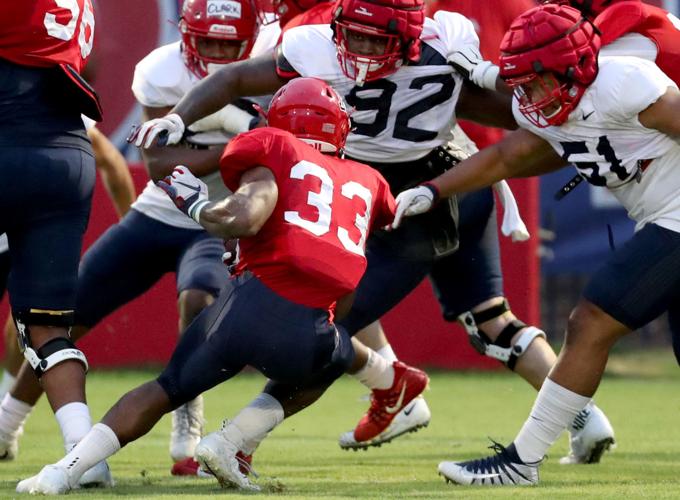
University of Arizona linebacker Derrion Clark, left, lineman Kyon Barrs and STUD Lee Anderson III clog the hole and stymie running back Nathan Tilford’s run up the middle during the third week of practice for the upcoming season, Tucson, Ariz., August 6, 2019.

