

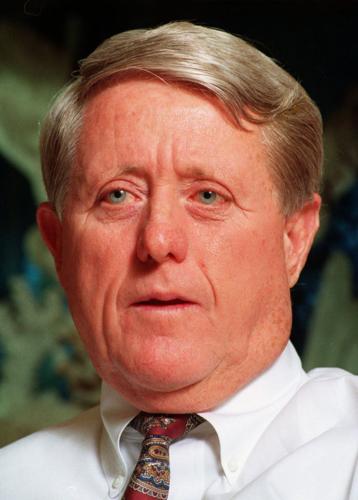


May 4, 1996: Tucson attorney Burt Kinerk’s horse races in the Kentucky Derby
If Burt Kinerk ever writes a book, the title is a lock: “How I Went Fishing in Argentina and Wound Up in the Kentucky Derby.”
Chapter 1: In 1988, Kinerk was on a plane when he dreamed up an idea to buy a world-class thoroughbred for a monumentally discounted price. He didn’t have a sheet of paper to work the figures, so he worked the math on an airsick bag.
A top Argentine thoroughbred could be acquired for about $20,000. Even at 1980s prices, a Kentucky-bred yearling cost as much as $400,000.
No one would be getting sick.
So Kinerk, a 1953 Tucson High School grad and former UA baseball player, phoned a veterinarian, an Arizona grad who worked the horse racing circuit at Arlington Park near Chicago and at Florida’s Gulf Stream Park.
They booked flights to Argentina and took their fly-fishing gear. But the real purpose of the trip was to examine race horses.
“I don’t remember if we caught any fish, but I bought Festin for $18,000,” Kinerk said last week. “It was the break of a lifetime.”
By 1991, Festin finished sixth in the Breeders’ Cup Classic at Churchill Down and would win more than $2.3 million. Five years later, Festin’s son, Corker, was in the Kentucky Derby.
When Kinerk reached the owner’s box at Churchill Downs on the first Saturday in May, 1996, he was presented a jacket for the occasion. His name was spelled wrong. But by then it didn’t matter. His journey from Tucson’s Rillito Race Track and the horse racing circuit in Sonoita and Arizona’s other county fair tracks had taken him to the Kentucky Derby.
Corker finished 11th, but, in retrospect, who cares?
It was Kinerk’s willingness to ignore the “snob appeal” of American racing and establish his own bloodline, via Argentina, that made it work.
“Kentucky is the gold standard,” he said. “To get a good offspring, you need a good mare, and you have to get the seal of approval. In other words, you have to marry her into the right family.”
He found that family in Argentina.
Kinerk, who grew up near the UA campus where his father operated a dry cleaning shop, became one of the leading figures in more than a century of Tucson sports. He was a founding father of the Copper Bowl football game held at Arizona Stadium from 1989-99 and is a life member of the Conquistadores, helping to operate more than 30 PGA Tour events at the Tucson Open.
Kinerk was the agent and negotiator for a Who’s Who of Tucson sports history: NBA All-star Sean Elliott, Olympic bronze medal sprinter Michael Bates, Olympic gold medal swimmer Crissy Perham, and UA football legends Chuck Cecil, Byron Evans and Tedy Bruschi, among others.
Here’s how connected he is: At the 2010 Kentucky Derby, when UA grad Bob Baffert’s horse, Lookin At Lucky, was considered the favorite, it was virtually impossible to get an interview with Baffert.
I was standing outside Lookin at Lucky’s stables about 6:30 one morning as the sun broke over Churchill Downs. It was Friday, a day before the big race. The main interview sessions had been conducted days earlier. I waited and waited and waited.
Nothing.
About 9:30, Kinerk walked to the barn.
“Are you waiting for Bob?” he asked.
I nodded.
“Let me get him,” he said.
In about 90 seconds I was able to interview the biggest name in horse racing.
Where are they now? As Corker began his road to the ’96 Derby, Kinerk’s reputation spread. He was joined, as full partners, by Bob McNair, now the owner of the NFL Houston Texans, and by Arthur Hancock, who has been one of the most influential men in the horse breeding/racing business for 30 years.
At 80, Kinerk hasn’t slowed much, if at all. He still works regular hours at his River Road law firm, flies to Alaska in the summer to fish with Bruschi and eagerly prepares for October’s elk hunting season.
How he did it: Kinerk’s investigative work in Argentina was remarkable. Festin came from impeccable bloodlines. His father was Mat Boy, a horse that debuted in Florida in 1984 and ran away with a series of top-grade races, including the Gulfstream Park Handicap. He developed some tendon problems, however, and was returned to Argentina to help produce a family of thoroughbreds.
Festin won the first race he ever entered in Argentina in 1988. Then he finished second in a race considered to be the second jewel in Argentina’s triple crown. After that, Kinerk brought Festin to Sonoita, where he was stabled at Art Pollard’s Breeding Ranch.
After that, it was comparatively easy.

