

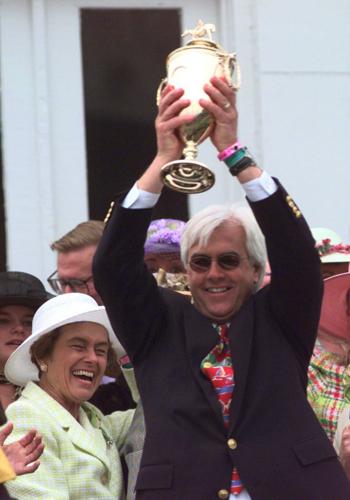

May 3, 1997: Horse trainer Bob Baffert wins his first Kentucky Derby
In the late 1970s and early 1980s, when few in Tucson knew Bob Baffert from Bob Lewis, their lives took a path that would merge side by side in the winner’s circle at the 1997 Kentucky Derby.
They didn’t live charmed lives. They lived Silver Charmed lives.
In the winter of 1991 at California’s Santa Anita horse track, Baffert was a 38-year-old rising star in the thoroughbred training business, and Lewis was a mega-wealthy beer distributor who hoped to get involved at the highest level of horse racing.
Baffert and Lewis met at Santa Anita.
“Are you related to Melissa Baffert of Nogales?” Lewis asked the relatively unknown Baffert.
“She’s my cousin,” Baffert said.
“Well, my daughter, Nancy, became good friends with Melissa at the University of Arizona. I used to own a Porsche dealership in Tucson.”
Lewis ultimately told Baffert he would give him $2 million to buy a horse at auction.
A bit later, while studying videos of the top 2-year-old thoroughbreds in Florida, Baffert got his first look at Silver Charm. Bingo. He contacted Lewis, who, acting on Baffert’s advice, made an $85,000 payment for Silver Charm.
In 1997, Baffert, Lewis and Silver Charm broke through, winning the Kentucky Derby, launching Baffert into a career in which he has become the world’s leading thoroughbred trainer. Silver Charm went on to win $6.94 million.
“Sometimes there’s a diamond in the rough in those 2-year-old sales, and we happened to find him,” Baffert said in 1997.
A year later, the son of a Nogales rancher won his second Kentucky Derby, with Real Quiet. As with Silver Charm, a victory in the Preakness followed. Baffert became a celebrity. He was photogenic, quotable and funny. Most of the funny stories came from the stories of his childhood days in Nogales and from his eight-year grind to earn an undergrad degree at the UA.
In 1999, Baffert wrote a biography, “Dirt Road to the Derby,” which is a candid account of his party-filled days (and nights) in Nogales, the UA and of his struggling days as a quarterhorse trainer at, among other places, Tucson’s Rillito Park racetrack.
It was as much “Animal House” as a story about horse racing.
How did all this happen? How did Baffert and his greatest horse, American Pharoah, win the 2015 Triple Crown?
In “Dirt Road to the Derby,” Baffert traces his instincts for recognizing and developing talent to his days as a kid on his father’s ranch. The Baffert kids were active in 4-H Club programs: Bob grew up judging goats, cattle and horses. He took care of his horses’ teeth. He wrapped their legs, studied their personalities, rode ’em, shoe’d ’em, fed ’em.
To make extra money, he sold eggs that he gathered from the chickens on his farm.
“He gives you that loosey-goosey, let’s-find-a-party, laugh-a-minute routine,” Mac McBride, for 25 years part of the administration at Del Mar racetrack outside San Diego, told me. “But when you see him conduct his business, he is the king of detail. He has wonderful organizational skills. He runs a very tight ship.”
That’s a long way from Baffert’s profile at his first Kentucky Derby, 1996, when his horse, Cavonnier finished second by a nose.
When Baffert climbed onto a timer’s stand during the week’s final workouts, he found himself near an ESPN analyst.
“Hey,” the analyst said, pointing to Baffert. “Can you run down to the media center and find my runner, Sally, and tell her ESPN is here?”
Baffert turned to a friend, deadpan, and said, “Go find Sally and tell her Norm needs more hot towels.”
Things changed in a hurry. After winning the ’97 Kentucky Derby and Preakness, Baffert told ESPN he “felt like the Pope.”
Where are they now? Lewis, who owned a Porsche-Audi dealership on East Speedway in Tucson from 1977 to 1985, died in 2006. He was 81.
How he did it: Baffert hasn’t forgotten his Tucson connections. After winning the ’97 Kentucky Derby, he scouted claiming races in California, looking for prospects for his old Tucson buddies, Bill Belton and Forest Metz, both with strong histories as horsemen. Baffert recommended they spend $16,000 to claim Busy Little Beaver.
“We didn’t have any intention of claiming a horse that day,” Belton told me. “We didn’t even have a check with us. But Bob was persuasive. He had been watching him and had a good feeling. He said he’d front us the money, so we went ahead and claimed him.”
Busy Little Beaver won its next three races and won in excess of $90,000 in three months.

