




The Star's longtime columnist compares the Pac-12 returning to football in the fall to jumping off a cliff. Plus, a look at other pertinent headlines in Southern Arizona sports this week.
A few miles outside of my northern Utah hometown is Hyrum Dam, a water-sports mecca with a captivating yet risky element that intrigued me and my friends for years.
At the south end of Hyrum Dam is “The Thumb,” a 35-foot high cliff that became something of a right of passage for teenagers. If you had not jumped off “The Thumb” by the time you were 18, you were, to put it politely, “soft.”
There have been deaths and drownings. There have been broken legs and broken necks.
But in the summer after my senior year in high school, I joined four friends at “The Thumb.” We all tiptoed to the edge of the cliff, staring over the edge, nervous, absorbing the risk. To get to the water, one had to sprint 10 or 15 yards — a blind jump — to reach water deep enough to avoid injury.
We stood and stared for what seemed like forever; we all knew that if one of us summoned the courage to jump, we must follow. Finally, my friend Greg Thorpe said something like “I hope I don’t regret this,” backed up, sprinted 15 yards and screamed loudly as he left safe ground.
A few minutes later, four of us were in the water. None of us ever attempted the jump again.
I get the feeling that a latter-day jump off of “The Thumb” was part of the process that led the Pac-12 and Big Ten to reconsider their decision not to play football in the fall of 2020.
The desire for normalcy, compounded by impatience and the chance to alleviate financial stress and save jobs — as well as the human nature of not wanting to be left behind — overcame the inexactness and medical ambiguity of playing college football.
There is little doubt that the Pac-12 this week will announce a return to football with a six-game schedule beginning Nov. 7. Everyone in the water.
The Pac-12’s decision will walk back its early August declaration to follow safety and science and not risk the health of those on their campuses. In retrospect, it’s somewhat hard to believe that UCLA, USC, Cal and Stanford — the league’s power brokers — are now aboard the let’s-play-football train.
Stanford is Stanford. If the Cardinal plays football or not, it really doesn’t matter. It will still be Stanford, a separate and powerful institution of one.
Cal is driven by academics. It’s in Berkeley, which in a lot of ways is still in the Haight-Ashbury hippie days of the 1960s and 1970s. Football is not king. Not even close.
UCLA has a new athletic director, who has yet to be more than a commuter newbie to campus. UCLA’s president has announced his retirement. What’s more, school has not yet begun at UCLA, which operates on the quarter system.
USC has a new president and first-year AD. The areas in and around USC and UCLA has all but been paralyzed by COVID-19.
You could see California’s wait-until-spring decision coming from 100 miles away.
Others in the league — notably Utah, Colorado, Arizona, ASU, Oregon and Oregon State — believed much earlier that playing football could be safe with the rapid-results testing the league engineered a few weeks ago. The California schools balked. But there’s more to it than that.
Had Arizona, ASU and their partners chosen not to return to fall football, three things were likely to happen:
1. Each athletic director and football coach would’ve had a line of players — the “opt-outs” — at the door seeking a transfer waiver, saying something like “I want to play somewhere that football is important.”
2. The already-struggling reputation and brand of Pac-12 football would’ve taken a punch like no other. Those in the SEC, Big 12 and Big Ten would’ve raided the West’s recruiting Classes of 2021 and 2022. The Pac-12’s status as a Power 5 football conference would’ve been further diminished. Its future media rights negotiations would’ve suffered.
3. It would’ve been difficult for ADs to look their coaching staffs in the eye and tell them why they should decline an offer to coach at, say, Kansas State or Illinois, even the mid-level schools in football-centric conferences.
By returning to action Nov. 7, or perhaps Oct. 31, each Pac-12 school should be able to realize its full media rights financial package and keep most of those in the department employed.
The media rights contracts with ESPN and Fox require 45 telecasts each football season. That can yet be fulfilled. Each game on ESPN/Fox is worth close to $5 million to the league. Do the math. Jobs can be saved.
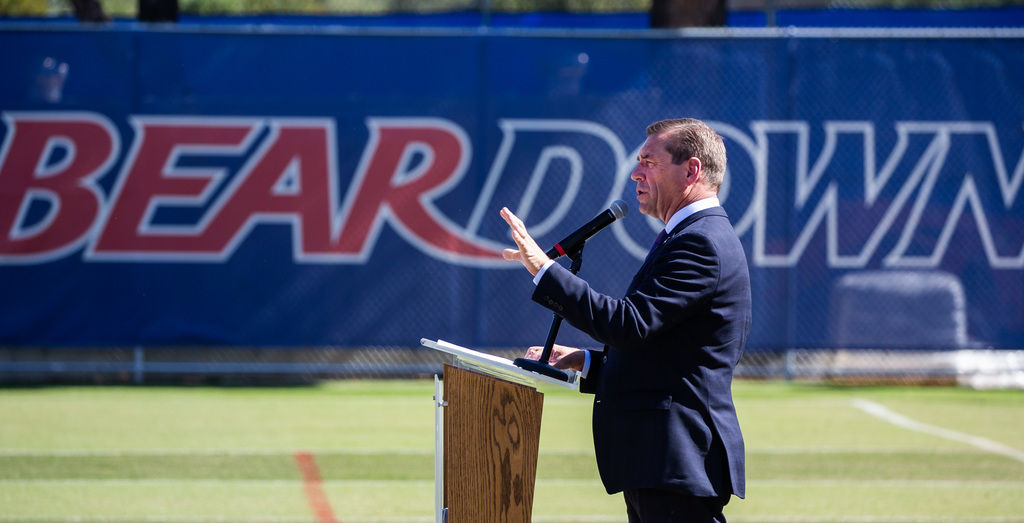
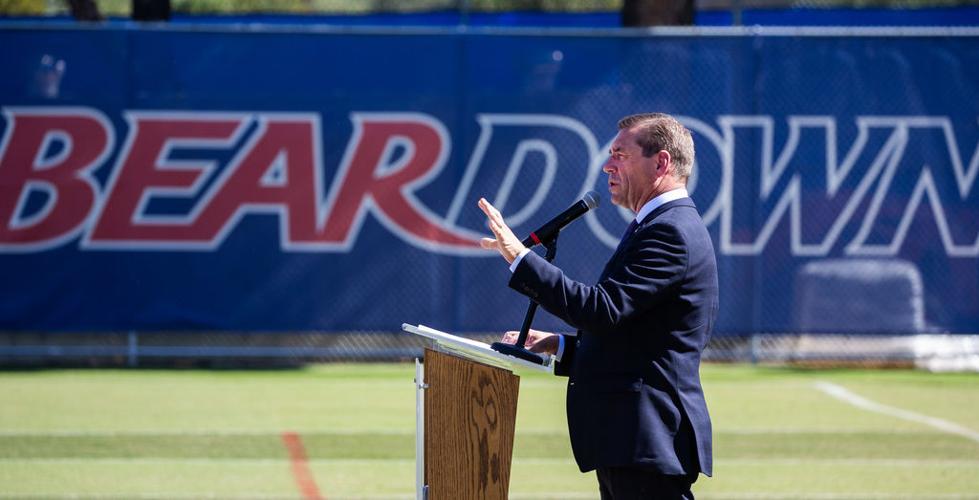
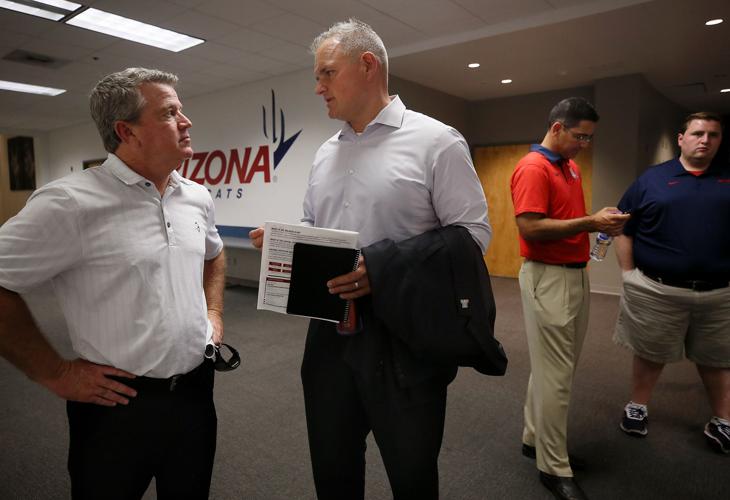
Dave Heeke, director of athletics at the University of Arizona, speaks during the dedication of Dick Tomey Football Practice Field at the University of Arizona, on Nov. 1, 2019.
Arizona athletic director Dave Heeke is not yet sure fans will be allowed at Arizona Stadium in November and December. Those decisions are fluid; plus, if only 5,000 or 8,000 fans are permitted inside the stadium, it might cost more for operational costs than what would be made by ticket sales. Travel — hotels and flights — will not only be risky, but very expensive in the environment of 2020.
As it now stands, Arizona’s football team can train about 12 hours a week. Most of it is strength and conditioning related, or “practicing against air.”
If the Pac-12 this week declares it is open for football, the UA would have about two weeks of ramp up preparation, followed by a traditional four-week training camp.
Many will be critical of the Pac-12 being the last Power 5 league to commit to football, but it had far more to overcome than its peers, with the California “issue” being foremost.
A few weeks ago, UA president Robert C. Robbins said “this isn’t a game” when speaking of on-campus students who were not observing safety protocols. College football is no longer a game, either. Five games were postponed this weekend because of health issues.
It’s not teaching a med student how to perform heart surgery, and it’s not teaching a pre-law candidate immigration laws.
Given all the risks at play, it’s going to be like jumping off a cliff.
Terry Francona, Jim Furyk set the longevity pace

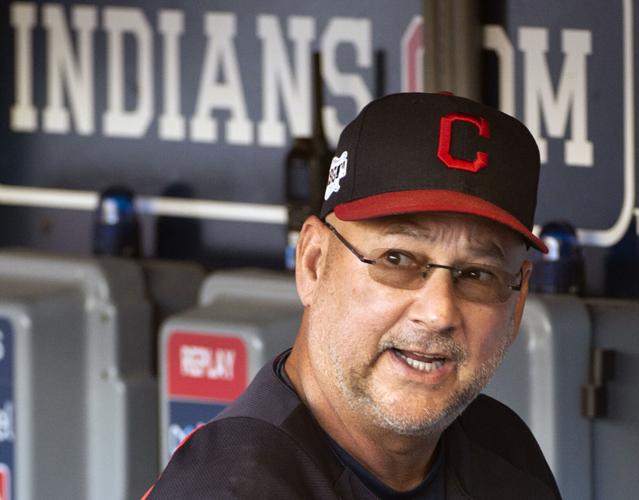
Terry Francona managed the Phillies and Red Sox, winning two World Series titles in Boston, before agreeing to take over the Indians.
Tucson’s Terry Francona, Arizona’s 1980 NCAA baseball player of the year, has missed most of the baseball season with gastrointestinal and blood-clotting issues; for the last six weeks, the Cleveland Indians manager has been replaced by assistant coach Sandy Alomar Jr.
This is Francona’s 30th year either as a major-league player or manager/coach, which is a longevity record for the approximately 300 former UA/Tucson athletes who reached MLB, the NBA, NFL or played on the PGA Tour. Next? It’s Jim Furyk, who is on his 27th year on the PGA Tour, although Furyk this weekend is missing his first U.S. Open since 1996.
Here’s the leaderboard, which should give you an idea of how difficult it is to find lifelong employment at the highest level of pro sports:
1. Francona, 30 years
2. Furyk, 27 years
3. Steve Kerr, basketball, 21 years
4. Chip Hale, baseball, 21 years
5. Ron Hassey, baseball, 20 years
6. Chuck Cecil, football, 20 years
7. Brad Mills, baseball, 20 years
8. Jason Terry, basketball, 19 years
9. Brant Boyer, football, 19 years
10. Luke Walton and Jud Buechler, basketball, 16 years
Boyer, a former UA linebacker from the “Desert Swarm” era, is working his 19th year in the NFL. He is the most unlikely of the above. He is now in his fifth year as part of the New York Giants coaching staff. He previously worked four years for the New York Jets, and played 10 NFL seasons.
Boyer played at small-school North Summit High School in northern Utah. He was a walk-on at Snow College before Dick Tomey spotted him in 1991 and signed him to play at Arizona. Boyer was the equivalent of a one-star recruit.

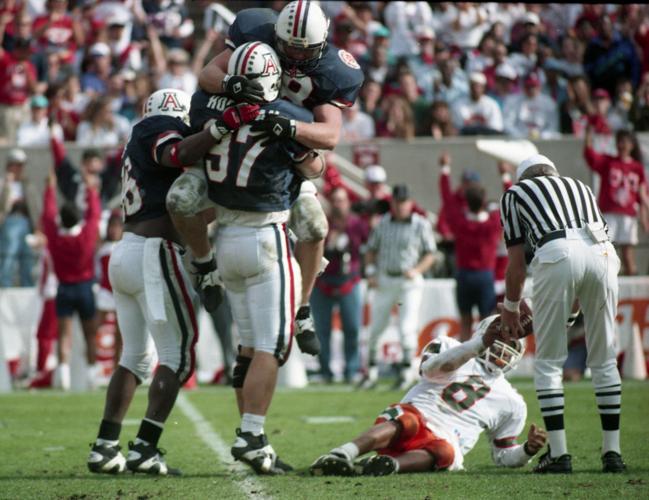
Arizona tackle Jim Hoffman is congratulated by teammates Brant Boyer and Akil Jackson after sacking Miami QB Ryan Collins during the 1994 Fiesta Bowl in Tempe, Ariz.
He’s so much like his father, my college classmate, who was a starting cornerback at Utah State in the 1970s. Too small. Too slow. All he could do was help you win. After Boyer somehow survived 10 NFL seasons with limited size and speed, he moved to Colorado and became an outdoor hunting/fishing guide for five years before he was coaxed back to the NFL by one of his former NFL coaches, Chuck Pagano.
I noticed Boyer during the national anthem of last week’s Giants game. He stood at attention with his hand over his heart. His face showed emotion. I remember meeting his grandfather, Edwin Boyer, while at a Utah State game in the 1970s. A mink rancher from a rural Utah town, he talked about his days as a Marine in World War II. He was almost killed at Iwo Jima and was so proud of his son — Brant’s father — who had become a starting college cornerback.
Fortunately, Edwin Boyer lived long enough — he died last winter at 94 — to see his grandson become an accomplished NFL coach.
Only seven ex-UA players sustained NFL careers longer than Boyer. They are:
1. Tedy Bruschi, linebacker, 13 seasons
2. Lance Briggs, linebacker, 12 seasons
3. Nick Folk, kicker, 12 seasons
4. Josh Miller, punter, 12 seasons
5. Glenn Parker, tackle, 12 seasons
6. John Fina, tackle, 11 seasons
7. Chris McAlister, cornerback, 11 seasons
Some perspective: UA linebacker Scooby Wright, the Pac-12’s defensive player of the year in 2014, played in 13 NFL games over two seasons. He is now at the start of a two-year process to become a firefighter. Getting to the NFL is hard. Staying in the NFL is harder.
Arizona's Derek van der Merwe on CMU's hot list

Derek van der Merwe, center, is the new chief operating officer, at the University of Arizona. July 26, 2018.
Derek van der Merwe, the UA’s athletic department’s Chief Operating Officer, is one of three finalists to become the athletic director at his alma mater, Central Michigan University.
Van der Merwe is expected to learn this week if he gets the job; the other finalists include Amy Folan, the No. 2 person in the Texas Longhorns athletic department, and Alan Haller, the deputy athletic director at Michigan State. It would be a surprise if van der Merwe isn’t hired. He played football at CMU from 1991-95, and was co-captain of the team.
What’s more, van der Merwe then worked every conceivable job in CMU’s athletic department — including five years under then-CMU AD Dave Heeke — before becoming the AD at Austin Peay.
“Derek is incredible; I’d hate to lose him,” said Heeke. “The depth and breadth of his experience, across the board, is so impressive. He’s got a lot of connections at Central Michigan.”
Van der Merwe has been the No. 2 person on Heeke’s staff for 2ƒ years. There is history involved; the No. 2 man under Cedric Dempsey at Arizona, Bob Bockrath, left Tucson to become Cal’s AD, and later the AD at Alabama and Texas Tech. The No. 2 person under Arizona AD Jim Livengood, Chris del Conte, became the AD at TCU and now Texas; and the No. 2 man under Dave Strack in the 1970s, Bill Belknap, left Tucson to become the AD at Idaho and later Wichita State.
Wildcats lose sprinter to Texas A&M
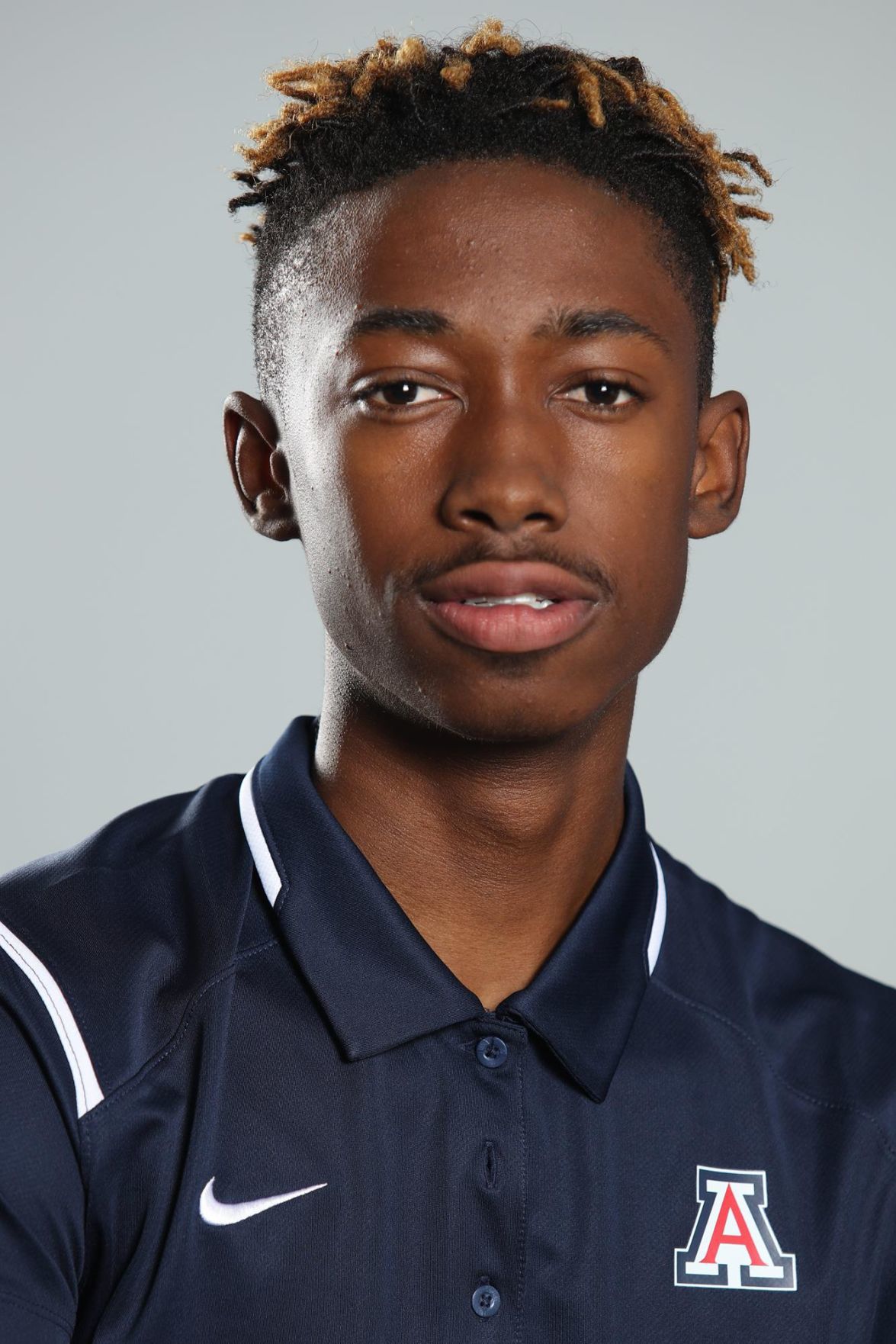
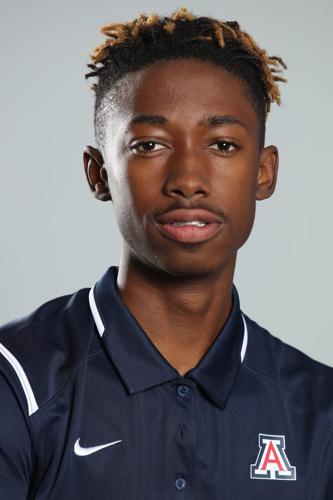
James Smith
Arizona’s track team has lost one of its most valued performers, sophomore sprinter/hurdler James Smith, who has transferred to Texas A&M. As a freshman in 2019, Smith finished fifth in the NCAA in the 400 hurdles, was a first-team All-American who won the USATF championship in the U-20 nationals and was second in the Pan American Games. UA coach Fred Harvey recruited Smith out of Westwood High School in the greater Phoenix area.
Charlie Dickey declines to take pay cut at Oklahoma State
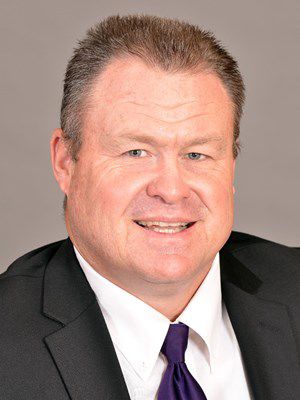
Former Arizona offensive lineman and longtime UA assistant football coach Charlie Dickey last week was part of an Oklahoma State coaching staff asked to take a 40% pay cut to help the financially embattled OSU athletic department. Dickey is paid $550,000 per year. He and the other assistant coaches declined to take the cut, according to Oklahoma newspapers. Another former UA assistant coach, Kasey Dunn, who is paid $800,000 a year as OSU’s offensive coordinator, was also part of the group that declined staff-wide reductions. It was not a good look; but because the football coaches did not have “act of God” clauses in their contracts, they could not be forced to take a pay cut. The Oklahoman reported that they offered to take a smaller percentage pay cut, but could not reach an agreement with the athletic department.
Pima hoops teams could soon return to gym

Pima coach Todd Holthaus celebrates after his team won the regional title game over Mesa Community College, earning the Aztecs a spot in the NJCAA Division II National Tournament.
Arizona women's golf team attracts Thailand star
UA women’s golf coach Laura Ianello, winner of the 2018 NCAA championship, has not been inactive during the shutdown of college sports. Last week she got a commitment from Pimmada Wongthanavimok — she goes by Nena Wong — of Thailand. That fits with Ianello’s rise to the top of NCAA women’s golf; her returning roster in 2021 includes world No. 2 women’s amateur Vivian Hou and her sister, No. 41-ranked Yu-Sang Hou of Taiwan, and No 54 Ya Chun Chang also of Taiwan. Wong, who is a high school junior, has already won international amateur titles at the Albatross International Juniors in India, and the World Stars of Junior Golf championship in Las Vegas.
Former UA football players to cook for 'tailgate'

Chuck and Carrie Cecil took part in the "Cooking With the Stars" in 2020. Chuck's cooking skills will be put to the test again with other Arizona greats.
Although no football game will be played, a dozen former Arizona football players will be part of a “Flying Aprons Cooking Tailgate Evening” from 5:30-7 p.m. Friday via Zoom conference.
Salpointe Catholic High School and UA grad John Fina, a long-time NFL lineman, will act as chef, cooking from his home with sous chefs Chuck Cecil and Lamont Hunley. Former Wildcat football players Ortege Jenkins, Joe Tafoya, Byron Evans, Trung Canidate, Earl Mitchell, Randy Robbins and Brandon Sanders will be among those participating in the socially distanced Zoom event. To register for the virtual tailgate party, email: flyingapronstucson@gmail.com
My two cents: Time to give UA docs like David Harris a raise

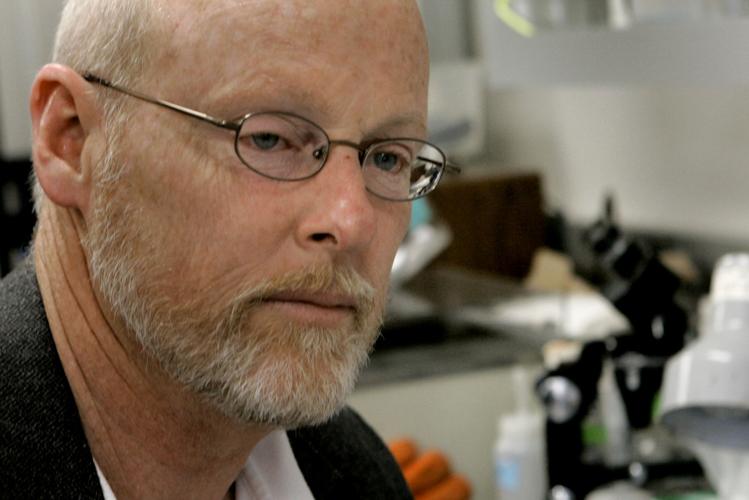
Dr. David T. Harris, executive director of the UA’s Health Sciences Biorepository, says he trusts Quidel’s product. The UA has administered more than 25,000 tests since the spring.
Much of the reason the Pac-12 is expected to announce it will resume football in early November is because Arizona has conducted more than 25,000 Quidel tests on students, athletes, staff members and ICU patients since spring. Quidel is a rapid-response antigen test; it will be delivered to all Pac-12 teams this month.
Dr. David Harris oversees the program. In a UA perspective, Harris’ work is something like Arizona winning a Rose Bowl — but better.
Harris, who played football at Wake Forest from 1974-78, is the executive director of the UA’s Biorepository program, a division of Translational and Regenerative Medicine. He has been conducting his remarkable work at the UA Health Sciences Center for 31 years. Not only that, Harris has founded five companies as they relate to biobanking and immunobiology.
Here’s my point: according to the UA’s 2018-19 salary database, Dr. Harris is paid $177,448 annually. Given the value of Harris’ work, shouldn’t his compensation include a few more digits or another comma?
In an era when college sports salaries have gotten twisted out of common sense — the UA’s two receivers coaches in football were paid $235,000 and $200,000, respectively, last season — the COVID-19 pandemic shows just head-shaking the salary structure of college sports has become.


